Statement By Legon Observer About Publisher
July 24, 2026
Transcript
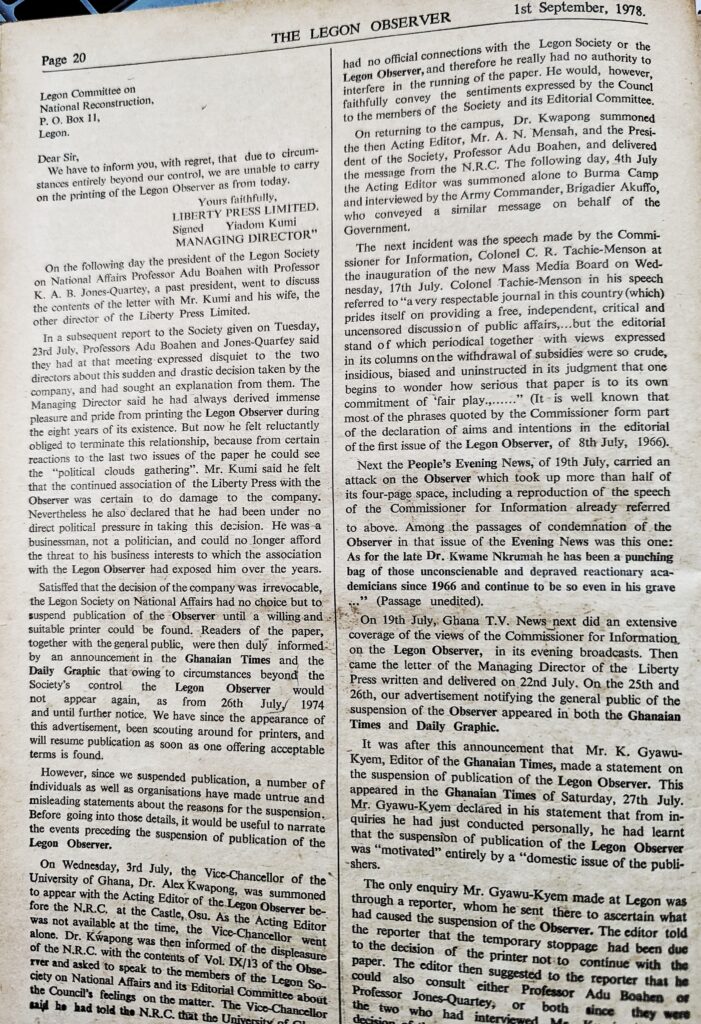
The Legon Observer
September 1, 1978
Legon Committee on National Reconstruction,
P. O. Box 11, Legon.
Dear Sir, we have to inform you, with regret, that due to circumstances entirely beyond our control, we are unable to carry on the printing of the Legon Observer from today.
Yours faithfully,
LIBERTY PRESS LIMITED.
Signed Yiadom Kumi
MANAGING DIRECTOR”
On the following day the president of the Legon Society on National Affairs, Professor Adu Boahen, with Professor K. A, B. Jones-Quartey, a past president, went to discuss the contents of the letter with Mr. Kumi and his wife, the other director of the Liberty Press Limited.
In a subsequent report to the Society given on Tuesday, 23rd July, Professors Adu Boahen and Jones-Quartey said they had at that meeting expressed disquiet to the two directors about this sudden and drastic decision taken by the com- pany, and had sought an explanation from them. The Managing Director said he had always derived immense pleasure and pride from printing the Legon Observer during the eight years of its existence. But now he felt reluctantly obliged to terminate this relationship, because from certain reactions to the last two issues of the paper he could see the “political clouds gathering”. Mr. Kumi said he felt that the continued association of the Liberty Press with the Observer was certain to do damage to the company. Nevertheless he also declared that he had been under no direct political pressure in taking this decision. He was a businessman, not a politician, and could no longer afford the threat to his business interests to which the associa- tion with the Legon Observer had exposed him over the years.
Satisfied that the decision of the company was irrevocable, the Legon Society on National Affairs had no choice but to suspend publication of the Observer until a willing and suitable printer could be found. Readers of the paper, together with the general public, were then duly informed by an announcement in the Ghanaian Times and the Daily Graphic that owing to circumstances beyond the Society’s control the Legon Observer would not appear again, as from 26th July, 1974 and until further notice. We have, since the appearance of this advert- isement, been scouting around for printers, and will resume publication as soon as one offering acceptable terms is found.
However, since we suspended publication, a number of individuals and organisations have made untrue and misleading statements about the reasons for the suspension. Before going into those details, it would be useful to narrate the events preceding the suspension of publication of the Legon Observer.
On Wednesday, 3rd July, the Vice-Chancellor of the University of Ghana, Dr. Alex Kwapong, was summoned to appear with the Acting Editor of the Legon Observer before the N.R.C. at the Castle, Osu. As the Acting Editor was not available at the time, the Vice-Chancellor went alone. Dr. Kwapong was then informed of the displeasure of the N.R.C. with the contents of Vol. IX/13 of the Observer and asked to speak to the members of the Legon Society on National Affairs and its Editorial Committee about the Council’s feelings on the matter. The Vice-Chancellor said he had told the N.R.C. that the University of Ghana had no official connections with the Legon Society or the Legon Observer, and therefore he really had no authority to interfere in the running of the paper. He would, however, faithfully convey the sentiments expressed by the Council to the members of the Society and its Editorial Committee.
On returning to the campus, Dr. Kwapong summoned the then Acting Editor, Mr. A. N. Mensah, and the President of the Society, Professor Adu Boahen, and delivered the message from the N.R.C. The following day, 4th July, the Acting Editor was summoned alone to Burma Camp and interviewed by the Army Commander, Brigadier Akuffo, who conveyed a similar message on behalf of the Government.
The next incident was the speech made by the Commissioner for Information Colonel C. R. Tachie-Menson, at the inauguration of the new Mass Media Board on Wednesday, 17th July. Colonel Tachie-Menson in his speech referred to “a very respectable journal in this coun- try (which) prides itself of providing ‘ free, independent, critical and uncen- sored discussion of public affairs, …, but the editorial stand of which periodical together with views expressed in its columns on the withdrawal of subsidies were so crude, insidious, biased and uninstructed in its judgment that one begins to wonder how serious that paper is to its own commitment of ‘fair play .”. (It is well known that most of the phrases quoted by the Commissioner form part of the declaration of aims and issue intentions in the editorial of the first of the Legon Observer, of 8th July, 1966.)
Next, the People’s Evening News, 19th July, carried an attack on the Observer which took up more than half of its four-page space, including a repro- duction of the speech of the Commissioner for Information already referred to above the Among Observer the passages in that issue of condemnation of the Evening of News was this one: “As for the late Dr. Kwame Nkrumah he has been a punch- ing bag of those unconscionable and depraved reactionary academicians since 1966 and continue to be so even in his grave..” (Passage unedited).
On 19th July, Ghana T.V. News next did an extensive coverage of the views of the Commissioner for Information on the Legon Observer, in its evening broad- casts. Then came the letter of the Managing Director of the Liberty Press, written and delivered on 22nd July. On the 25th and 26th July, our advertise- ment notifying the general public of the both suspension the Ghanaian of the Observer Times and appeared the Daily in Graphic.
It was after this announcement that Mr. K. Gyawu-Kyem, Editor of the Ghanaian Times, made a statement on the suspension of publication of the Legon Observer. This appeared in the Ghanaian Times of Saturday, 27th July. Mr. Gyawu-Kyem declared in his statement that from inquiries he had just conducted personally, he had learnt that the suspension of publication of the Legon Observer was “motivated” entirely by a “domestic issue of the publishers”.
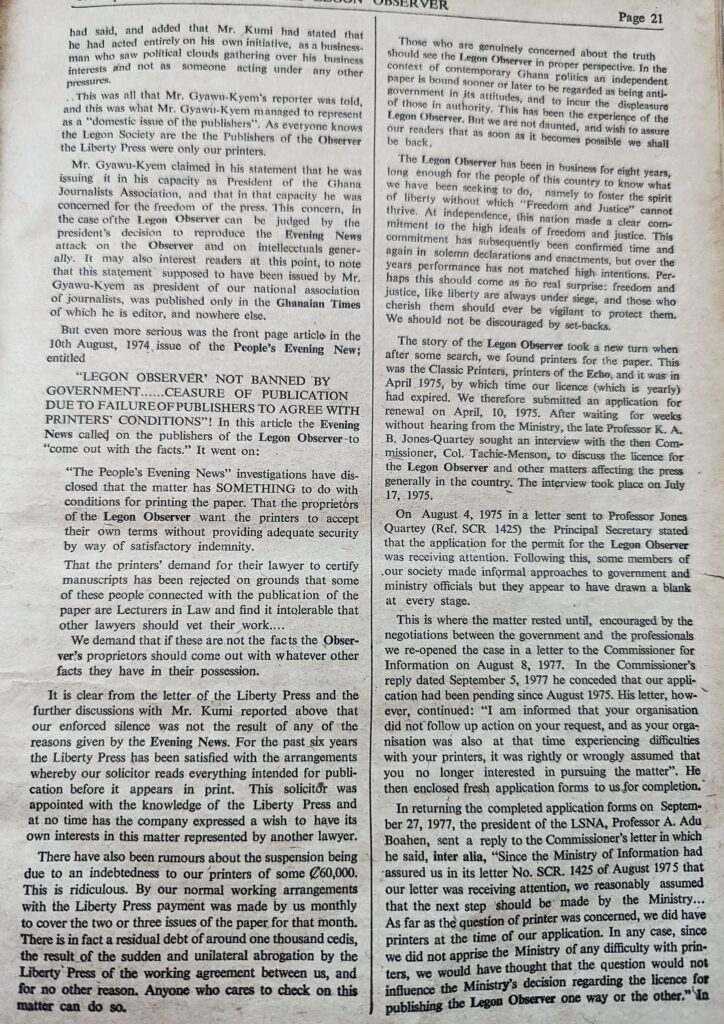
The only enquiry Mr. Gyawu-Kyem made at Legon was through a reporter, whom he had sent there to ascertain what had caused the suspension of the Observer. The editor told the reporter that the temporary stoppage had been due to the decision of the printer not to continue with the paper. The editor then suggested to the reporter that he could also consult either Professor Adu Boahen or Professor Jones-Quartey, or both, since they were the two who had inter- viewed Mr. Kumi about the decision of the Liberty Press. The reporter did go to talk with Professor Jones-Quartey, who repeated what the editor had said, and added that Mr. Kumi had stated that he had acted entirely on his own initiative, as a businessman who saw political clouds gathering over his business interests and not as someone acting under any other pressures.
This was all that Mr. Gyawu-Kyem’s reporter was told, and this was what Mr. Gyawu-Kyem managed to represent as a “domestic issue of the publishers.” As everyone knows, the Legon Society are the Publishers of the Observer: the Liberty Press were only our printers.
Mr. Gyawu-Kyem claimed in his statement that he was issuing it in his capacity as President of the Ghana Journalists Association, and that in that capacity he was concerned for the freedom of the press. This concern, in the case of the Legon Observer, can be judged by the president’s decision to reproduce the Evening News attack on the Observer and on intellectuals generally. It may also interest readers, at this point, to note that this statement, supposed to have been issued by Mr. Gyawu-Kyem as president of our national national association of journalists, Ghanaian Times, was published of which he only is in editor, the and nowhere else.
But even more serious was the front- page article in the 10th August, 1974 issue of the People’s Evening News; entitled “LEGON OBSERVER’ NOT BANNED BY GOVERNMENT… CEASURE OF PUBLI- CATION DUE TO FAILURE OF PUBLISH- ERS TO AGREE WITH PRINTERS’ CONDITIONS”! In this article the Evening News called on the publishers of the Legon Observer to “come out with the facts”. It went on:
“The People’s Evening News’ investigations have disclosed that the matter has SOMETHING to do with conditions for printing the paper. That the proprietors of the Legon Observer want the printers to accept their own terms without providing adequate security by way of satisfactory indemnity.
That the printers’ demand for their lawyer to certify manuscripts has been rejected on grounds that some of these people connected with the publication of the paper are Lecturers in Law and find it intolerable that other lawyers should vet their work…
We demand that if these are not the facts, the Observer’s proprietors should come out with whatever other facts they have in their possession.
It is clear from the letter of the Liberty Press and the further discussions with Mr. Kumi reported above that our enforced silence was not the result of any of the reasons given by the Evening News. For the past six years the Liberty Press has been satisfied with the arrangements whereby our solicitor reads everything intended for publication before it appears in print. This solicitor was appointed with the knowledge of the Liberty Press and at no time has the company expressed a wish to have its own interests in this matter represented by another lawyer.
There have also been rumours about the suspension being due to an indebted- ness to our printers of some ₵60,000. This is ridiculous. By our normal working arrangements with the Liberty Press payment was made by us monthly to cover the two or three issues of the paper for that month. There is in fact a residual debt of around one thousand cedis, the result of the sudden and unilateral abrogation by the Liberty Press of the working agreement between us, and for no other reason. Anyone who cares to check on this matter can do so.
Those who are genuinely concerned about the truth should see the Legon Observer in proper perspective. In the context of contemporary Ghana politics an independent paper is bound sooner or later to be regarded as being anti- the displeasure of those in authority. This has been the experience of the Legon Observer. But we are not daunted, and wish to assure our readers that as soon as it becomes possible we shall be back.
The Legon Observer has been in business for eight years, long enough for the people of this country to know what we have been seeking to do, namely to foster the spirit of liberty, without which “Freedom and Justice” cannot thrive. At independence, this nation made a clear commitment to the high ideals of freedom and justice. This commitment has subsequently been confirmed time and again in solemn declarations and enactments, but over the years performance has not matched high intentions. Perhaps this should come as no real surprise: freedom and justice, like liberty, are always under siege, and those who cherish them should ever be vigilant to protect them. We should not be discouraged by set-backs.
The story of the Legon Observer took a new turn when after some search, we found printers for the paper. This was the Classic Printers, printers of the Echo, and it was in April 1975, by which time our licence (which is yearly) had expired. We therefore submitted an application for renewal on April, 10, 1975. After waiting for weeks without hearing from the Ministry, the late Professor K. A. B. Jones-Quartey sought an interview with the then Commissioner, Col. Tachie-Menson, to discuss the licence for the Legon Observer and other matters affecting the press generally in the country. The interview took place on July 17, 1975.
On August 4, 1975 in a letter sent to Professor Jones Quartey (Ref. SCR 1425) the Principal Secretary stated that the application for the permit for the Legon Observer was receiving attention. Following this, some members of our society made informal approaches to government and ministry officials but they appear to have drawn a blank at every stage.
This is where the matter rested until, encouraged by the negotiations between the government and the professionals, we re-opened the case in a letter to the Commissioner for Information on August 8, 1977. In the Commissioner’s reply dated September 5, 1977 he conceded that our appli- cation had been pending since August 1975. His letter, how- ever, continued: “I am informed that your organisation did not follow up action on your request, and as your organisation was also at that time experiencing difficulties with your printers, it was rightly or wrongly assumed that you were no longer interested in pursuing the matter”. He then enclosed fresh application forms to us for completion.”
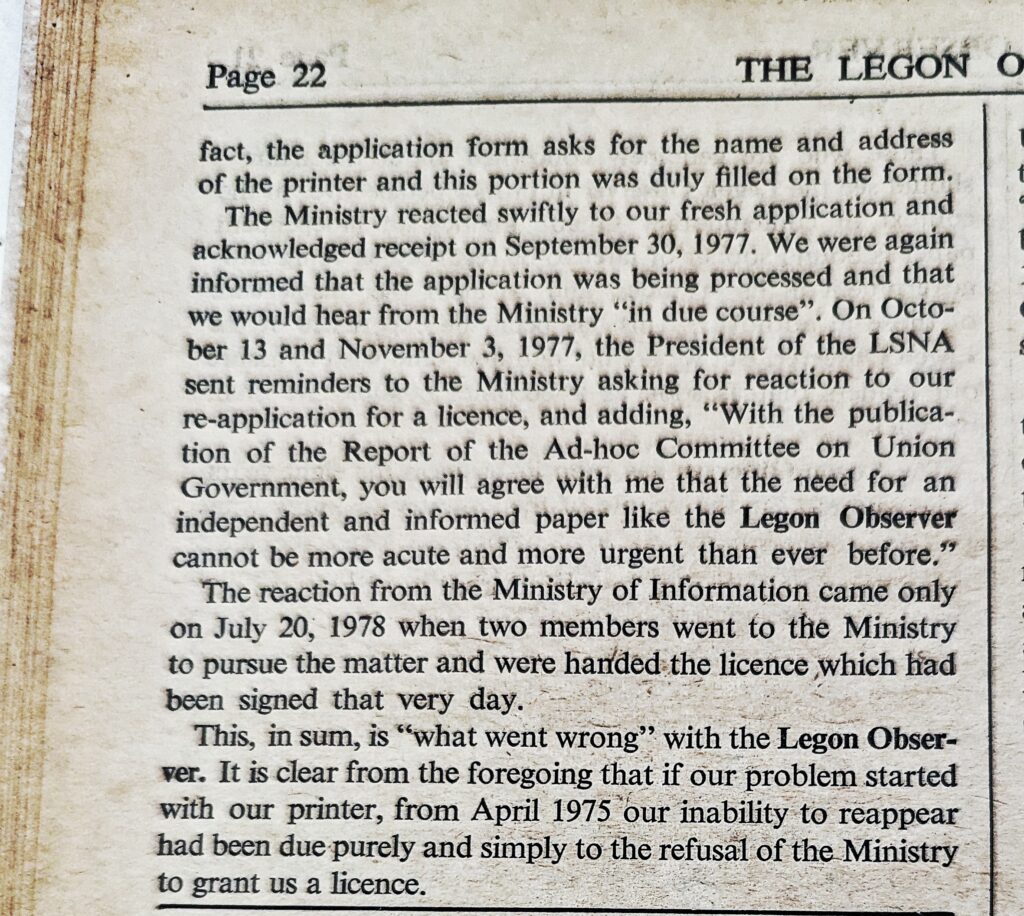
In returning the completed application forms on Septem- ber 27, 1977, the president of the LSNA, Professor A. Adu Boahen, sent a reply to the Commissioner’s letter in which he said, inter alia, “Since the Ministry of Information had assured us in its letter No. SCR. 1425 of August 1975 that our letter was receiving attention, we reasonably assumed the next step should be made by the Ministry… As far as the question of printer was concerned, we did have printers at the time of our application. In any case, since we did not apprise the Ministry of any difficulty with printers, we would have thought that the question would not influence the Ministry’s decision regarding the licence for publishing the Legon Observer one way or the other.” In fact, the application form asks for the name and address of the printer and this portion was duly filled on the form.
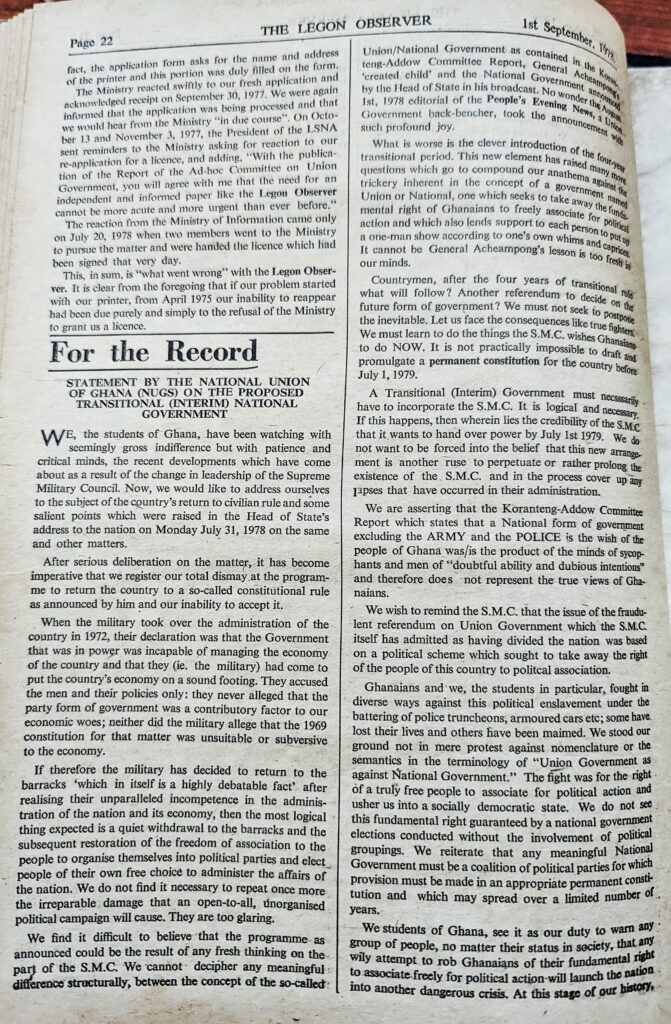
The Ministry reacted swiftly to our fresh application and acknowledged receipt on September 30, 1977. We were again informed that the application was being processed and that we would hear from the Ministry “in due course”. On Octo- ber 13 and November 3, 1977, the President of the LSNA sent reminders to the Ministry asking for reaction to our re-application for a licence, and adding, “With the publica-. tion of the Report of the Ad-hoc Committee on Union Government, you will agree with me that the need for an independent and informed paper like the Legon Observer cannot be more acute and more urgent than ever before.”
The reaction from the Ministry of Information came only on July 20, 1978 when two members went to the Ministry to pursue the matter and were handed the licence which had been signed that very day.
This, in sum, is “what went wrong” with the Legon Observer. It is clear from the foregoing that if our problem started with our printer, from April 1975 our inability to reappear had been due purely and simply to the refusal of the Ministry to grant us a licence.
More from the legon observer