Student Demonstrations
July 3, 2026
Transcript
The Legon Observer
March 26, 1971
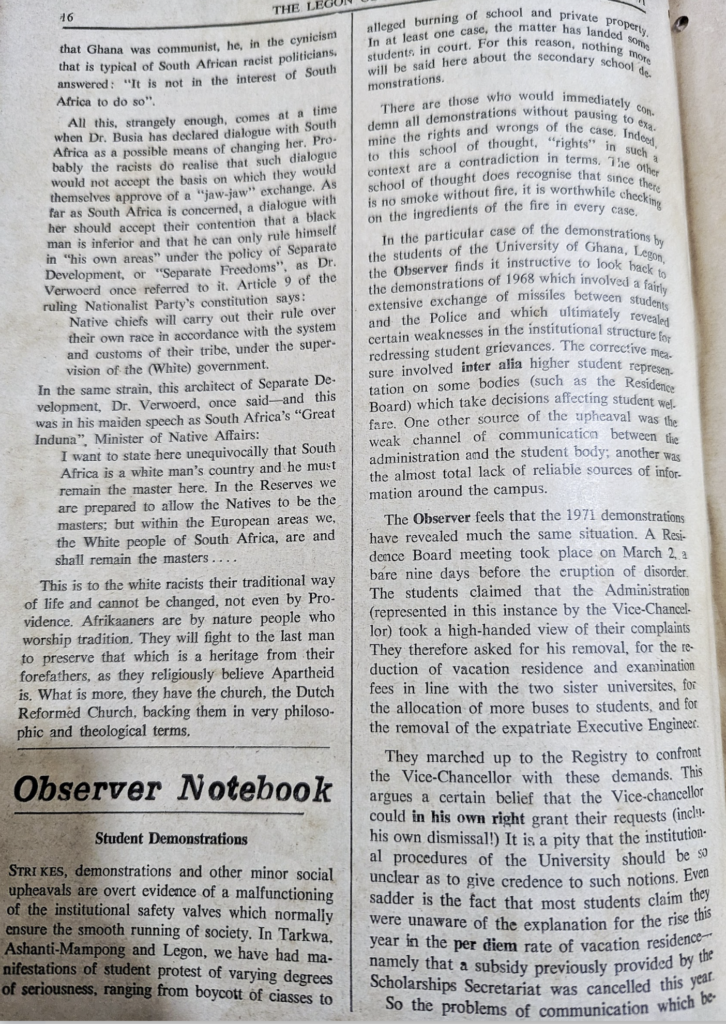
Strikes, demonstrations and other minor social upheavals are overt evidence of a malfunctioning of the institutional safety valves which normally ensure the smooth running of society. In Tarkwa, Ashanti-Mampong and Legon, we have had manifestations of student protest of varying degrees, ranging from boycott of classes to alleged burning of school and private property. In at least one case, the matter has landed some students in court. For this reason, nothing more will be said here about the secondary school demonstrations.
There are those who would immediately condemn all demonstrations without pausing to examine the rights and wrongs of the case. Indeed, to this school of thought, “rights” in such a context are a to contradiction in terms. The other school of thought does recognise that since there is no smoke without fire, it is worthwhile checking ingredients of the fire in every case.
In the particular case of the demonstrations the University of Ghana, by the students, Legon, the Observer finds it instructive to look back to the demonstrations of 1968 which involved a fairly extensive exchange of missiles between students and the Police and which ultimately and the revealed certain weaknesses in the institutional structure for redressing student grievances. The corrective mea- sure involved inter alia higher student representation on some bodies (such as the Residence Board) which take decisions affecting student welfare. One other source of the upheaval was the weak channel of communication between the administration and the student body; another was the almost total lack of reliable sources of information around the campus.
The Observer feels that the 1971 demonstrations have revealed much the same situation. A Residence Board meeting took place on March 2, a bare nine days before the eruption of disorder. The students claimed that the Administration (represented in this instance by the Vice-Chancellor) took a high-handed view of their complaints. They therefore asked for his removal, for the reduction of vacation residence and examination fees in line with the two sister universities, for the allocation of more buses to students, and for the removal of the expatriate Executive Engineer.
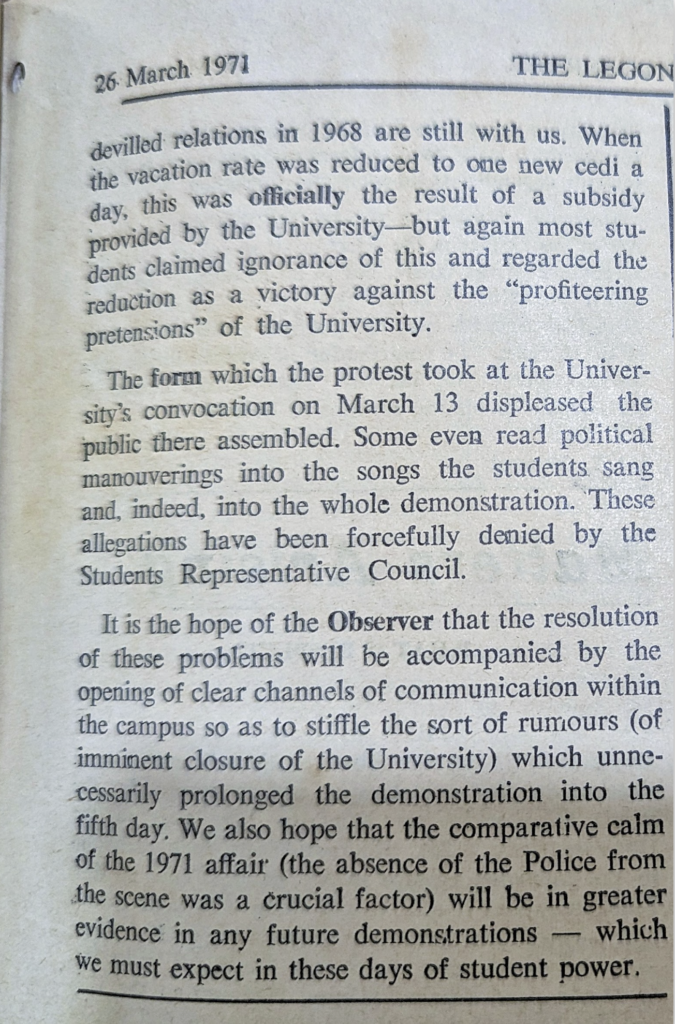
They marched up to the Registry to confront the Vice-Chancellor with these demands. This argues a certain belief that the Vice-chancellor could in his own right grant their requests (including his own dismissal!) It is a pity that the institutional procedures of the University should be so unclear as to give credence to such notions. Even sadder is the fact that most students claim they were unaware of the explanation for the rise this year in the per diem rate of vacation residence–namely that a subsidy previously provided by the Scholarships Secretariat was cancelled this year. So the problems of communication which bedevilled relations in 1968 are still with us. When the vacation rate was reduced to one new cedi a day, this was officially the result of a subsidy provided by the University but again most students claimed ignorance of this and regarded the reduction as a victory against the “profiteering pretensions” of the University. The form which the protest took at the University’s convocation on March 13 displeased the public there assembled. Some even read political manoeuvrings into the songs the students sang and, indeed, into the whole demonstration. These allegations have been forcefully denied by the Students Representative Council. It is the hope of the Observer that the resolution of these problems will be accompanied by the opening of clear channels of communication within the campus so as to stifle the sort of rumours (of imminent closure of the University) which unnecessarily prolonged the demonstration into the fifth day. We also hope that the comparative calm of the 1971 affair (the absence of the Police from the scene was a crucial factor) will be in greater evidence in any future demonstrations which we must expect in these days of student power.