Episode Six
Coming Soon

Podcast

Archive
History
Coming Soon

Coming Soon
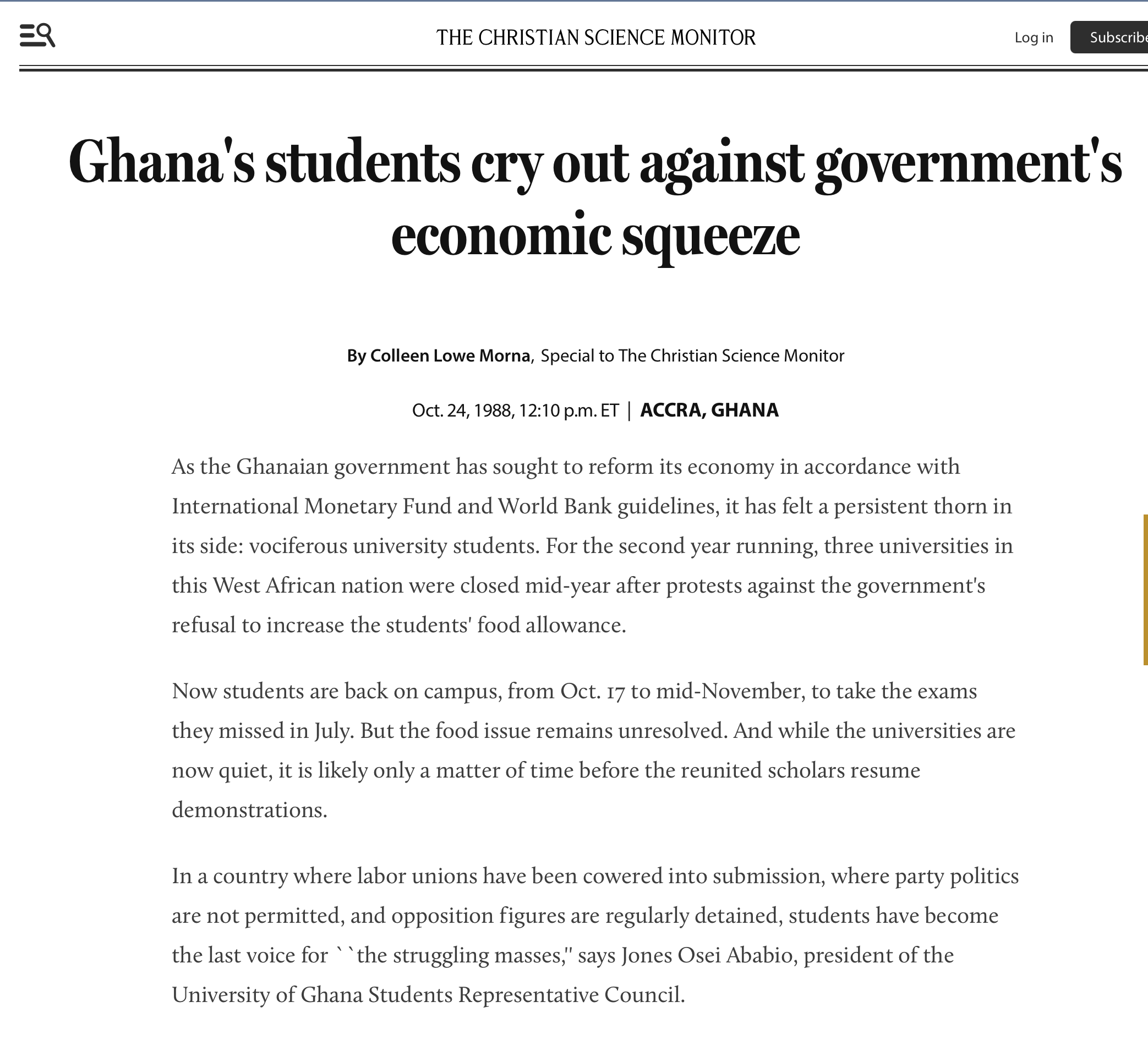
As the Ghanaian government has sought to reform its economy in accordance with International Monetary Fund and World Bank guidelines, it has felt a persistent thorn in its side: vociferous university students. For the second year running, three universities in this West African nation were closed mid-year after protests against the government’s refusal to increase the students’ food allowance. Now students are back on campus, from Oct. 17 to mid-November, to take the exams they missed in July. But the food issue remains unresolved. And while the universities are now quiet, it is likely only a matter of time before the reunited scholars resume demonstrations. In a country where labor unions have been cowered into submission, where party politics are not permitted, and opposition figures are regularly detained, students have become the last voice for ”the struggling masses,” says Jones Osei Ababio, president of the University of Ghana Students Representative Council The students’ power as an opposition force is strengthened by three factors: an existing structure – a Student Representative Council at each of the country’s three universities, all coordinated by the National Union of Ghana Students; the fact that students live close together; and an atmosphere that is generally more conducive to discussion and debate. Because of the transient nature of student organization memberships, student loyalties in Ghana can vacillate tremendously. In the past, students have sought the removal of a government, and are credited with helping to oust Col. Ignatius Kutu Acheampong from power in 1978. But in 1982, they helped to rally support for the current regime. For now, student sympathies seem staunchly antigovernment, mainly because the government policy in question directly affects the students. At the heart of the current controversy is a demand by the students that the government, which intends to remove all food and lodging subsidies in the education sector by the end of the year, triple the present university feeding subsidy equivalent to 23 cents a day. This sum is enough to buy one banana. Around this revolves a broader debate sparked by the World Bank, which is using Ghana as a test case for its thesis that developing countries spend too much on higher education, which should be made to pay for itself. The bank has sunk some $34.5 million into education in Ghana, the first loan it has given to reorganize an entire education system. The loan is part of a $463 million government restructuring of the education system, which has suffered from Ghana’s troubled economy. The World Bank has argued that Ghanaian resources for primary school education should be growing faster than at any other level. So the government advocated eliminating all food and lodging costs for students in secondary schools and institutes of higher learning. But mere rumors of impending cuts led to widespread protests at the universities last February. Some students accuse the World Bank of not wanting people of African nations to be well educated. Others say eliminating the subsidy would lead poorer students to drop out of a system already charged with becoming too elitist. Because of agitation last year, which caused the universities to close twice, the government did not remove the food allowance. But students continued to demand a threefold increase in the subsidy and eventually boycotted classes. Campuses were closed in July. No announcement has been made yet on whether the universities will reopen for the 1988-1989 academic year. But for now, students are back at school, and seem determined to stick to their demands.
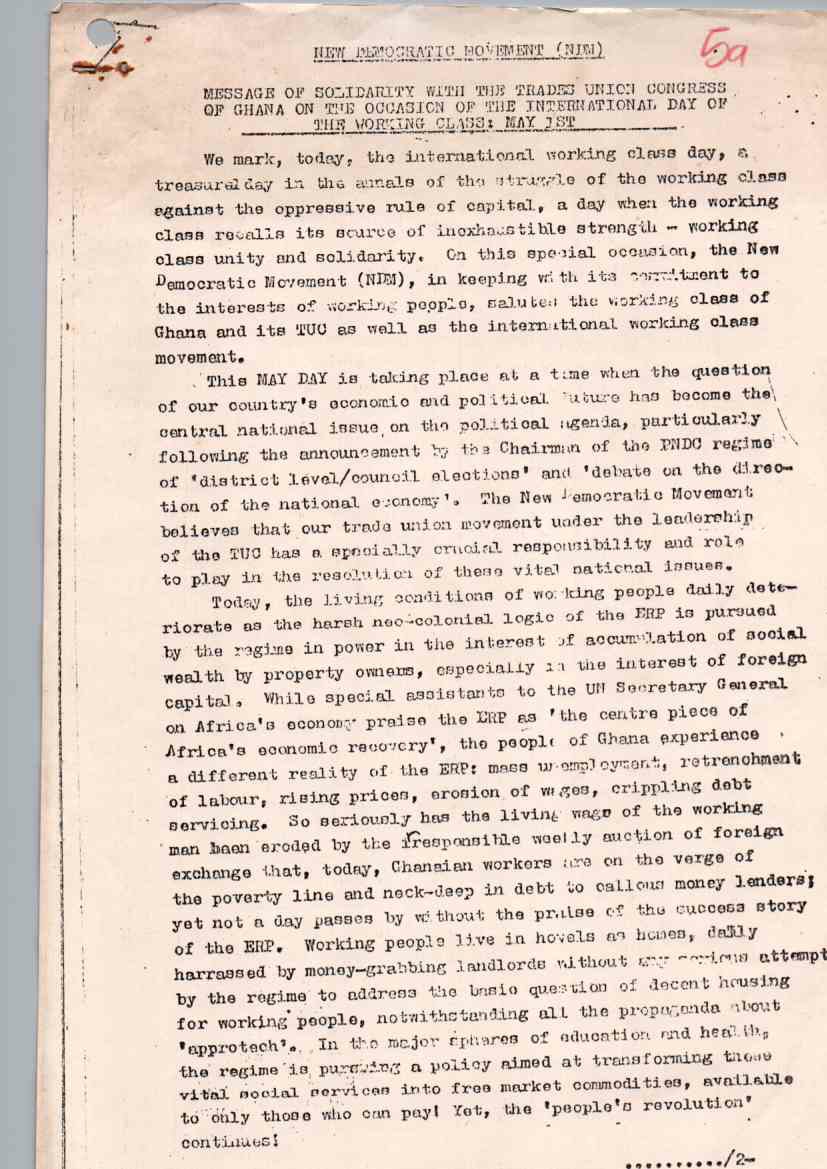
We mark, today, the international working class day, a treasured day in the annals of the straggle of the working class against the oppressive rule of capital, a day when the working class recalls its source of inexhaustible strength–working class unity and solidarity. On this special occasion, the New Democratic Movement (NDM), in keeping with its commitment to the interests of working people, salutes the working class of Ghana and its TUC as well as the international working class movement. This MAY DAY is taking place at a time when the question of our country’s economic and political future has become the central national issue, on the political agenda, particularly following the announcement by the Chairman of the PNDC regime of district level/council elections’ and ‘debate on the direction of the national economy’. The New Democratic Movement believes that our trade union movement under the leadership of the TUC has a specially crucial responsibility and role to play in the resolution of these vital national issues. Today, the living conditions of working people daily deteriorate as the harsh neo-colonial logic of the ERP is pursued by the regime in power in the interest of accumulation of social wealth by property owners, especially in the interest of foreign capital. While special assistants to the UN Secretary General on Africa’s economy praise the ERP as ‘the centre piece of Africa’s economic recovery’, the people of Ghana experience a different reality of the ERP: mass unemployment, retrenchment of labour, rising prices, erosion of wages, crippling debt servicing. So seriously has the living wage of the working man been eroded by the irresponsible weekly auction of foreign exchange that, today, Ghanaian workers are on the verge of the poverty line and neck-deep in debt to callous money lenders; yet not a day passes by without the praise of the success story of the ERP. Working people live in hovels as homes, daily harassed by money-grabbing landlords without… attempt by the regime to address the basic question of decent housing for working people, notwithstanding all the propaganda about approtech’. In the major spheres of education and health, the regime is pursuing a policy aimed at transforming those vital social services into free market commodities, available to only those who can pay! Yet, the ‘people’s revolution’ continues! The ERP may be a miracle of economic recovery for foreign capital and big Ghanaian exploiting classes; but for working people, it is a programme of social misery and oppression. Any attempt by the TUC and patriots to protest against these policies and their effects on the people is viciously condemned as ‘counter revolutionary’, ‘subversive’, ‘CIA inspired’, ‘ unpatriotic’. Workers leaders are arrested and thrown into cells without legal authority when they fight for basic trade union rights. Armed policemen intervene brutally to ‘resolve’ normal trade union disputes in favour of the owners of capital. Even the right of the TUC as the organised expression of workers is being questioned. The state-controlled media have become a sycophantic reproduction of the regime’s voice, while critical and constructive views are completely muzzled. Yet, unconvincing concerns are expressed about a creeping ‘culture of silence’. Where a regime in power does not tolerate critical views, what else can it expect but a culture of silence! Meanwhile the very independent existence of the TUC is threatened by such unilateral acts as the establishment of the so-called Ministry of Mobilisation and Productivity (MOBIPRO) and the threat of an ominous MOBIPRO law. The NDM take this occasion, once again, to alert the TUC leadership and our workers’ movement as a whole against any attempt to change the Industrial Relations Act unilaterally and in a manner that undermines the independent organisation of the trade union and the right to collective bargaining. We wish to draw the attention of the TUC to the major education reforms that the regime is hurriedly imposing on the country without any real discussion with the people, nor proper conception, planning nor preparation. Everything suggests that the so-called JSS if implemented in the current state of affairs will produce a caricature of an education system. No one, not even the teachers who are to implement it nor those who are to teach the teachers, knows what it is all about. The JSS programme must be stopped immediately if it is not to cause further havoc to our crisis ridden school system. Furthermore we call for the reversal of the policy aimed at imposing further burden in financing higher education on parents and students. We note the assurance by government’ that the policy will not be implemented in the coming academic year, and state that the problem with the policy is not when it is to be implemented but with the policy itself. Any attempt to impose further costs of higher education on the people will result in denying working people and their… higher education, while making it the privilege … position on this important matter and we are confident that it will be in the interest of democracy. Meanwhile the NDM strongly protests against the cynical and cowardly manner in which the former NUGS Secretary, Kakrabah Cromwell has been arrested and detained by the authorities. What must be recognied by all is that Kakrabah Cromwell’s arrest is an act of repression of his political right to free expression as a student leader and a citizen of this country. It is also aimed at intimidating the student movement from exercising their legitimate right of protest. The allegation of dealing in indian hemp, even if true, must therefore be seen simply as a God-sent pretext for political repression of democratic expression. The political nature of the arrest is shown by the fact that he has been in detention for more than two weeks, incommunicado, without charge in violation of the law of the land. We therefore call for his immediate release. All these issues raise the question of democracy in national life. Our people have had five years of PNDC rule while the NCD…
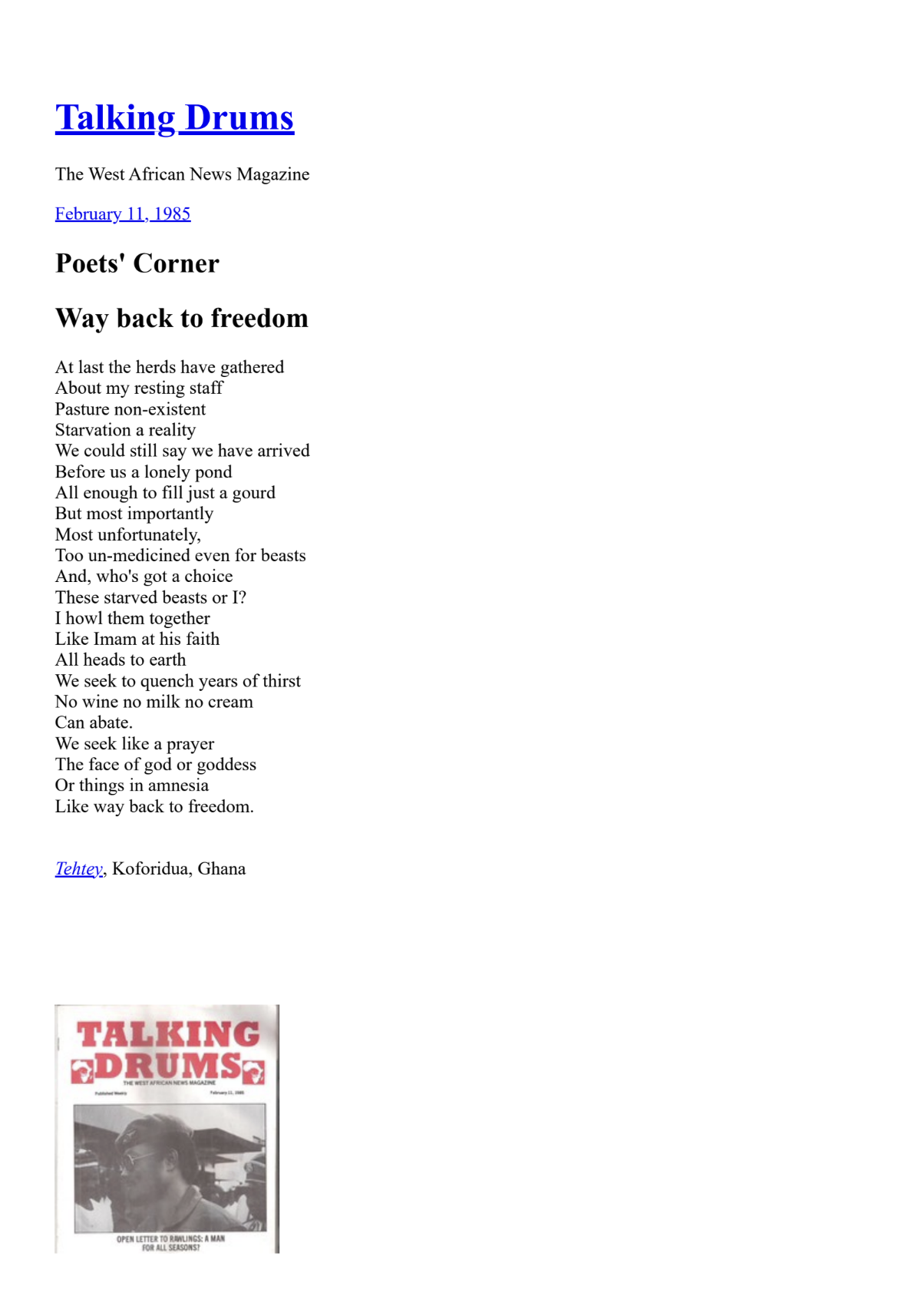
At last the herds have gathered About my resting staff Pasture non-existent Starvation a reality We could still say we have arrived Before us a lonely pond All enough to fill just a gourd But most importantly Most unfortunately, Too un-medicined even for beasts And, who’s got a choice These starved beasts or I? I howl them together Like Imam at his faith All heads to earth We seek to quench years of thirst No wine no milk no cream Can abate. We seek like a prayer The face of god or goddess Or things in amnesia Like way back to freedom. Tehtey, Koforidua, Ghana
As the Ghanaian government has sought to reform its economy in accordance with International Monetary Fund and World Bank guidelines,…



As the Ghanaian government has sought to reform its economy in accordance with International Monetary Fund and World Bank guidelines,…
We mark, today, the international working class day, a treasured day in the annals of the straggle of the working…
At last the herds have gathered About my resting staff Pasture non-existent Starvation a reality We could still say we…
The first two months of the year have gone by and the PNDC government is plodding on nevertheless. On the…
The Peoples Daily Graphic editorial on the Workers Defence Committee executives (Talking Drums, November 26, 1984) is disgusting. The Graphic…
We are really overwhelmed and lost for words to express our sincere and warmest appreciation to your outfit for the…
This is just to inform you of the shock I had after reading through your weekly magazine, the Talking Drums….
The following is a copy of the letter sent by the Ghana Democratic Movement to Jerry Rawlings on the bloody…
Title: Power to the People: Reflections on Retrogressive Politics. Author: Kodjo Crobsen. Price: £3.50 The overall picture that emerges from…
STANDARD NATIONAL CATHOLIC WEEKLY PRICE ¢5.00 The Ministry of Information has with immediate effect revoked the registration of the Catholic…



Generate a properly formatted citation for this item.