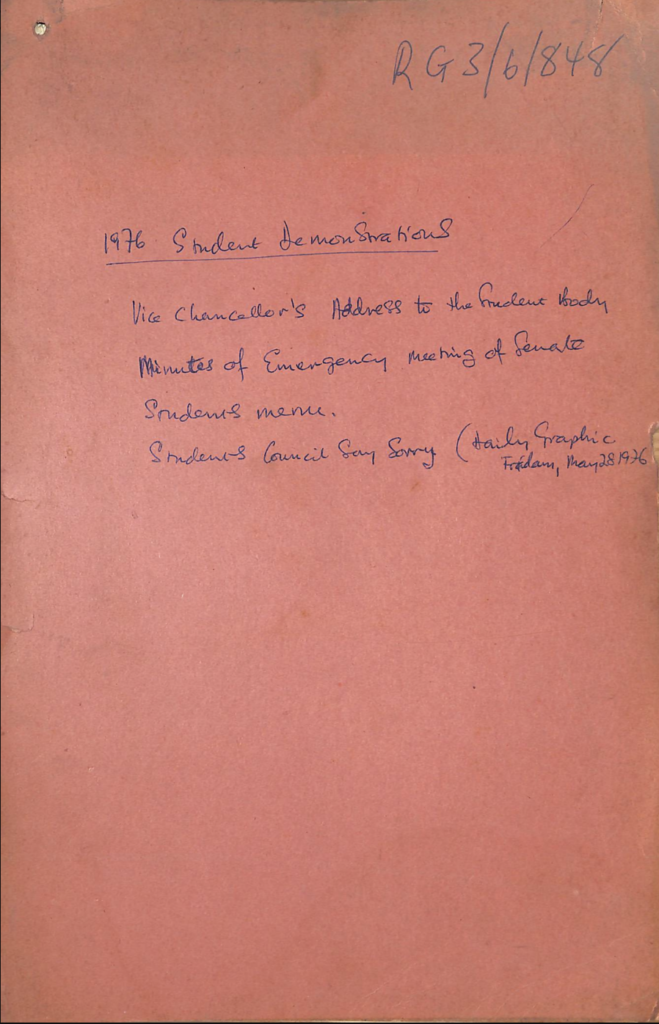
Vice-Chancellor’s Address On 14th May, 1976 To The Student Body Of The University Of Ghana
July 21, 2026






Transcript
National Council For Higher Education
April 28, 1976
Pro-Vice-Chancellor, Deans of Faculties, Senior Tutors and Tutors, students of the University:
The purpose of this meeting is to acquaint you with the events of the last few weeks on the campus, as it appears that quite a number of you have not as yet got to know what happened, beyond the newspaper reports.
On the 22nd of April, 1976, I received a letter dated 22nd April, 1967, signed by the Secretary of the Students’ Representative Council asking the University –
(i) to reduce the charges for student accommodation during holidays, and
(ii) to improve the monu, and ending “Sir, item two mentioned above requires much serious attention. We have had the chance, through dialogue with the appropriate authorities to offer suggestions here and there on the menu but the result has always been not quite appreciable; Sir, the fact still remains that our menu leaves much to be desired even though we are aware of the rising costs of living.
“It is the general feeling of students, referring to the incident of the sports contingent who refused to take supper on Sunday, 11th March, 1976, and had something better consequently, that we need to advice (sic) ourselves as the next approach to ameriolate (sic) this much talked of issue.
“Sir, much as we would co-operate in ensuring peace and tranquility as far as these issues are concerned we would at the same time not fail to advice (sic) ourselves accordingly.
“Hoping something satisfying would be done immediately. Thank you.”
When I received the students’ letter dated 22nd April, 1976, I directed that the Chairman of the Committee of Heads of Halls and the Senior Tutors should as a matter of urgency meet the Students’ Representative Council to discuss the issues raised in their petition. It is not clear what happened after that, but it appears the Chairman of Heads of Halls was not in at the weekend, nor were the officials of the S.R.C. who had submitted the letter in question.
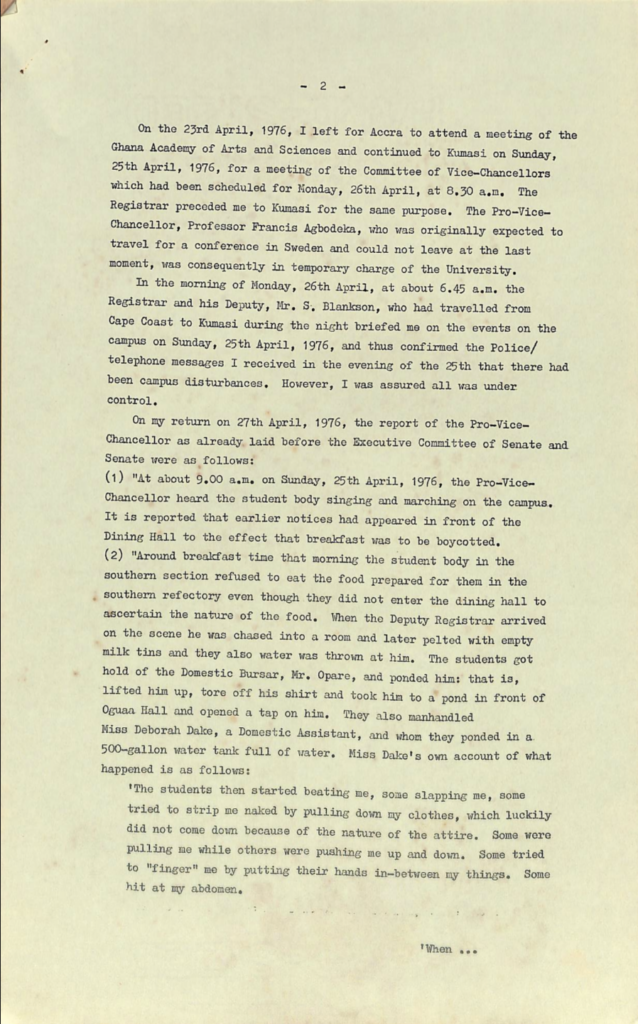
On the 23rd April, 1976, I left for Accra to attend a meeting of the Ghana Academy of Arts and Sciences and continued to Kumasi on Sunday, 25th April, 1976, for a meeting of the Committee of Vice-Chancellors which had been scheduled for Monday, 26th April, at 8.30 a.m. The Registrar preceded me to Kumasi for the same purpose. The Pro-Vice- Chancellor, Professor Francis Agbodeka, who was originally expected to travel for a conference in Sweden and could not leave at the last moment, was consequently in temporary charge of the University.
In the morning of Monday, 26th April, at about 6.45 a.m. the Registrar and his Deputy, Mr. S. Blankson, who had travelled from Cape Coast to Kumasi during the night briefed me on the events on the campus on Sunday, 25th April, 1976, and thus confirmed the Police/ telephone messages I received in the evening of the 25th that there had been campus disturbances. However, I was assured all was under control.
On my return on 27th April, 1976, the report of the Pro-Vice- Chancellor as already laid before the Executive Committee of Senate and Senate were as follows:
(1) “At about 9.00 a.m. on Sunday, 25th April, 1976, the Pro-Vice- Chancellor heard the student body singing and marching on the campus. It is reported that earlier notices had appeared in front of the Dining Hall to the effect that breakfast was to be boycotted.
(2) “Around breakfast time that morning the student body in the southern section refused to eat the food prepared for them in the southern refectory even though they did not enter the dining hall to ascertain the nature of the food. When the Deputy Registrar arrived on the scene he was chased into a room and later pelted with empty milk tins and they also water was thrown at him. The students got hold of the Domestic Bursar, Mr. Opare, and ponded him: that is, lifted him up, tore off his shirt and took him to a pond in front of Oguaa Hall and opened a tap on him. They also manhandled Miss Deborah Dake, a Domestic Assistant, and whom they ponded in a 500-gallon water tank full of water. Miss Dake’s own account of what happened is as follows:
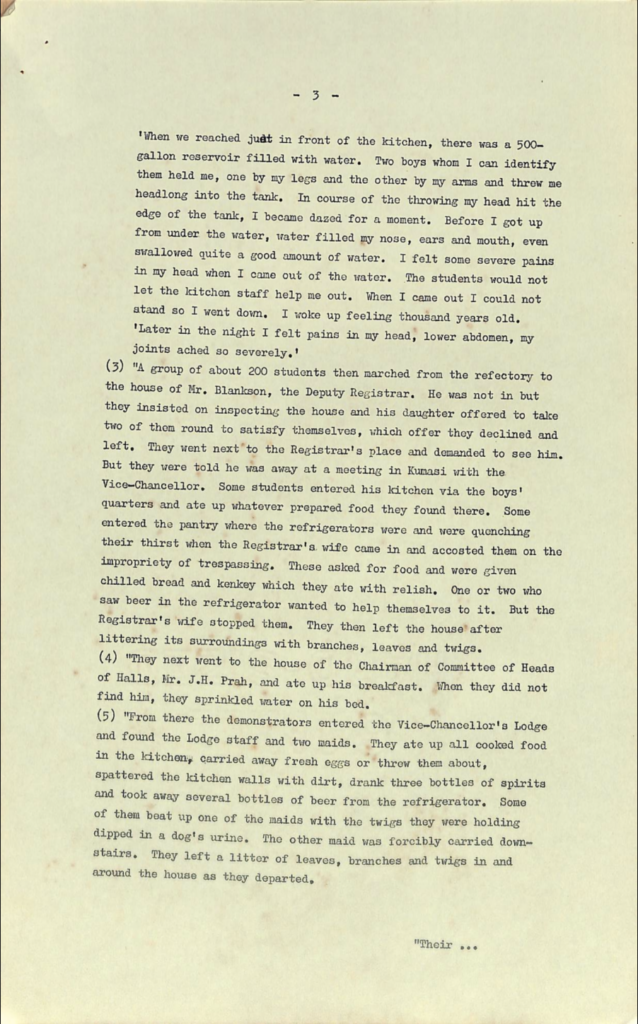
The students then started beating me, some slapping me, some tried to strip me naked by pulling down my clothes, which luckily did not come down because of the nature of the attire. Some were pulling me while others were pushing me up and down. Some tried to “finger” me by putting their hands in-between my things. Some hit at my abdomen.
‘When we reached just in front of the kitchen, there was a 500- gallon reservoir filled with water. Two boys whom I can identify them held me, one by my legs and the other by my arms and threw me headlong into the tank. In course of the throwing my head hit the edge of the tank, I became dazed for a moment. Before I got up from under the water, water filled my nose, ears and mouth, even swallowed quite a good amount of water. I felt some severe pains in my head when I came out of the water. The students would not let the kitchen staff help me out. When I came out I could not stand so I went down. I woke up feeling thousand years old. ‘Later in the night I felt pains in my head, lower abdomen, my joints ached so severely.’
(3) “A group of about 200 students then marched from the refectory to the house of Mr. Blankson, the Deputy Registrar. He was not in but they insisted on inspecting the house and his daughter offered to take two of them round to satisfy themselves, which offer they declined and left. They went next to the Registrar’s place and demanded to see him. But they were told he was away at a meeting in Kumasi with the Vice-Chancellor. Some students entered his kitchen via the boys’ quarters and ate up whatever prepared food they found there. Some entered the pantry where the refrigerators were and were quenching their thirst when the Registrar’s wife came in and accosted them on the impropriety of trespassing. These asked for food and were given chilled bread and kenkey which they ate with relish. One or two who saw beer in the refrigerator wanted to help themselves to it. But the Registrar’s wife stopped them. They then left the house after littering its surroundings with branches, leaves and twigs.
(4) “They next went to the house of the Chairman of Committee of Heads of Halls, Mr. J.H. Prah, and ato up his breakfast. When they did not find him, they sprinkled water on his bed.
(5) “From there the demonstrators entered the Vice-Chancellor’s Lodge and found the Lodge staff and two maids. They ate up all cooked food in the kitchen, carried away fresh eggs or threw them about, spattered the kitchen walls with dirt, drank three bottles of spirits and took away several bottles of beer from the refrigerator. Some of them beat up one of the maids with the twigs they were holding dipped in a dog’s urine. The other maid was forcibly carried down- stairs. They left a litter of leaves, branches and twigs in and around the house as they departed.
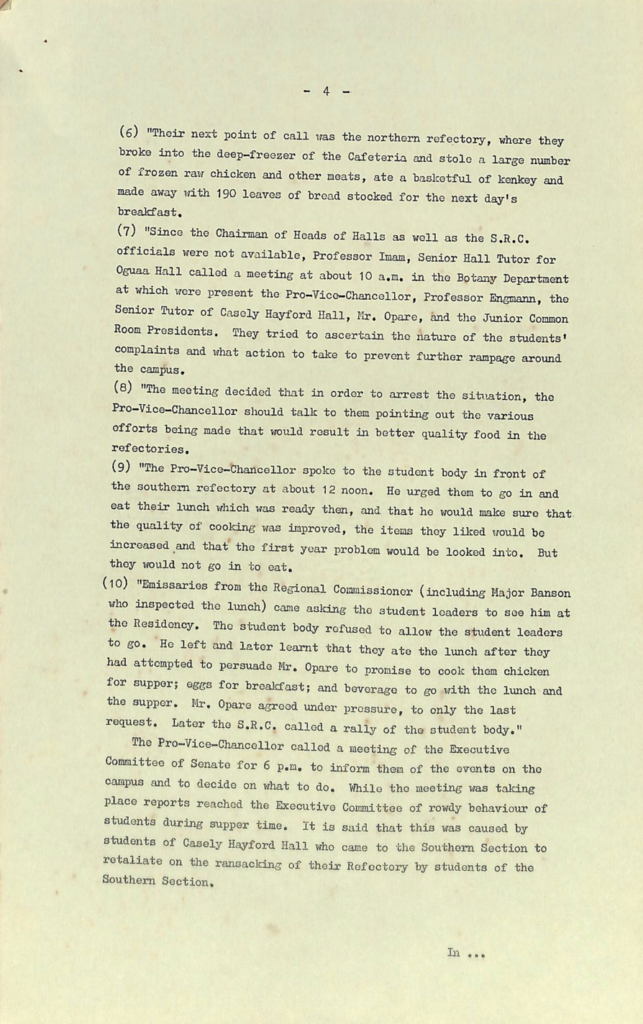
(6) “Their next point of call was the northern refectory, where they broke into the deep-freezer of the Cafeteria and stole a large number of frozen raw chicken and other meats, ate a basketful of kenkey and made away with 190 leaves of bread stocked for the next day’s breakfast.
(7) “Since the Chairman of Heads of Halls as well as the S.R.C. officials were not available, Professor Imam, Senior Hall Tutor for Oguaa Hall called a meeting at about 10 a.m. in the Botany Department at which were present the Pro-Vice-Chancellor, Professor Engmann, the Senior Tutor of Casely Hayford Hall, Mr. Opare, and the Junior Common Room Presidents. They tried to ascertain the nature of the students’ complaints and what action to take to prevent further rampage around the campus.
(8) “The meeting decided that in order to arrest the situation, the Pro-Vice-Chancellor should talk to them pointing out the various offorts being made that would result in better quality food in the refectories.
(9) “The Pro-Vice-Chancellor spoke to the student body in front of the southern refectory at about 12 noon. He urged them to go in and eat their lunch which was ready then, and that he would make sure that the quality of cooking was improved, the items they liked would be increased and that the first year problem would be looked into. But they would not go in to eat.
(10) “Emissaries from the Regional Commissioner (including Major Banson who inspected the lunch) came asking the student leaders to see him at the Residency. The student body rofused to allow the student leaders to go. He left and later learnt that they ate the lunch after they had attempted to persuade Mr. Opare to promise to cook them chicken for supper; eggs for breakfast; and beverage to go with the lunch and the supper. Mr. Opare agreed under pressure, to only the last request. Later the S.R.C. called a rally of the student body.”
The Pro-Vice-Chancellor called a meeting of the Executive Committee of Senate for 6 p.m. to inform them of the events on the campus and to decide on what to do. While the meeting was taking place reports reached the Executive Committee of rowdy behaviour of students during supper time. It is said that this was caused by students of Casely Hayford Hall who came to the Southern Section to retaliate on the ransacking of their Refectory by students of the Southern Section.
In that atmosphere it became apparent to the Executive Committee that the University could not continue to carry on its functions, and so the Committee decided that the University should be closed down. It was also noted that the students failed to abide by the rules of the University governing demonstrations and that violence had occurred.
Senate met the following day and approved the decision of the Executive Committee of Senate and also decided that all students, excluding foreign students, should be suspended for two weeks for not respecting the rules on demonstrations. This meant that the University was to re-open on Monday, 10th May, 1976, and classes to resume the following day. It also decided that owing to a number of fixed arrangements made with External Examiners, this term cannot be extended. This means that you will have to work hard.
A report on the incidents was then sent to the Chairman of the University Council who visited the campus on 27th April when the Vice- Chancellor had just returned from Kumasi. The Council of the University met on 1st May, 1976, and endorsed the decisions of Senate. It decided that the students of the Southern Section should pay for the loss and damage to university property, and also that the aspects of the demonstrations which were of a criminal nature should be handed over to the Police for investigations and necessary action. That those who have been identified as being involved in suspected criminal acts are to be suspended pending the outcome of police investigations which Council hopes will be expeditious.
In the meantime the University received letters of protest from the Local Branch of Teachers and Educational Workers’ Union on behalf of Miss Dake and Mr. Opare, and from the Senior Staff Association also on behalf of Mr. Opare. The workers of the University in these petitions contended that they have observed the growing habit of students in maltreating workers, and that should such acts occur again, they also will advise themselves of the appropriate action to take.
On 10th May, 1976, the University was reopened. The students decided to take the following day not for lectures but to express their solidarity with their colleagues who have been suspended. Lectures therefore resumed on Wednesday, 12th May, 1976.
On that day, the S.R.C. met the Vice-Chancellor to discuss the presentation to him of an appeal for the re-instatement of the suspended students and the withdrawal of the matter from the police. The appeal has been received this morning.
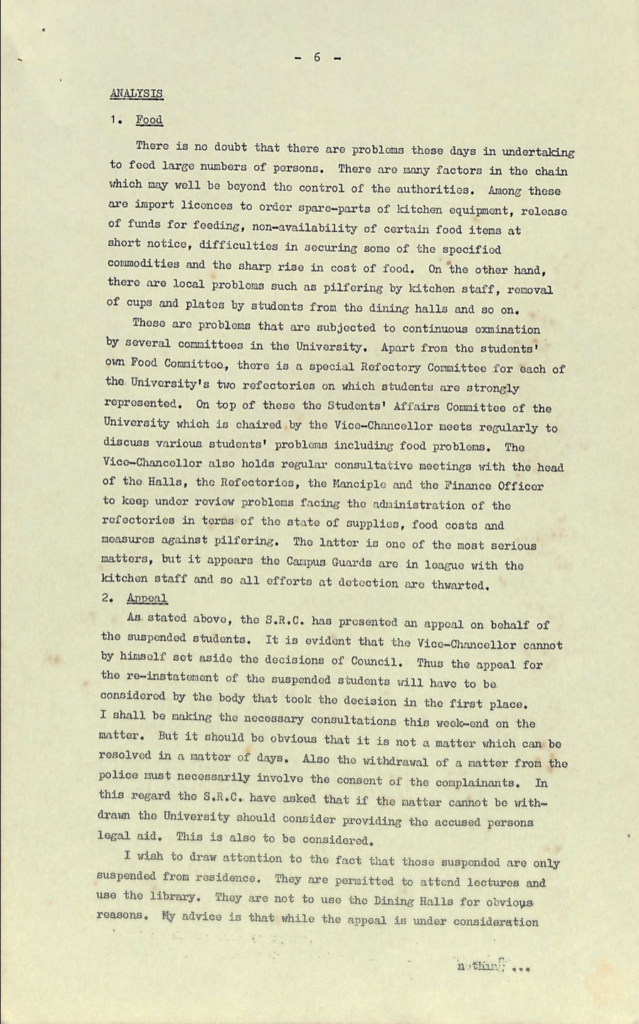
ANALYSIS
- Food
There is no doubt that there are problems these days in undertaking to feed large numbers of persons. There are many factors in the chain which may well be beyond the control of the authorities. Among these are import licences to order spare-parts of kitchen equipment, release of funds for feeding, non-availability of certain food items at short notice, difficulties in securing some of the specified commodities and the sharp rise in cost of food. On the other hand, there are local problems such as pilfering by kitchen staff, removal of cups and plates by students from the dining halls and so on. These are problems that are subjected to continuous exmination by several committees in the University. Apart from the students’ own Food Committee, there is a special Refectory Committee for each of the University’s two refectories on which students are strongly represented. On top of these the Students’ Affairs Committee of the University which is chaired by the Vice-Chancellor meets regularly to discuss various students’ problems including food problems. The Vico-Chancellor also holds regular consultative meetings with the head of the Halls, the Refectorios, the Manciple and the Finance Officer to keep under review problems facing the administration of the refectories in terms of the state of supplies, food costs and measures against pilfering. The latter is one of the most serious matters, but it appears the Campus Guards are in league with the kitchen staff and so all efforts at detection are thwarted.
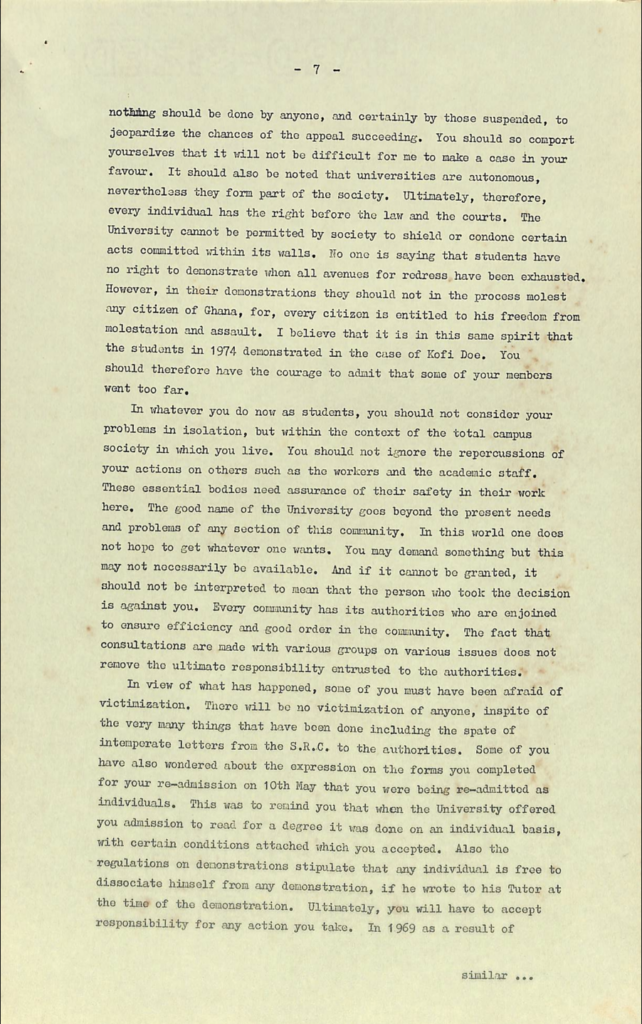
- Appeal
As stated above, the S.R.C. has presented an appeal on behalf of the suspended students. It is evident that the Vice-Chancellor cannot by himself set aside the decisions of Council. Thus the appeal for the reinstatement of the suspended students will have to be considered by the body that took the decision in the first place. I shall be making the necessary consultations this week-end on the matter. But it should be obvious that it is not a matter which can be resolved in a matter of days. Also the withdrawal of a matter from the police must necessarily involve the consent of the complainants. In this regard the S.R.C. have asked that if the matter cannot be with- drawn the University should consider providing the accused persons legal aid. This is also to be considered.
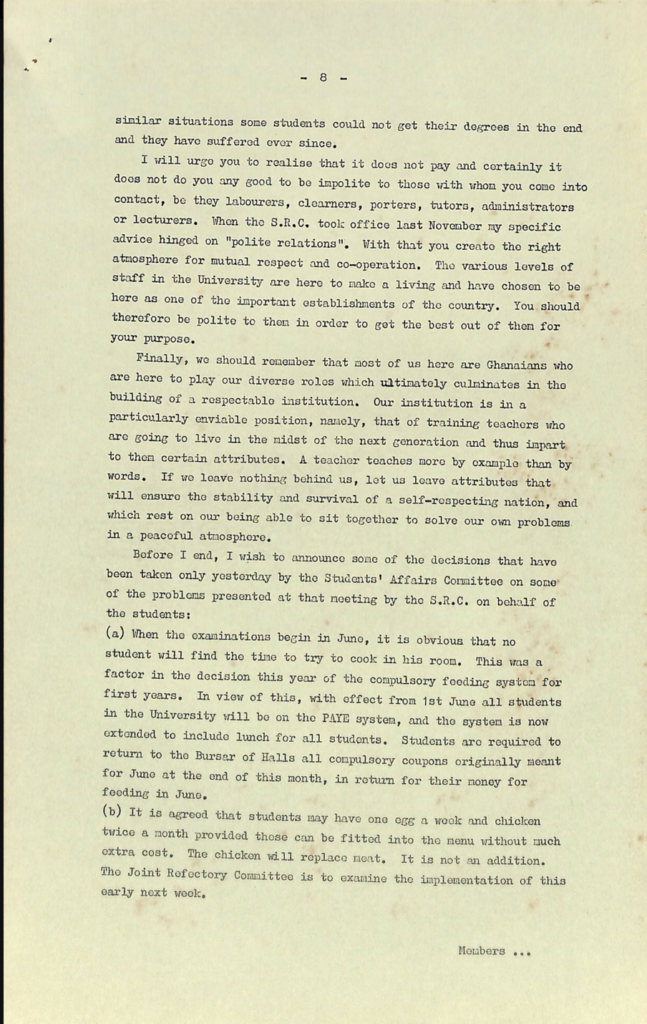
I wish to draw attention to the fact that those suspended are only suspended from residence. They are permitted to attend lectures and use the library. They are not to use the Dining Halls for obvious reasons. My advice is that while the appeal is under consideration nothing should be done by anyone, and certainly by those suspended, to jeopardize the chances of the appeal succeeding. You should so comport yourselves that it will not be difficult for me to make a case in your favour. It should also be noted that universities are autonomous, nevertheless they form part of the society. Ultimately, therefore, every individual has the right before the law and the courts. The University cannot be permitted by society to shield or condone certain acts committed within its walls. No one is saying that students have no right to demonstrate when all avenues for redress have been exhausted. However, in their demonstrations they should not in the process molest any citizen of Ghana, for, every citizen is entitled to his freedom from molestation and assault. I believe that it is in this same spirit that the students in 1974 demonstrated in the case of Kofi Doe. You should therefore have the courage to admit that some of your members went too far.
In whatever you do now as students, you should not consider your problems in isolation, but within the context of the total campus society in which you live. You should not ignore the repercussions of your actions on others such as the workers and the academic staff. These essential bodies need assurance of their safety in their work here. The good name of the University goes beyond the present needs and problems of any section of this community. In this world one does not hope to get whatever one wants. You may demand something but this may not necessarily be available. And if it cannot be granted, it should not be interpreted to mean that the person who took the decision is against you. Every community has its authorities who are enjoined to ensure efficiency and good order in the community. The fact that consultations are made with various groups on various issues does not remove the ultimate responsibility entrusted to the authorities.
In view of what has happened, some of you must have been afraid of victimization. There will be no victimization of anyone, inspite of the very many things that have been done including the spate of intemperate letters from the S.R.C. to the authorities. Some of you have also wondered about the expression on the forms you completed for your re-admission on 10th May that you were being re-admitted as individuals. This was to remind you that when the University offered you admission to read for a degree it was done on an individual basis, with certain conditions attached which you accepted. Also the regulations on demonstrations stipulate that any individual is free to dissociate himself from any demonstration, if he wrote to his Tutor at the time of the demonstration. Ultimately, you will have to accept responsibility for any action you take. In 1969 as a result of similar situations some students could not get their degrees in the end and they have suffered ever since.
I will urge you to realise that it does not pay and certainly it does not do you any good to be impolite to those with whom you come into contact, be they labourers, cleaners, porters, tutors, administrators or lecturers. When the S.R.C. took office last November my specific advice hinged on “polite relations”. With that you create the right atmosphere for mutual respect and co-operation. The various levels of staff in the University are here to make a living and have chosen to be here as one of the important establishments of the country. You should therefore be polite to then in order to get the best out of them for your purpose.
Finally, we should remember that most of us here are Ghanaians who are here to play our diverse roles which ultimately culminates in the building of a respectable institution. Our institution is in a particularly enviable position, namely, that of training teachers who are going to live in the midst of the next generation and thus impart to them certain attributes. A teacher teaches more by example than by words. If we leave nothing behind us, let us leave attributos that will ensure the stability and survival of a self-respecting nation, and which rest on our being able to sit together to solve our own problems. in a peaceful atmosphere.
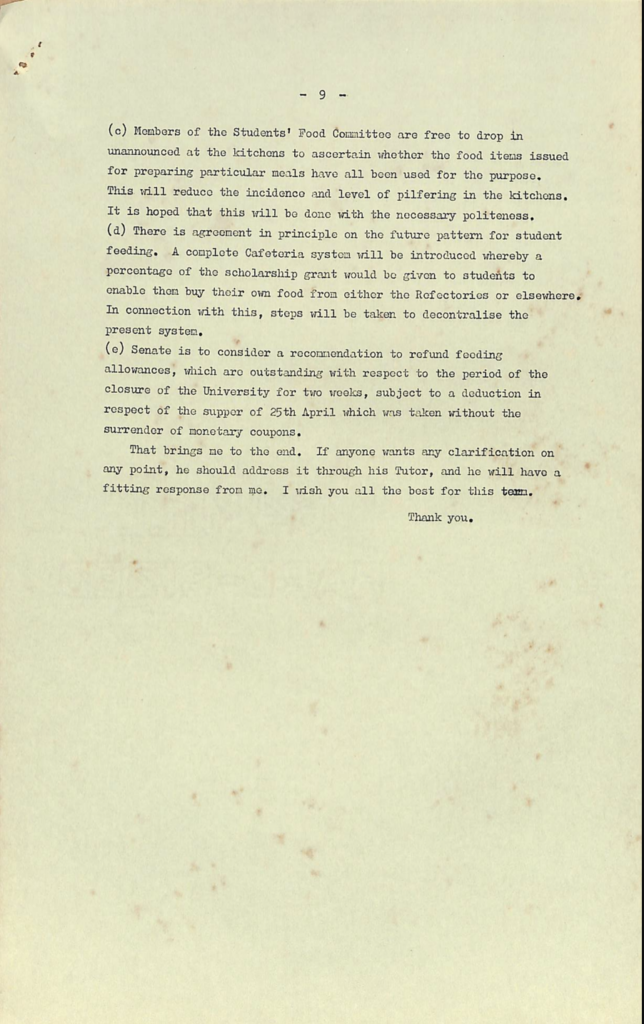
Before I end, I wish to announce some of the decisions that have been taken only yesterday by the Students’ Affairs Committee on some of the problems presented at that meeting by the S.R.C. on behalf of the students:
(a) When the examinations begin in Juno, it is obvious that no student will find the time to try to cook in his room. This was a factor in the decision this year of the compulsory fooding syston for first years. In view of this, with effect from 1st June all students in the University will be on the PAYE system, and the system is now extended to include lunch for all students. Students are required to return to the Bursar of Halls all compulsory coupons originally meant for June at the end of this month, in return for their money for feeding in June.
(b) It is agreed that students may have one egg a week and chicken twice a month provided these can be fitted into the menu without much extra cost. The chicken will replace meat. It is not an addition. The Joint Refectory Committee is to examine the implementation of this early next week.
(c) Members of the Students’ Food Committee are free to drop in unannounced at the kitchens to ascertain whether the food items issued for preparing particular meals have all been used for the purpose. This will reduce the incidence and level of pilfering in the kitchens. It is hoped that this will be done with the necessary politeness.
(d) There is agreement in principle on the future pattern for student feeding. A complete Cafeteria system will be introduced whereby a percentage of the scholarship grant would be given to students to enable them buy their own food from either the Refectories or elsewhere. In connection with this, steps will be taken to decontralise the present system.
(e) Senate is to consider a recommendation to refund feeding allowances, which are outstanding with respect to the period of the closure of the University for two weeks, subject to a deduction in respect of the supper of 25th April which was taken without the surrender of monetary coupons.
That brings me to the end. If anyone wants any clarification on any point, he should address it through his Tutor, and he will have a fitting response from me. I wish you all the best for this term.
Thank you.
“Culled from Daily Graphic, Friday, May 28, 1976 Page 9
STUDENTS COUNCIL SAY SORRY!
The Students’ Representative Council (SRC) of the University of Cape Coast has apologised to three members of the university staff who were mishandled during a violent demonstration at the campus on April 26 against alleged poor food served at the university.
The Council’s apology was contained in a letter dated May 18 addressed to the affected staff, with a copy to the university authorities.
The letter signed by the executive of the SRC said, “on behalf of the entire student body, we sincerely and unreservedly render our apology to the members of the university staff for the inconveniences caused during the recent demonstration on this campus”.
The SRC said they believed that the student body “took part in the demonstration which purported to bring to the notice of the university authority, the deteriorating food situation on this campus – had no pre-meditated intention or any aim to cause harm or any inconvenience whatsoever to any worker or for that matter any member of the university staff.”
The Council said in order to maintain the harmony that existed between students and members of the university staff, they hoped their apology would be accepted in “good faith”.
The affected staff are: ir. F.0. Opare, Senior Domestic Bursar, Miss Debora Dake, Assistant Domestic Bursar, and Mr. Thomas Mensah, Accounts Clerk.
The University was closed down for two weeks immediately after the demonstration on orders of the Executive Committee of the Senate.
During the demonstration, the students were alleged to have assaulted the members of staff. The University was re-opened on May 10.
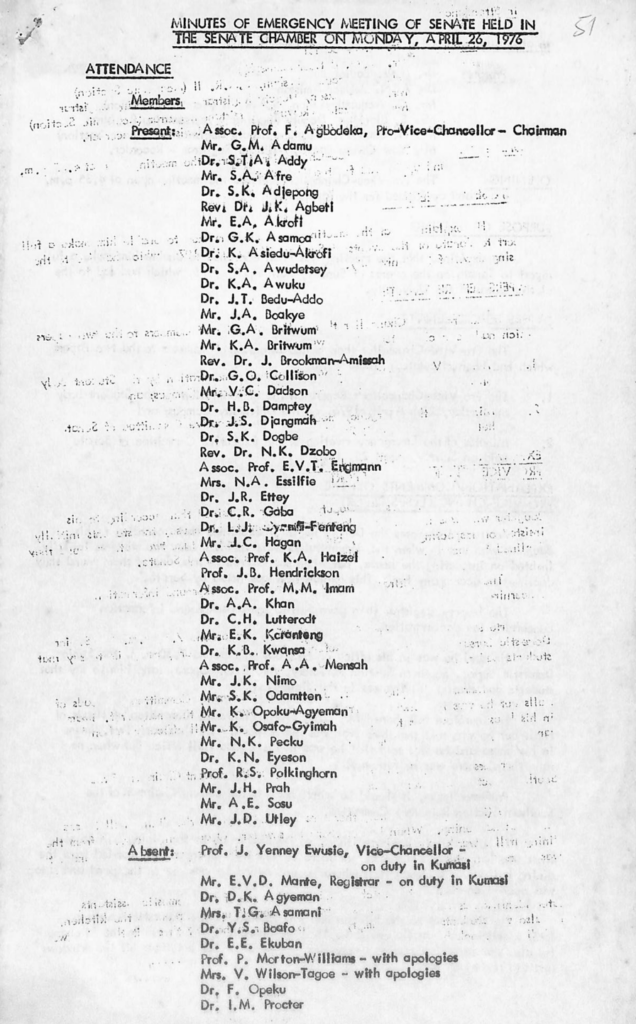
MINUTES OF EMERGENCY MEETING OF SENATE HELD IN THE SENATE CHAMBER ON MONDAY, APRIL 26, 1976
ATTENDANCE
Members
Present:
Assoc. Prof. F. Agbodeka, Pro-Vice-Chancellor – Chairman
Mr. G.M. A damu
Dr. S.T.A. Addy
Mr. S.A. Afre
Dr. S.K. Adjepong
Rev. Dr. J.K. Agbeti
Mr. E.A, Akrofi
Dr.. G.K. Asamoa
Dr. K. Asiedu-Akrofi
Dr. S.A. Awudetsey
Dr. K.A. Awuku
Dr. J.T. Bedu-Addo
Mr. J.A. Boakye
Mr. G.A. Britwum
Mr. K.A. Britwum
Rev. Dr. J. Brookman-Amissah
Dr. G.O. Collison
Mr. V.C. Dadson
Dr. H.B. Damptey
Dr. J.S. Djangmah
Dr. S.K. Dogbe
Rev. Dr. N.K, Dzobo
Assoc. Prof. E.V.T. Engmann
Mrs. N.A. Essilfie
Dr. J.R. Ettey
Dr. Dr. C.R. Gaba
Dr. L.J. Gyamfi-Fenteng
Mr. J.C. Hagan
Assoc. Prof. K.A. Haizel
Prof. J.B. Hendrickson
Assoc. Prof. M. M. Imam
Dr. A.A. Khan
Dr. C.H. Lutterodt
Mr. E.K. Keranteng
Dr. K.B.. Kwansa
Assoc. Prof. A.A. Mensah
Mr. J.K. Nimo
Mr. S.K. Odamtten
Mr. K. Opoku-Agyeman
Mr. K. Osafo-Gyimah
Mr. N.K. Pecku
Dr. K. N. Eyeson
Prof. R.S. Polkinghorn
Mr. J. H. Prah
Mr. A.E. Sosu
Mr. J.D. Utley
Absent:
Prof. J. Yenney Ewusie, Vice-Chancellor ini on duty in Kumasi
Mr. E.V.D. Mante, Registrar on duty in Kumasi
Dr. D.K. Agyeman
Mrs. T.G.Asamani
Dr. Y.S. Boafo
Dr. E.E. Ekuban
Prof. P. Morton-Williams – with apologies
Mrs. V. Wilson-Tagoe with apologies
Dr. F. Opeku
Dr. I.M. Procter
In attendance
Present:
Dr. A.A. Badiei
Dr. A. N. de Heer-Amissah
Mr. G. Acquaah-A shun, S.A.R. II (Academic Section)
Mr. S. Blankson, Deputy Registrar – representing Registrar
Mr. Asafo-Akowuah, Assistant Registrar (Academic Section)
Mr. Yaw Owusu-Bamfo, Assistant Registrar – Recorder.
OPENING
The Pro-Vice-Chancellor declared the meeting open at 4.35 p.m. and apologised for the late start.
PURPOSE OF MEETING
He explained that the meeting had been convened to enable him make a full report to Senate on the events of Sunday, 25th April, 1976, which had led to the closing down of the University.
PAPERS BEFORE SENATE
The Pro-Vice-Chancellor then called attention of members to the two Papers which had been circulated; these were: 1. The Pro-Vice-Chancellor’s Report on the demonstration by the Student Body on Sunday, 25th April, 1976, on the University Campus; and 2. Minutes of the Emergency meeting of the Executive Committee of Senate held on Sunday, April 25, 1976.
EXPLANATION/COMMENTS ON THE PRO-VICE-CHANCELLOR’S REPORT
For record purposes the Deputy Registrar explained that according to his daughter who was in when the demonstrators went to his house, the students initially insisted on inspecting the house, but when she offered to take two of them round they declined to accompany her. This explanation was noted by Senate.
The Deputy Registrar then gave Senate some background information concerning the demonstration.
He said he was in his office on that day and around 7.30 a, m, the Senior Domestic Bursar, Southern Section Refectory, Mr. F.O. Opare, rang him to say that students had started disturbances in the dining hall.
He therefore telephoned Mr. J.H. Prah, Chairman, Committee of Heads of Halls but he was told that Mr. Prah was out of town. He then rang Prof. Imam in his house and he was told that he was in his Oguaa Hall office but when he rang there, there was no response.
Professor Imam, it should be mentioned, is the current Chairman of the Southern Section Refectory Committee.
He (the Deputy Registrar) therefore decided to go to the dining hall to see what was happening. When he got there he saw Mr. Opare being carried from the dining hall towards Oguaa Hall where he understood he was put in the pond and a tap was opened on him.
He then went to the kitchen and saw that one of the Domestic Assistants, later identified as Miss Debora Bake, had shut herself up in a room in the kitchen. He also saw students throwing empty tins and water at her but these hit the windows and did not touch her.
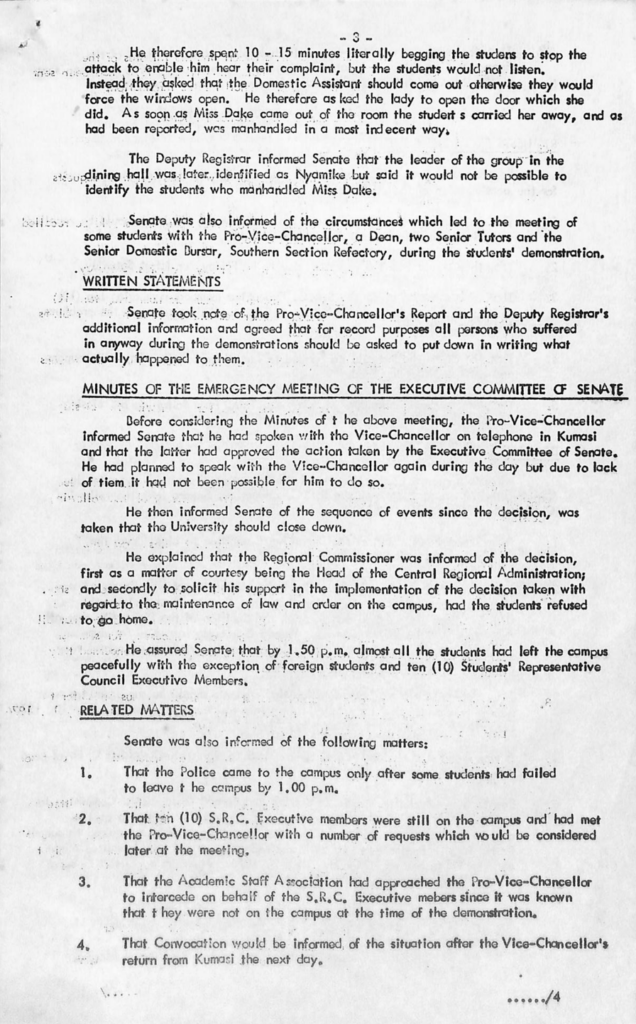
He therefore spent 10-15 minutes literally begging the students to stop the attack to enable him hear their complaint, but the students would not listen. Instead they asked that the Domestic Assistant should come out otherwise they would force the windows open. He therefore asked the lady to open the door which she did. As soon as Miss Dake came out of the room the students carried her away, and as had been reported, was manhandled in a most indecent way.
The Deputy Registrar informed Senate that the leader of the group in the dining hall was later, identified as Nyamike but said it would not be possible to identify the students who manhandled Miss Dake.
Senate was also informed of the circumstances which led to the meeting of some students with the Pro-Vice-Chancellor, a Dean, two Senior Tutors and the Senior Domestic Bursar, Southern Section Refectory, during the students’ demonstration.
WRITTEN STATEMENTS
Senate took note of the Pro-Vice-Chancellor’s Report and the Deputy Registrar’s additional information and agreed that for record purposes all persons who suffered in anyway during the demonstrations should be asked to put down in writing what actually happened to them.
MINUTES OF THE EMERGENCY MEETING OF THE EXECUTIVE COMMITTEE OF SENATE
Before considering the Minutes of the above meeting, the Pro-Vice-Chancellor informed Senate that he had spoken with the Vice-Chancellor on telephone in Kumasi and that the latter had approved the action taken by the Executive Committee of Senate. He had planned to speak with the Vice-Chancellor again during the day but due to lack of tiem it had not been possible for him to do so.
He then informed Senate of the sequence of events since the decision, was taken that the University should close down.
He explained that the Regional Commissioner was informed of the decision, first as a matter of courtesy being the Head of the Central Regional Administration; ie and secondly to solicit his support in the implementation of the decision taken with regard to the maintenance of law and order on the campus, had the students refused to go home.
He assured Senate that by 1.50 p.m. almost all the students had left the campus peacefully with the exception of foreign students and ten (10) Students’ Representative Council Executive Members.
RELATED MATTERS
Senate was also informed of the following matters:
- That the Police came to the campus only after some students had failed to leave the campus by 1.00 p.m.
- That ten (10) S.R, C. Executive members were still on the campus and had met the Pro-Vice-Chancellor with a number of requests which would be considered later at the meeting.
- That the Academic Staff Association had approached the Pro-Vice-Chancellor to intercede on behalf of the S.R. C. Executive members since it was known that they were not on the campus at the time of the demonstration.
- That Convocation would be informed of the situation after the Vice-Chancellor’s return from Kumasi the next day.
- That copies, of the Pro-Vice-Chancellor’s Report and the Minutes of the Executive Committee of Senate Meeting held on April 25, 1976, had been sent to to the Pro-Chancellor and Chairman of Council for his information.
That a fuller Report would be sent to the Chancellor later.
REQUESTS FROM THE S.R. C.
Senate was informed that the S.R. C. had put forward the following requests for the consideration of the meeting:
- That in order not to disrupt the academic programme, students should be recalled . tan as early as possible but not later than a week.
- That they would like the reporting day to be Friday, or latest Saturday.
- That Senate should allow the S.R. C. Executive members numbering ten (10) to stay behind to help the University authorities find solutions to the problems. which had led to the demonstrations.
- That the dining hall should be opened to feed them because they had coupons and not money to buy food.
- That Senate should consider extending the Third Term following the closing down of the University.
DECISIONS
After taking note of the Minutes of the Executive Committee and after due 2.W consideration of the requests from the S.R.C, Executive, Senate took the following decisions:
- It endorsed the decision of the Executive Committee to close down the University with effect from April 26, 1976.
- It decided that the S, R, C. Executive members should not be allowed to stay. It was explained in this connection that since they were students in the first instance, they should comply with the decision of the University that all students should leave the campus. Should it become necessary for some students to come back to help find solutions to the problems concerned they would be invited at the appropriate time.
- It was agreed by a majority decision that students should be suspended for two weeks; this meant that they would return into residence on Monday, May 10, 1976. Lectures would then start on Tuesday, May 11, 1976.
- It was noted that students would be required to sign an undertaking to be of good behaviour on their return.
- Senate recognised that there was a crisis and agreed to appoint a Committee to enquire into and examine the causes of the students demonstration on the campus on Sunday, April 25, 1976; the Committee would be required to submit its findings to Senate together with any recommendations the Committee might consider fit to make by Monday, May 3, 1976. Members appointed to serve on the Committee were: Prof, K.A. Haizel, School of Agriculture – Chairman Dr. L.J. Gyanfi-Fenteng, Geography Department Member Mr. G.M. Adamu, Economics, Department Member Mr. A.E. Sosu, Department of Curriculum and Teaching – Member.
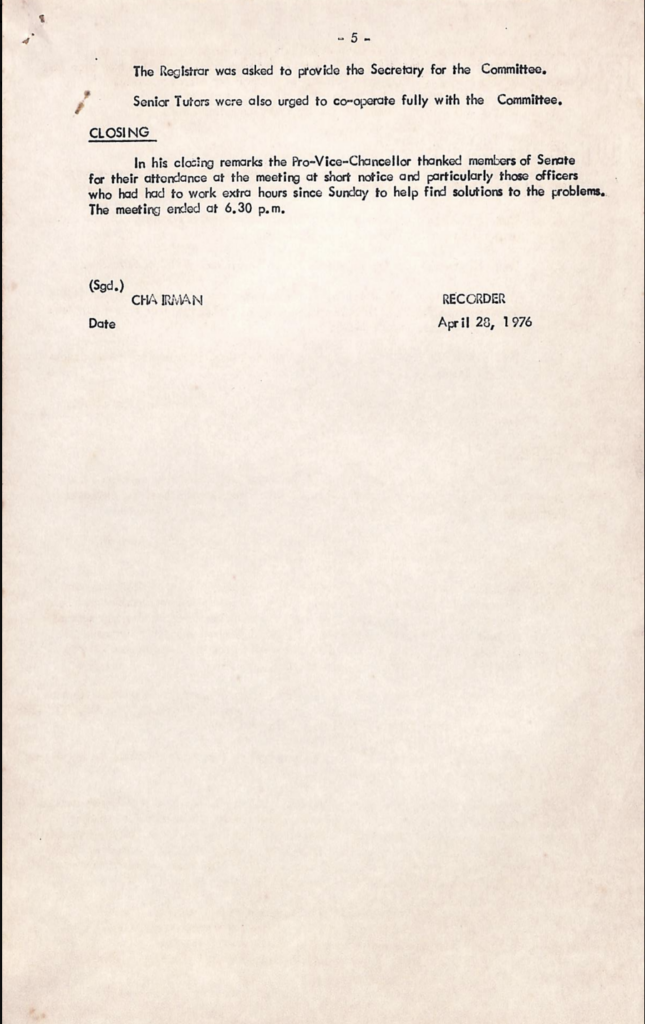
The Registrar was asked to provide the Secretary for the Committee.
Senior Tutors were also urged to co-operate fully with the Committee.
CLOSING
In his closing remarks the Pro-Vice-Chancellor thanked members of Senate for their attendance at the meeting at short notice and particularly those officers who had had to work extra hours since Sunday to help find solutions to the problems. The meeting ended at 6.30 p.m.
(Sgd.) CHA IRMAN
RECORDER Date April 28, 1976
Read Vice Chancellor's 1974 Address here

Read about the 1971 students disturbances here

Read about the 1968 students demonstrations here