Rawlings Regime Seems Jittery And Desperate
August 5, 2026
Transcript
Guardian
1982
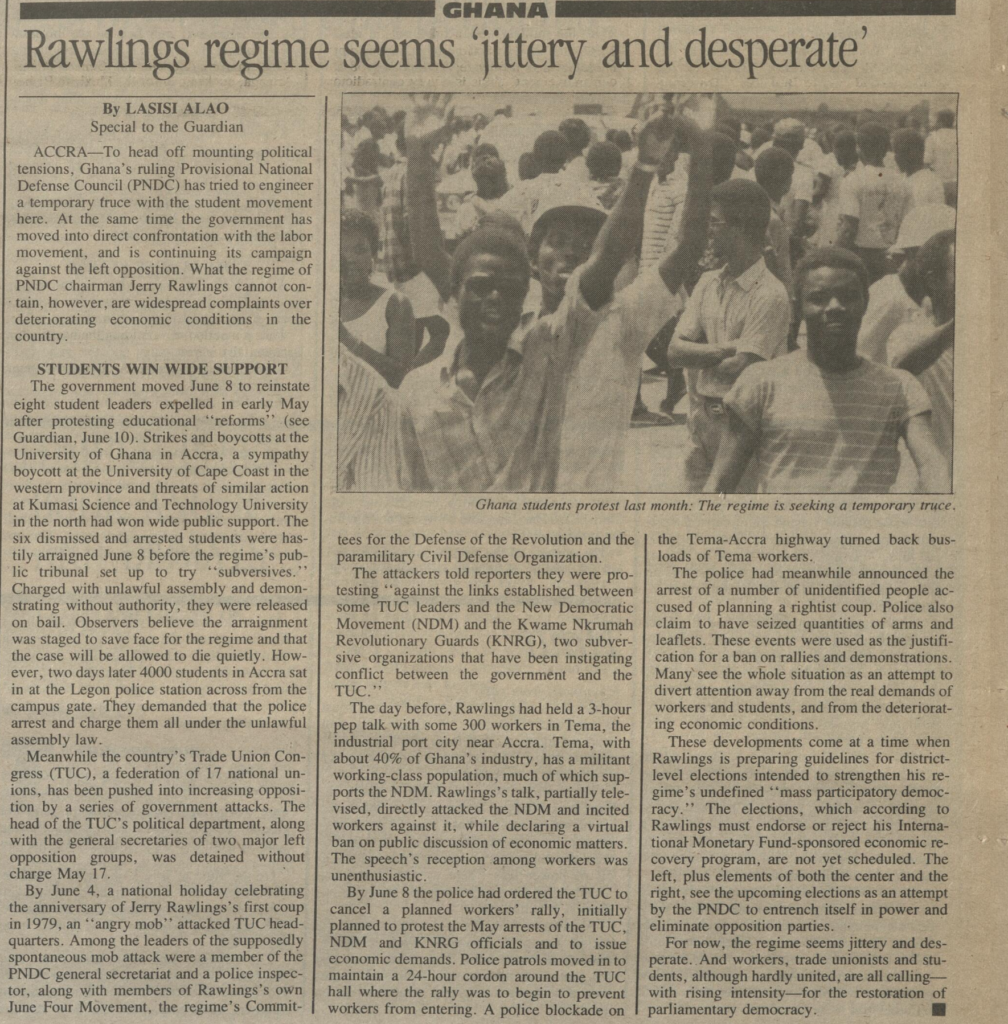
Photo Caption: Ghana students protest last month: The regime is seeking a temporary truce
By LASISI ALAO
Special to the Guardian
ACCRA
To head off mounting political tensions, Ghana’s ruling Provisional National Defense Council (PNDC) has tried to engineer a temporary truce with the student movement here. At the same time the government has moved into direct confrontation with the labor movement, and is continuing its campaign against the left opposition. What the regime of PNDC chairman Jerry Rawlings cannot contain, however, are widespread complaints over deteriorating economic conditions in the country.
STUDENTS WIN WIDE SUPPORT
The government moved June 8 to reinstate eight student leaders expelled in early May after protesting educational “reforms” (see Guardian, June 10). Strikes and boycotts at the University of Ghana in Accra, a sympathy boycott at the University of Cape Coast in the western province and threats of similar action at Kumasi Science and Technology University in the north had won wide public support. The six dismissed and arrested students were hastily arraigned June 8 before the regime’s public tribunal set up to try “subversives. Charged with unlawful assembly and demonstrating without authority, they were released on bail. Observers believe the arraignment was staged to save face for the regime and that the case will be allowed to die quietly. However, two days later 4000 students in Accra sat in at the Legon police station across from the campus gate. They demanded that the police arrest and charge them all under the unlawful assembly law.
Meanwhile the country’s Trade Union Congress (TUC), a federation of 17 national unions, has been pushed into increasing opposition by a series of government attacks. The head of the TUC’s political department, along with the general secretaries of two major left opposition groups, was detained without charge May 17.
By June 4, a national holiday celebrating the anniversary of Jerry Rawlings’s first coup
in 1979, an “angry mob” attacked TUC head- quarters. Among the leaders of the supposedly spontaneous mob attack were a member of the PNDC general secretariat and a police inspector, along with members of Rawlings’s own June Four Movement, the regime’s Committees for the Defense of the Revolution and the paramilitary Civil Defense Organization.
The attackers told reporters they were pro- testing “against the links established between some TUC leaders and the New Democratic Movement (NDM) and the Kwame Nkrumah Revolutionary Guards (KNRG), two subversive organizations that have been instigating conflict between the government and the TUC.”
The day before, Rawlings had held a 3-hour pep talk with some 300 workers in Tema, the industrial port city near Accra. Tema, with about 40% of Ghana’s industry, has a militant
working-class population, much of which supports the NDM. Rawlings’s talk, partially televised, directly attacked the NDM and incited workers against it, while declaring a virtual ban on public discussion of economic matters.The speech’s reception among workers was unenthusiastic.
By June 8 the police had ordered the TUC to cancel a planned workers’ rally, initially planned to protest the May arrests of the TUC, NDM and KNRG officials and to issue economic demands. Police patrols moved in to maintain a 24-hour cordon around the TUC hall where the rally was to begin to prevent workers from entering. A police blockade on the Tema-Accra highway turned back busloads of Tema workers.
The police had meanwhile announced the arrest of a number of unidentified people accused of planning a rightist coup. Police also claim to have seized quantities of arms and leaflets. These events were used as the justification for a ban on rallies and demonstrations. Many see the whole situation as an attempt to divert attention away from the real demands of workers and students, and from the deteriorating economic conditions.
These developments come at a time when Rawlings is preparing guidelines for district level elections intended to strengthen his regime’s undefined “mass participatory democracy.” The elections, which according to Rawlings must endorse or reject his International Monetary Fund-sponsored economic recovery program, are not yet scheduled. The left, plus elements of both the center and the right, see the upcoming elections as an attempt by the PNDC to entrench itself in power and eliminate opposition parties.
For now, the regime seems jittery and desperate. And workers, trade unionists and students, although hardly united, are all calling–with rising intensity–for the restoration of parliamentary democracy.
- Protest Note: University Of Cape Coast – 1977
- Notice Of Boycott Of Lectures – 1977
- Protest Note: Ghana Association Of University Teachers
- 1964: Portrait of Nkrumah as a Dictator – read here
- 1965: Ghana To Purge Schools – read here
- 1968: Ghana Students And Police Clash At Protest Gathering– read here
- 1968: Ghanaians Yield In College Fight; Students And Officials Both Aid In Reopening – read here