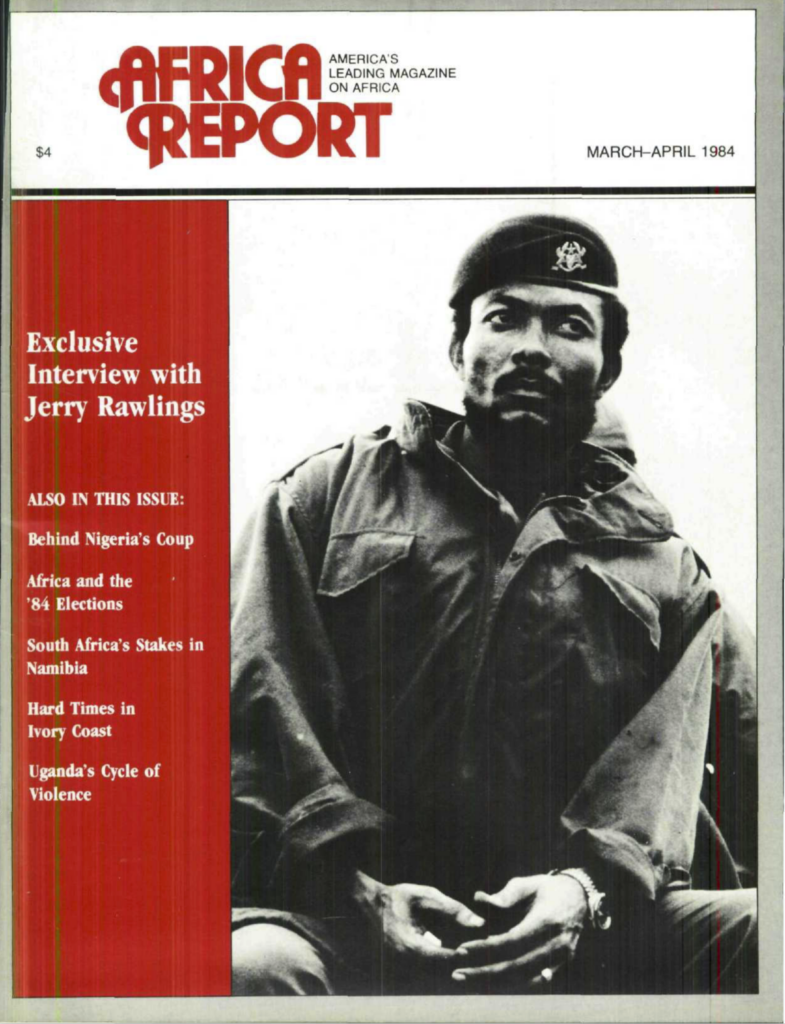
Exclusive Interview With Jerry Rawlings
August 11, 2026

Transcript
Africa Report
1984
Interviewed by Margaret A. Novicki
AFRICA REPORT: Could you provide an assessment of your government’s two-year record, highlighting both those areas where you feel it has registered its most concrete. achievements and where its shortcomings have been?
RAWLINGS: At the end of 1981, Ghana was like a runaway train, rushing downhill towards a broken bridge. The economy and the moral fiber of the people appeared to have reached a point of no return. We have however been able to apply the brakes and gradually bring the train to a halt, and we have started repairing the bridge. It is only when this is done that the train can cross the bridge and begin climbing the hill on the other side.
Now for the ordinary people, this means that they have seen very little in the way of material improvements in their daily lives. Indeed, they face increased hardships caused by the drought, which has severely affected the 1983 harvests despite all the efforts they put into it; the effects of the bushfires, which did considerable damage too; the low level of the Volta Lake, which has brought about the need for power cuts; and the effects of absorbing over one million Ghanaian returnees from Nigeria.
And yet they have faced these hardships with hope and some cheerfulness. And I think this is our most important achievement the restoration of hope and confidence even in the face of material hardships.
Our shortcomings have been in the same area of attitudes, rather than in material things. Some sections of the community have been unnecessarily alienated by the actions of people unused to the responsible use of power, but we have learned from these mistakes over the past two years. A general positive feeling is being generated.
AFRICA REPORT: You inherited an economy on the brink of bankruptcy, and over the last year you have introduced an austerity budget, a three-year recovery plan, and a devaluation of the cedi, in response to which you have won a substantial International Monetary Fund [IMF] loan and pledges of Western finance. Could you describe your government’s economic program, pointing out the priority sectors, and comment on whether you think these measures will be sufficient to pull Ghana out of its economic morass? Will these programs not further your dependence on Western finance?
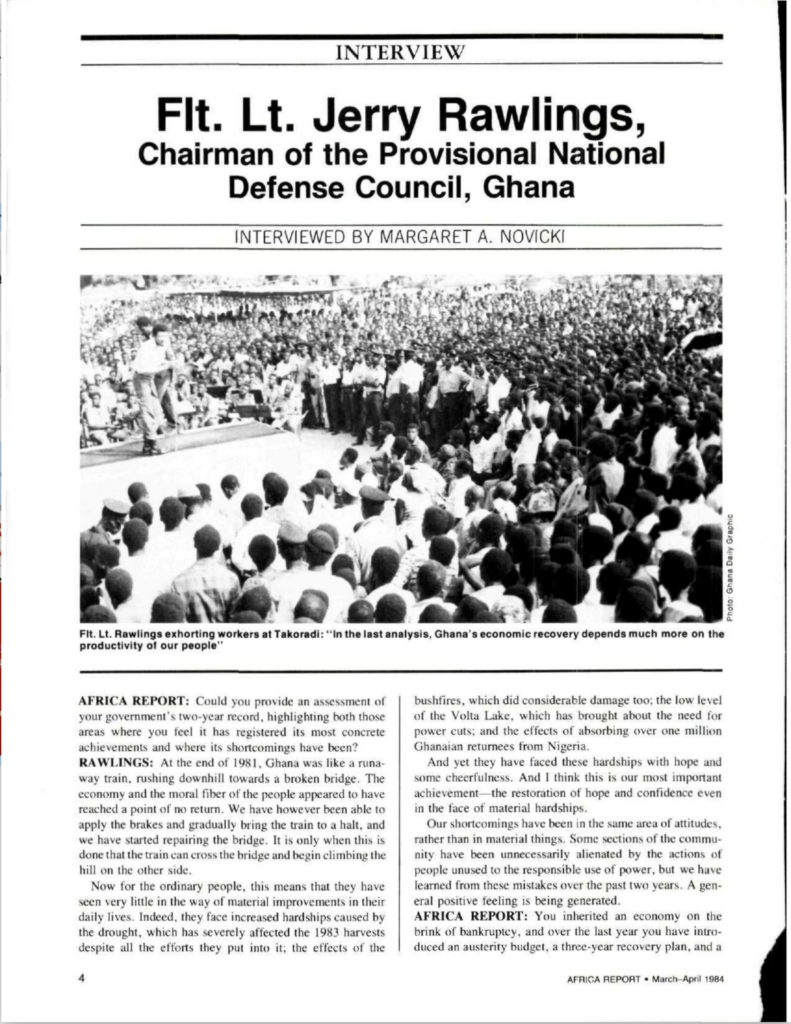
RAWLINGS: In the last analysis, Ghana’s economic recovery depends much more upon the productivity of our people. Without hard work and a substantial effort to produce more, no amount of economic plans, fiscal measures, or external financing can do more than provide temporary relief.
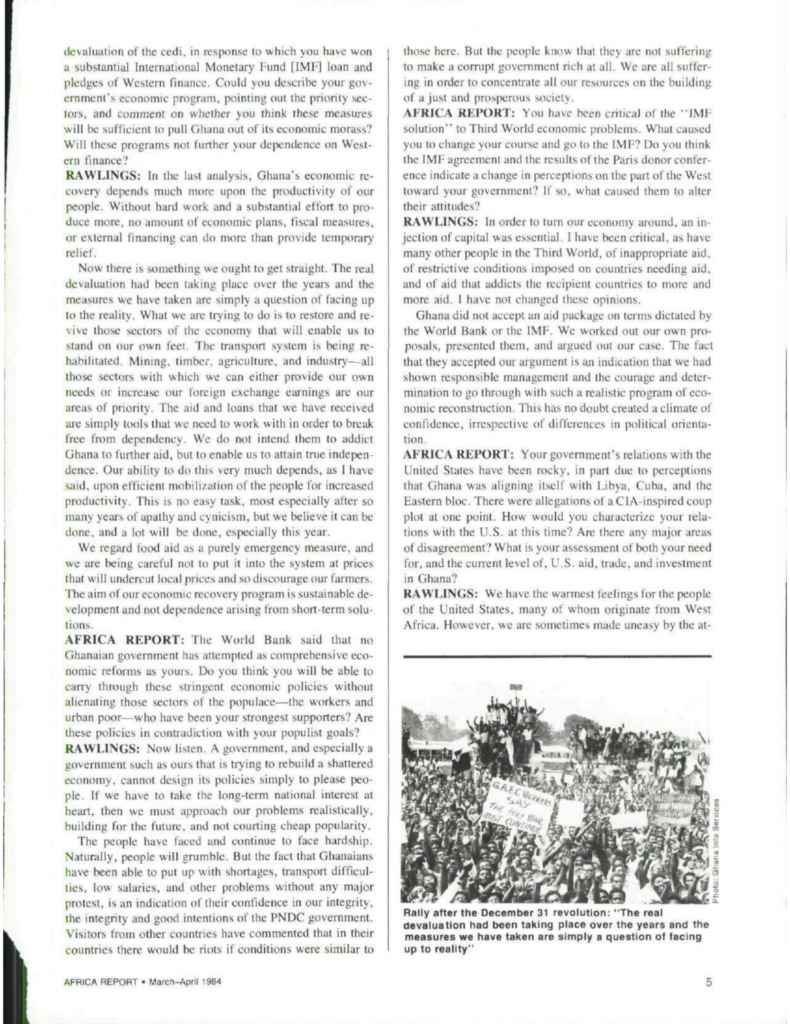
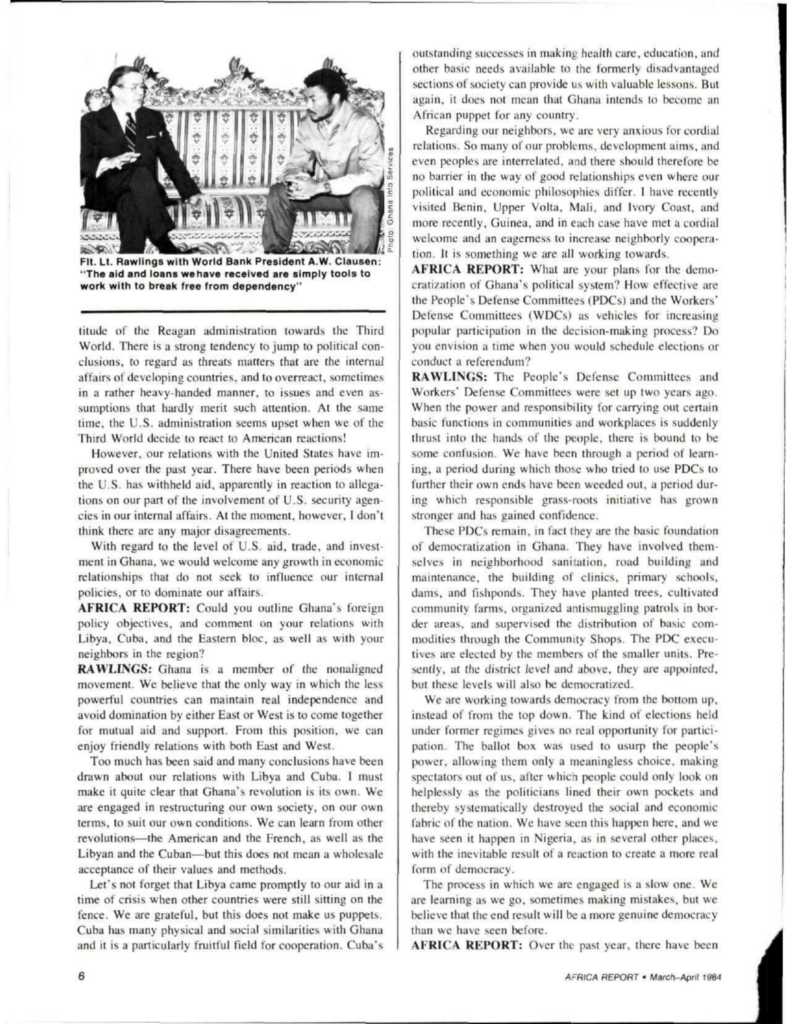
Now there is something we ought to get straight. The real devaluation had been taking place over the years and the measures we have taken are simply a question of facing up to the reality. What we are trying to do is to restore and re- vive those sectors of the economy that will enable us to stand on our own feet. The transport system is being rehabilitated. Mining, timber, agriculture, and industry–all those sectors with which we can either provide our own needs or increase our foreign exchange earnings are our areas of priority. The aid and loans that we have received are simply tools that we need to work with in order to break free from dependency. We do not intend them to addict Ghana to further aid, but to enable us to attain true independence. Our ability to do this very much depends, as I have said, upon efficient mobilization of the people for increased productivity. This is no easy task, most especially after so many years of apathy and cynicism, but we believe it can be done, and a lot will be done, especially this year.
We regard food aid as a purely emergency measure, and we are being careful not to put it into the system at prices that will undercut local prices and so discourage our farmers. The aim of our economic recovery program is sustainable development and not dependence arising from short-term solutions.
AFRICA REPORT: The World Bank said that no Ghanaian government has attempted as comprehensive economic reforms as yours. Do you think you will be able to carry through these stringent economic policies without alienating those sectors of the populace-the workers and urban poor–who have been your strongest supporters? Are these policies in contradiction with your populist goals?
RAWLINGS: Now listen. A government, and especially a government such as ours that is trying to rebuild a shattered. economy, cannot design its policies simply to please people. If we have to take the long-term national interest at heart, then we must approach our problems realistically, building for the future, and not courting cheap popularity.
The people have faced and continue to face hardship. Naturally, people will grumble. But the fact that Ghanaians have been able to put up with shortages, transport difficulties, low salaries, and other problems without any major protest, is an indication of their confidence in our integrity, the integrity and good intentions of the PNDC government. Visitors from other countries have commented that in their countries there would be riots if conditions were similar to those here. But the people know that they are not suffering to make a corrupt government rich at all. We are all suffering in order to concentrate all our resources on the building of a just and prosperous society.
AFRICA REPORT: You have been critical of the IMF solution” to Third World economic problems. What caused you to change your course and go to the IMF? Do you think the IMF agreement and the results of the Paris donor conference indicate a change in perceptions on the part of the West toward your government? If so, what caused them to alter their attitudes?
RAWLINGS: In order to turn our economy around, an injection of capital was essential. I have been critical, as have many other people in the Third World, of inappropriate aid, of restrictive conditions imposed on countries needing aid, and of aid that addicts the recipient countries to more and more aid. I have not changed these opinions.
Ghana did not accept an aid package on terms dictated by the World Bank or the IMF. We worked out our own proposals, presented them, and argued out our case. The fact that they accepted our argument is an indication that we had shown responsible management and the courage and determination to go through with such a realistic program of economic reconstruction. This has no doubt created a climate of confidence, irrespective of differences in political orientation.
AFRICA REPORT: Your government’s relations with the United States have been rocky, in part due to perceptions that Ghana was aligning itself with Libya, Cuba, and the Eastern bloc. There were allegations of a CIA-inspired coup plot at one point. How would you characterize your relations with the U.S. at this time? Are there any major areas of disagreement? What is your assessment of both your need for, and the current level of, U.S. aid, trade, and investment in Ghana?
RAWLINGS: We have the warmest feelings for the people of the United States, many of whom originate from West Africa. However, we are sometimes made uneasy by the attitude of the Reagan administration towards the Third World. There is a strong tendency to jump to political conclusions, to regard as threats matters that are the internal affairs of developing countries, and to overreact, sometimes in a rather heavy-handed manner, to issues and even assumptions that hardly merit such attention. At the same time, the U.S. administration seems upset when we of the Third World decide to react to American reactions!
However, our relations with the United States have improved over the past year. There have been periods when the U.S. has withheld aid, apparently in reaction to allegations on our part of the involvement of U.S. security agencies in our internal affairs. At the moment, however, I don’t
think there are any major disagreements.
With regard to the level of U.S. aid, trade, and investment in Ghana, we would welcome any growth in economic relationships that do not seek to influence our internal policies, or to dominate our affairs.
AFRICA REPORT: Could you outline Ghana’s foreign policy objectives, and comment on your relations with Libya, Cuba, and the Eastern bloc, as well as with your neighbors in the region?
RAWLINGS: Ghana is a member of the nonaligned movement. We believe that the only way in which the less powerful countries can maintain real independence and avoid domination by either East or West is to come together for mutual aid and support. From this position, we can enjoy friendly relations with both East and West.
Too much has been said and many conclusions have been drawn about our relations with Libya and Cuba. I must make it quite clear that Ghana’s revolution is its own. We are engaged in restructuring our own society, on our own terms, to suit our own conditions. We can learn from other revolutions the American and the French, as well as the Libyan and the Cuban–but this does not mean a wholesale acceptance of their values and methods.
Let’s not forget that Libya came promptly to our aid in a time of crisis when other countries were still sitting on the fence. We are grateful, but this does not make us puppets. Cuba has many physical and social similarities with Ghana and it is a particularly fruitful field for cooperation. Cuba’s outstanding successes in making health care, education, and other basic needs available to the formerly disadvantaged sections of society can provide us with valuable lessons. But again, it does not mean that Ghana intends to become an African puppet for any country.
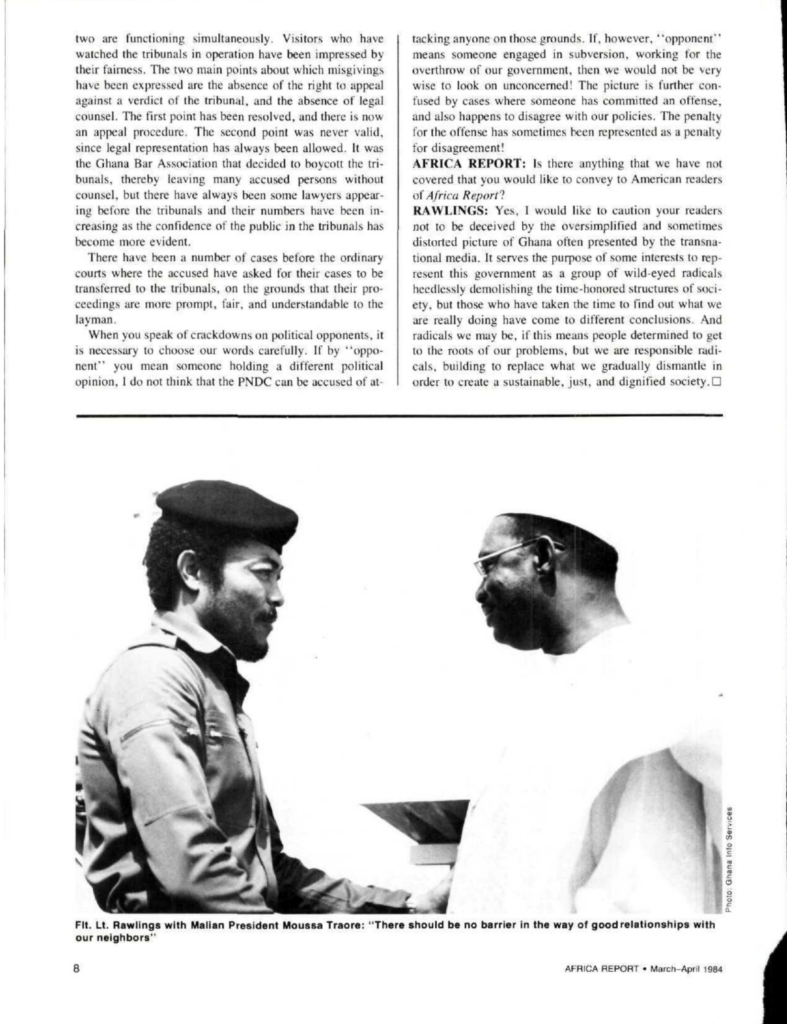
Regarding our neighbors, we are very anxious for cordial relations. So many of our problems, development aims, and even peoples are interrelated, and there should therefore be no barrier in the way of good relationships even where our political and economic philosophies differ. I have recently. visited Benin, Upper Volta, Mali, and Ivory Coast, and more recently, Guinea, and in each case have met a cordial welcome and an eagerness to increase neighborly cooperation. It is something we are all working towards.
AFRICA REPORT: What are your plans for the democratization of Ghana’s political system? How effective are the People’s Defense Committees (PDCs) and the Workers’ Defense Committees (WDCs) as vehicles for increasing popular participation in the decision-making process? Do you envision a time when you would schedule elections or conduct a referendum?
RAWLINGS: The People’s Defense Committees and Workers” Defense Committees were set up two years ago. When the power and responsibility for carrying out certain basic functions in communities and workplaces is suddenly thrust into the hands of the people, there is bound to be some confusion. We have been through a period of learning, a period during which those who tried to use PDCs to further their own ends have been weeded out, a period during which responsible grass-roots initiative has grown stronger and has gained confidence.
These PDCs remain, in fact they are the basic foundation of democratization in Ghana. They have involved themselves in neighborhood sanitation, road building and maintenance, the building of clinics, primary schools, dams, and fishponds. They have planted trees, cultivated
community farms, organized antismuggling patrols in border areas, and supervised the distribution of basic commodities through the Community Shops. The PDC executives are elected by the members of the smaller units. Presently, at the district level and above, they are appointed, but these levels will also be democratized.
We are working towards democracy from the bottom up, instead of from the top down. The kind of elections held under former regimes gives no real opportunity for participation. The ballot box was used to usurp the people’s power, allowing them only a meaningless choice, making
spectators out of us, after which people could only look on helplessly as the politicians lined their own pockets and thereby systematically destroyed the social and economic fabric of the nation. We have seen this happen here, and we have seen it happen in Nigeria, as in several other places, with the inevitable result of a reaction to create a more real form of democracy.
The process in which we are engaged is a slow one. We are learning as we go, sometimes making mistakes, but we believe that the end result will be a more genuine democracy than we have seen before.
AFRICA REPORT: Over the past year, there have been several coup attempts against your government, defections rom the PNDC, demonstrations by students and workers. Do these activities indicate a dwindling of support among those who were initially firmly behind your revolution? To what do you attribute these activities?
RAWLINGS: In order to provide the disadvantaged with a fair share of the nation’s resources, it follows that those who formerly had an unfair share must have less. There is no way around this fact. Anyone who thinks that it is possible to improve the lot of the underprivileged while leaving the privileges of an elite minority untouched is not being realistic. Nor is it realistic to expect the privileged to give up without protest some of the advantages that they have taken for granted. I am not only speaking of material advantages, but of the assumption, for example, that a certain class of people can evade their tax obligations and other social responsibilities with impunity, or that they have some inherent right to make decisions on behalf of their less fortunate compatriots.
In such a situation, some will merely grumble and then adjust themselves to the new system. Others will openly protest. But others will go further and attempt to return to the old system by overthrowing the new. And to do this, they will use other people. They may play upon the grievances or problems of workers or students. They may even form uneasy alliances with radicals who feel that the pace of change is too slow. They will make use of foreign business and political connections. We have experienced all of these combinations here, often orchestrated by self-exiled. Ghanaians who prefer to do their politics at a very safe distance, from your countries.
AFRICA REPORT: Critics charge your government with having waged a class war against the middle and professional classes, of having sanctioned attacks or crackdowns on suspected political opponents, and of having abrogated the independent judiciary via the establishment of public tribunals. How do you respond to these charges?
RAWLINGS: As I said earlier, to help the underprivileged, to attempt to narrow the huge gap between the lifestyle of a privileged few and the disadvantaged majority. must necessarily mean that those with an unfair share may have to lose some. If 10 percent of the people eat half the national cake, and if it is agreed that it is unfair that the other half must feed the remaining 90 percent, we can only give more to the 90 percent by reducing the slice of the 10 percent.
Some people would say, “Then make the cake bigger so that everyone gets more.” This is not completely accept- able. First, it will take time and hard work to increase the size of the cake, and the starving poor cannot be asked to wait. Second, the unjust disproportion still remains. The gap is unchanged. To try and rectify this imbalance is not war. It is social justice.
With regard to the judiciary and the public tribunals, the two are functioning simultaneously. Visitors who have watched the tribunals in operation have been impressed by their fairness. The two main points about which misgivings have been expressed are the absence of the right to appeal against a verdict of the tribunal, and the absence of legal counsel. The first point has been resolved, and there is now an appeal procedure. The second point was never valid, since legal representation has always been allowed. It was the Ghana Bar Association that decided to boycott the tribunals, thereby leaving many accused persons without counsel, but there have always been some lawyers appearing before the tribunals and their numbers have been increasing as the confidence of the public in the tribunals has become more evident.
There have been a number of cases before the ordinary courts where the accused have asked for their cases to be transferred to the tribunals, on the grounds that their proceedings are more prompt, fair, and understandable to the layman.
When you speak of crackdowns on political opponents, it is necessary to choose our words carefully. If by “opponent” you mean someone holding a different political. opinion, I do not think that the PNDC can be accused of attacking anyone on those grounds. If, however, “opponent” means someone engaged in subversion, working for the overthrow of our government, then we would not be very wise to look on unconcerned! The picture is further confused by cases where someone has committed an offense, and also happens to disagree with our policies. The penalty for the offense has sometimes been represented as a penalty for disagreement!
AFRICA REPORT: Is there anything that we have not covered that you would like to convey to American readers. of Africa Report?
RAWLINGS: Yes, I would like to caution your readers not to be deceived by the oversimplified and sometimes distorted picture of Ghana often presented by the transnational media. It serves the purpose of some interests to rep- resent this government as a group of wild-eyed radicals heedlessly demolishing the time-honored structures of society, but those who have taken the time to find out what we are really doing have come to different conclusions. And radicals we may be, if this means people determined to get to the roots of our problems, but we are responsible radicals, building to replace what we gradually dismantle in order to create a sustainable, just, and dignified society
Photo Captions
Photo 1 (Page 4): Flt. Lt. Rawlings exhorting workers at Takoradi: “In the last analysis, Ghana’s economic recovery depends much more on the
productivity of our people”
Photo 2 ( Page 5): Rally after the December 31 revolution: “The real devaluation had been taking place over the years and the measures we have taken are simply a question of facing up to reality”
Photo 3 (Page 6): Flt. Lt. Rawlings with World Bank President A.W. Clausen: “The aid and loans we have received are simply tools to work with to break free from dependency”
Photo 4 (Page 7): PNDC Chairman Jerry Rawlings at opening of Ho rural electrification project: “Our most important achievement–the restoration of hope and confidence even in the face of material hardship’
Photo 5 (Page 8): Flt. Lt. Rawlings with Malian President Moussa Traore: “There should be no barrier in the way of good relationships with our neighbors
Other articles featuring Rawlings
- 1982: Rawlings regime Seems Jittery
- 1979: AFRC
- 1983: We No Go Sit Down
- 1983: IMF and Ghana