White Paper On The Commission Of Inquiry – University Of Science And Technology, Kumasi
July 2, 2026



Transcript
August 22, 1967
WHITE PAPER ON THE COMMISSION OF INQUIRY UNIVERSITY OF SCIENCE AND TECHNOLOGY, KUMASI
INTRODUCTION
By Executive Instrument No. 102 dated 16th April, 1966, a Commission of Inquiry was set up under the Commission of Inquiry Act, 1964 (Act 250) to enquire into student disturbances at the University of Science and Technology which took place between 18th and 20th March, 1966, also to enquire into allegations of malpractices and irregularities in the administration of the University by the then Vice-Chancellor, Dr. R.P. Baffour, and other senior academic and administrative officials; also to ascertain whether there was, and if so, the extent of improper diversion of funds and assets of the University to the use and benefit of any senior official.
- Government is aware of the existence of a conflict of opinion as to the desirability of establishing outside commissions to investigate the affairs of its universities on the ground that this amounts to an interference with the University’s academic freedom and autonomy. Government fully acknowledges that there are spheres in the life and administration of a University wherein it would be neither wise, expedient nor desirable to interfere; the sphere of autonomy must, however, be clearly defined and limited to matters which are clearly academic in character. Even within this limited sphere, particularly in the case of universities which are almost wholly supported by public funds, occasions might arise, which require an inquiry through the appropriate state machinery. In this connection there are historic instances even in countries with long university traditions.
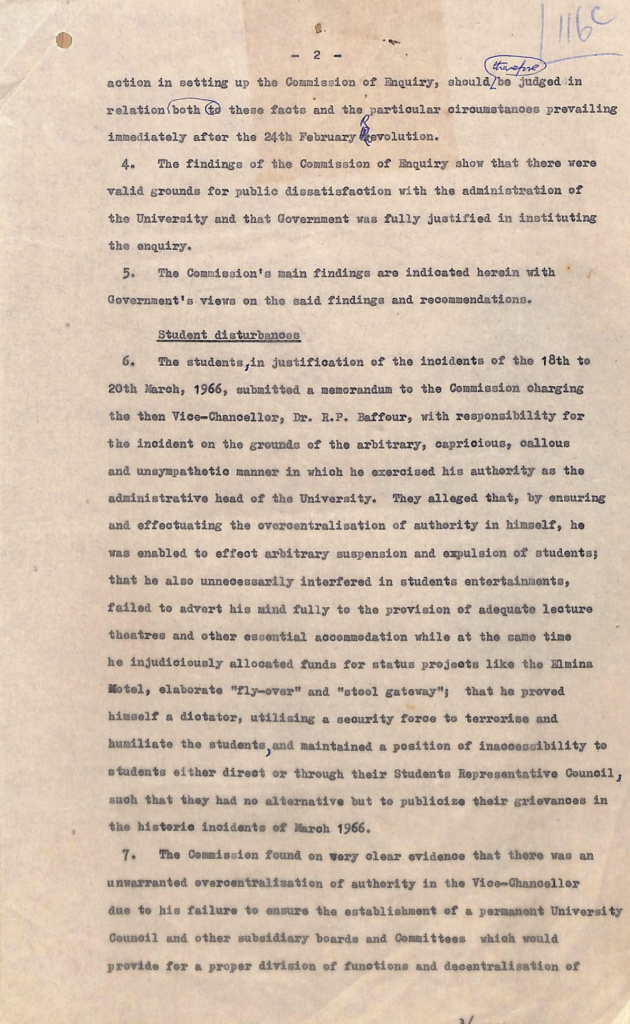
- The case for instituting an enquiry is strongest where allegations of maladministration and malpractices are widely publicised or where discipline has broken down. In such circumstances, a Government has a duty to cause an enquiry to be instituted, Government action in setting up the Commission of Enquiry, should be judged in relation both to these facts and the particular circumstances prevailing immediately after the 24th February evolution.
- The findings of the Commission of Enquiry show that there were valid grounds for public dissatisfaction with the administration of the University and that Government was fully justified in instituting the enquiry.
- The Commission’s main findings are indicated herein with Government’s views on the said findings and recommendations.
Student Disturbances
- The students, in justification of the incidents of the 18th to 20th March, 1966, submitted a memorandum to the Commission charging the then Vice-Chancellor, Dr. R.P. Baffour, with responsibility for the incident on the grounds of the arbitrary, capricious, callous and unsympathetic manner in which he exercised his authority as the administrative head of the University. They alleged that, by ensuring and effectuating the overcentralisation of authority in himself, he was enabled to effect arbitrary suspension and expulsion of students; that he also unnecessarily interfered in students entertainments, failed to advert his mind fully to the provision of adequate lecture theatres and other essential accommodation while at the same time he injudiciously allocated funds for status projects like the Elmina Motel, elaborate “fly-over” and “stool gateway”; that he proved himself a dictator, utilising a security force to terrorise and humiliate the students, and maintained a position of inaccessibility to students either direct or through their Students Representative Council, such that they had no alternative but to publicize their grievances in the historic incidents of March 1966.
- The Commission found on very clear evidence that there was an unwarranted overcentralisation of authority in the Vice-Chancellor due to his failure to ensure the establishment of a permanent University Council and other subsidiary boards and Committees which would provide for a proper division of functions and decentralisation of authority; in particular the Commission found that, despite the existence of a Hall Organisation and a Students’ Representative Council, the Vice-Chancellor neither encouraged nor promoted Hall autonomy; instead he assumed the role of sole administrator and disciplinarian even in respect of trivial breaches of Hall regulations, meting out punishments of suspension and expulsion even without the knowledge of Hall Master and Tutors.
- The Commission found, as instances of the arbitrary and capricious exercise of administrative powers by the Vice-Chancellor;
(a) The wholly unjustified and unwarranted suspension of Mr. E.L. Ansah for one academic year for allegedly writing an offending letter to the Dean of his faculty, which, on subsequent investigation by the Police, was proved not to have been written by him; here it should be noted that the Vice-Chancellor used his unorthodox “occult pendulum” device to “detect” the alleged miscreant.
(b) The expulsion of Mr. C.K. Brooks, an engineering student, from the University by the Vice-Chancellor for returning late from town, contrary to Hall regulations and for allegedly being a bad influence on other students,, he being considered to be anti-C.P.P.; the said Mr. Brooks, on the instruction and complaint of the Vice-Chancellor,was subsequently prosecuted in Court for visiting the University campus to collect books which he could not collect at the time of his expulsion.
(c) The expulsion of Mr. W. C. Amonoo-Coleman, an engineering student, by the Vice-Chancellor for allegedly drawing cartoons of his Hall Master. The Vice-Chancellor again used his unorthodox device of the “occult pendulum” in the detection of the alleged miscreant. The said Mr. Amonoo-Coleman was not given an opportunity of exonerating himself and was sent home under security escort as if he were a criminal. This incident revealed a lack of a sense of proportion and humour on the part of the Vice-Chancellor.
(d) The expulsion of Mr. Ago-Okunor, then a student in the Faculty of Architecture, by the Vice-Chancellor for allegedly writing letters in a magazine edited by him; he was sent down under security escort and a police officer. As a final year student his expulsion on mere suspicion was, in the opinion of the Commission, an irresponsible act on the part of the Vice- Chancellor, which showed utter disregard of the consequences to the said Mr. Ago-Okunor.
(e) The expulsion of Mr. E. C. A. Dove, a second year engineering student by the Vice-Chancellor for being found on a solitary occasion in the women’s Hall of residence during proscribed hours; the fact that Mr. Dove was at the time in an inebriated condition and that he merely intruded and fell asleep in a chair in the room in question merited, in the opinion of the Commission, no more than a severe reprimand.
- The Commission found that grievances of the students which had been made known to the Vice-Chancellor, particularly in respect of the use and subsequent disposal of academic gowns, the isolation of students of the junior college doing preliminary science course from the main student body, the non-representation of students on the swimming pool committee, the absence of organised transport service for students between the campus and Kumasi, remained unredressed; these coupled with the use by the Vice-Chancellor of his security force to terrorise and instil fear in the students, his unwarranted descent to the plebeian level of a dance hall attendant, and the manhandling and exclusion of male students from their end-of-term dance, all created an atmosphere of pent-up tension, frustration, and humiliation in the student body and was the basic cause of the incidents of March 1966.
- Government’s views
Government deplores the attitude of the then Vice-Chancellor, Dr. Baffour, in allowing avoidable situations to develop into demonstrations; in Government’s view this reflected ineptitude in the Vice-Chancellor, and an absence of the qualities necessary for the efficient discharge of duties connected with such a responsible post as chief administrator of a University. Government considers that as a matter of urgency the University Council should consider the active encouragement and promotion of Hall autonomy for regulating the conduct and discipline of students in such Halls and making it unnecessary for the Vice-Chancellor to be involved in matters which are peculiarly matters of Hall discipline, except when the Hall authorities fail to discharge their responsibilities.
Irregularities in University Administration
- The Commission found that during the stewardship of Dr. R.P. Baffour as Vice-Chancellor there were irregularities and malpractices in the administration of the University largely due to his failure to ensure the enactment of statutes for the University establishing procedures for the due administration of the various facets of the University, and as a result
(a) A permanent University Council was not established; even though the Interim University Council was intended to function for only one year it continued for over 5 years, meeting very infrequently; in fact it met only 8 times during the said 5 years though it was enjoined to meet at least 3 times in each academic year.
(b) Though committees of the Interim Council were approved as early as 1962, these were all still-born; in their place certain other committees were established directly responsible to the Vice-Chancellor and never operated as committees of the Academic Board.
(c) There was an undue concentration of functions in the hands of the Vice-Chancellor to the detriment of democratic principles which should be the characteristic of the University. There was also an absence of guide lines determining levels of authority within the various divisions of the University administration.