University Of Ghana Report On The Committee Of Enquiry Into The Disturbances Of 13th January, 1978: Assessment Of Injuries
August 3, 2026

Transcript
University of Ghana
March 23, 1978
CHAPTER THREE
ASSESSMENT OF INJURIES SUSTAINED BY INDIVIDUALS, DAMAGE CAUSED TO PUBLIC PROPERTY AND IDENTIFICATION OF PARTIES RESPONSIBLE
SECTION 1 – PERSONAL INJURIES
Part 1-A General Account
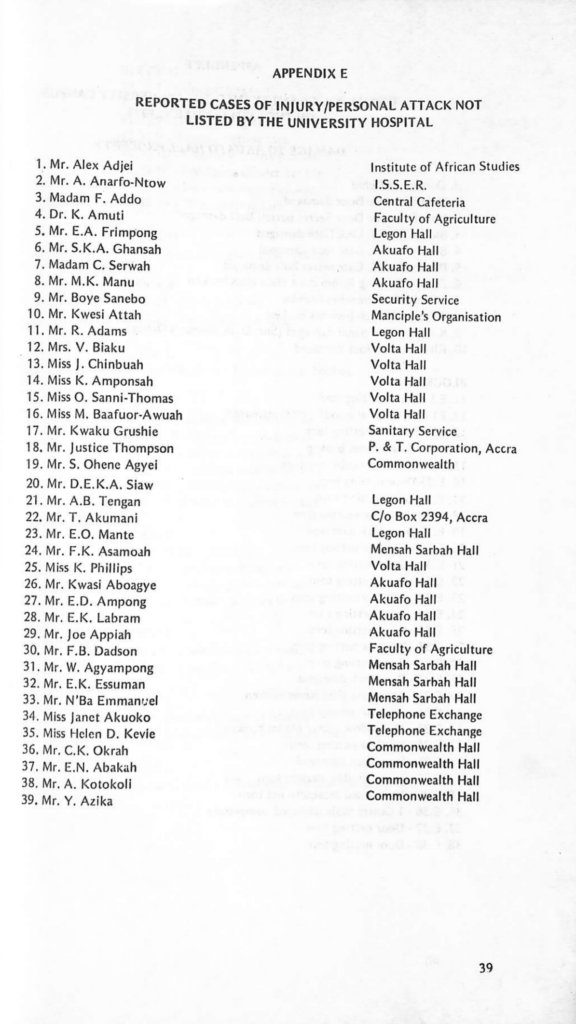
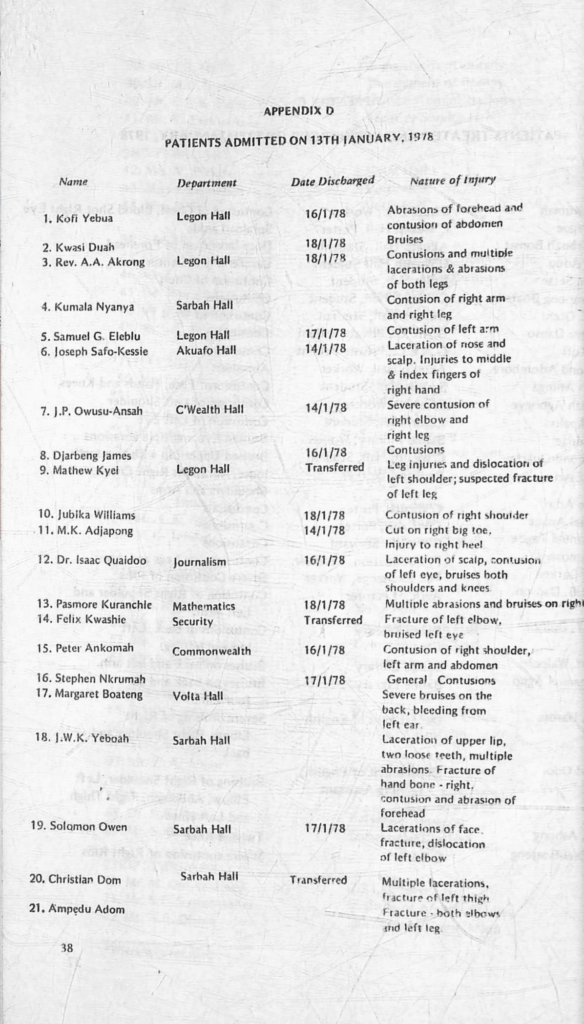
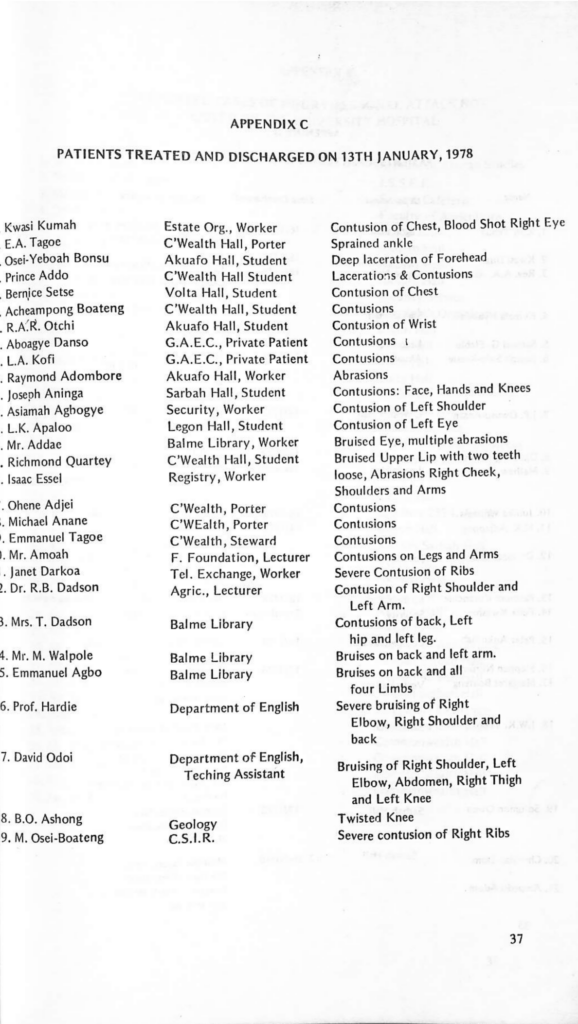
Given the nature of the Police attacks, it should not be surprising that the Committee has been unable to examine all cases of attack and of injury. Many victims who did not belong to the University sought medical treatment in safer places outside the University. A number of students who fled the campus went to private hospitals for treatment, and some residents of the University were given first aid in their houses, or in the houses of friends. Appendix C to this Report is a list of patients treated at the University Hospital and discharged on 13th January. Appendix D lists out the patients admitted at the University Hospital on the same day (i.e. 13th January). In these lists, provided by the University Hospital, the nature of the injuries sustained in each case has been described rather tersely. Furthermore, the returns were limited to cases attended to on 13th January, but it is well known that in view of the situation on the campus on Friday, Saturday and Sunday, and in view also of the pressures on the University Hospital on Friday 13th, several injured persons were unable to go to the University Hospital or to have treatment there until Monday 16th January. In Appendix E we have provided more names of persons who were injured by the Police. Some of these were treated at the University Hospital after the 13th January. Others were treated in other places, including the Police Hospital, and in a few cases the victims did not consult any doctor. According to information received from the Police Hospital by the University Director of Health Services, thirty-nine injured persons were treated and discharged at the out-patients department of the Police Hospital, and a few were admitted in that hospital. Unfortunately, the Committee was unable to obtain a list of cases treated at the Police Hospital, and the details of these cases. The case of a University employee who had not yet recovered full sight in one eye two weeks after he was brutally slapped several times in the face has already been mentioned in Chapter One of this Report (Part II, sub-section G). A female Senior Member of the University who was pummelled in the abdomen several times with a truncheon had premature menstruation five days later. The Committee saw on the chest of a male witness, a ring of raised tissue that had been caused by the impact of the butt of a truncheon. Another witness had a thick lump between two ribs. A non-University victim reported to the Committee in the following terms:-
The doctor noticed some bruises along the upper back at the capules and at the upper thoracic spines and requested that I should take X’ray photographs… the doctor has since examined the X’ray films and he confirmed that there is a slight bend in my upper back as a result of the beatings.
A student who was hit on the head with a truncheon has been suffering from recurring headaches since 13th January. In forcing a lecturer to come out of his car the Police broke the glass of his car, and pieces of the glass cut the lecturer on the corner of his eye. An Eye Specialist at Korle-Bu Hospital has confirmed that although the cut has healed, there would be a permanent scar on the eye.
In her report to the Committee dated 2nd February, 1978 – i.e. fifteen days after the Police invasion – a female telephonist who was beaten up at the Telephone Exchange wrote as follows:-
At the moment I cannot sit for twenty minutes without feeling pains at my back. When I walk I feel very dizzy, severe headache and general weakness. From these examples it will be seen that a number of victims are still suffering from the effects of the attacks.
Part II Parties Responsible
Responsibility for the injuries lies squarely with the Police.
Part III-Assessment of Injuries
In respect of this aspect of our work, the Committee has had to seek professional advice, and the Committee agrees with the opinion of an expert that:-
(a) an assessment of the injuries at this stage will be a premature exercise; and that
(b) there will be need for a thorough examination of each individual case to determine the degree of injury and permanent incapacity.
SECTION 2-DAMAGE CAUSED TO PUBLIC PROPERTY
Part 1-Nature of Damage
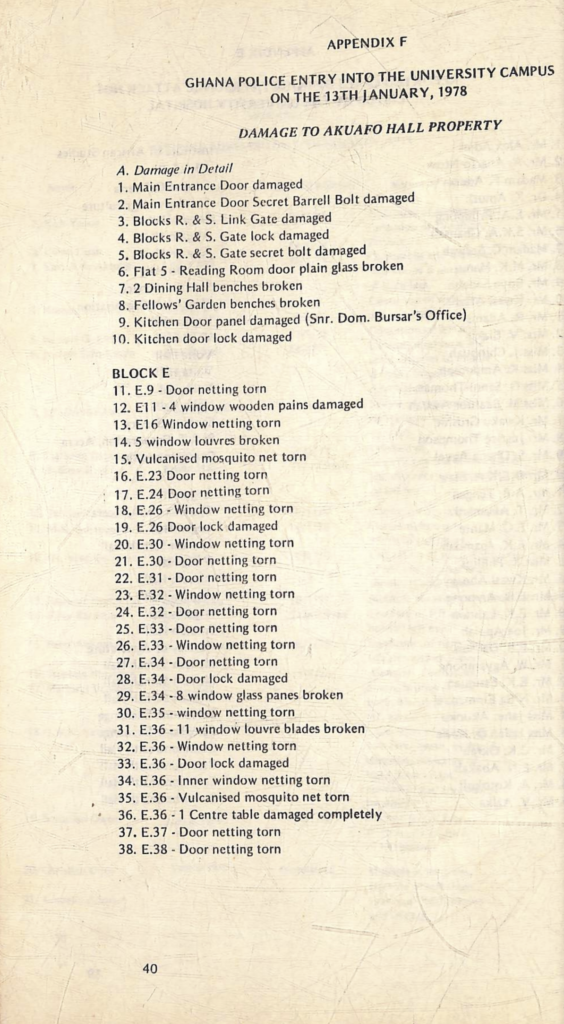
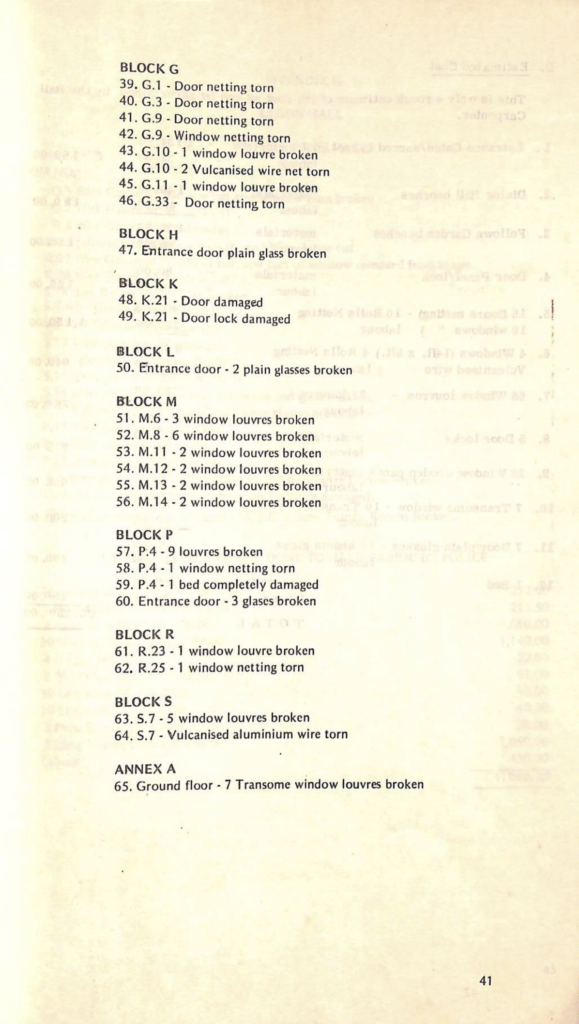
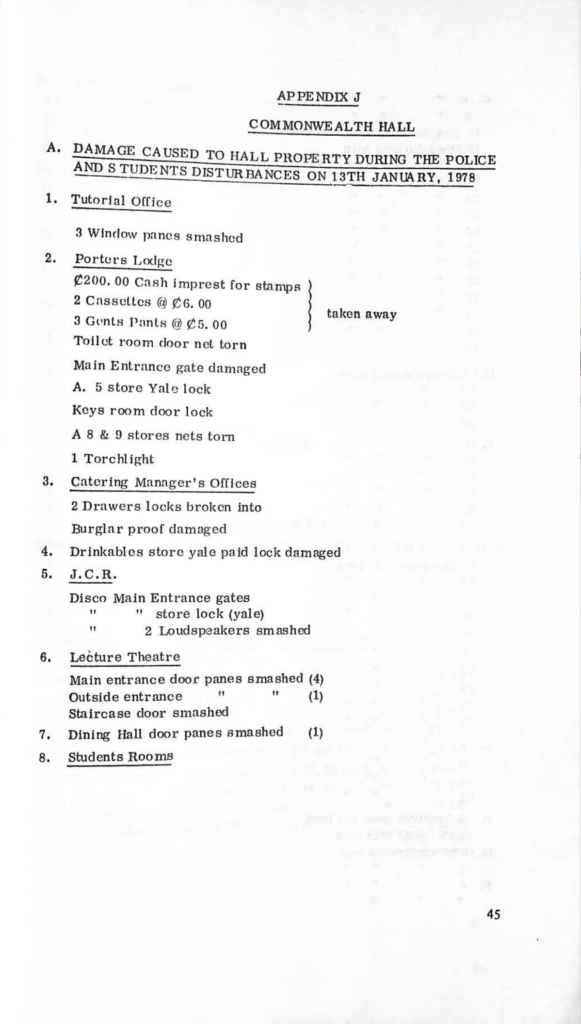
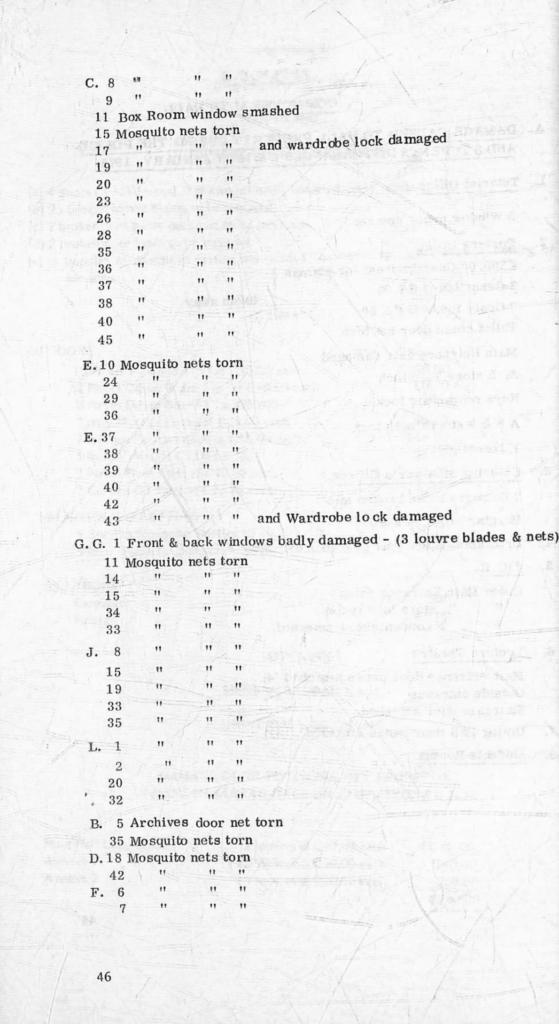
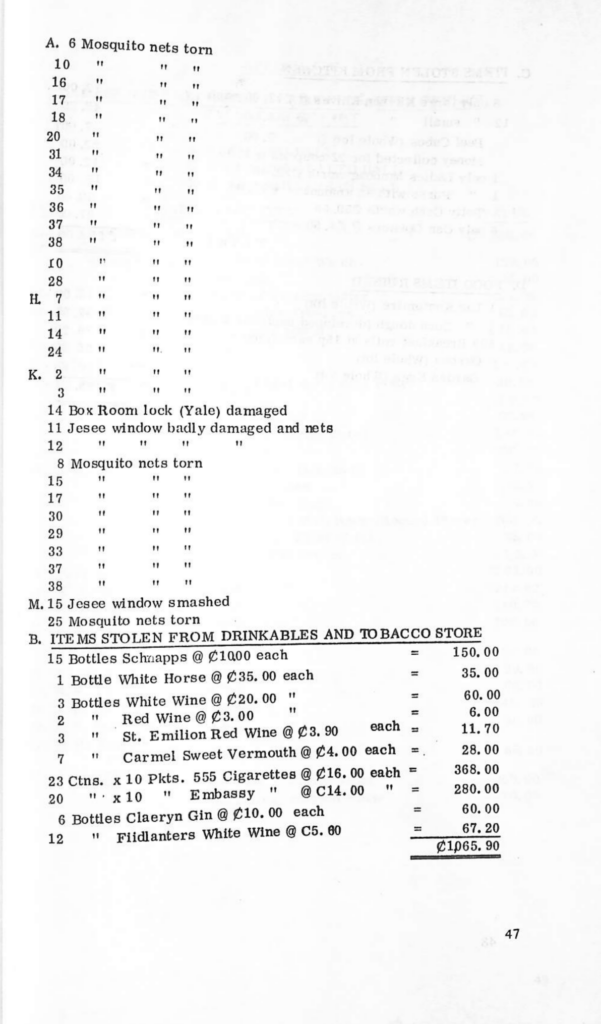
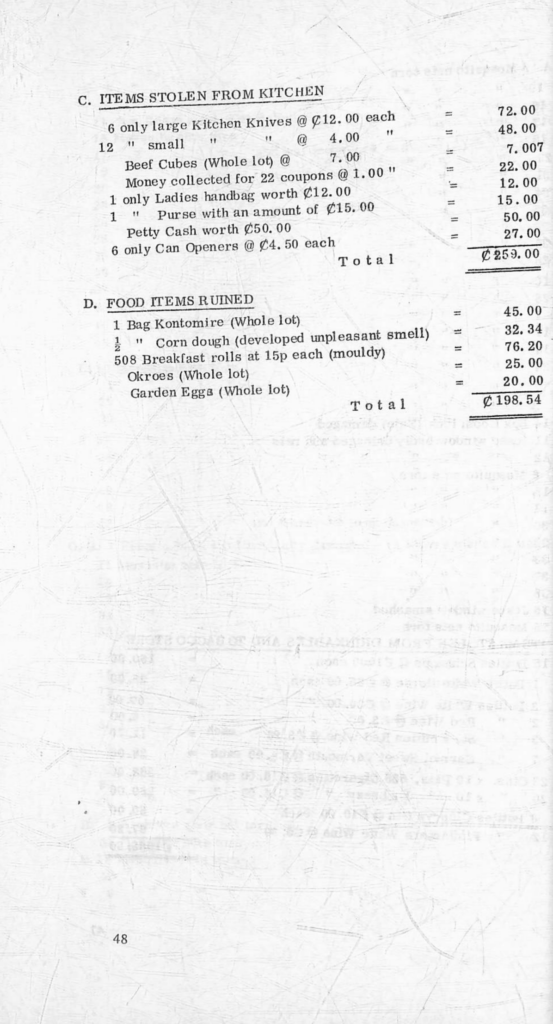
Damage caused to public property was mainly in respect of buildings. There were, however, many cases of looting by the Police. We are using the term ‘damage” to cover items lost or stolen. For convenience we have set out the details of damage caused to public property in appendices as follows:-
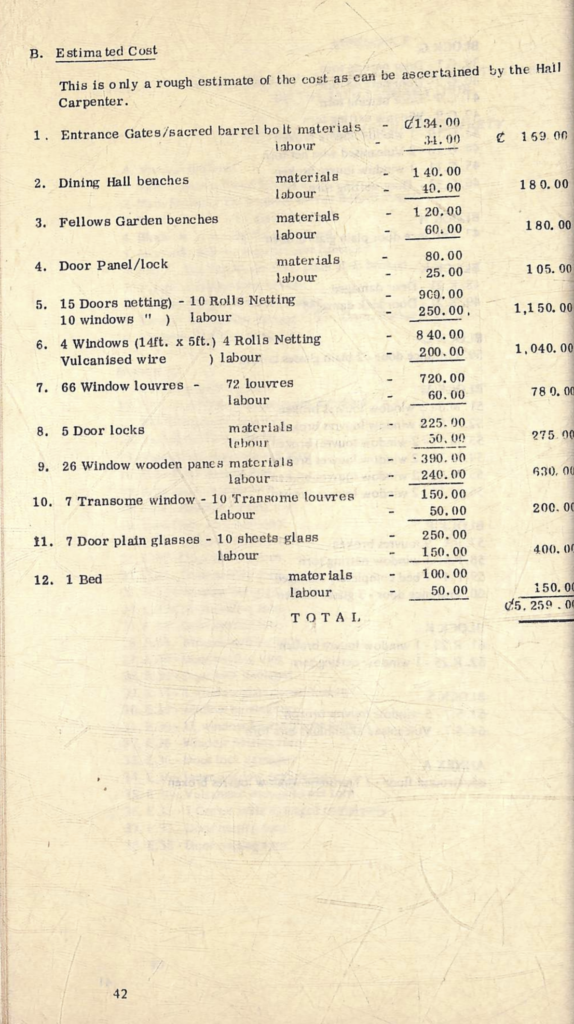
Appendix F — Akuafo Hall
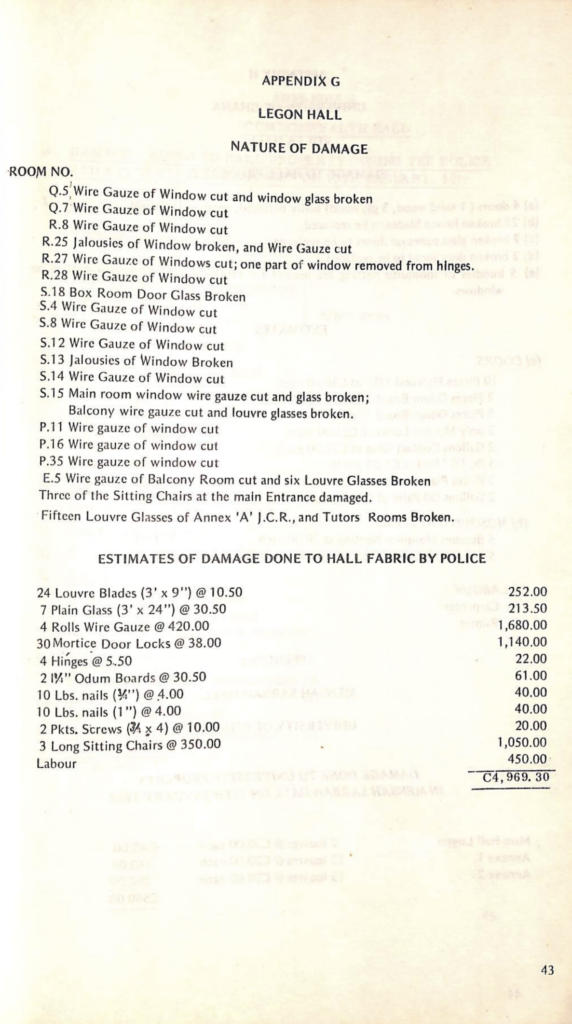
Appendix G — Legon Hall
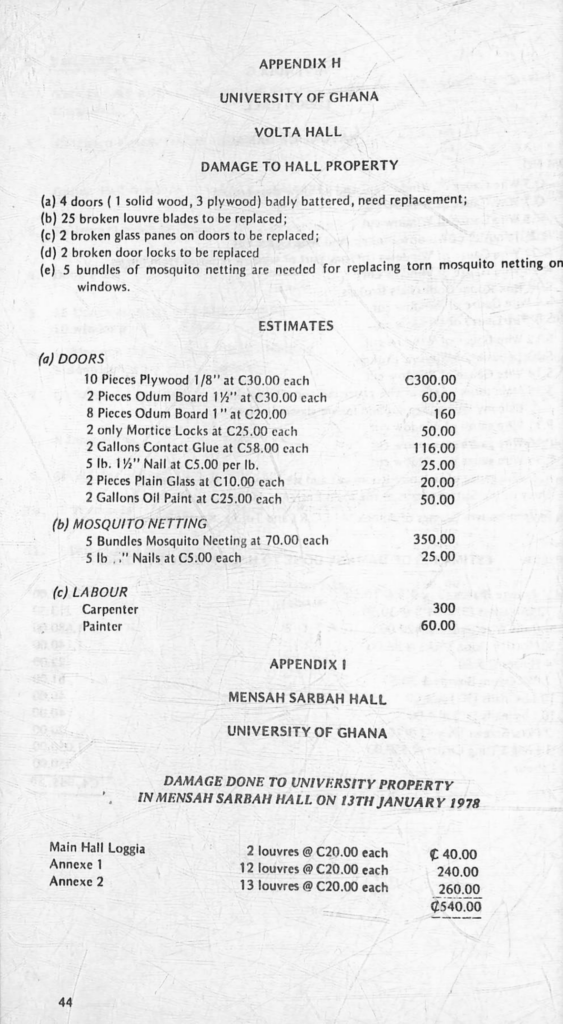
Appendix H — Volta Hall
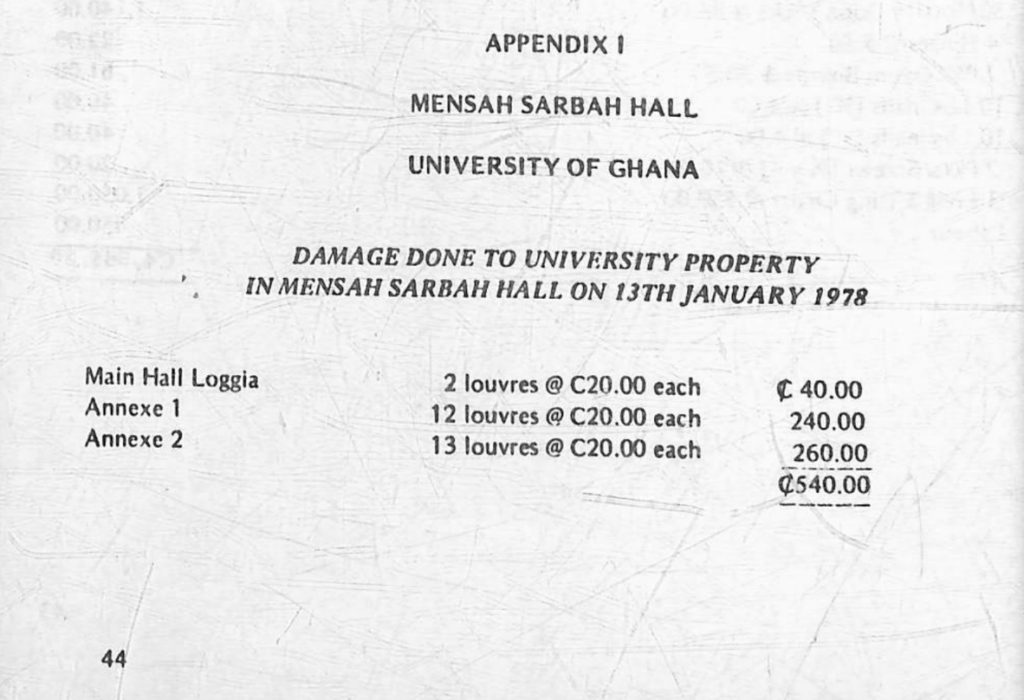
Appendix I — Mensah Sarbah Hall
Appendix J — Commonwealth Hall
The Committee inspected the damage done in all places in order to satisfy itself, and was appalled by the senselessness of much of it.
Part II – Responsibility for the Damage
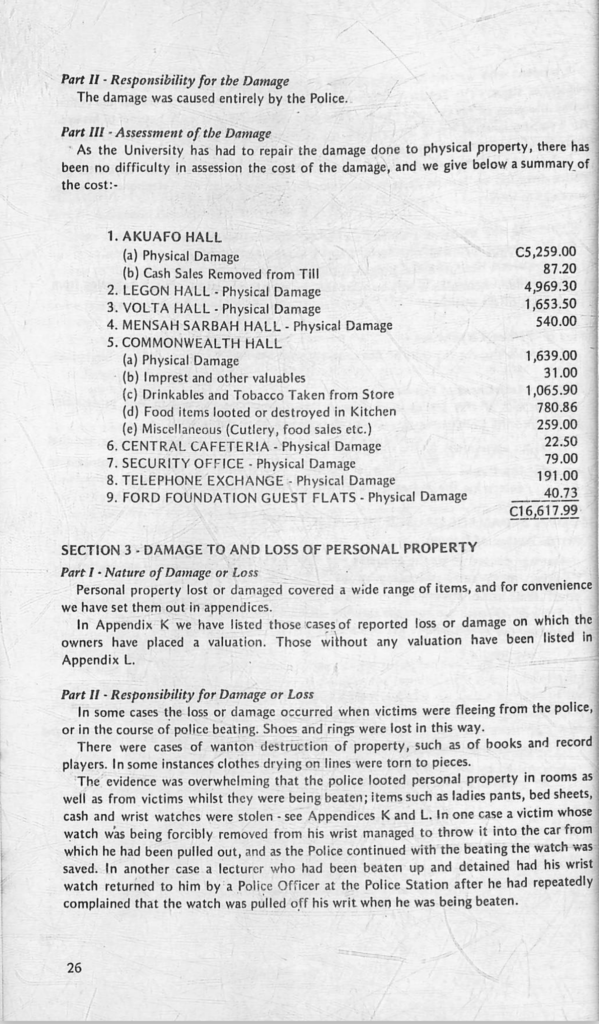
The damage was caused entirely by the Police.
Part III-Assessment of the Damage
As the University has had to repair the damage done to physical property, there has been no difficulty in assession the cost of the damage, and we give below a summary of the cost:-
- AKUAFO HALL
(a) Physical Damage ₵5,259.00
(b) Cash Sales Removed from Till 87.20
- LEGON HALL Physical Damage ₵4,969.30
- VOLTA HALL . Physical Damage ₵1,653.50
- MENSAH SARBAH HALL Physical Damage ₵540.00
- COMMONWEALTH HALL
(a) Physical Damage ₵1,639.00
(b) Imprest and other valuables ₵31.00
(c) Drinkables and Tobacco Taken from Store ₵1,065.90
(d) Food items looted or destroyed in Kitchen ₵780.86
(e) Miscellaneous (Cutlery, food sales etc.) ₵259.00
- CENTRAL CAFETERIA – Physical Damage ₵22.50 7
SECURITY OFFICE Physical Damage ₵79.00
- TELEPHONE EXCHANGE Physical Damage ₵191.00
- FORD FOUNDATION GUEST FLATS – Physical Damage 40.73
= ₵16,617.99
SECTION 3 DAMAGE TO AND LOSS OF PERSONAL PROPERTY
Part 1-Nature of Damage or Loss
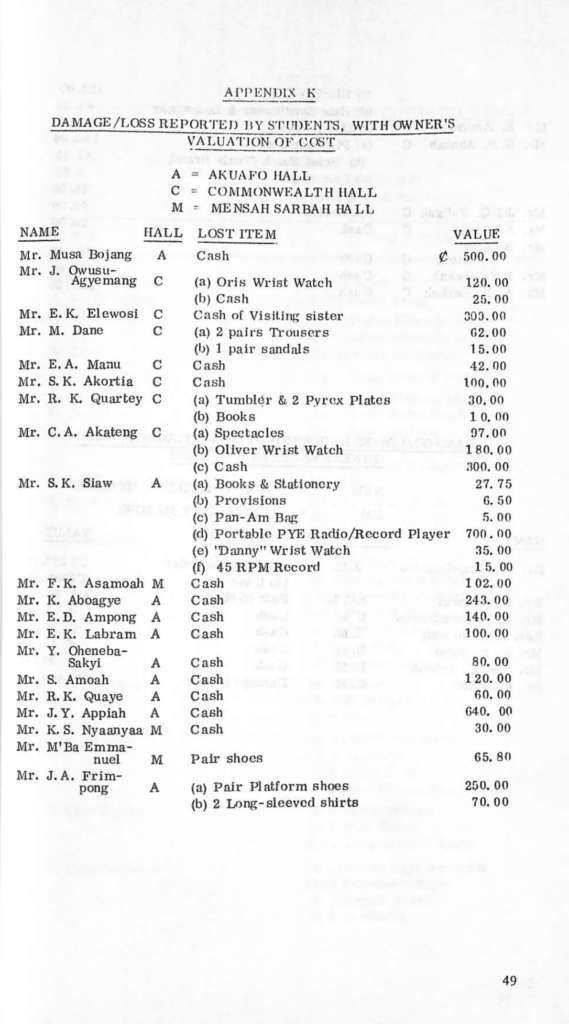
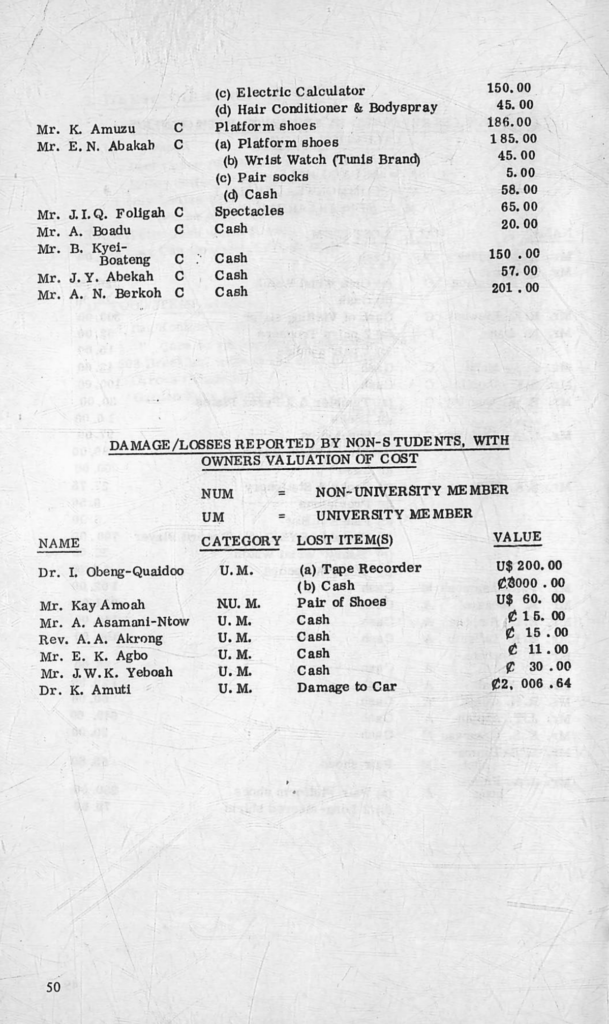
Personal property lost or damaged covered a wide range of items, and for convenience we have set them out in appendices. In Appendix K we have listed those cases of reported loss or damage on which the owners have placed a valuation. Those without any valuation have been listed in Appendix L.
Part II Responsibility for Damage or Loss
In some cases the loss or damage occurred when victims were fleeing from the police, or in the course of police beating. Shoes and rings were lost in this way. There were cases of wanton destruction of property, such as of books and record players. In some instances clothes drying on lines were torn to pieces. The evidence was overwhelming that the police looted personal property in rooms as well as from victims whilst they were being beaten; items such as ladies pants, bed sheets, cash and wrist watches were stolen – see Appendices K and L. In one case a victim whose watch was being forcibly removed from his wrist managed to throw it into the car from which he had been pulled out, and as the Police continued with the beating the watch was saved. In another case a lecturer who had been beaten up and detained had his wrist watch returned to him by a Police Officer at the Police Station after he had repeatedly complained that the watch was pulled off his wrist when he was being beaten. Much damage was done to cars by the police. In forcing people out of their cars with their truncheons, denting the cars in many parts. In one instance the back and side windows were shattered.
Part III – Assessment of Damage or Loss
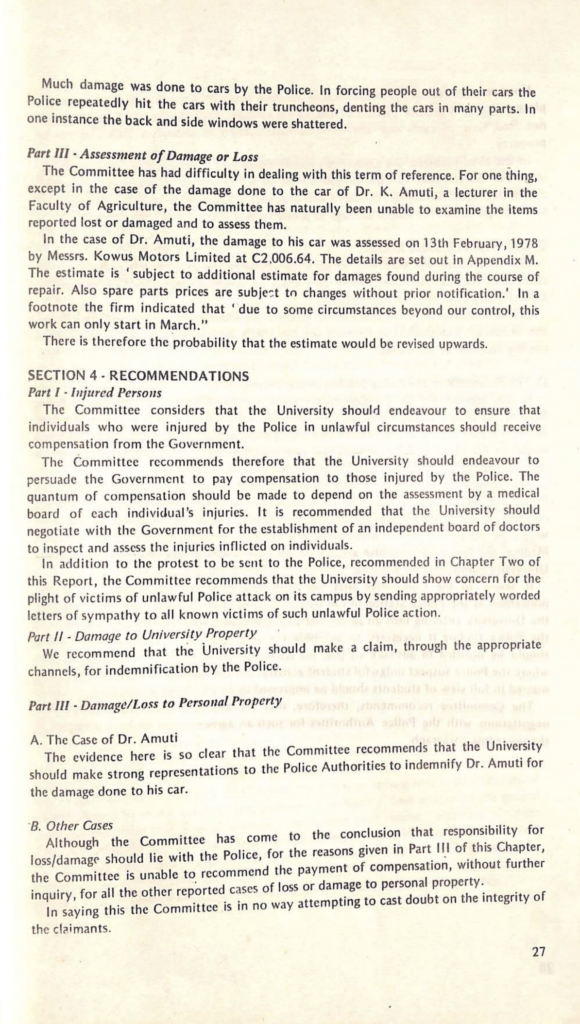
The Committee has had difficulty in dealing with this term of reference. For one thing, except in the case of the damage done to the car of Dr. K. Amuti, a lecturer in the Faculty of Agriculture, the Committee has naturally been unable to examine the items reported lost or damaged and to assess them.
In the case of Dr. Amuti, the damage to his car was assessed on 13th February, 1978 by The Messrs. Kowus Motors Limited estimate at ₵2,006.64. The details are set out in the Appendix M. The estimate is subject to additional estimate for damages found during the course of the repair. Also spare parts prices are subject to changes without prior notification.’ In a footnote the firm indicated that due to some circumstances beyond our control, this work can only start in March.”
There is therefore the probability that the estimate would be revised upwards.
SECTION 4 – RECOMMENDATIONS
Part I – Injured Persons
The Committee considers that the University should endeavour to ensure that individuals who were injured by the Police in unlawful circumstances should receive compensation from the Government. The Committee recommends therefore that the University should endeavour to persuade the Government to pay compensation to those injured by the Police. The quantum of compensation should be made to depend on the assessment by a medical board of each individual’s injuries. It is recommended that the University should negotiate with the Government for the establishment of an independent board of doctors to inspect and assess the injuries inflicted on individuals. In addition to the protest to be sent to the Police, recommended in Chapter Two of this Report, the Committee recommends that the University should show concern for the plight of victims of unlawful Police attack on its campus by sending appropriately worded letters of sympathy to all known victims of such unlawful Police action. Part We II-Damage recommend to University that the University Property should make a claim, through the appropriate channels, for indemnification by the Police.
Part III-Damage/Loss to Personal Property
A. The Case of Dr. Amuti
The evidence here is so clear that the Committee recommends that the University should make strong representations to the Police Authorities to indemnify Dr. Amuti for the damage done to his car
B. Other Cases
Although the Committee has come to the conclusion that responsibility for Toss/damage should lie with the Police, for the reasons given in Part III of this Chapter, the Committee is unable to recommend the payment of compensation, without further inquiry, for all the other reported cases of loss or damage to personal property.
In saying this the Committee is in no way attempting to cast doubt on the integrity of the claimants.
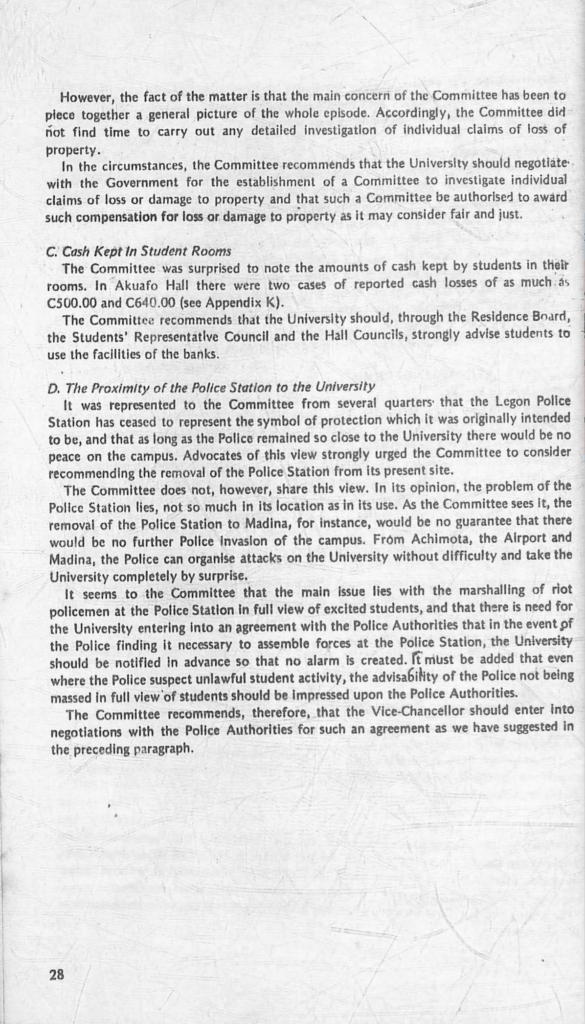
However, the fact of the matter is that the main concern of the Committee has been to piece together a general picture of the whole episode. Accordingly, the Committee did not find time to carry out any detailed investigation of individual claims of loss of property. In the circumstances, the Committee recommends that the University should negotiate with the Government for the establishment of a Committee to investigate individual claims of loss or damage to property and that such a Committee be authorised to award such compensation for loss or damage to property as it may consider fair and just.
C. Cash Kept In Student Rooms
The Committee was surprised to note the amounts of cash kept by students in their rooms. In Akuafo Hall there were two cases of reported cash losses of as much as C500.00 and C640.00 (see Appendix K). The Committee recommends that the University should, through the Residence Board, the Students’ Representative Council and the Hall Councils, strongly advise students to use the facilities of the banks.
D. The Proximity of the Police Station to the University
It was represented to the Committee from several quarters that the Legon Police Station has ceased to represent the symbol of protection which it was originally intended to be, and that as long as the Police remained so close to the University there would be no peace on the campus. Advocates of this view strongly urged the Committee to consider recommending the removal of the Police Station from its present site. The Committee does not, however, share this view. In its opinion, the problem of the Police Station lies, not so much in its location as in its use. As the Committee sees it, the removal of the Police Station to Madina, for instance, would be no guarantee that there would be no further Police invasion of the campus. From Achimota, the Airport and Madina, the Police can organise attacks on the University without difficulty and take the University completely by surprise. It seems to the Committee that the main issue lies with the marshalling of riot policemen at the Police Station in full view of excited students, and that there is need for the University entering into an agreement with the Police Authorities that in the event of the Police finding it necessary to assemble forces at the Police Station, the University should be notified in advance so that no alarm is created. It must be added that even where the Police suspect unlawful student activity, the advisability of the Police not being massed in full view of students should be impressed upon the Police Authorities. The Committee recommends, therefore, that the Vice-Chancellor should enter into negotiations with the Police Authorities for such an agreement as we have suggested in the preceding paragraph.
Read previous chapters below