The Transitional Provisions Of The The 1979 Constitution – To Be Or Not To Be
August 4, 2026
Transcript
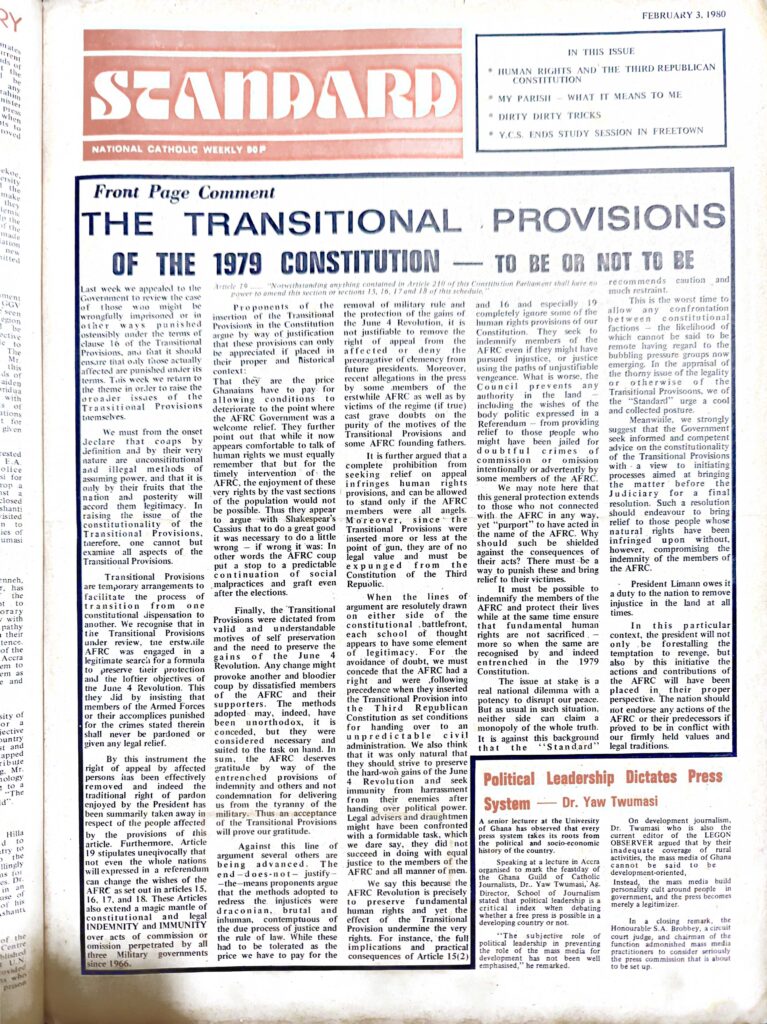
Standard
February 3, 1980
Last week we appealed to the Government to review the case of those who might be wrongfully imprisoned or in other ways punished ostensibly under the terms of clause 16 of the Transitional Provisions, and that it should ensure that only those actually affected are punished under its terms. This week we return to the theme in order to raise the broader issues of the Transitional Provisions themselves.
We must from the onset declare that coups by nature are unconstitutional and illegal methods of assuming power, and that it is only by their fruits that the nation and posterity will accord them legitimacy. In raising the issue of the constitutionality of the Transitional Provisions, therefore, one cannot but examine all aspects of the Transitional Provisions.
Transitional Provisions are temporary arrangements to facilitate the process of transition from one constitutional dispensation to another. We recognise in the Transitional Provisions under review, on the erstwhile AFRC was engaged in legitimate search for a formula to preserve their protection and the loftier objectives of the June 4 Revolution. This they did by insisting that members of the Armed Forces or their accomplices punished for the crimes stated therein shall never be pardoned or given any legal relief.
By this instrument the right of appeal by affected persons has been effectively removed and indeed the traditional right of pardon enjoyed by the President has been summarily taken away in respect of the people affected by the provisions of this article. Furthermore, Article 19 stipulates unequivocally that not even the whole nation’s will expressed in a referendum can change the wishes of the AFRC as set out in articles 15. 16, 17, and 18. These Articles also extend a magic mantle of constitutional and legal INDEMNITY and IMMUNITY over acts of commission or omission perpetrated by all three Military governments since 1966.
Proponents of the insertion of the Transitional Provisions in the Constitution argue by way of justification that these provisions can only be appreciated if placed in their proper and historical context:
That they are the price Ghanaians have to pay for allowing conditions to deteriorate to the point where the AFRC Government was a welcome relief. They further point out that while it now appears comfortable to talk of human rights we must equally remember that but for the timely intervention of the AFRC, the enjoyment of these very rights by the vast sections of the population would not be possible. Thus to argue with Shakespear’s Cassius that to do a great good it was necessary to do a little wrong if wrong it was: In other words the AFRC coup put a stop to a predictable continuation of social malpractices and graft even after the elections.
Finally, the Transitional Provisions were dictated from valid and understandable motives of self preservation and the need to preserve the gains of the June 4 Revolution. Any change might provoke another and bloodier coup by dissatisfied members of the AFRC and their supporters. The methods adopted indeed, have been unorthodox, it is conceded, but they were considered necessary and suited to the task on hand. In sum. the AFRC deserves gratitude by way of the entrenched provisions of indemnity and others and not condemnation for delivering us from the tyranny of the military. Thus an acceptance of the Transitional Provisions will prove our gratitude.
Against this line of argument several others are being advanced. The end-does-not-justify -the-means proponents argue that the methods adopted to redress the injustices were draconian, brutal and inhuman, contemptuous of the due process of justice and the rule of law. While these had to be tolerated as the price we have to pay for the removal of military rule and the protection of the gains of the June 4 Revolution, it is not justifiable to remove the right of appeal from the affected or deny the prerogative of clemency from future presidents. Moreover, recent allegations in the press by some members of the erstwhile AFRC as well as by victims of the regime (if true) cast grave doubts on the purity of the motives of the Transitional Provisions and some AFRC founding fathers.
It is further argued that a complete prohibition from seeking relief on appeal infringes human rights provisions, and can be allowed to stand only if the AFRC members were all angels. Moreover, since the Transitional Provisions were inserted more or less at the point of gun, they are of no legal value and must be expunged from the Constitution of the Third Republic.
When the lines of argument are resolutely drawn either side of the constitutional battlefront, each school of thought appears to have some element of legitimacy. For the avoidance of doubt, we must concede that the AFRC had a right and were following precedence when they inserted the Transitional Provision into the Third Republican Constitution as set conditions for handing over to an unpredictable civil administration. We also think that it was only natural that they should strive to preserve the hard-won gains of the June 4 Revolution and seek immunity from harassment from their enemies after handing over political power. Legal advisers and draughtmen might have been confronted with a formidable task, which we dare say, they did not succeed in doing with equal justice to the members of the AFRC and all manner of men.
We say this because the AFRC Revolution is precisely to preserve fundamental human rights and yet the effect of the Transitional Provision undermines the very rights. For instance, the full implications and practical consequences of Article 15(2) and 16 and especially 19 completely ignore some of the human rights provisions of our Constitution. They seek to indemnify members of the AFRC even if they might have pursued injustice, or justice using the paths of unjustifiable vengeance. What is worse, the Council prevents any authority in the land including the wishes of the body politic expressed in a Referendum from providing relief to those people who might have been jailed for doubtful crimes of commission or omission some intentionally or advertently by some members of the AFRC.
We may note here that this general protection extends to those who are not connected with the AFRC in any way, yet “purport” to have acted in the name of the AFRC. Why should such be shielded against the consequences of their acts? There must be a way to punish these and bring relief to their victims.
It must be possible to indemnify the members of the AFRC and protect their lives while at the same time ensure that fundamental human rights are not sacrificed more so when the same are recognised by and indeed entrenched in the 1979 Constitution.
The issue at stake is a real national dilemma with a potency to disrupt our peace. But as usual in such a situation, neither side can claim a monopoly of the whole truth. It is against this background that the “Standard” recommends caution and much restraint.
This is the worst time to allow any confrontation between constitutional factions the likelihood of which cannot be said to be remote having regard to the bubbling pressure groups now emerging. In the appraisal of the thorny issue of the legality or otherwise of the Transitional Provisions, we of the “Standard” urge a cool and collected posture.
Meanwhile, we strongly suggest that the Government advice for the constitutionality of the Transitional Provisions with a view to initiating processes aimed at bringing the matter before the Judiciary for a final resolution. Such resolution should endeavour to bring relief to those people whose natural rights have been infringed upon without, however, compromising the indemnity members of the AFRC.
President Limann owes it a duty to the nation to remove injustice in the land at all times.
In this particular context, the president will not only be forestalling the temptation to revenge, but also by this initiative the actions and contributions of the AFRC will have been placed in their proper perspective. The nation should not endorse any actions of the AFRC or their predecessors if proved to be in conflict with our firmly held values and legal traditions.