The Return To Constitutional Rule – Statement By Ghana Association Of University Teachers (GAUT), Legon, 1 July 1977
July 7, 2026

Transcript
July 1, 1977
Early in the morning of 1st July, 1977, the Chairman of the SMC in a broadcast outlined what the G.” .C. has described as steps towards the re-
turn to constitutional government in the country. No doubt this is a reaction to the pressure put on the government since the 13th May demonstrations by the University students calling upon the government to resign. Almost all professional bodies have participated in the demand for return. to constitutional civilian rule, and the general mass of the people is rest- less and seething with anger.
The implications of these stops are noteworthy. Among them are:
First, the SMC government is going to preside over the process of return to civilian or constitutional rule.
Second, there is no time limit to the whole process.
Third, the terms membership and necessity of the Union Government Committee are to remain unquestioned.
We reject without hesitation these implications and, hence, the steps. set out by the Chairman.
This government has never displayed any enthusiasm for return to civilian rule and amply demonstrated
(i) its contempt for constitutional rule as shown among others, by:
(a) the unexplained series of arbitrary dismissals of high public servants;
(b) the attempt to destroy academic freedom by dismissal of University Professors and closure of the Universities
without reference to the properly constituted university authorities;
(c) the arbitrary use of military tribunals; and
(d) the persistent attempt to impose “Union Government” on the people of Ghana, a bare faced attempt at continued military rule.
(ii) its egregious ineptitude at solving the country’s problems, as witnessed, among others by:
(a) the continued and dangerous shortage of not only imported items of consumption but also of local foodstuffs and
drugs;
(b) the unprecedentedly high rate of inflation in the country;
(c) the re-iterated falsehood that the shortages and inflation are due solely to foreign exchange constraints and world-wide inflation or to drought.
how doos the Government’s own underestimated rate of inflation of 67% compare with Britain’s “dizzy rate” of 17.5%? (See The Guardian, June 19, p.3.) And what has happened to the enormous sums of foreign exchange being paid. for our cocoa which is currently selling at more than £3,300 a ton and has sold for more than £900 per ton for the last three years?
(d) the frivolous use of the country’s foreign exchange for the acquisition of planes and armoured vehicles even for the police, expensive and luxurious cars such as Mercedes and BMW for its members and Audi cars at outrageous
price;
(e) the uncontrolled creation of money; the maintenance of the Cedi at a wildly over-valued rate; the unmitigated failure of the government’s agricultural policy, such as it is;
(iii) its cynical duplicity in manipulating public opinion and the system of government, as amply revealed in;
(a) its encouragement of political activities like rallies, demonstrations, press conferences and telegrams which support it whilst denying the same
opportunities to others under the guise of a ban on political activities;
(b) its killing of independent newspapers, suppression of dissenting
views in the state-owned radio and press run with public funds, their publication of outrageous editorials and now the “Prohibition of Rumours
Decree”.
(c) brutality against striking workers and students by the police and Army;
(d) the use of agents provocateurs among students, particularly on the Legon campus
(e) the use of torture against political prisoners;
(f) the detention without of innocent citizens; and
finally,
(iv) its incapacity to govern, as evidenced by:
(a) its evident inability to control corruption in the government machinery itself especially in connexion with the granting of import licences, etc.
and hence, in the rest of the country;
(b) its blaming scape goats, such middlemen for almost all its economic
failures;
(c) its inability to impose a simple ban on exportation of food in a situation of near-famine at the same time it is unable to discipline workers
who refuse to load such exports;
(d) its resort to ad hoc and ever-changing solutions to problems such as the immediate “Operation This” and “Operation That” without any effective over-all policy: evidence of a poor military mind that is fed on tactics without strategy;
(e) its attempt to substitute prayers for intelligent policies and to make repentance follow redemption;
(f) its generally erratic leadership. It goes without saying that we cannot have any trust whatsoever in this
government’s good intentions. We regard it as certain that, given the chance, it will only manipulate the process of restoration of constitutional rule to its own inimical ends. What else can we expect of a government that is already firmly committed to “Union Government?” What doubt can there be of the results of a referendum to decide between specific proposals for a “Union Government” on one hand and, on the other hand, a vague “any other” form of government?
Who is to guard the guardians?
Our fundamental distrust of the government, which we believe is widely shared in the country, is strengthened by the absence of a clear time
limit to the process of the so-called restoration of constitutional rule. We hold the view that the retention of the Ad-Hoc Committee on Union
Government is incompatible with any serious attempt to establish a constitution that is adequate to the wishes and problems of the country
terms of reference grossly prejudge the issues at stake and its membership does not enjoy the respect and confidence of the public. Nor is the
committee necessary at all.
We regard the broadcast of 1st July, 1977, as merely an attempt, as cynical as ever, to regain the initiative for this regime to have a mew lease of life. We shall not be taken in by it.
We endorse the steps set out in the “Resolution Adopted by the National Executive of the Association of Recognised Professional Bodies” on Thursday, 23rd June, 1977 namely;
WE, THE MEMBERS OF THE NATIONAL EXECUTIVE OF THE ASSOCIATION OF RECOGNISED PROFESSIONAL BODIES:
- Do here RESOLVE to condemn unreservedly all the actions of the Government stated above and call upon the Government to
resign IMMEDIATELY and to hand over to a PRESIDENTIAL COMMISSION comprising the Chief Justice as Chairman, a representative of the National House of Chiefs and a representative of the Christian Council of Ghana. - We further resolve that the Presidential Commission should be Assisted by a National Advisory Council comprising:-
(a) The Speaker of the last National Assembly
(b) A representative of the National House of Chiefs
(c) A representative of the National Catholic Secretariat.
(d) A representative of the National Council for Women and Development.
(e) A representative of the Trades Union Congress.
(f) A representative of three Universities
(g) A representative of the Ghana Chamber of Commerce.
(h) A representative of the Armed Forces
(1) A representative of the Police and
(j) A representative of the Association of Recognised Professional Bodies.
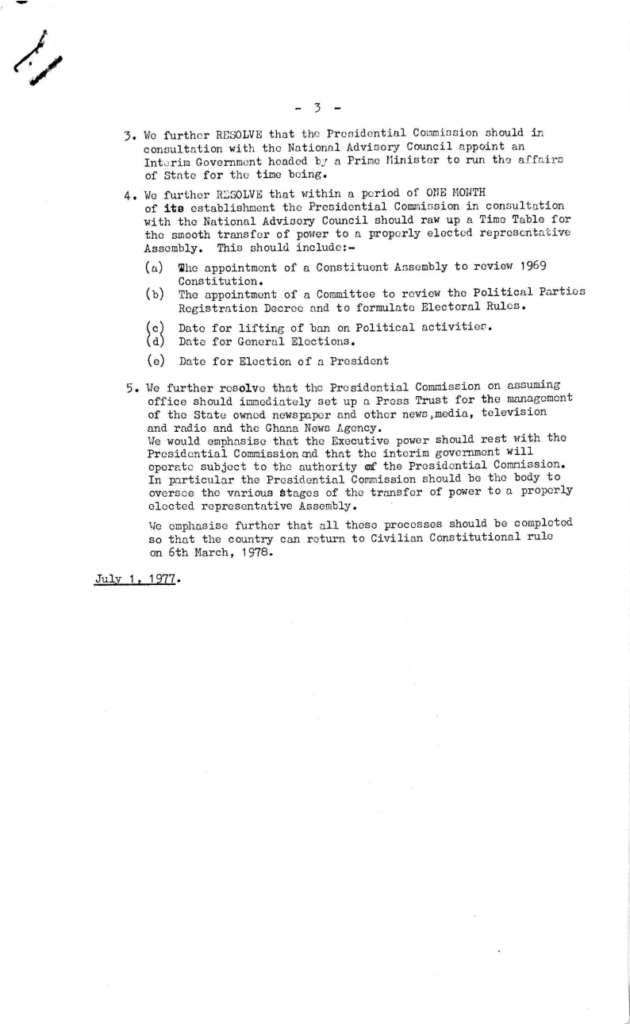
3. We further RESOLVE that the Presidential Commission should in consultation with the National Advisory Council appoint an Interim Government headed by a Prime Minister to run the affairs of State for the time being.
4. We further RESOLVE that within a period of ONE MONTH of its establishment the Presidential Commission in consultation with the National Advisory Council should raw up a Time Table for the smooth transfer of power to a properly elected representative Assembly. This should include:
(a) The appointment of a Constituent Assembly to review 1969
Constitution.
(b) The appointment of a Committee to review the Political Parties Registration Decree and to formulate Electoral Rules.
(c) Date for lifting of ban on Political activities.
(d) Date for General Elections.
(e) Date for Election of a President
5. We further resolve that the Presidential Commission on assuming office should immediately set up a Press Trust for the management
of the State owned newspaper and other news, media, television and radio and the Ghana News Agency. We would emphasise that the Executive power should rest with the Presidential Commission and that the interim government will operate subject to the authority of the Presidential Commission. In particular the Presidential Commission should be the body to oversee the various stages of the transfer of power to a properly
elected representative Assembly.
We emphasise further that all these processes should be completed so that the country can return to Civilian Constitutional rule on 6th March, 1978.
July 1, 1977.