The Catholic Church, The “Standard”, And National Issues
July 24, 2026
Transcript
The Standard
March 19, 1978
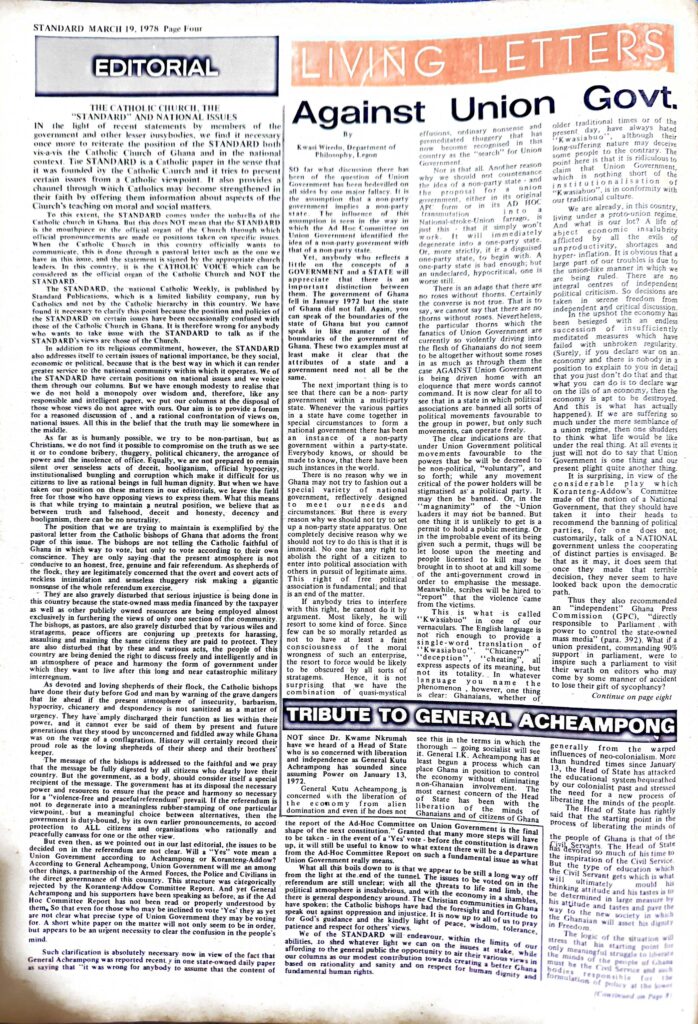
In the light of recent statements by members of the government and other lesser busybodies, we find it necessary once more to reiterate the position of the STANDARD both vis-a-vis the Catholic Church of Ghana and in the national context. The STANDARD is a Catholic paper in the sense that it was founded by the Catholic Church and it tries to present certain issues from a Catholic viewpoint. It also provides a channel through which Catholics may become strengthened in their faith by offering them information about aspects of the Church’s teaching on moral and social matters.
To this extent, the STANDARD comes under the umbrella of the Catholic church in Ghana. But this does NOT mean that the STANDARD is the mouthpiece or the official organ of the Church through which official pronouncements are made or positions taken on specific issues When the Catholic Church in this country officially wants to communicate, this is done through a pastoral letter such as the one we have in this issue, and the statement is signed by the appropriate church leaders. In this country, it is the CATHOLIC VOICE which can be considered as the official organ of the Catholic Church and NOT the STANDARD.
The STANDARD, the national Catholic Weekly, is published by Standard Publications, which is a limited liability company, run by Catholics and not by the Catholic hierarchy in this country. We have found it necessary to clarify this point because the position and policies of the STANDARD on certain issues have been occasionally confused with those of the Catholic Church in Ghana. It is therefore wrong for anybody who wants to take issue with the STANDARD to talk as if the STANDARD’s views are those of the Church.
In addition to its religious commitment, however, the STANDARD also addresses itself to certain issues of national importance, be they social, economic or political, because that is the best way in which it can render greater service to the national community within which it operates. We of the STANDARD have certain positions on national issues and we voice them through our columns. But we have enough modesty to realise that we do not hold a monopoly over wisdom and, therefore, like any responsible and intelligent paper, we put our columns at the disposal of those whose views do not agree with ours. Our aim is to provide a forum for a reasoned discussion of, and a rational confrontation of views on, national issues. All this in the belief that the truth may lie somewhere in the middle.
As far as is humanly possible, we try to be non-partisan, but as Christians, we do not find it possible to compromise on the truth as we see it or to condone bribery, thuggery, political chicanery, the arrogance of power and the insolence of office. Equally, we are not prepared to remain silent over senseless acts of deceit, hooliganism, official hypocrisy, institutionalised bungling and corruption which make it difficult for us citizens to live as rational beings matters in full human dignity. But when we have taken our position on these matters in our editorials, we leave the field free for those who have opposing views to express them. What this means is that while trying to maintain a neutral position, we believe that as between truth and falsehood, deceit and honesty, decency and hooliganism, there can be no neutrality.
The position that we are trying to maintain is exemplified by the pastoral letter from the Catholic bishops of Ghana that adorns the front page of this issue. The bishops are not telling the Catholic faithful of Ghana in which way to vote, but only to vote according to their own conscience. They are only saying that the present atmosphere is not conducive to an honest, free, genuine and fair referendum. As shepherds of the flock, they are legitimately concerned that the overt and covert acts of reckless intimidation and senseless thuggery risk making a gigantic nonsense of the whole referendum exercise.
They are also gravely disturbed that serious injustice is being done in this country because the state-owned mass media financed by the taxpayer as well as other publicly owned resources are being employed almost exclusively in furthering the views of only one section of the community. The bishops, as pastors, are also gravely disturbed that by various wiles and stratagems, peace officers are conjuring up pretexts for harassing, assaulting and maiming the same citizens they are paid to protect. They are also disturbed that by these and various acts, the people of this country are being denied the right to discuss freely and intelligently and in an atmosphere of peace and harmony the form of government under which they want to live after this long and near catastrophic military interregnum.
As devoted and loving shepherds of their flock, the Catholic bishops have that done lie ahead their duty if the before present God and atmosphere man by warning of the grave dangers hypocrisy, chicanery and despondency is not sanitized insecurity, as a barbarism. matter of urgency. They have amply discharged their function as lies within their generations power, and it cannot ever be said of them by present and future) that they stood by unconcerned and fiddled away while Ghana was on the verge of a conflagration. History will certainly record their proud role as the loving shepherds of their sheep and their brothers’ keeper.
The message of the bishops addressed that the message is to the faithful and we pray that the message be fully digested by all citizens who dearly love their country. But the government, as a body, should consider itself a special recipient of the message. The government has at its disposal the necessary power and resources to ensure that the peace and harmony so necessary for a “violence-free and peaceful referendum” prevail. If the referendum is not to degenerate into a meaningless rubber stamping of one particular viewpoint, but a meaningful choice between alternatives, then the government is duty-bound, by its own earlier pronouncements, to accord protection to ALL citizens and organisations who rationally and peacefully canvass for one or the other view.
But even then, as we pointed out in our last editorial, the issues to be decided on in the referendum are not clear. Will a “Yes” vote mean Union Government according to Acheampong or Koranteng-Addow? According to General Acheampong, Union Government will be among other things, a partnership of the Armed Forces, the Police and Civilians in the direct governance of this country. This structure was categorically rejected by the Koranteng Addow Committee Report. And yet General Acheampong and his supporters have been speaking as before, as if the Ad Hoc Committee Report has not been read or properly understood by them. So that even those who may be inclined to vote “Yes” they as yet are not clear what precise type of Union Government they may be voting for. A short white paper on the matter will not only seem to be in order, but appears to be an urgent necessity to clear the confusion in the people’s mind.
Such clarification is absolutely necessary now in view of the fact that Acheampong was reported recently in one state-owned daily paper as saying that “it was wrong for anybody to assume that the content of the report of the Ad-Hoc Committee on Union Government is the final shape of the next constitution.” Granted that many more steps will have to be taken in the event of a “Yes’ vote before the constitution is drawn up, it will still be useful to know to what extent there will be a departure from the Ad-Hoc Committee Report on such a fundamental issue as what Union Government really means.
What all this boils down to is that we appear to be still a long way off from the light at the end of the tunnel. The issues to be voted on in the referendum are still: with all the threats to life and on limb, in the the political atmosphere is insalubrious, and with the there is the economy in shambles, there is general despondency around. The Christian communities in Ghana have spoken: the Catholic bishops have had the foresight and fortitude to speak out against for God’s guidance and the kindly light of now up to all of us to pray Patience and respect for others views light of peace, wisdom, tolerance, patience and respect for others’ views.
We of the STANDARD will endeavour, within the limits of our abilities, to shed whatever light we can on the issues at stake, while affording to the general public the opportunity to air their various views in our columns as our modest contribution towards creating a better Ghana based on rationality and sanity and on respect for human dignity and fundamental human rights.
Read other editorials below: