Student Unrest At Legon And The Implementation Of Decisions
July 3, 2026

Transcript
National Council For Higher Education
June 10, 1971
File No.CC.2 (A)/PT. II.
Since the last Council meeting which was held on 1st April, 1971, I have issued letters to the four student leaders who were present at the negotiations with some members of the Council on 17th March, 1971. Please find enclosed a copy of a letter dated 2nd April, 1971. Copies of this letter were also sent to the parents/guardians of the students concerned. I also enclose a copy of a statement which I issued on behalf of the University Council to the entire student body dated 8th April, 1971. 2. All the four students replied by 8th April, 1971 to the effect that the letters which had been addressed to them should have been directed to the Students Representative Council and not to the individuals concerned. This view was reinforced by letter SRC.14/71/16 dated 14th April 1971, addressed to me by the President of the Students Representative Council, a copy of which is enclosed. I also enclose a copy of a letter SRC.14/ 71/20 dated 20th April, 1971 addressed to the Chairman of the University Council by the President of the Students Representative Council. This letter had attached copies of resolutions from the five Junior Common Rooms of Halls of Residence in response to a letter addressed to them by the President of the Students Representative Council dated 14th April, 1971. Copies of the resolutions are attached. I have kept the Chairman of the University Council informed of all the various stages of development on this matter.
- I now turn to developments over the implementation of the concessions which the University Council had granted to the student leaders at the meeting held on 17th March 1971:-
(i) Student Representation on the Estate Management Committee
The Executive Committee of the Academic Board has decided that two student representatives, one an official and the other elected by the Students Representative Council, should serve as members of the Estate Management Committee.
(ii) Student Representation on Hall Councils
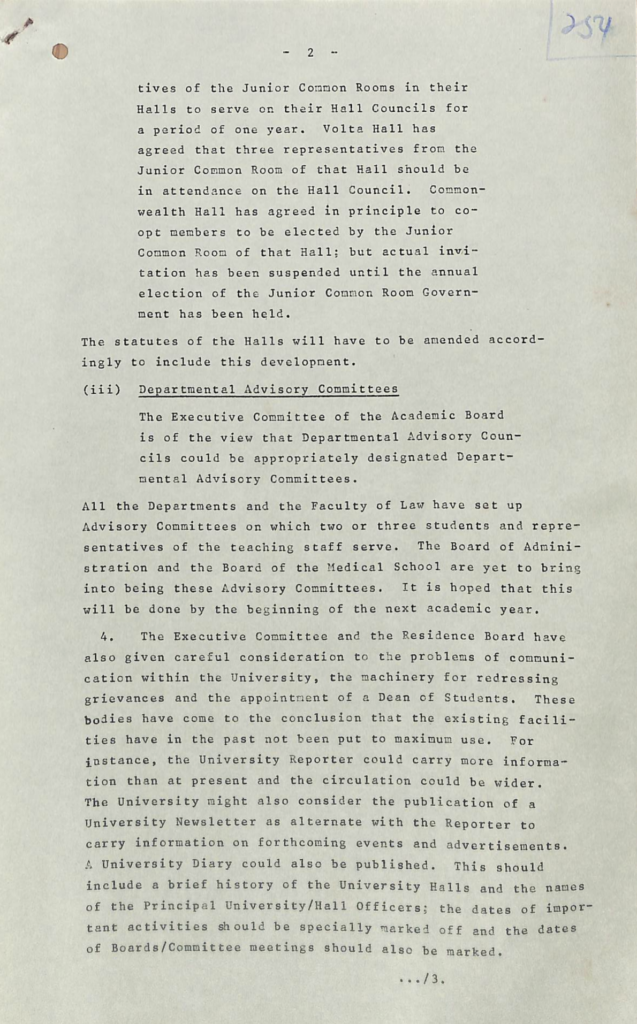
The Hall Councils of Akuafo, Legon and Mensah Sarbah have agreed to co-opt two representatives of the Junior Common Rooms in their Halls to serve on their Hall Councils for a period of one year. Volta Hall has agreed that three representatives from the Junior Common Room of that Hall should be in attendance on the Hall Council. Common- wealth Hall has agreed in principle to co- opt members to be elected by the Junior Common Room of that Hall; but actual invitation has been suspended until the annual election of the Junior Common Room Govern- ment has been held.
The statutes of the Halls will have to be amended accordingly to include this development.
(iii) Departmental Advisory Committees
The Executive Committee of the Academic Board is of the view that Departmental Advisory Councils could be appropriately designated Depart- mental Advisory Committees. All the Departments and the Faculty of Law have set up Advisory Committees on which two or three students and representatives of the teaching staff serve. The Board of Administration and the Board of the Medical School are yet to bring into being these Advisory Committees. It is hoped that this will be done by the beginning of the next academic year.
- The Executive Committee and the Residence Board have also given careful consideration to the problems of communi- cation within the University, the machinery for redressing grievances and the appointment of a Dean of Students. These bodies have come to the conclusion that the existing facili- ties have in the past not been put to maximum use. For instance, the University Reporter could carry more informa- tion than at present and the circulation could be wider. The University might also consider the publication of a University Newsletter as alternate with the Reporter to carry information on forthcoming events and advertisements. A University Diary could also be published. This should include a brief history of the University Halls and the names of the Principal University/Hall Officers; the dates of important activities should be specially marked off and the dates of Boards/Committee meetings should also be marked.
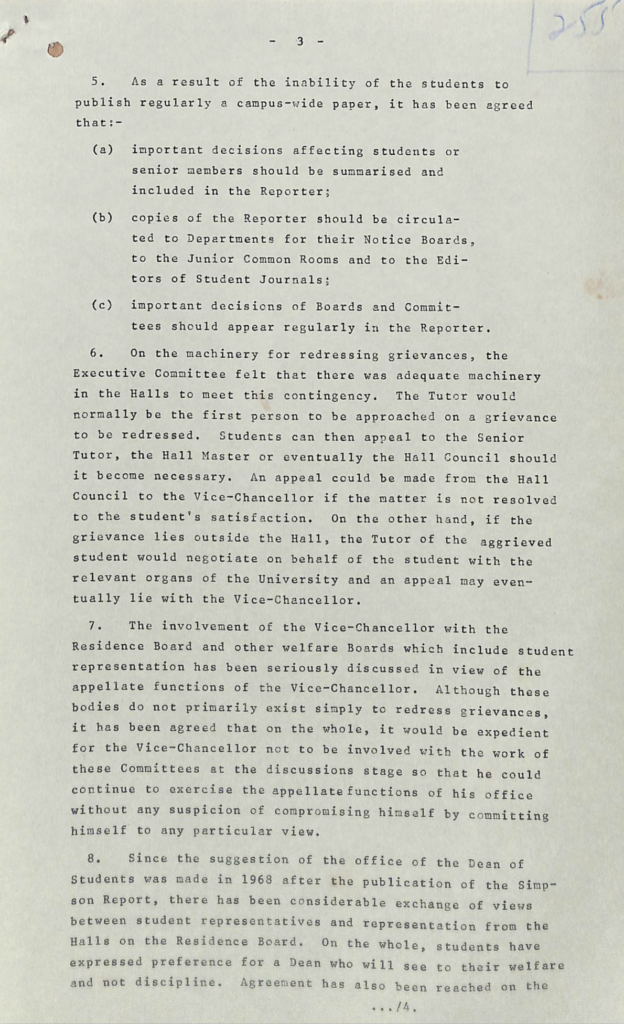
- As a result of the inability of the students to publish regularly a campus-wide paper, it has been agreed that:–
(a) important decisions affecting students or senior members should be summarised and included in the Reporter;
(b) copies of the Reporter should be circulated to Departments for their Notice Boards, to the Junior Common Rooms and to the Editors of Student Journals;
(c) important decisions of Boards and Commit- tees should appear regularly in the Reporter.
- On the machinery for redressing grievances, the Executive Committee felt that there was adequate machinery in the Halls to meet this contingency. The Tutor would normally be the first person to be approached on a grievance to be redressed. Students can then appeal to the Senior Tutor, the Hall Master or eventually the Hall Council should it become necessary. An appeal could be made from the Hall Council to the Vice-Chancellor if the matter is not resolved to the student’s satisfaction. On the other hand, if the grievance lies outside the Hall, the Tutor of the aggrieved student would negotiate on behalf of the student with the relevant organs of the University and an appeal may eventually lie with the Vice-Chancellor.
- The involvement of the Vice-Chancellor with the Residence Board and other welfare Boards which include student representation has been seriously discussed in view of the appellate functions of the Vice-Chancellor. Although these bodies do not primarily exist simply to redress grievances, it has been agreed that on the whole, it would be expedient for the Vice-Chancellor not to be involved with the work of these Committees at the discussions stage so that he could continue to exercise the appellate functions of his office without any suspicion of compromising himself by committing himself to any particular view.
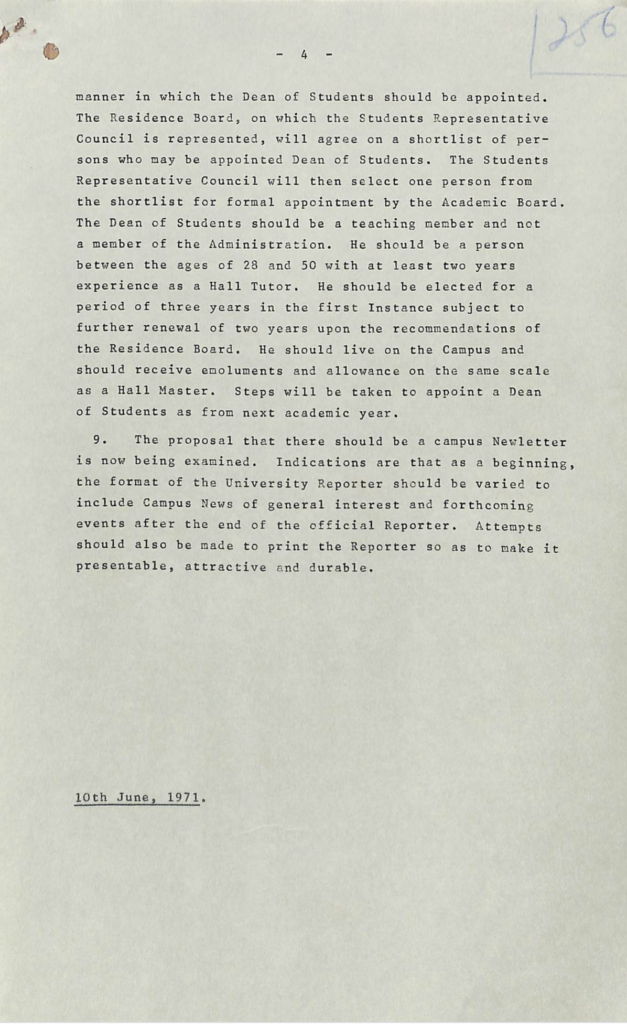
- Since the suggestion of the office of the Dean of Students was made in 1968 after the publication of the Simp- son Report, there has been considerable exchange of views between student representatives and representation from the Halls on the Residence Board. On the whole, students have expressed preference for a Dean who will see to their welfare and not discipline. Agreement has also been reached on the manner in which the Dean of Students should be appointed. The Residence Board, on which the Students Representative Council is represented, will agree on a shortlist of per- sons who may be appointed Dean of Students. The Students Representative Council will then select one person from the shortlist for formal appointment by the Academic Board. The Dean of Students should be a teaching member and not a member of the Administration. He should be a person between the ages of 28 and 50 with at least two years experience as a Hall Tutor. He should be elected for a period of three years in the first Instance subject to further renewal of two years upon the recommendations of the Residence Board. He should live on the Campus and should receive emoluments and allowance on the same scale as a Hall Master. Steps will be taken to appoint a Dean of Students as from next academic year.
- The proposal that there should be a campus Newsletter is now being examined. Indications are that as a beginning, the format of the University Reporter should be varied to include Campus News of general interest and forthcoming events after the end of the official Reporter. Attempts should also be made to print the Reporter so as to make it presentable, attractive and durable.
10th June, 1971.