Student Power And Solidarity In The Ghanaian Universities
August 4, 2026
Transcript
The Standard
June 8, 1980
by Ohene Kwaku Bonsu,
former SRC Secretary, U.S.T.
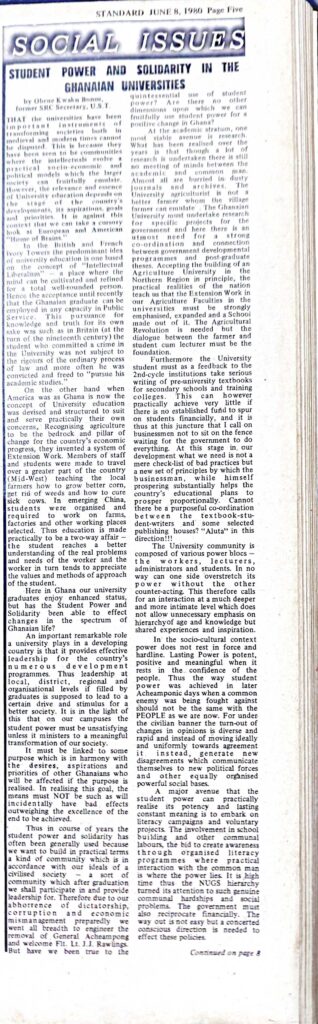
That the universities have been important instruments of transforming societies both in medieval and modern times cannot be disputed. This is because they have been seen to be communities where the intellectuals evolve practical socio-economic and political models which the larger society can fruitfully emulate. However, the relevance and essence of University education depends on the stage of the country’s developments, its aspirations, goals and priorities. It is against this context that we can take a cursory look at European and American “Home of Brains.”
In the British and French Ivory Towers the predominant idea of university education is one based on the concept of “Intellectual Liberalism” a place where the mind can be cultivated and refined for a totally well-rounded person. Hence the acceptance until recently that the Ghanaian graduate can be employed in any capacity in Public Service. This pursuance for knowledge and truth for its own. sake was such as in Britain (at the turn of the nineteenth century) the student who committed a crime in the University was not subject to the rigours of the ordinary process. of law and more often he was convicted and freed to “pursue his academic studies.”
On the other hand when America was as Ghana is now the concept of University education was devised and structured to suit and serve practically their own. concerns. Recognising agriculture to be the bedrock and pillar of change for the country’s economic progress, they invented a system of Extension Work. Members of staff and students were made to travel over a greater part of the country (Mid-West) teaching the local farmers how to grow better corn, get rid of weeds and how to cure sick cows. In emerging China, students were organised and required to work on farms, factories and other working places selected. Thus education is made practically to be a two-way affair – the student reaches a better understanding of the real problems and needs of the worker and the worker in turn tends to appreciate the values and methods of approach of the student.
Here in Ghana our university graduates enjoy enhanced status, but has Student Power and Solidarity been able to effect changes in the spectrum of Ghanaian life?
An important remarkable role a university plays in a developing country is that it provides effective leadership for the country’s numerous development programmes. Thus leadership at local, district, regional and organisational levels if filled by graduates is supposed to lead to a certain drive and stimulus for a better society. It is in the light of this that on our campuses the student power must be unsatisfying unless it ministers to a meaningful transformation of our society.
It must be linked to some purpose which is in harmony with the desires, aspirations and priorities of other Ghanaians who will be affected if the purpose is realised. In realising this goal, the means must NOT be such as will incidentally have bad effects outweighing the excellence of the end to be achieved.
Thus in course of years the student power and solidarity has often been generally used because we want to build in practical terms a kind of community which is in accordance with our ideals of a civilised society – 3 sort of community which after graduation we shall participate in and provide leadership for. Therefore due to our abhorrence of dictatorship, corruption and economic mismanagement preparedly we went all breadth to engineer the removal of General Acheampong and welcome Flt. Lt. J.J. Rawlings But have we been true to the quintessential use of student power? Are there no other dimensions upon which we can fruitfully use student power for a positive change in Ghana?
At the academic stratum, one most viable avenue is research. What has been realised over the years is that though a lot of research is undertaken there is still no meeting of minds between the academic and common man. Almost all are buried in dusty journals and archives. The University agriculturist is not a better farmer whom the village farmer can emulate. The Ghanaian University must undertake research for specific projects for the government and here there is an utmost need for a strong co-ordination and connection between government developmental programmes and post-graduate theses. Accepting the building of an Agriculture University in the Northern Region in principle, the practical realities of the nation teach us that the Extension of the Work nation in our Agriculture Faculties in the universities must be strongly emphasised, expanded and a School made out of it. The Agricultural Revolution is needed but the dialogue between the farmer and student cum lecturer must be the foundation.
Furthermore the University student must as a feedback to the 2nd-cycle institutions take serious writing of pre-university textbooks for secondary schools and training colleges. This can however practically achieve very little if there is no established fund to spur on students financially, and it is thus at this juncture that I call on businessmen not to sit on the fence waiting for the government to do everything. At this stage in our development, what we need is not a mere check-list of bad practices but a new set of principles by which the businessman, while himself prospering substantially, helps the country’s educational plans to prosper proportionally. Cannot there be a purposeful co-ordination between the textbook-student-writers and some selected publishing houses? “Aluta” in this direction!!!
The University community is composed of various power blocs – the workers, lecturers, administrators and students. In no way can one side overstretch its power without the other counter-acting. This therefore calls for an interaction at a much deeper and more intimate level which does not allow unnecessary emphasis on hierarchy of age and knowledge but shared experiences and inspiration.
In the socio-cultural context power does not rest in force and hardline. Lasting Power is potent, positive and meaningful when it rests in the confidence of the people. Thus the way student power was achieved in later Acheamponic days when a common enemy was being fought against should not be the same with the PEOPLE as we are now. For under the civilian banner the turn-out of changes in opinions is diverse and rapid and instead of moving ideally and uniformly towards agreement it instead generates new disagreements which communicate themselves to new political forces and other equally organised powerful social bases.
A major avenue that the student power can practically realise its potency and lasting constant meaning is to embark on literacy campaigns and voluntary projects. The involvement in school building and other communal labours, the bid to create awareness through organised literacy programmes where practical interaction with the common man is where the power lies. It is high time thus the NUGS hierarchy turned its attention to such genuine communal hardships and social problems The government must also reciprocate financially. The way out is not easy but a concerted conscious direction is needed to effect these policies.
More about students’ power