Statement Of Students Unrest At Legon By The Chairman Of The University Council
July 3, 2026



Transcript
National Council For Higher Education
1971
- Members of the public have expressed concern over the recent student unrest at Legon during the last few days of the Lent Term this year. The University Council has also watched with pain such developments in the University of Ghana and it has made every effort to look into the causes of the unrest and to make appropriate changes in the administrative machinery which are to come into effect as from the next Term.
2. Students at Legon met at the University Square in the afternoon of 11th March, 1971, to discuss the following items:Examination fees, Security at Gate, Vacation Residence Fees, Transport. After the meeting, they marched to the entrance of the Registry and demanded a meeting with the Vice-Chancellor. At this meeting, they expressed concern over the charges for vacation residence, during the coming Easter Vacation. The Vice-Chancellor after discussing their grievances with the student leaders confirmed in writing that he would ask the Hall Authorities not to press on with the charge of NC1.25 per day immediately and that he would look into the matter with the Hall Authorities and take a decision on the matter by the afternoon of 15th March, 1971. In the evening a group of students entered the Central Cafeteria of the University and broke a large quantity of crockery which has been estimated at about NC150.00.
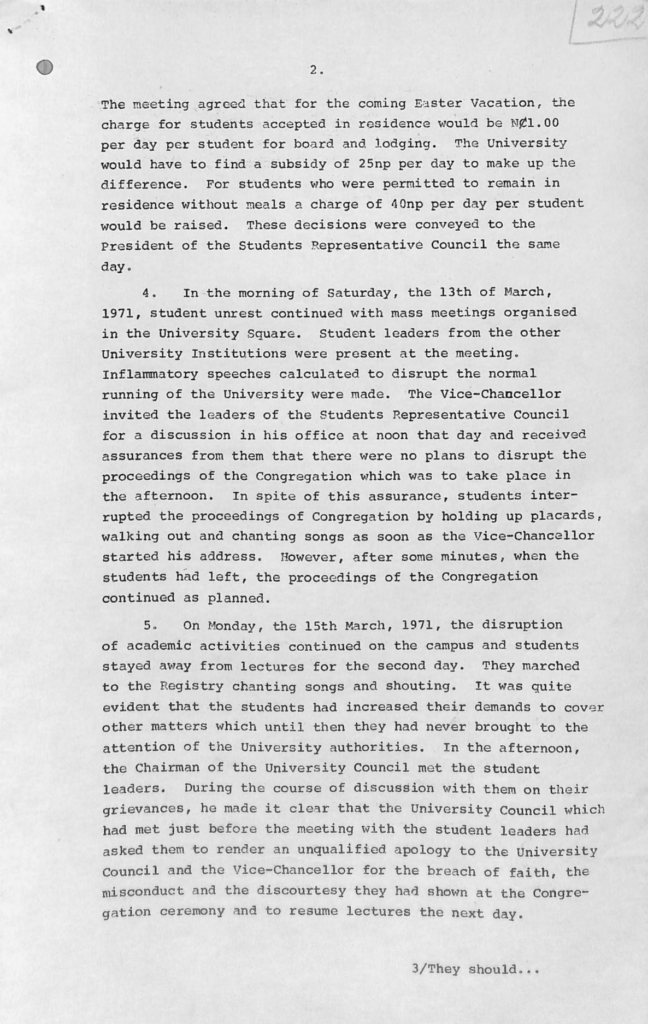
3. For the whole of 12th March, 1971, to back up their demands, quite a number of students stayed away from lectures and prevented others who wished to attend from so doing. At about 10.00 a.m. on that day, some students marched up to the Registry and delivered a letter at the Vice- Chancellor’s Office to the effect that his “stop-gap” measure had been rejected in “toto” by the student body and that they demanded a substantive reply by 2.00 p.m. on that day. Earlier in the day, the Vice-Chancellor had arranged a meeting with the Hall Authorities to look into the problem of vacation residence charges. The meeting agreed that for the coming Easter Vacation, the charge for students accepted in residence would be NC1.00 per day per student for board and lodging. The University would have to find a subsidy of 25np per day to make up the difference. For students who were permitted to remain in residence without meals a charge of 40np per day per student would be raised. These decisions were conveyed to the President of the Students Representative Council the same day.
4. In the morning of Saturday, the 13th of March, 1971, student unrest continued with mass meetings organised in the University Square. Student leaders from the other University Institutions were present at the meeting. Inflammatory speeches calculated to disrupt the normal running of the University were made. The Vice-Chancellor invited the leaders of the Students Representative Council for a discussion in his office at noon that day and received assurances from them that there were no plans to disrupt the proceedings of the Congregation which was to take place in the afternoon. In spite of this assurance, students interrupted the proceedings of Congregation by holding up placards, walking out and chanting songs as soon as the Vice-Chancellor started his address. However, after some minutes, when the students had left, the proceedings of the Congregation continued as planned.
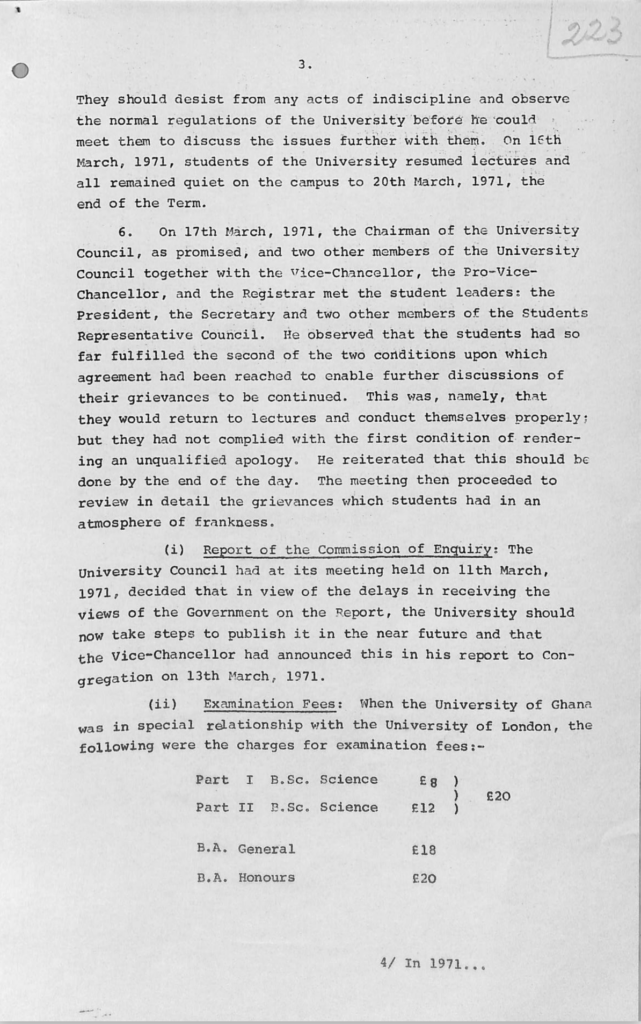
5. On Monday, the 15th March, 1971, the disruption of academic activities continued on the campus and students stayed away from lectures for the second day. They marched to the Registry chanting songs and shouting. It was quite evident that the students had increased their demands to cover other matters which until then they had never brought to the attention of the University authorities. In the afternoon, the Chairman of the University Council met the student leaders. During the course of discussion with them on their grievances, he made it clear that the University Council which had met just before the meeting with the student leaders had asked them to render an unqualified apology to the University Council and the Vice-Chancellor for the breach of faith, the misconduct and the discourtesy they had shown at the Congregation ceremony and to resume lectures the next day. They should desist from any acts of indiscipline and observe the normal regulations of the University before he could meet them to discuss the issues further with them. On 16th March, 1971, students of the University resumed lectures and all remained quiet on the campus to 20th March, 1971, the end of the Term.
6. On 17th March, 1971, the Chairman of the University Council, as promised, and two other members of the University Council together with the Vice-Chancellor, the Pro-Vice- Chancellor, and the Registrar met the student leaders: the President, the Secretary and two other members of the Students Representative Council. He observed that the students had so far fulfilled the second of the two conditions upon which agreement had been reached to enable further discussions of their grievances to be continued. This was, namely, that they would return to lectures and conduct themselves properly; but they had not complied with the first condition of render- ing an unqualified apology. He reiterated that this should be done by the end of the day. The meeting then proceeded to review in detail the grievances which students had in an atmosphere of frankness.
2. Students at Legon met at the University Square in the afternoon of 11th March, 1971, to discuss the following items:Examination fees, Security at Gate, Vacation Residence Fees, Transport. After the meeting, they marched to the entrance of the Registry and demanded a meeting with the Vice-Chancellor. At this meeting, they expressed concern over the charges for vacation residence, during the coming Easter Vacation. The Vice-Chancellor after discussing their grievances with the student leaders confirmed in writing that he would ask the Hall Authorities not to press on with the charge of NC1.25 per day immediately and that he would look into the matter with the Hall Authorities and take a decision on the matter by the afternoon of 15th March, 1971. In the evening a group of students entered the Central Cafeteria of the University and broke a large quantity of crockery which has been estimated at about NC150.00.
3. For the whole of 12th March, 1971, to back up their demands, quite a number of students stayed away from lectures and prevented others who wished to attend from so doing. At about 10.00 a.m. on that day, some students marched up to the Registry and delivered a letter at the Vice- Chancellor’s Office to the effect that his “stop-gap” measure had been rejected in “toto” by the student body and that they demanded a substantive reply by 2.00 p.m. on that day. Earlier in the day, the Vice-Chancellor had arranged a meeting with the Hall Authorities to look into the problem of vacation residence charges. The meeting agreed that for the coming Easter Vacation, the charge for students accepted in residence would be NC1.00 per day per student for board and lodging. The University would have to find a subsidy of 25np per day to make up the difference. For students who were permitted to remain in residence without meals a charge of 40np per day per student would be raised. These decisions were conveyed to the President of the Students Representative Council the same day.
4. In the morning of Saturday, the 13th of March, 1971, student unrest continued with mass meetings organised in the University Square. Student leaders from the other University Institutions were present at the meeting. Inflammatory speeches calculated to disrupt the normal running of the University were made. The Vice-Chancellor invited the leaders of the Students Representative Council for a discussion in his office at noon that day and received assurances from them that there were no plans to disrupt the proceedings of the Congregation which was to take place in the afternoon. In spite of this assurance, students interrupted the proceedings of Congregation by holding up placards, walking out and chanting songs as soon as the Vice-Chancellor started his address. However, after some minutes, when the students had left, the proceedings of the Congregation continued as planned.
5. On Monday, the 15th March, 1971, the disruption of academic activities continued on the campus and students stayed away from lectures for the second day. They marched to the Registry chanting songs and shouting. It was quite evident that the students had increased their demands to cover other matters which until then they had never brought to the attention of the University authorities. In the afternoon, the Chairman of the University Council met the student leaders. During the course of discussion with them on their grievances, he made it clear that the University Council which had met just before the meeting with the student leaders had asked them to render an unqualified apology to the University Council and the Vice-Chancellor for the breach of faith, the misconduct and the discourtesy they had shown at the Congregation ceremony and to resume lectures the next day. They should desist from any acts of indiscipline and observe the normal regulations of the University before he could meet them to discuss the issues further with them. On 16th March, 1971, students of the University resumed lectures and all remained quiet on the campus to 20th March, 1971, the end of the Term.
6. On 17th March, 1971, the Chairman of the University Council, as promised, and two other members of the University Council together with the Vice-Chancellor, the Pro-Vice- Chancellor, and the Registrar met the student leaders: the President, the Secretary and two other members of the Students Representative Council. He observed that the students had so far fulfilled the second of the two conditions upon which agreement had been reached to enable further discussions of their grievances to be continued. This was, namely, that they would return to lectures and conduct themselves properly; but they had not complied with the first condition of render- ing an unqualified apology. He reiterated that this should be done by the end of the day. The meeting then proceeded to review in detail the grievances which students had in an atmosphere of frankness.
(i) Report of the Commission of Enquiry: The University Council had at its meeting held on 11th March, 1971, decided that in view of the delays in receiving the views of the Government on the Report, the University should now take steps to publish it in the near future and that the Vice-Chancellor had announced this in his report to Congregation on 13th March, 1971.
(ii) Examination Fees: When the University of Ghana was in special relationship with the University of London, the following were the charges for examination fees:-
Part I B.Sc. Science £ 8,
Part II B.Sc. Science £12 {£20}
B.A. General £18
B.A. Honours £20
In 1971, ten years after the University became autonomous, the following are the examination fees charged:-
FUE Science N₵4.00
SUE Science 18.00
Final Science 18.00
= N₵40.00
FUE Arts N₵ 4.00
Final Arts 36.00
= N₵40.00
Even at the current rate of exchange, the fees should have been N₵49.00 and not N₵40.00 as at present. Furthermore, income from examination fees, registration and admission fees has over the past five years averaged N₵39,000.00 while expenditure on examination fees, passages, accommodation charges and emoluments for external examiners, cost of stationery and printing, invigilators’ fees, postage and charges in connection with arrangements of Halls for examinations averaged N₵47,000.00. The University was not therefore making a profit out of examinations. The cost of supporting external examiners continued to be high as a result of the devaluation of currency. It was necessary for reasons of security, professional and academic competence and convenience to print examination questions overseas. This was expensive but the use of external examiners and the methods adopted to ensure the security and the quality of the examinations have helped to guarantee international acceptance of degrees from Legon.
(iii) Vacation Residence Charges: In 1963-64, the University Council on the advice of the then Vice-Chancellor, and on representations from the Students Representative Council, agreed that final year students who were accepted in residence during the Easter Vacation should receive a subsidy of 25np per day per student; each student was to pay 65np per day thus bringing the total cost of a student’s residence cost up to 85np per day. It was never intended that students of all years who stayed on during vacation periods, should receive this subsidy. In December, 1969, the Hall Authorities decided to raise charges for vacation residence from 85np to Ng1.25 in view of rising costs. The Students Representative Council reached agreement with the Hall Authorities that for the Christmas Vacation of 1969, students accepted for residence should pay NZ1.00 per day, but that, thereafter, the new rate of Ne1.25 per student per day should come into force.
At a meeting of the Residence Board held on 29th January, 1970, at which the President and the Secretary of the Students Representative Council and two other Students representatives were present as members, the Board approved the vacation residence fee of N₵1.25. It was explained that this measure had become necessary because the finances of the University made it difficult for it to continue to subsidise students who chose to stay on during the vacation periods. This was approved by the Finance Committee at its meeting held on 2nd March, 1970. It however agreed that in view of inadequate notice of this new policy, final year students who intended to stay in residence during that Easter Vacation (of 1970) (which was then barely three weeks ahead) should be subsidised and that with effect from the 1970/71 academic year, subsidies to final year students during the Easter Vacation should be abolished. The position at the beginning of this academic year was that students who elected to stay in residence during vacations should not receive any subsidies. Students who were accepted in residence over the last Christmas Vacation therefore paid this new rate of N₵1.25 per day. Indeed, students who had stayed during the previous long vacation had also paid the new rate of N₵1.25. On 17th February, 1971, however, the Students Representative Council raised afresh the issue of vacation residence with the Vice-Chancellor on the ground that there were disparities in vacation residence charges at Legon, Kumasi and Cape Coast, and Legon’s charges were the highest! Investigations confirmed the information that at both Kumasi and Cape Coast Vacation residence fee is NZ1.00 per student per day. But it is not correct that final year students in those institutions stayed on without charge. The basis for the charge of N₵1.25 per day for the University of Ghana is as follows: accommodation is 40np and food 85np per day. These charges reflected the current level of cost in maintaining a student per day at Legon.
As a result of mounting anxiety of students over the vacation residence fee, the University decided on 12th March, 1971, that vacation residence should be NC1.00 per day for board and lodging and 40np per day for accommodation only. It is estimated that this concession would cost the University about N₵26,000.00 per each Easter Vacation and about NC12,000.00 for all the vacations in the year.
(iv) Bookshop Prices: The allegation that the University Bookshop makes “enormous profits” is incorrect. There is no mark-up on basic text books. Apart from the effects of currency devaluations, the price of text books is the same as in the country of origin. The specific example of Megarry and Wade’s “Manual of Real Property” which alleged by some students to be selling at N₵5.00 at Kumasi and N₵15.00 at Legon is due to confusion over the prices of paperback and hard back copies, (nor were the students even certain of the particular edition being sold at Kumasi). The Bookshop of the University of Ghana however carries other profitable lines which the general public as well as Secondary Schools find reasonable and far cheaper than either those ordered directly from their country of origin or selling elsewhere in other bookshops in the country. The Bookshop is not being run as a commercial concern. It enjoys heavy subsidies from the University by way of free accommodation and subsidised housing for its staff who also enjoy other University facilities. Whatever surplus income accrues to the Bookshop is appropriated on the authority of the Finance Committee as follows:
one-third to the Balme Library to procure stocks of books for the use of students; one-third for the increase of stocks in the Bookshop for the general benefit of students and the public and one-third as a reserve for the expansion of the Bookshop.
It is therefore evident that the Bookshop receives heavy subsidies from the University.
(v) Campus Security System: As a result of the increase in crime wave on the campus over the past two years, the Estate Management Committee has expressed concern over the security of life and property on the campus. In November last year, a Visiting Professor and his wife were followed as they were driving from Accra at night by certain unidentified persons in a taxi and were held up in the middle of the campus, slashed with razor blade, robbed of N250.00, and their car driven away by the assailants. This happened at 9.45 p.m. It was this incident, the culmination of many other thefts on the campus, which immediately compelled the Estate Management Committee of the University to erect a barrier at the Main Gate and to regulate the traffic of taxis and other vehicles coming into the campus after 9.00 p.m.
Under this regulation, all drivers of taxi cars are required to deposit their licence at the entrance gate after that hour and to collect them on their return. Taxi drivers who do not carry their licences are not allowed entry to the campus. Both cars without the appropriate University labels and taxis are searched. The students complained that they had found this arrangement inconvenient because several taxi-drivers (obviously without such driving licences) had been dropping their passengers at the gate, thus obliging them to walk from the re to their Halls of Residence. They however made some useful suggestions at the meeting of the Residence Board on 2nd March, 1971, and at their meeting with the Chairman of the University Council on 17th March, 1971. These were to the effect that certain unauthorised routes to the campus should be closed to traffic; the two main entrances to the campus should be linked by telephones, the calibre of the security guard at the gates should be improved and that student passengers on taxis be required to produce their identity cards to prove that they are bona-fide students. The University has taken note of all these suggestions with a view to their implementation.
(vi) Transport System: The students had requested that five buses should be placed at their disposal. It has been explained to the student leaders that no University anywhere is under obligation to provide transport solely for the social needs of students. The University buses were acquired to carry University staff who live in various parts of Accra to and from their place of work. Most of the University’s present fleet of buses which are heavily taxed are on their last legs and suffer from frequent breakdowns in spite of strenuous efforts to maintain them at considerable cost. The University would however continue to assist students with transport as far as possible so as to promote their academic welfare. The University has also urged students to look into a system that will further ease transport difficulties between Legon and Accra and submit their proposals to the Residence Board.
(vii) Students Re presentation on University Bodies: The Chairman of the University Council had in his address of welcome at the last Congregation expressed sympathy for the worldwide demand for greater student participation in the management of the affairs of Universities. He also emphasised his anxiety on the quality of responsibility which such participation involved.
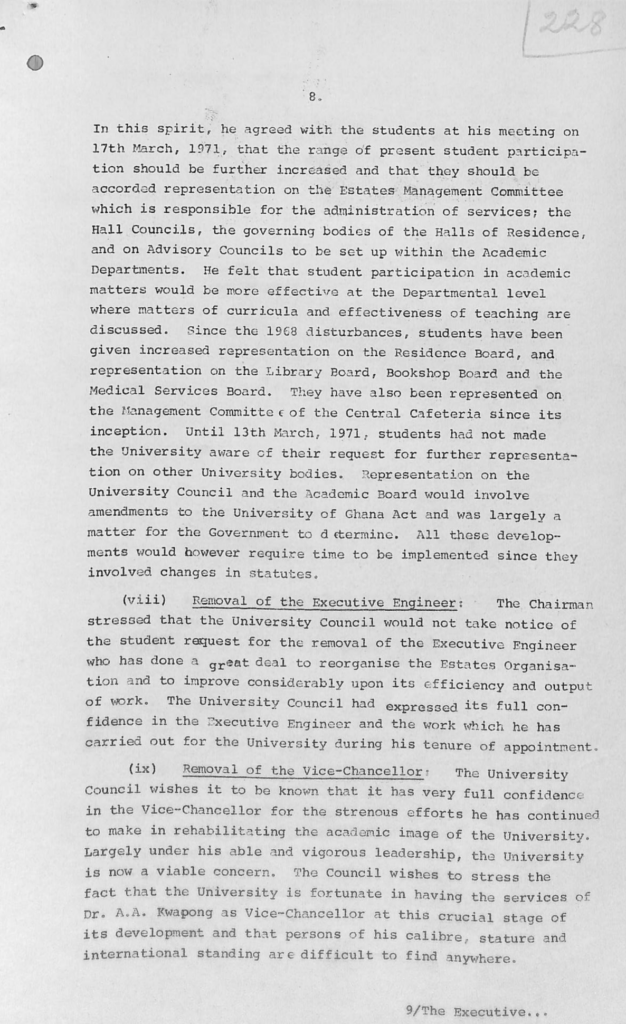
In this spirit, he agreed with the students at his meeting on 17th March, 1971, that the range of present student participation should be further increased and that they should be accorded representation on the Estates Management Committee which is responsible for the administration of services; the Hall Councils, the governing bodies of the Halls of Residence, and on Advisory Councils to be set up within the Academic Departments. He felt that student participation in academic matters would be more effective at the Departmental level where matters of curricula and effectiveness of teaching are discussed. Since the 1968 disturbances, students have been given increased representation on the Residence Board, and representation on the Library Board, Bookshop Board and the Medical Services Board. They have also been represented on the Management Committee of the Central Cafeteria since its inception. Until 13th March, 1971, students had not made the University aware of their request for further representation on other University bodies. Representation on the University Council and the Academic Board would involve amendments to the University of Ghana Act and was largely a matter for the Government to determine. All these developments would however require time to be implemented since they involved changes in statutes.
(viii) Removal of the Executive Engineer: The Chairman stressed that the University Council would not take notice of the student request for the removal of the Executive Engineer who has done a great deal to reorganise the Estates Organisation and to improve considerably upon its efficiency and output of work. The University Council had expressed its full confidence in the Executive Engineer and the work which he has carried out for the University during his tenure of appointment.
(ix) Removal of the Vice-Chancellor: The University Council wishes it to be known that it has very full confidence in the Vice-Chancellor for the strenuous efforts he has continued to make in rehabilitating the academic image of the University. Largely under his able and vigorous leadership, the University is now a viable concern. The Council wishes to stress the fact that the University is fortunate in having the services of Dr. A.A. Kwapong as Vice-Chancellor at this crucial stage of its development and that persons of his calibre, stature and international standing are difficult to find anywhere.
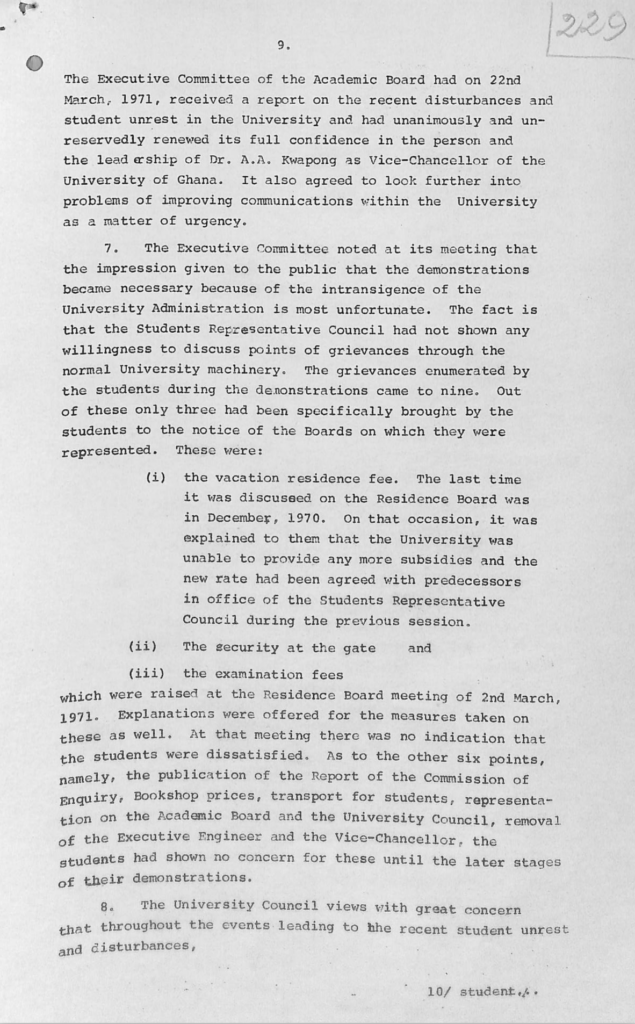
The Executive Committee of the Academic Board had on 22nd March, 1971, received a report on the recent disturbances and student unrest in the University and had unanimously and un- reservedly renewed its full confidence in the person and the leadership of Dr. A.A. Kwapong as Vice-Chancellor of the University of Ghana. It also agreed to look further into problems of improving communications within the University as a matter of urgency.
- The Executive Committee noted at its meeting that the impression given to the public that the demonstrations became necessary because of the intransigence of the University Administration is most unfortunate. The fact is that the Students Representative Council had not shown any willingness to discuss points of grievances through the normal University machinery. The grievances enumerated by the students during the demonstrations came to nine. Out of these only three had been specifically brought by the students to the notice of the Boards on which they were represented. These were:
(i) the vacation residence fee: The last time it was discussed on the Residence Board was in December, 1970. On that occasion, it was explained to them that the University was unable to provide any more subsidies and the new rate had been agreed with predecessors in office of the Students Representative Council during the previous session.
(ii) The security at the gate and
(iii) the examination fees which were raised at the Residence Board meeting of 2nd March, 1971. Explanations were offered for the measures taken on these as well. At that meeting there was no indication that the students were dissatisfied. As to the other six points, namely, the publication of the Report of the Commission of Enquiry, Bookshop prices, transport for students, representation on the Academic Board and the University Council, removal of the Executive Engineer and the Vice-Chancellor, the students had shown no concern for these until the later stages of their demonstrations.
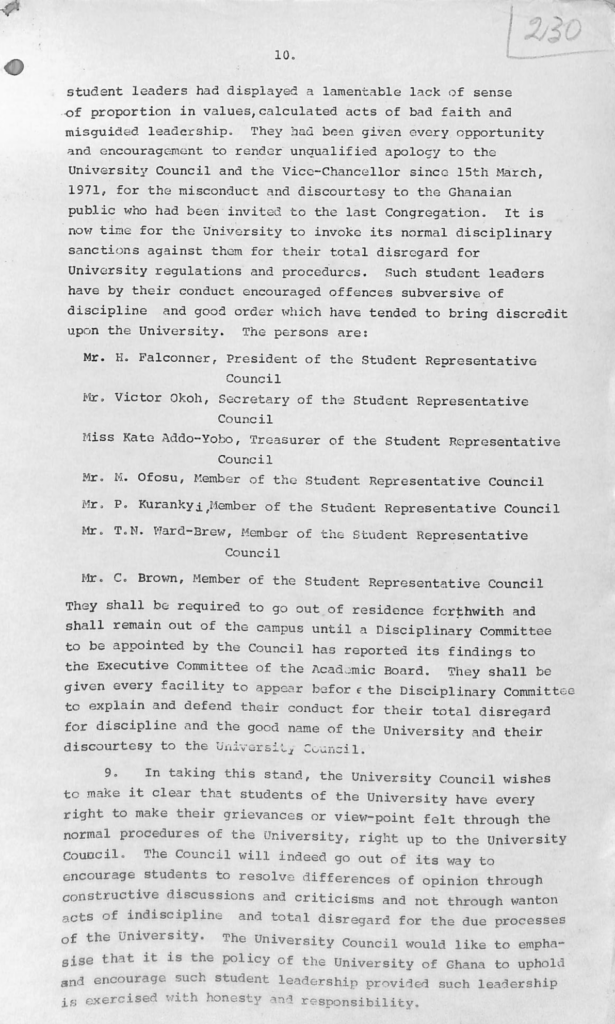
- The University Council views with great concern that throughout the events leading to the recent student unrest and disturbances, student leaders had displayed a lamentable lack of sense of proportion in values, calculated acts of bad faith and misguided leadership. They had been given every opportunity and encouragement to render unqualified apology to the University Council and the Vice-Chancellor since 15th March, 1971, for the misconduct and discourtesy to the Ghanaian public who had been invited to the last Congregation. It is now time for the University to invoke its normal disciplinary sanctions against them for their total disregard for University regulations and procedures. Such student leaders have by their conduct encouraged offences subversive of discipline and good order which have tended to bring discredit upon the University. The persons are:
Mr. H. Falconner, President of the Student Representative Council
Mr. Victor Okoh, Secretary of the Student Representative Council
Miss Kate Addo-Yobo, Treasurer of the Student Representative Council
Mr. M. Ofosu, Member of the Student Representative Council
Mr. P. Kurankyi,Member of the Student Representative Council
Mr. T. N. Ward-Brew, Member of the Student Representative Council
Mr. C. Brown, Member of the Student Representative Council
They shall be required to go out of residence forthwith and shall remain out of the campus until a Disciplinary Committee to be appointed by the Council has reported its findings to the Executive Committee of the Academic Board. They shall be given every facility to appear before the Disciplinary Committee to explain and defend their conduct for their total disregard for discipline and the good name of the University and their discourtesy to the University Council.
- In taking this stand, the University Council wishes to make it clear that students of the University have every right to make their grievances or view-point felt through the normal procedures of the University, right up to the University Council. The Council will indeed go out of its way to encourage students to resolve differences of opinion through constructive discussions and criticisms and not through wanton acts of indiscipline and total disregard for the due processes of the University. The University Council would like to empha- sise that it is the policy of the University of Ghana to uphold and encourage such student leadership provided such leadership is exercised with honesty and responsibility.