Statement By The PNDC Secretary For Finance And Economic Planning
August 5, 2026


Transcript
December 30, 1982
Statement By The PNDC Secretary For Finance And Economic Planning On The PNDC’s Programme For Reconstruction And Development On Thursday 30th December 1982
Good Evening Fellow Countrymen,
I have come here tonight to talk to you about the state of our national economy and the Government’s programme for economic reconstruction and development.
- The crisis in our national economy has been with us for so long, has left such ugly scars on our social system as a whole, that many many of us have begun to yearn for instant and almost miraculous solutions. This longing is perfectly understandable. As a nation we have certainly seen better times even if those seemingly glorious times themselves contained the seeds of our present crisis. However, in real life, in matters of social and economic development, miracles do not happen, and change, alas, must be brought about through planned and deliberate action based on thorough knowledge of what it is we seek to change knowledge that is not coloured by grudge, prejudice or sheer cynicism.
- To begin with, it is important for us to understand that the continuing problems of our economy which manifest themselves in critical shortage of basic needs and consequent deterioration in the living standards of the vast majority of our people, are not peculiarly Ghanaian, that the entire world, particularly the Western world with which our economy, like those of all so-called under-developed economies, is most closely associated, is in crisis, and that there is hardly a single country in the world today that is unaffected by this crisis. At the level of international economic relations the problem manifests itself in increasing currency instability and trade protectionism as even the developed countries themselves are struggling to deal with large budget deficits, inflation, unemployment and social tension. To admit the universality of the crisis is not, of course, to say that our situation is a happy one. It is simply to recognise that our problems are not attributable to any innate cultural weaknesses in us as a people, that other people who are not Ghanaians are suffering similar problems, and that given the very structure of our economy, with its heavy dependence on imports, external factors do exercise a trenchant effect on our internal development.
- In the final analysis however, there can be no doubt that our problems have been greatly aggravated by the pursuit, over the years, particularly from the mid-seventies, of monetary, fiscal, foreign exchange and pricing policies which systematically destroyed or discouraged local production in agriculture and manufacturing. brought the export sector and thus our foreign exchange earning capability, to the point of virtual collapse, severely penalised productive effort, hard work and creative initiative, while lavishly rewarding idleness, and the most flagrant violation of existing laws.
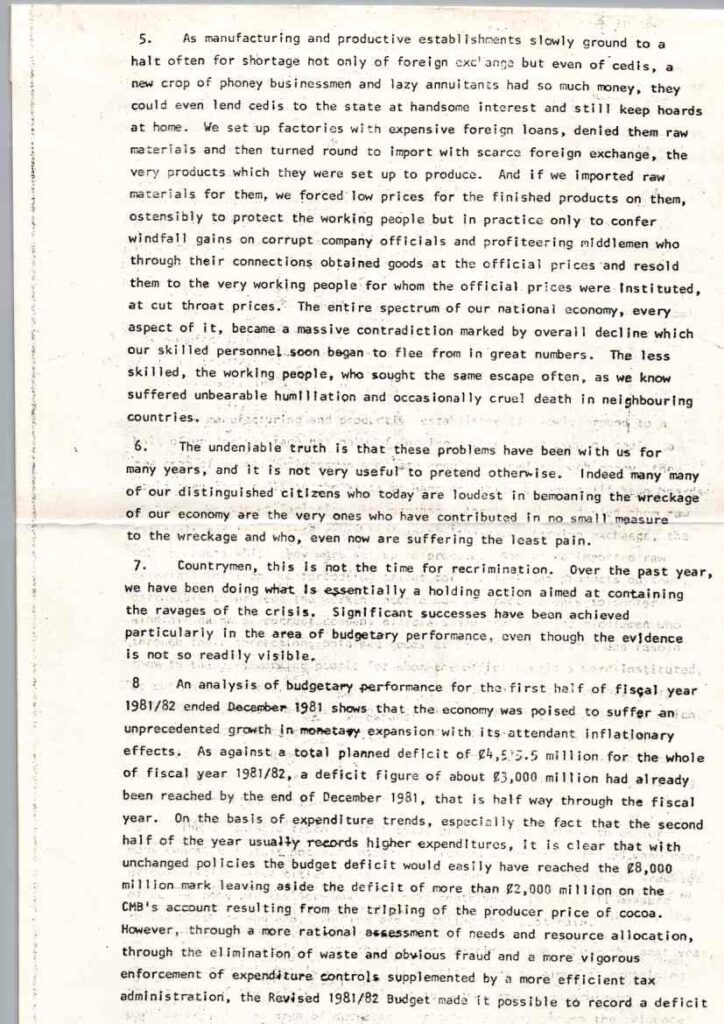
- As manufacturing and productive establishments slowly ground to a halt often for shortage hot only of foreign exchange but even of cedis, a new crop of phoney businessmen and lazy annuitants had so much money, they could even lend cedis to the state at handsome interest and still keep hoards at home. We set up factories with expensive foreign loans, denied them raw materials and then turned round to import with scarce foreign exchange, the very products which they were set up to produce. And if we imported raw materials for them, we forced low prices for the finished products on them, ostensibly to protect the working people but in practice only to confer windfall gains on corrupt company officials and profiteering middlemen who through their connections obtained goods at the official prices and resold them to the very working people for whom the official prices were Instituted, at cut throat prices. The entire spectrum of our national economy, every aspect of it, became a massive contradiction marked by overall decline which our skilled personnel soon began to flee from in great numbers. The less skilled, the working people, who sought the same escape often, as we know suffered unbearable humiliation and occasionally cruel death in neighbouring countries.
- The undeniable truth is that these problems have been with us for many years, and it is not very useful to pretend otherwise. Indeed many many of our distinguished citizens who today are loudest in bemoaning the wreckage of our economy are the very ones who have contributed in no small measure to the wreckage and who, even now are suffering the least pain.
- Countrymen, this is not the time for recrimination. Over the past year, we have been doing what is essentially a holding action aimed at containing the ravages of the crisis. Significant successes have been achieved a particularly in the area of budgetary performance, even though the evidence is not so readily visible.
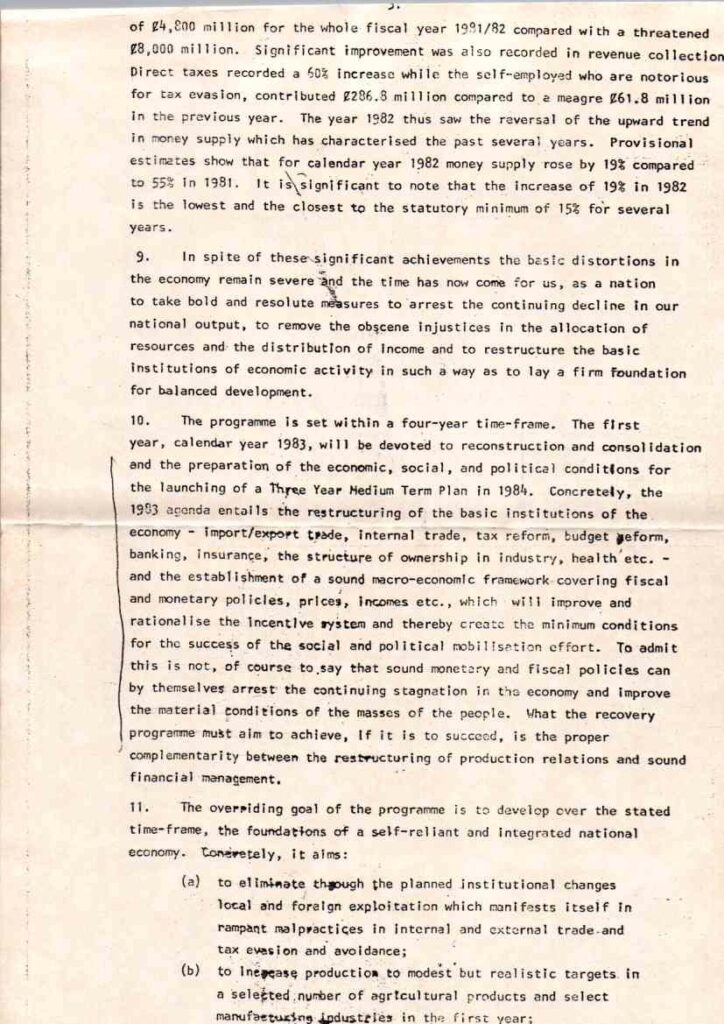
- An analysis of budgetary performance for the first half of fiscal year 1981/82 ended December 1981 shows that the economy was poised to suffer an unprecedented growth in monetary expansion with its attendant inflationary effects. As against a total planned deficit of £4,5 5.5 million for the whole of fiscal year 1981/82, a deficit figure of about 23,000 million had already been reached by the end of December 1981, that is half way through the fiscal year. On the basis of expenditure trends, especially the fact that the second half of the year usually records higher expenditures, it is clear that with unchanged policies the budget deficit would easily have reached the £8,000 million mark leaving aside the deficit of more than £2,000 million on the CMB’s account resulting from the tripling of the producer price of cocoa. However, through a more rational assessment of needs and resource allocation, through the elimination of waste and obvious fraud and a more vigorous enforcement of expenditure controls supplemented by a more efficient tax administration, the Revised 1981/82 Budget made it possible to record a deficit of £4,200 million for the whole fiscal year 1991/82 compared with a threatened 28,000 million. Significant improvement was also recorded in revenue collection Direct taxes recorded a 50% increase while the self-employed who are notorious for tax evasion, contributed £286.8 million compared to a meagre £61.8 million in the previous year. The year 1982 thus saw the reversal of the upward trend in money supply which has characterised the past several years. Provisional estimates show that for calendar year 1982 money supply rose by 19% compared to 55% in 1981. It is significant to note that the increase of 19% in 1982 is the lowest and the closest to the statutory minimum of 15% for several years.
- In spite of these significant achievements the basic distortions in the economy remain severe and the time has now come for us, as a nation to take bold and resolute measures to arrest the continuing decline in our national output, to remove the obscene injustices in the allocation of resources and the distribution of Income and to restructure the basic institutions of economic activity in such a way as to lay a firm foundation for balanced development.
- The programme is set within a four-year time-frame. The first year, calendar year 1983, will be devoted to reconstruction and consolidation and the preparation of the economic, social, and political conditions for the launching of a Three Year Medium Term Plan in 1984. Concretely, the 1983 agenda entails the restructuring of the basic institutions of the economy import/export trade, internal trade, tax reform, budget reform, banking, insurance, the structure of ownership in industry, health etc. and the establishment of a sound macro-economic framework covering fiscal and monetary policies, prices, incomes etc., which will improve and rationalise the Incentive system and thereby create the minimum conditions for the success of the social and political mobilisation effort. To admit this is not, of course to say that sound monetary and fiscal policies can by themselves arrest the continuing stagnation in the economy and improve the material conditions of the masses of the people. What the recovery programme must aim to achieve, If it is to succeed, is the proper complementarity between the restructuring of production relations and sound financial management.
- The overriding goal of the programme is to develop over the stated time-frame, the foundations of a self-reliant and integrated national economy. Concretely, it aims:
(a) to eliminate through the planned institutional changes local and foreign exploitation which manifests itself in rampant malpractices in internal and external trade-and tax evasion and avoidance;
(b) to Increase production to modest but realistic targets. in a selected number of agricultural products and select manufacturing Industries in the first year:
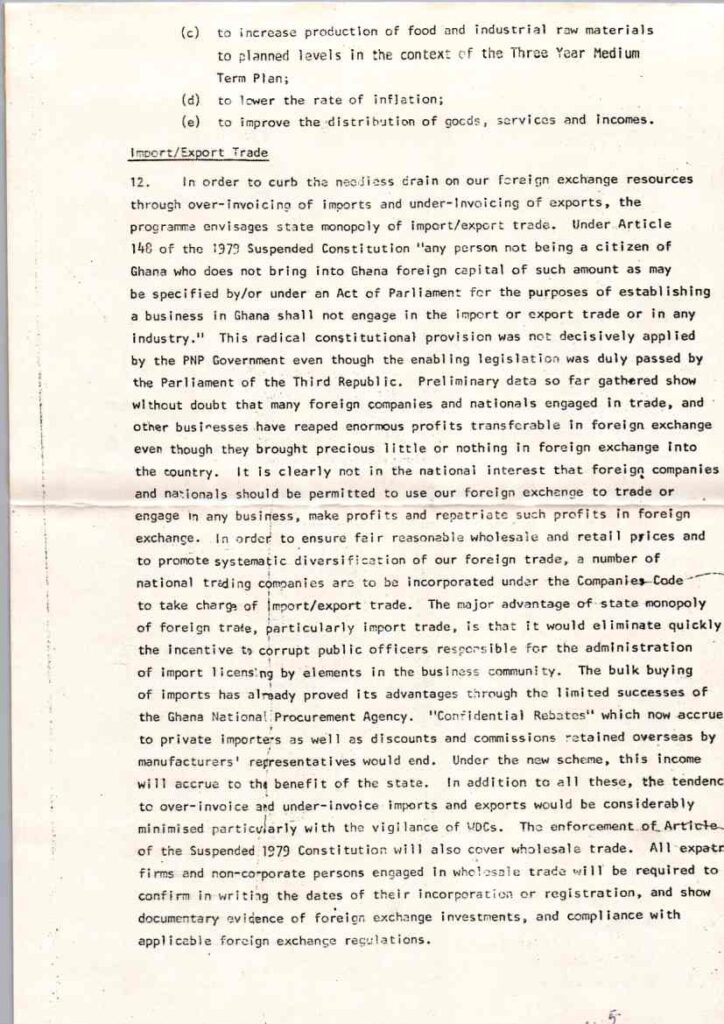
(c) to increase production of food and industrial raw materials to planned levels in the context of the Three Year Medium Term Plan;
(d) to lower the rate of inflation;
(e) to improve the distribution of goods, services and incomes.
Import/Export Trade
- In order to curb the needless drain on our foreign exchange resources through over-invoicing of imports and under-Invoicing of exports, the programme envisages state monopoly of import/export trade. Under Article 148 of the 1979 Suspended Constitution “any person not being a citizen of Ghana who does not bring into Ghana foreign capital of such amount as may be specified by/or under an Act of Parliament for the purposes of establishing a business in Ghana shall not engage in the import or export trade or in any industry.” This radical constitutional provision was not decisively applied by the PNP Government even though the enabling legislation was duly passed by the Parliament of the Third Republic. Preliminary data so far gathered show without doubt that many foreign companies and nationals engaged in trade, and other businesses have reaped enormous profits transferable in foreign exchange even though they brought precious little or nothing in foreign exchange into the country. It is clearly not in the national interest that foreign companies and nationals should be permitted to use our foreign exchange to trade or engage in any business, make profits and repatriate such profits in foreign exchange. In order to ensure fair reasonable wholesale and retail prices and to promote systematic diversification of our foreign trade, a number of national trading companies are to be incorporated under the Companies Code to take charge of Import/export trade. The major advantage of state monopoly of foreign trade, particularly import trade, is that it would eliminate quickly the incentive to corrupt public officers responsible for the administration of import licensing by elements in the business community. The bulk buying of imports has already proved its advantages through the limited successes of the Ghana National Procurement Agency. “Confidential Rebates” which now accrue to private importers as well as discounts and commissions retained overseas by manufacturers’ representatives would end. Under the new scheme, this income will accrue to the benefit of the state. In addition to all these, the tendency to over-invoice and under-invoice imports and exports would be considerably minimised particularly with the vigilance of VDCs. The enforcement of Article of the Suspended 1979 Constitution will also cover wholesale trade. All expatriate firms and non-corporate persons engaged in wholesale trade will be required to confirm in writing the dates of their incorporation or registration, and show documentary evidence of foreign exchange investments, and compliance with applicable foreign exchange regulations.
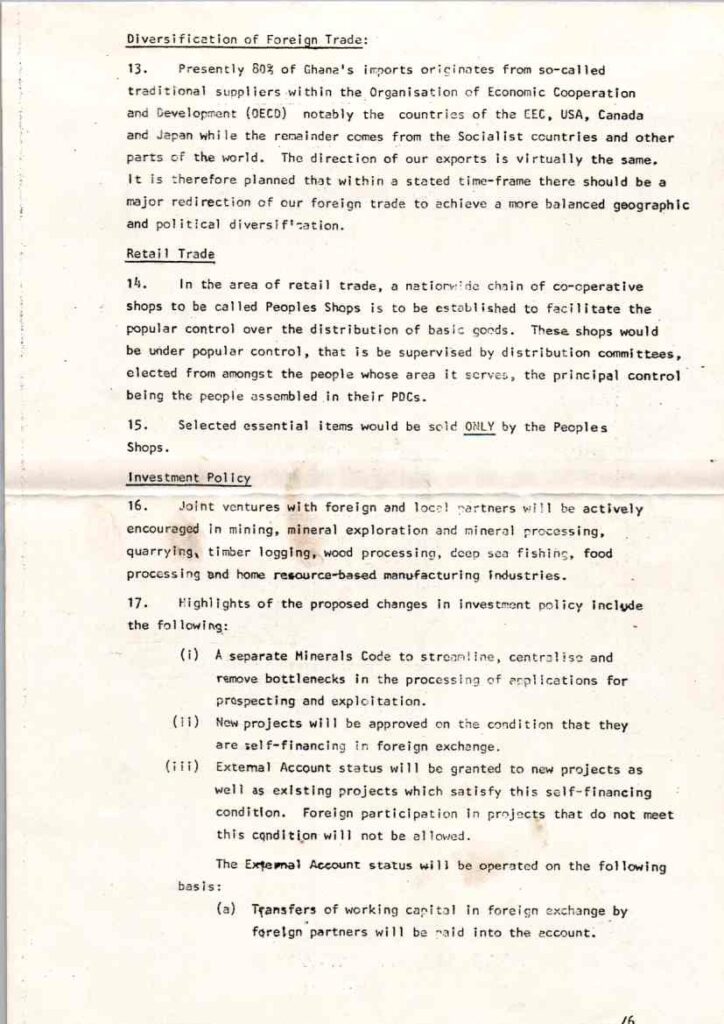
Diversification of Foreign Trade:
- Presently 80% of Ghana’s imports originates from so-called traditional suppliers within the Organisation of Economic Cooperation and Development (OECD) notably the countries of the EEC, USA, Canada and Japan while the remainder comes from the Socialist countries and other parts of the world. The direction of our exports is virtually the same. It is therefore planned that within a stated time-frame there should be a major redirection of our foreign trade to achieve a more balanced geographic and political diversification.
Retail Trade
- In the area of retail trade, a nationwide chain of co-operative shops to be called Peoples Shops is to be established to facilitate the popular control over the distribution of basic goods. These shops would be under popular control, that it be supervised by distribution committees, elected from amongst the people whose area it serves, the principal control being the people assembled in their PDCs.
- Selected essential items would be sold ONLY by the Peoples Shops.
Investment Policy
- Joint ventures with foreign and local partners will be actively encouraged in mining, mineral exploration and mineral processing, quarrying, timber logging, wood processing, deep sea fishing, food processing and home resource-based manufacturing Industries.
- Highlights of the proposed changes in investment policy include the following:
(i) A separate Minerals Code to streamline, centralise and remove bottlenecks in the processing of applications for prospecting and exploitation.
(ii) New projects will be approved on the condition that they are self-financing in foreign exchange. (iii) Extemal Account status will be granted to new projects as well as existing projects which satisfy this self-financing condition. Foreign participation in projects that do not meet this condition will not be allowed.
The External Account status will be operated on the following basis:
(a) Transfers of working capital in foreign exchange by foreign partners will be paid into the account.
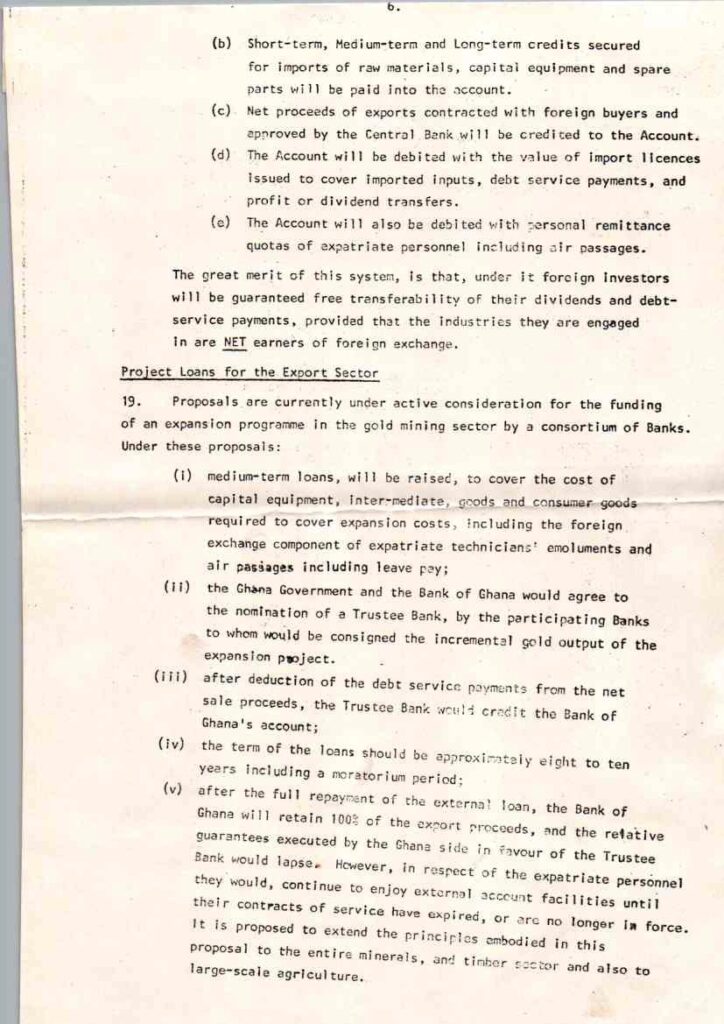
(b) Short-term, Medium-term and Long-term credits secured for imports of raw materials, capital equipment and spare parts will be paid into the account.
(c) Net proceeds of exports contracted with foreign buyers and approved by the Central Bank will be credited to the Account.
(d) The Account will be debited with the value of import licences Issued to cover imported inputs, debt service payments, and profit or dividend transfers.
(e) The Account will also be debited with personal remittance quotas of expatriate personnel including air passages.
The great merit of this system, is that, under it foreign Investors will be guaranteed free transferability of their dividends and debt- service payments, provided that the industries they are engaged In are NET earners of foreign exchange.
Project Loans for the Export Sector
- Proposals are currently under active consideration for the funding of an expansion programme in the gold mining sector by a consortium of Banks. Under these proposals:
(i) medium-term loans, will be raised, to cover the cost of capital equipment, inter-mediate, goods and consumer goods required to cover expansion costs, including the foreign exchange component of expatriate technicians’ emoluments and air passages including leave pay;
(ii) the Ghana Government and the Bank of Ghana would agree to the nomination of a Trustee Bank, by the participating Banks to whom would be consigned the incremental gold output of the expansion project.
(iii) after deduction of the debt service payments from the net sale proceeds, the Trustee Bank would credit the Bank of Ghana’s account;
(iv) the term of the loans should be approximately eight to ten years including a moratorium period;
(v) after the full repayment of the external Ghana loan, the Bank of will retain 100% of the export proceeds, guarantees and the relative executed by the Ghana side in favour of the Trustee Bank would lapse. However, in respect of the expatriate personnel they would, continue to enjoy external account facilities until their contracts of service have expired, or are no longer in force. It is proposed to extend the principles embodied in this proposal to the entire minerals, and timber sector and also to large-scale agriculture.
Transport
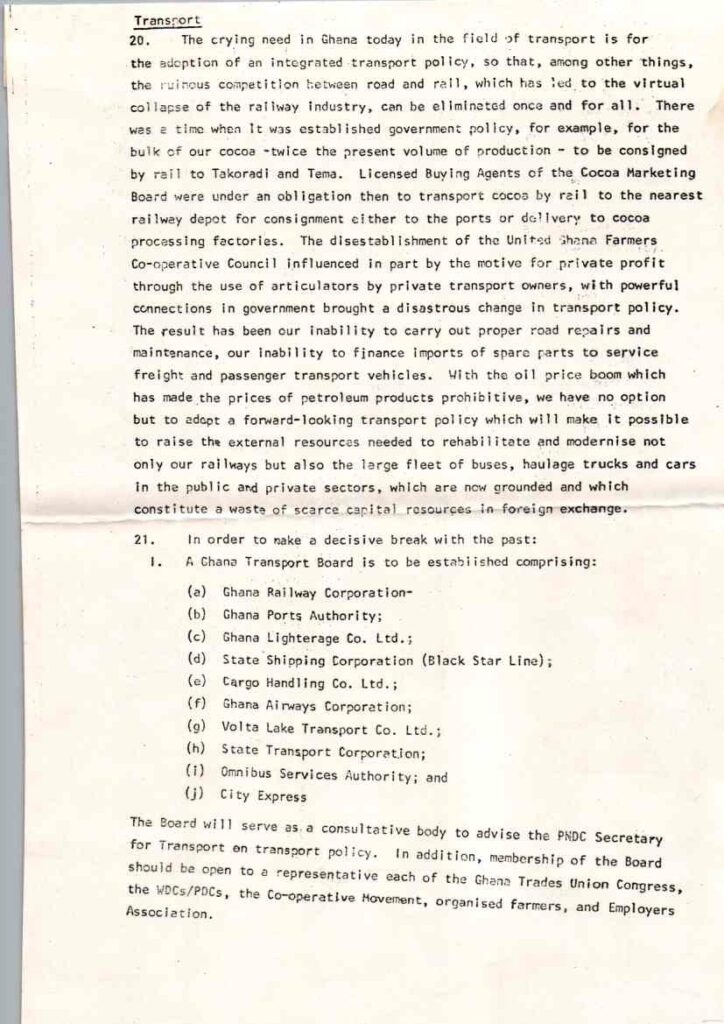
- The crying need in Ghana today in the field of transport is for the adoption of an integrated transport policy, so that, among other things, the ruinous competition between road and rail, which has led to the virtual collapse of the railway industry, can be eliminated once and for all. There was a time when it was established government policy, for example, for the bulk of our cocoa -twice the present volume of production – to be consigned by rail to Takoradi and Tema. Licensed Buying Agents of the Cocoa Marketing Board were under an obligation then to transport cocos by rail to the nearest railway depot for consignment either to the ports or delivery to cocoa processing factories. The disestablishment of the United Shana Farmers Co-operative Council influenced in part by the motive for private profit through the use of articulators by private transport owners, with powerful connections in government brought a disastrous change in transport policy. The result has been our inability to carry out proper road repairs and maintenance, our inability to finance imports of spare parts to service freight and passenger transport vehicles. With the oil price boom which has made the prices of petroleum products prohibitive, we have no option but to adopt a forward-looking transport policy which will make it possible to raise the external resources needed to rehabilitate and modernise not only our railways but also the large fleet of buses, haulage trucks and cars. In the public and private sectors, which are now grounded and which constitute a waste of scarce capital resources in foreign exchange.
- In order to make a decisive break with the past:
- A Ghana Transport Board is to be established comprising:
(a) Ghana Railway Corporation-
(b) Ghana Ports Authority;
(c) Ghana Lighterage Co. Ltd.;
(d) State Shipping Corporation (Black Star Line);
(e) Cargo Handling Co. Ltd.;
(f) Ghana Airways Corporation;
(g) Volta Lake Transport Co. Ltd.;
(h) State Transport Corporation;
(i) Omnibus Services Authority; and
(j) City Express
The Board will serve as a consultative body to advise the PNDC Secretary for Transport en transport policy. In addition, membership of the Board should be open to a representative each of the Ghana Trades Union Congress, the WDCs/PDCs, the Co-operative Movement,. organised farmers, and Employers Association
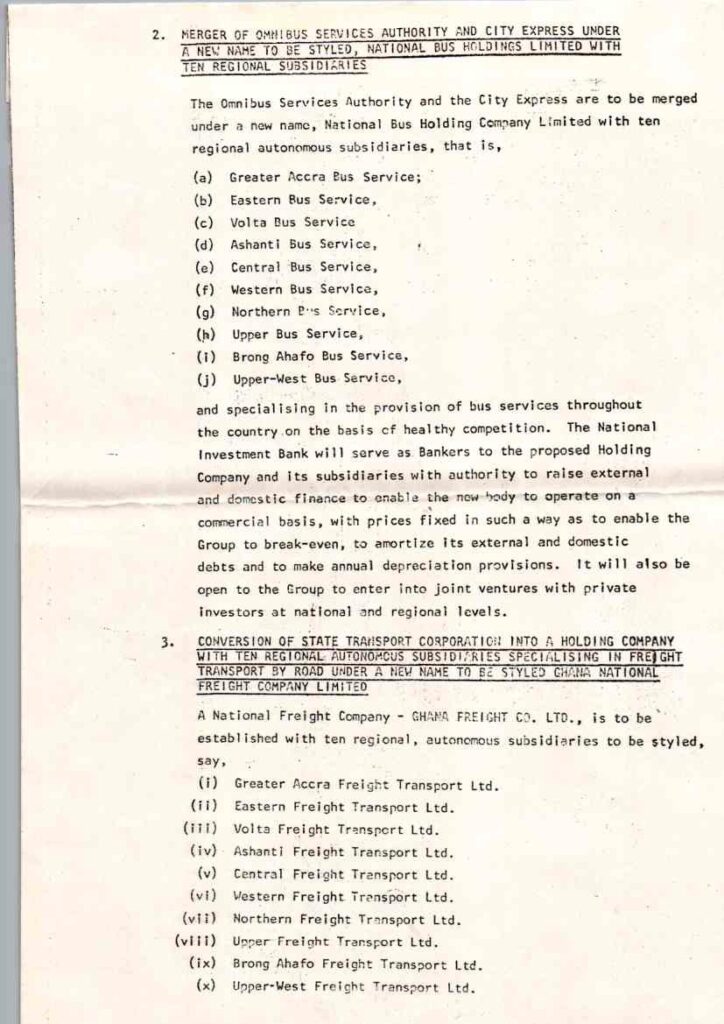
- MERGER A NEW NAME OF OMNIBUS TO BE STYLED, SERVICES NATIONAL AUTHORITY BUS AND HOLDINGS CITY EXPRESS LIMITED UNDER WITH TEN REGIONAL SUBSIDIARIES
The Omnibus Services Authority and the City Express are to be merged under a new name, National Bus Holding Company Limited with ten regional autonomous subsidiaries, that is,
(a) Greater Accra Bus Service;
(b) Eastern Bus Service,
(c) Volta Bus Service
(d) Ashanti Bus Service,
(e) Central Bus Service,
(f) Western Bus Service,
(g) Northern Ps Service,
(h) Upper Bus Service,
(i) Brong Ahafo Bus Service,
(j) Upper-West Bus Service, and specialising in the provision of bus services throughout the country on the basis of healthy competition. The National Investment Bank will serve as Bankers to the proposed Holding Company and its subsidiaries with authority to raise external and domestic finance to enable the new body to operate on a commercial basis, with prices fixed in such a way as to enable the Group to break-even, to amortize its external and domestic debts and to make annual depreciation provisions. It will also be open to the Group to enter into joint ventures with private investors at national and regional levels.
- CONVERSION OF STATE TRANSPORT CORPORATION INTO A HOLDING COMPANY WITH TEN REGIONAL AUTONOMOUS SUBSIDIARIES SPECIALISING IN FREIGHT TRANSPORT BY ROAD UNDER A NEW NAME TO BE STYLED GHANA NATIONAL FREIGHT COMPANY LIMITED
A National Freight Company GHANA FREIGHT CO. LTD., is to be established with ten regional, autonomous subsidiaries to be styled, say,
(i) Greater Accra Freight Transport Ltd.
(ii) Eastern Freight Transport Ltd.
(iii) Volta Freight Transport Ltd.
(iv) Ashanti Freight Transport Ltd.
(v) Central Freight Transport Ltd.
(vi) Western Freight Transport Ltd.
(vii) Northern Freight Transport Ltd.
(viii) Upper Freight Transport Ltd.
(ix) Brong Ahafo Freight Transport Ltd.
(x) Upper-West Freight Transport Ltd.
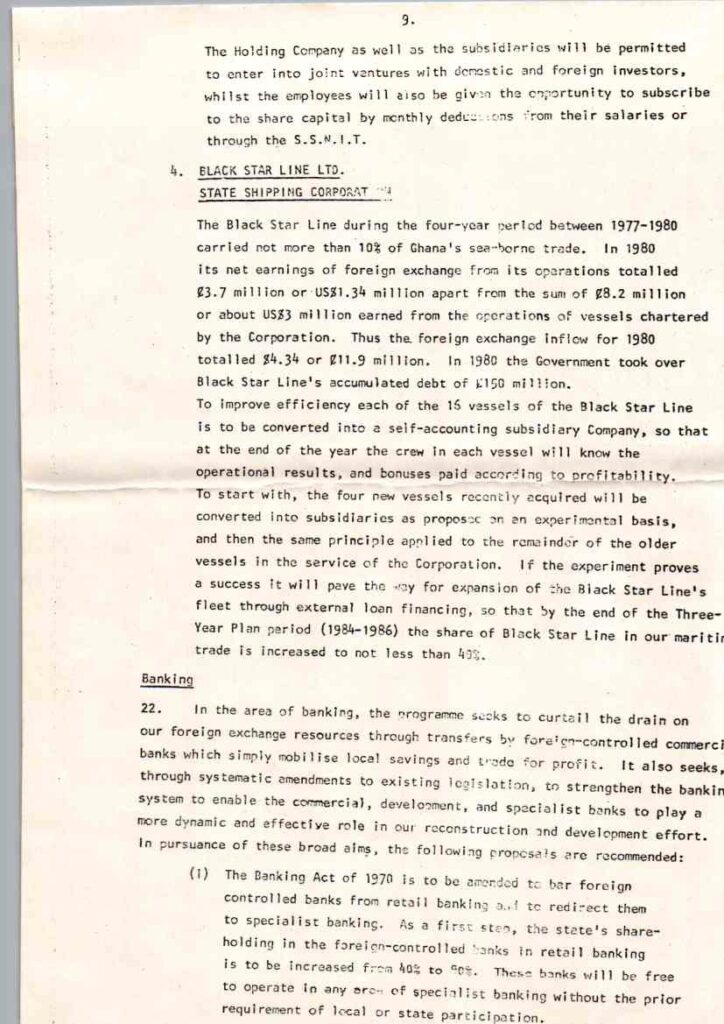
The Holding Company as well as the subsidiaries will be permitted domestic and foreign investors, to enter into joint ventures with the opportunity to subscribe whilst the employees will also be given deductions from their salaries or to the share capital by monthly through the S.S.N.I.T.
- BLACK STAR LINE LTD. STATE SHIPPING CORPORATION
The Black Star Line during the four-year period between 1977-1980 carried not more than 10% of Ghana’s sea-borne trade. In 1980 its net earnings of foreign exchange from its operations totalled 23.7 million or US$1.34 million apart from the sum of £8.2 million or about US$3 million earned from the operations of vessels chartered by the Corporation. Thus the foreign exchange inflow for 1980 totalled $4.34 or £11.9 million. In 1980 the Government took over Black Star Line’s accumulated debt of £150 million. To improve efficiency each of the 15 vessels of the Black Star Line is to be converted into a self-accounting subsidiary Company, so that at the end of the year the crew in each vessel will know the operational results, and bonuses paid according to profitability. To start with, the four new vessels recently acquired will be converted into subsidiaries as proposed on an experimental basis, and then the same principle applied to the remainder of the older vessels in the service of the Corporation. If the experiment proves a success it will pave the way for expansion of the Black Star Line’s fleet through external loan financing, so that by the end of the Three- Year Plan period (1984-1986) the share of Black Star Line in our maritime trade is increased to not less than 40%.
Banking
- In the area of banking, the programme seeks to curtail the drain on our foreign exchange resources through transfers by foreign-controlled commercial banks which simply mobilise local savings and trade for profit. It also seeks through systematic amendments to existing legislation, to strengthen the banking system to enable the commercial, development, and specialist banks to play a more dynamic and effective role in our reconstruction and development effort.
In pursuance of these broad aims, the following proposals are recommended:
(i) The Banking Act of 1970 is to be amended to bar foreign controlled banks from retail banking a.. te redirect them to specialist banking. As a first step, the state’s share- holding in the foreign-controlled banks in retail banking is to be increased from 40% to 90%. These banks will be free to operate in any area of specialist banking without the prior requirement of local or state participation.
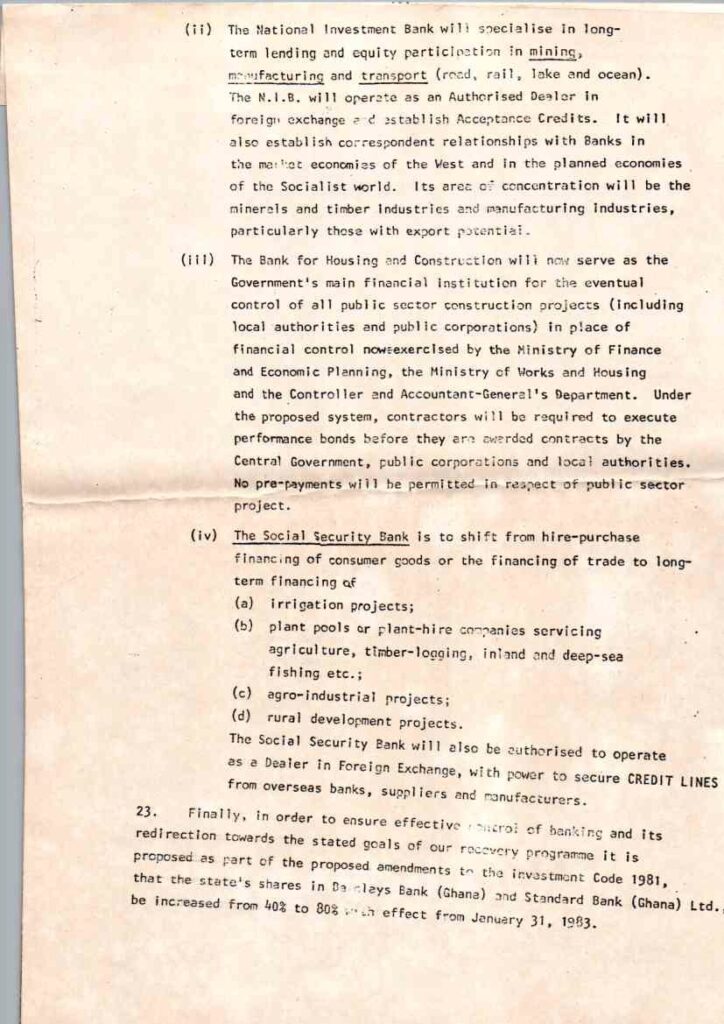
(ii) The National Investment Bank will specialise in long-term lending and equity participation in mining manufacturing and transport (read, rail, lake and ocean). The N.I.B. will operate as an Authorised Dealer in foreign exchange and establish Acceptance Credits. It will also establish correspondent relationships with Banks in the market economies of the West and in the planned economies of the Socialist world. Its area of concentration will be the minerals and timber industries and manufacturing industries, particularly those with export potential.
(iii) The Bank for Housing and Construction will now serve as the Government’s main financial institution for the eventual control of all public sector construction projects (Including local authorities and public corporations) in place of financial control now exercised by the Ministry of Finance and Economic Planning, the Ministry of Works and Housing and the Controller and Accountant-General’s Department. Under the proposed system, contractors will be required to execute performance bonds before they are awarded contracts by the Central Government, public corporations and local authorities. No pre-payments will be permitted in respect of public sector project.
(iv) The Social Security Bank is to shift from hire-purchase financing of consumer goods or the financing of trade to long- term financing of
(a) irrigation projects;
(b) plant pools or plant-hire companies servicing agriculture, timber-logging, inland and deep-sea fishing etc.;
(c) agro-industrial projects;
(d) rural development projects.
The Social Security Bank will also be authorised to operate as a Dealer in Foreign Exchange, with power to secure CREDIT LINES from as overseas banks, suppliers and manufacturers.
- Finally, in order to ensure effective control of banking and its redirection towards the stated goals of our recovery programs, it is proposed as part of the proposed amendment to the investment code 1981, that the state’s shares in Barclays Bank (Ghana) and Standard bank (Ghana) Ltd. be increased from 40% to 80% with effect from January 31, 1963.
A Policy for Insurance
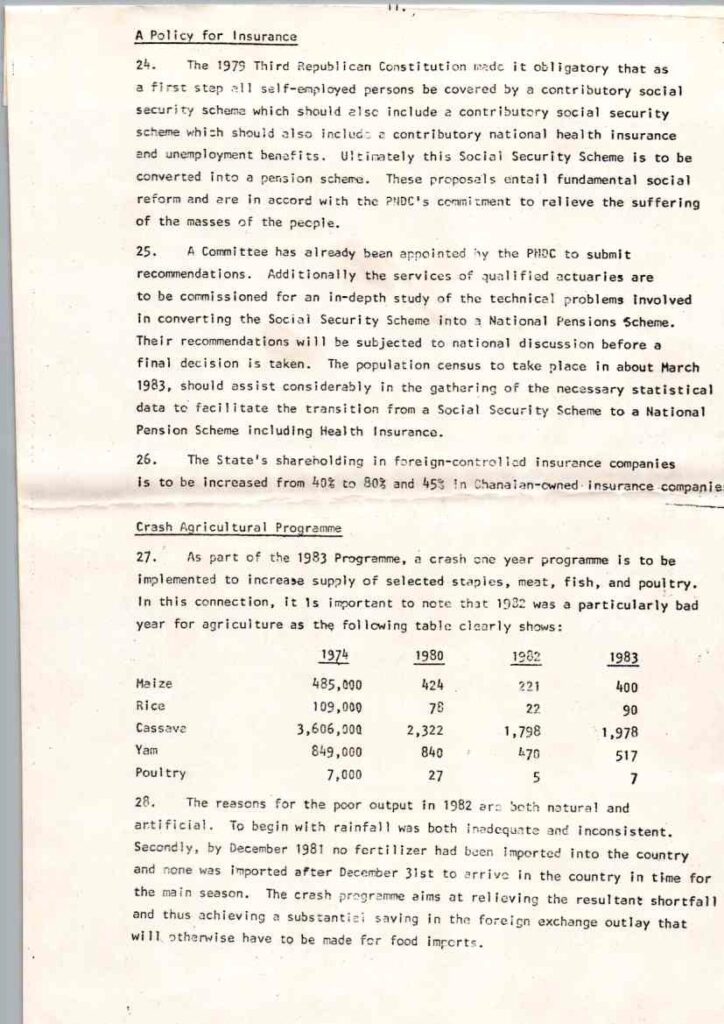
- The 1979 Third Republican Constitution made it obligatory that as a first step all self-employed persons be covered by a contributory social security scheme which should also include a contributory social security scheme which should also include a contributory national health insurance and unemployment benefits. Ultimately this Social Security Scheme is to be converted into a pension scheme. These proposals entail fundamental social reform and are in accord with the PNDC’s commitment to relieve the suffering of the masses of the people.
- A Committee has already been appointed by the PHDC to submit recommendations. Additionally the services of qualified actuaries are to be commissioned for an in-depth study of the technical problems Involved In converting the Social Security Scheme into a National Pensions Scheme. Their recommendations will be subjected to national discussion before a final decision is taken. The population census to take place in about March 1983, should assist considerably in the gathering of the necessary statistical data to facilitate the transition from a Social Security Scheme to a National Pension Scheme including Health Insurance.
- The State’s shareholding in foreign-controlled insurance companies is to be increased from 40% to 80% and 45% in Chanaian-owned insurance companies.
Crash Agricultural Programme
- As part of the 1983 Programme, a crash one year programme is to be implemented to increase supply of selected staples, meat, fish, and poultry. In this connection, it is important to note that 1982 was a particularly bad year for agriculture as the following table clearly shows:
| 1974 | 1980 | 1982 | 1983 | |
| Maize | 485,000 | 424 | 221 | 400 |
| Rice | 109,000 | 78 | 22 | 90 |
| Cassava | 3,606,000 | 2,322 | 1,798 | 1978 |
| Yam | 849,000 | 840 | 470 | 517 |
| Poultry | 7,000 | 27 | 5 | 7 |
- The reasons for the poor output in 1982 are both natural and artificial. To begin with rainfall was both inadequate and inconsistent. Secondly, by December 1981 no fertilizer had been Imported into the country and none was imported after December 31st to arrive in the country in time for the main season. The crash programme aims at relieving the resultant shortfall and thus achieving a substantial saving in the foreign exchange outlay that will otherwise have to be made for food imports.
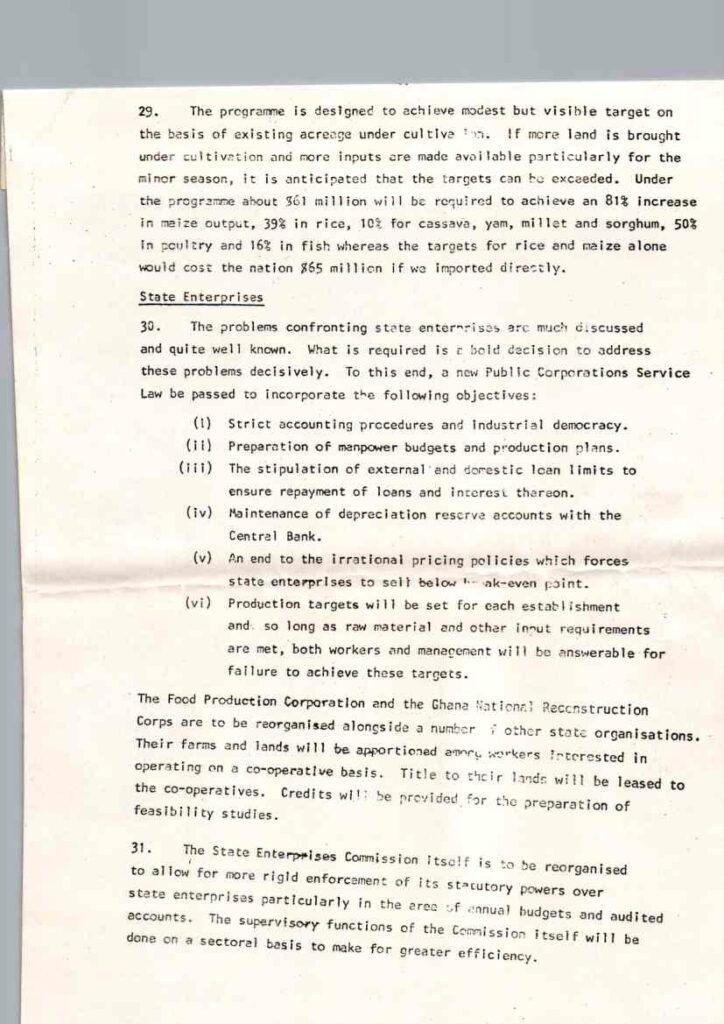
- The programme is designed to achieve modest but visible target on the basis of existing acreage under cultivation. If more land is brought under cultivation and more inputs are made available particularly for the minor season, it is anticipated that the targets can be exceeded. Under the programme about $61 million will be required to achieve an 81% increase in maize output, 39% in rice, 10% for cassava, yam, millet and sorghum, 50% In poultry and 16% in fish whereas the targets for rice and maize alone would cost the nation 865 million if we imported directly.
State Enterprises
- The problems confronting state enterprises are much discussed and quite well known. What is required is a bold decision to address these problems decisively. To this end, a new Public Corporations Service Law be passed to incorporate the following objectives:
(i) Strict accounting procedures and Industrial democracy.
(ii) Preparation of manpower budgets and production plans.
(iii) The stipulation of external and domestic loan limits to ensure repayment of loans and interest thereon.
(iv) Maintenance of depreciation reserve accounts with the Central Bank.
(v) An end to the irrational pricing policies which forces state enterprises to sell below ak-even point. (vi) Production targets will be set for each establishment and so long as raw material and other input requirements are met, both workers and management will be answerable for failure to achieve these targets.
The Food Production Corporation and the Ghana National Reconstruction Corps are to be reorganised alongside a number other state organisations. Their farms and lands will be apportioned amory workers Interested in operating on a co-operative basis. Title to their lands will be leased to the co-operatives. Credits wi!: be provided for the preparation of feasibility studies.
- The State Enterprises Commission Itself is to be reorganised to allow for more rigid enforcement of its statutory powers over state enterprises particularly in the area of annual budgets and audited accounts. The supervisory functions of the Commission itself will be done on a sectoral itself will be basis to make for greater efficiency.
Incomes Policy
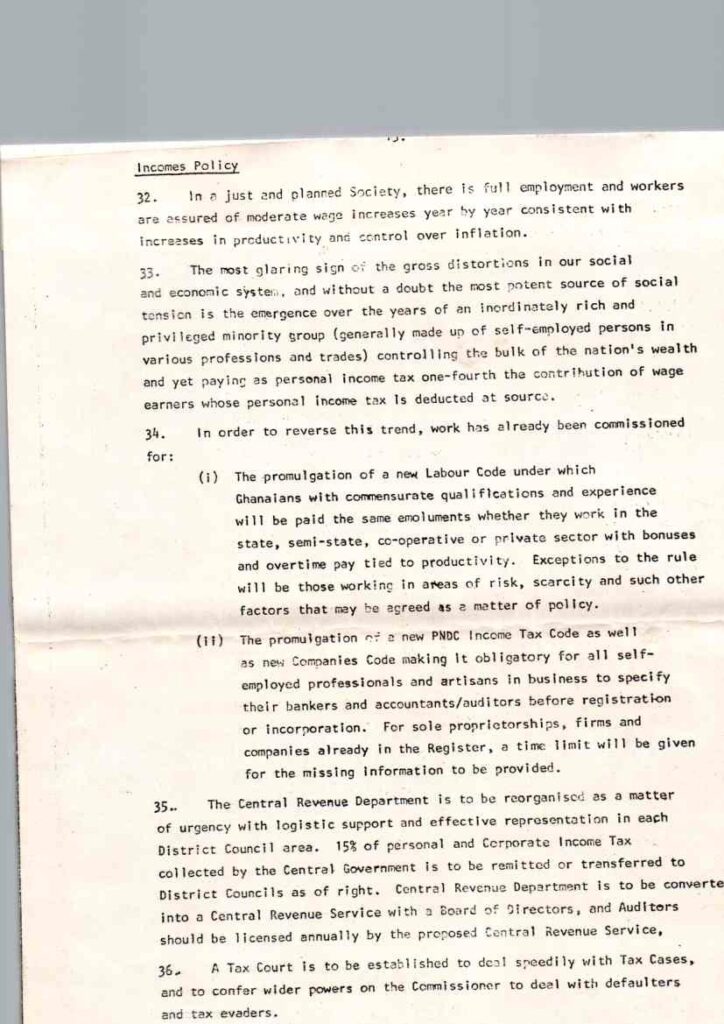
- In a just and planned Society, there is full employment and workers are assured of moderate wage increases year by year consistent with increases in productivity and control over inflation.
- The most glaring sign of the gross distortions in our social and economic system, and without a doubt the most potent source of social tension is the emergence over the years of an inordinately rich and privileged minority group (generally made up of self-employed persons in various professions and trades) controlling the bulk of the nation’s wealth and yet paying as personal income tax one-fourth the contribution of wage earners whose personal income tax is deducted at source.
- In order to reverse this trend, work has already been commissioned for:
(i) The promulgation of a new Labour Code under which Ghanaians with commensurate qualifications and experience will be paid the same emoluments whether they work in the state, semi-state, co-operative or private sector with bonuses and overtime pay tied to productivity. Exceptions to the rule will be those working in areas of risk, scarcity and such other factors that may be agreed as a matter of policy.
(ii) The promulgation of a new PNDC Income Tax Code as well as new Companies Code making It obligatory for all self- employed professionals and artisans in business to specify their bankers and accountants/auditors before registration or incorporation. For sole proprietorships, firms and companies already in the Register, a time limit will be given for the missing information to be provided.
- The Central Revenue Department is to be reorganised as a matter of urgency with logistic support and effective representation in each District Council area. 15% of personal and Corporate Income Tax collected by the Central Government is to be remitted or transferred to District Councils as of right. Central Revenue Department is to be converted into a Central Revenue Service with a Board of Directors, and Auditors should be licensed annually by the proposed Central Revenue Service,
- A Tax Court is to be established to deal speedily with Tax Cases, and to confer wider powers on the Commissioner to deal with defaulters and tax evaders.
Manufacturing
- In the area of manufacturing, the programme envisages (1) a major rationalisation exercise to achieve greater concentration and better economies, (2) better integration between research and production and (3) maximum reliance on our local raw material base.
- The rationalisation exercise will prepare the ground for shedding those industries that have been set up largely as fronts for syphoning foreign exchange out of the country and also critically examining the possibility of merging industries in the same product line to achieve better concentration and the economies of scale.
- The development of our local raw materials base will concentrate on agro-based raw materials, (principally, cotton, kenaf, maize, sugar-cane, shea-butter, groundnuts, copra, coir fibre and rubber) and industrial raw materials such as clays, iron ore and bauxite which the country has large deposits of.
- Some progress has already been made In encouraging the use of local substitutes for hitherto Imported raw materials. The Geological Survey Department has discovered that dorfner clay can be replaced with a local substitute.
- Work on the use of composite cement with the admixture of local limestone is far advanced. It is estimated that the composite cement project could increase local cement supply by about 100,000 tonnes per annum and would save us about $4.4 million a year.
- The programme will pursue the policy of linking research and production. with the greatest vigour in order to consolidate the gains that have already been made and to develop new possibilities. Research institutions will have to produce results or perish.
MACRO-ECONOMIC POLICY
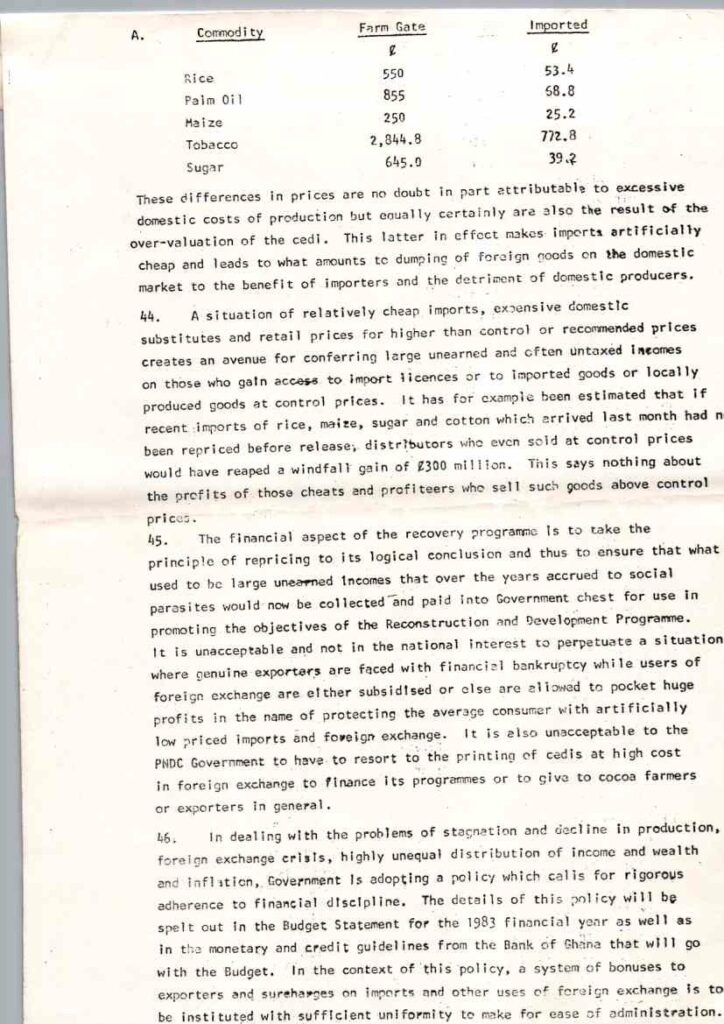
- The socio-economic crisis facing the country manifests itself in severe imbalances in the finances of the Government as well as the finances of various sectors and producing units particularly in the export sector. At the same time a comparison of the landed prices of Imports of agricultural produce like maize, rice, cotton, palm oil and tobacco on the one hand and the wholesale prices of domestically produced substitutes of these same commodities on the other, reveals staggering differences.
Commodity
Farm Gate
Imported
₵
₵
Rice
550
53.4
Palm Oil
855
68.8
Maize
250
25.2
Tobacco
2,844.8
772.8
Sugar
645.0
39.2
These differences in prices are no doubt in part attributable to excessive domestic costs of production but equally certainly are also the result of the over-valuation of the cedi. This latter in effect makes imports artificially cheap and leads to what amounts to dumping of foreign goods on the domestic market to the benefit of importers and the detriment of domestic producers.
- A situation of relatively cheap imports, expensive domestic substitutes and retail prices for higher than control or recommended prices creates an avenue for conferring large unearned and often untaxed Incomes on those who gain access to import licences or to imported goods or locally produced goods at control prices. It has for example been estimated that if recent imports of rice, maize, sugar and cotton which arrived last month had been repriced before release, distributors who even sold at control prices would have reaped a windfall gain of £300 million. This says nothing about the profits of those cheats and profiteers who sell such goods above control prices.
- The financial aspect of the recovery programme Is to take the principle of repricing to its logical conclusion and thus to ensure that what used to be large unearned Incomes that over the years accrued to social parasites would now be collected and paid into Government chest for use in promoting the objectives of the Reconstruction and Development Programme. It is unacceptable and not in the national interest to perpetuate a situation where genuine exporters are faced with financial bankruptcy while users of foreign exchange are either subsidised or else are allowed to pocket huge profits in the name of protecting the average consumer with artificially low priced imports and foreign exchange. It is also unacceptable to the PNDC Government to have to resort to the printing of cedis at high cost in foreign exchange to finance its programmes or to give to cocoa farmers or exporters in general.
- In dealing with the problems of stagnation and decline in production, foreign exchange crisis, highly unequal distribution of income and wealth and inflation, Government is adopting a policy which calls for rigorous adherence to financial discipline. The details of this policy will be spelt out in the Budget Statement for the 1983 financial year as well as in the monetary and credit guidelines from the Bank of Chana that will go with the Budget. In the context of this policy, a system of bonuses to exporters and surcharges on imports and other uses of foreign exchange is to be instituted with sufficient uniformity to make for ease of administration.