Restoration Of Normal Academic Activity In The University: Why The N.C.H.E. Is Interested In This Subject
July 28, 2026
Transcript
National Council For Higher Education
June 1978
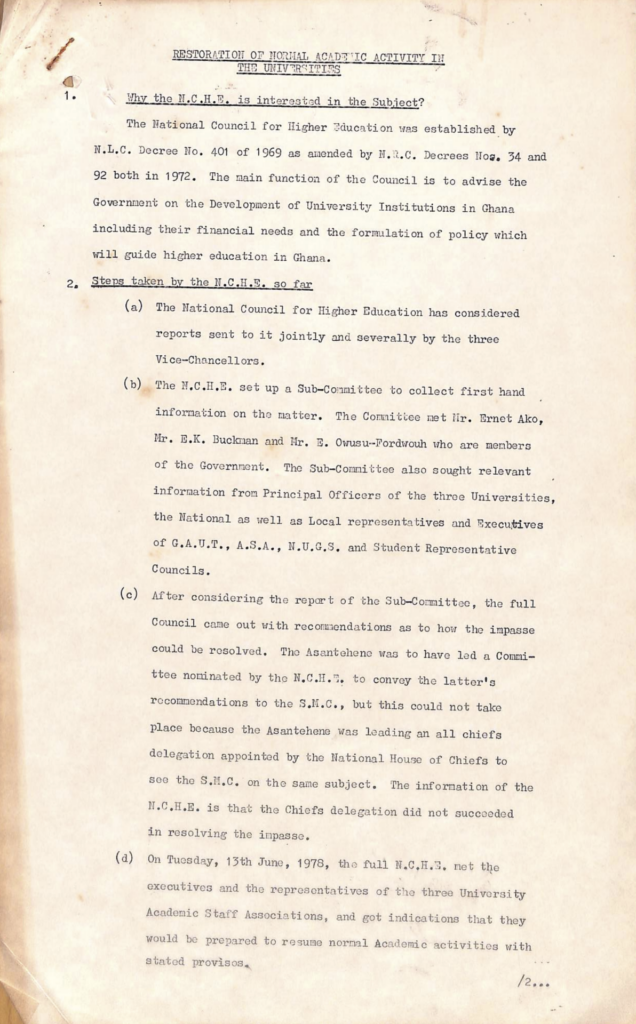
Why the N.C.H.E. is interested in the Subject?
The National Council for Higher Education was established by N.L.C. Decree No. 401 of 1969 as amended by N.R.C. Decrees Nos. 34 and 92 both in 1972. The main function of the Council is to advise the Government on the Development of University Institutions in Ghana including their financial needs and the formulation of policy which will guide higher education in Ghana.
- Steps taken by the N.C.H.E. so far
(a) The National Council for Higher Education has considered reports sent to it jointly and severally by the three Vice-Chancellors.
(b) The N.C.H.E. set up a Sub-Committee to collect first hand information on the matter. The Committee net lir. Ernet Ako, Mr. E.K. Buckman and Mr. E. Owusu-Fordwouh who are members of the Government. The Sub-Committee also sought relevant information from Principal Officers of the three Universities, the National as well as Local representatives and Executives of G.A.U.T., A.S.A., N.U.G.S. and Student Representative Councils.
(c) After considering the report of the Sub-Committee, the full Council came out with recommendations as to how the impasse could be resolved. The Asantehene was to have led a Committee nominated by the N.C.H.. to convey the latter’s recommendations to the S.M.C., but this could not take place because the Asantehene was leading an all chiefs delegation appointed by the National House of Chiefs to see the S.M.C. on the same subject. The information of the N.C.H.E. is that the Chiefs delegation did not succeeded in resolving the impasse.
(d) On Tuesday, 13th June, 1978, the full N.C.H.E. met the executives and the representatives of the three University Academic Staff Associations, and got indications that they would be prepared to resume normal Academic activities with stated provisos.
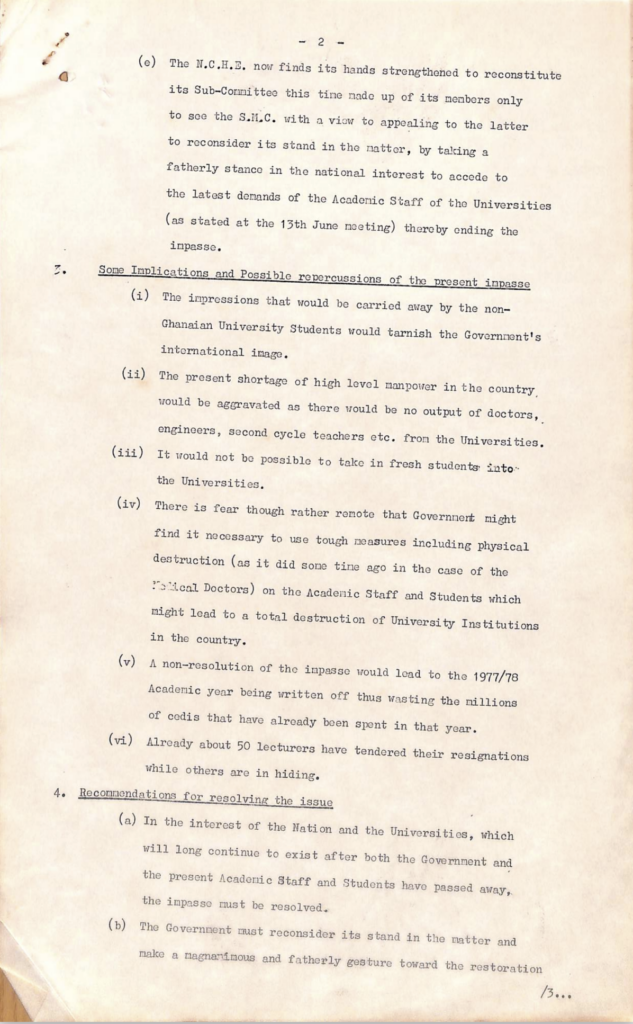
(e) The N.C.H.E. now finds its hands strengthened to reconstitute its Sub-Committee this time made up of its members only to see the S.M.C. with a view to appealing to the latter to reconsider its stand in the matter, by taking a fatherly stance in the national interest to accede to the latest demands of the Academic Staff of the Universities (as stated at the 13th June neeting) there by ending the impasse.
Some implications and possible repercussions of the present impasse
(i) The impressions that would be carried away by the non- Ghanaian University Students would tarnish the Government’s international image.
(ii) The present shortage of high level manpower in the country, would be aggravated as there would be no output of doctors, engineers, second cycle teachers etc. from the Universities.
(iii) It would not be possible to take in fresh students into the Universities.
(iv) There is fear though rather remote that Government might find it necessary to use tough measures including physical destruction (as it did some time ago in the case of the alical Doctors) on the Academic Staff and Students which might lead to a total destruction of University Institutions in the country.
(v) A non-resolution of the impasse would lead to the 1977/78 Academic year being written off thus wasting the millions of cedis that have already been spent in that year.
(vi) Already about 50 lecturers have tendered their resignations while others are in hiding.
Recommendations for resolving the issue
(a) In the interest of the Nation and the Universities, which will long continue to exist after both the Government and the present Academic Staff and Students have passed away, the impasse must be resolved.
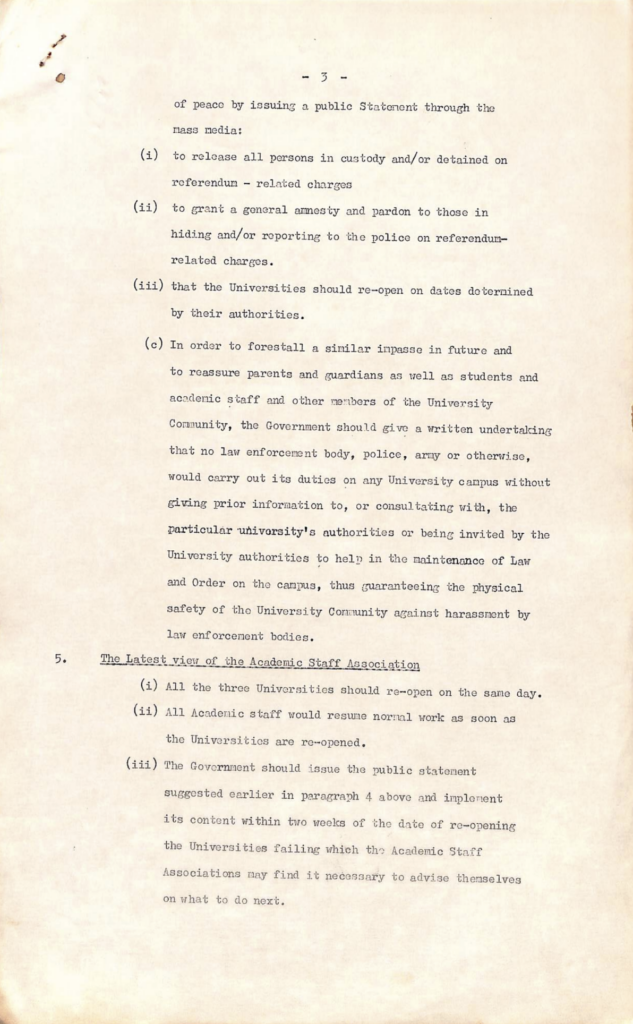
(b) The Government must reconsider its stand in the matter and make a magnanimous and fatherly gesture toward the restoration of peace by issuing a public Statement through the mass media:
(i) to release all persons in custody and/or detained on referendum related charges
(ii) to grant a general amnesty and pardon to those in hiding and/or reporting to the police on referendum- related charges.
(iii) that the Universities should re-open on dates determined by their authorities.
(c) In order to forestall a similar impasse in future and to reassure parents and guardians as well as students and academic staff and other members of the University Community, the Government should give a written undertaking that no law enforcement body, police, army or otherwise, would carry out its duties on any University campus without giving prior information to, or consulting with, the particular university’s authorities or being invited by the University authorities to help in the maintenance of Law and Order on the campus, thus guaranteeing the physical safety of the University Community against harassment by law enforcement bodies.
The Latest view of the Academic Staff Association
(i) All the three Universities should re-open on the same day.
(ii) All Academic staff would resume normal work as soon as the Universities are re-opened.
(iii) The Government should issue the public statement suggested earlier in paragraph 4 above and implement its content within two weeks of the date of re-opening the Universities failing which the Academic Staff Associations may find it necessary to advise themselves on what to do next.