Report Of The Committee Of The National Council For Higher Education On The Restoration Of Normal Academic Activity In The Universities
July 28, 2026
Transcript
National Council For Higher Education
May 31, 1978
31st May, 1978
THE IMMEDIATE CAUSE OF THE PRESENT STOPPAGE
- After several months of unrest at the Universities, normal academic activity finally ground to a complete halt immediately after the referendum. The University authorities, in a bid to salvage what remained of the shattered academic year, brought forward the long vacation and, by the 15th of May, 1978, all three Universities had gone down. The intention is to reopen by the end of June for University of Cape Coast and University of Science and Technology (24th July for Legon) so that, by working through to the end of the calendar year, the academic year 1977/78 might still be saved, leaving the 1978/79 academic year to begin in January, 1979, three months late. In order to achieve this minimum objective of preventing the 1977/78 academic year from having to be completely written off, it is. necessary and urgent to resolve the present impasse at the Universities so that work can proceed smoothly upon resumption as planned.
- While there were bitter complaints and expressions of acute dis- satisfaction on the University campuses regarding the way and manner in which the referendum was conducted, the stoppage of lectures after the re-opening of the Universities in April, following on the referendum, was the result of a resolution which had been passed by GAUT as far back as 25th January, 1977 to the effect that if any University person was arrested and/or detained, this Association would initiate strike action. Members of the University appear to be unshakeable in their conviction that anything less than this expression of solidarity with their fellows in the common struggle would be treacherous and grossly immoral, and stated that they fully realised the possible consequences of their stand and were prepared to bear them.
SOME FACTORS OF THE UNREST ON THE CAMPUSES
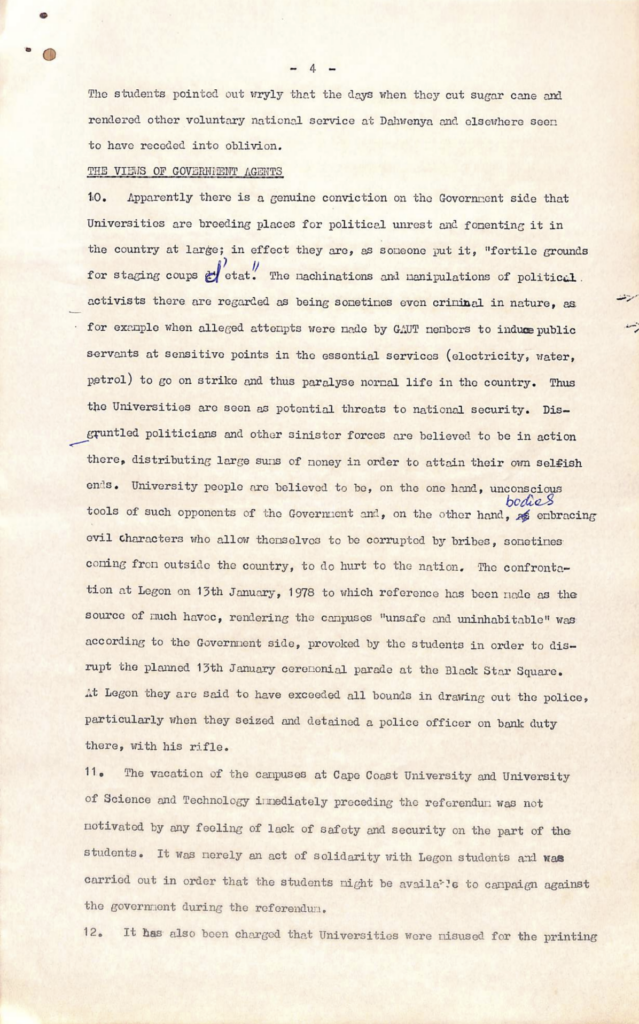
- Our discussions with representatives of the student body and the Academic Staff Associations revealed a deeply seated and (as far as we could judge) absolutely genuine and very strongly felt concern for the state of the economy and developments on the political front.
- The general shortages in essential commodities and the seeming inability of the Government to bring the economy under effective control and to manage it to meet the normal needs of the people; the palpable deterioration in the quality of life and living standards of the average citizen; these matters have been agitating University minds. In their own immediate sphere the shortage of books and basic equipment of all kinds for learning and research, and the growing inadequacy of facilities and supplies in general, have had frustrating effects. Even the quality of teaching is being eroded as University teachers have to spend long hours in search of ordinary household requirements and feel constrained to engage in extraneous money-generating activities in order to supplement their incomes.
- The students in particular emphasised again and again their fear and anxiety about the general political and economic direction of the nation. They complained that the heritage upon which it is their right to enter later is being recklessly squandered and ruined. Their firmly held view is that a sort of totalitarianism is being constructed in which a few hand-picked favourites with their satellites sit upon and manipulate the total national wealth at will, without effective control by Parliament or any other responsible body, and without due regard for the welfare of the totality of the people. They insist that this is not the type of nation they wish to inherit, and feel strongly that in the circumstances it is their plain duty to make their voices heard now.
- While the usual anti-establishment attitude of the youth and their often intemperate language, as well as some of the obvious aberrations of their demonstrations must be discounted, we believe that it is important in this whole matter that the concerns which are moving their spirits and passions so deeply should be clearly seen and understood. Only so can the underlying issues of the present disturbances be realistically and competently grappled with.
THE OUTCOME OF SOME RECENT EVENTS
- The unhappy confrontation between the law-enforcement authorities and students at Legon on 13th January, 1978 (which was paralleled at other institutions elsewhere) has quite clearly resulted in a psychosis of personal insecurity, persecution and uncertainty about the physical safety of the entire University community even including their visitors. This fear is fully shared by parents, guardians and friends. The alleged excessive use of force by the police, their indiscriminate heavy beatings meted out to any- one in sight regardless of who they were and whether or not they had any connection whatsoever with the strife, and their wanton destruction of property, have loft deep scars and suspicions of Government’s motive in the minds of those affected. The situation has only been worsened by the searches of rooms and residences of University staff and students by the police. The view is that a deliberate policy of revenge, harassment and subjection to physical violence is being implemented by the Government and the University people who had been vocal in criticism of the Union Government proposals have been spending successive nights in different places for fear of arrest. Never in our experience have confidence and trust in Government and its agents been at such a low ebb.
- The Government charges that University people had indulged in unwarranted political activity leave the latter baffled and unimpressed. Names were given of University personnel who openly and actively campaigned in favour of the Union Government proposals to a point which might even be regarded as detrimental to their official duties, but who have now been given national assignments by the Government in reward for their stand. Those who entertained the contrary view are now in jail or have to go into hiding for fear of arrest and harassment on the grounds that they indulged in unwarranted political activity. This ostensible application of double standards is felt to be repugnant in the extreme, particularly in view of the fact that prior to the referendum the entire public was being constantly urged to come forward with their frank and free expressions of opinion on the subject. Was this merely a trap to catch the unwary, and if so, is such a trap properly set by the ruling authority?
- The present feeling of acute disillusionment and estrangement must be viewed against the 1972 speech made by the Head of State in Parliament House, in which he singled out the student community for commendation, inviting their active co-operation and promising then opportunities for full participation in national, economic and political life at all levels. The students pointed out wryly that the days when they cut sugar cane and rendered other voluntary national service at Dahwenya and elsewhere seen to have receded into oblivion.
THE VIEWS OF GOVERNMENT AGENTS
- Apparently there is a genuine conviction on the Government side that Universities are breeding places for political unrest and fomenting it in the country at large; in effect they are, as someone put it, “fertile grounds for staging coups d’etat.” The machinations and manipulations of political activists there are regarded as being sometimes even criminal in nature, as for example when alleged attempts were made by GAUT members to induce public servants at sensitive points in the essential services (electricity, water, petrol) to go on strike and thus paralyse normal life in the country. Thus the Universities are seen as potential threats to national security. Disgruntled politicians and other sinister forces are believed to be in action there, distributing large sums of money in order to attain their own selfish ends. University people are believed to be, on the one hand, unconscious bodies tools of such opponents of the Government and, on the other hand, bodies embracing evil characters who allow themselves to be corrupted by bribes, sometimes coming from outside the country, to do hurt to the nation. The confrontation at Legon on 13th January, 1978 to which reference has been made as the source of much havoc, rendering the campuses “unsafe and uninhabitable” was according to the Government side, provoked by the students in order to disrupt the planned 13th January ceremonial parade at the Black Star Square. At Legon they are said to have exceeded all bounds in drawing out the police, particularly when they seized and detained a police officer on bank duty there, with his rifle.
- The vacation of the campuses at Cape Coast University and University of Science and Technology immediately preceding the referendum was not motivated by any feeling of lack of safety and security on the part of the students. It was merely an act of solidarity with Legon students and was carried out in order that the students might be available to campaign against the government during the referendum.
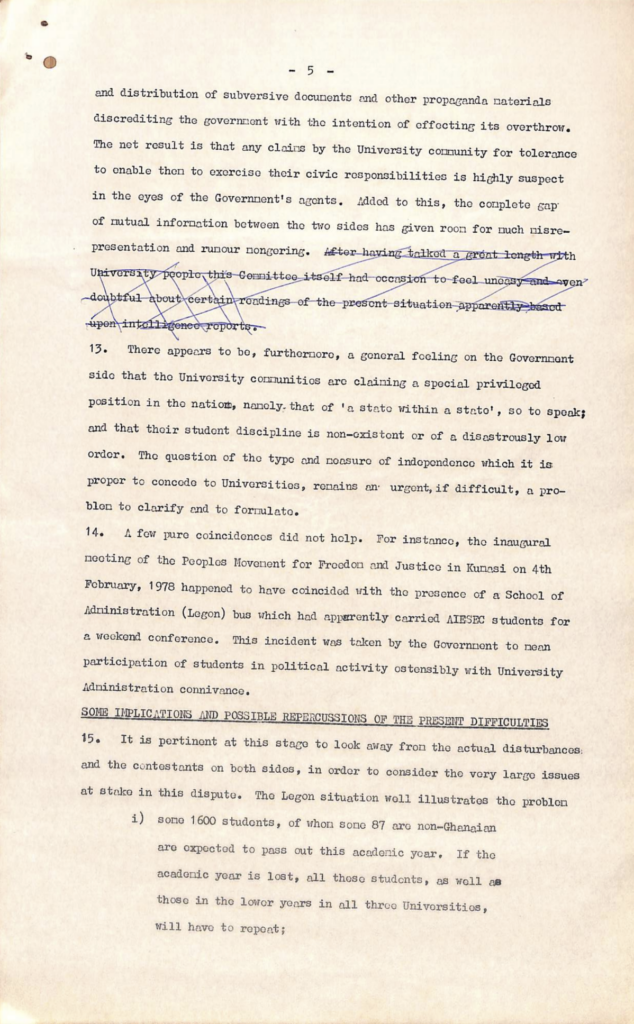
- It has also been charged that Universities were misused for the printing and distribution of subversive documents and other propaganda materials discrediting the government with the intention of effecting its overthrow. The net result is that any claims by the University community for tolerance to enable them to exercise their civic responsibilities is highly suspect in the eyes of the Government’s agents. Added to this, the complete gap of mutual information between the two sides has given room for much misrepresentation and rumor mongering.
After having talked a great length with University people this Committee itself had occasion to feel uneasy and even doubtful about certain roadings of the present situation apparently based upon intelligencereports. - There appears to be, furthermore, a general feeling on the Government side that the University communities are claiming a special privileged position in the nation, namely that of a state within a state, so to speak; and that their student discipline is non-existent or of a disastrously low order. The question of the type and measure of independence which it is proper to concede to Universities, remains an urgent, if difficult, a problem to clarify and to formulate.
- A few pure coincidences did not help. For instance, the inaugural meeting of the Peoples Movement for Freedom and Justice in Kunasi on 4th February, 1978 happened to have coincided with the presence of a School of Administration (Legon) bus which had apparently carried AIESEC students for a weekend conference. This incident was taken by the Government to mean participation of students in political activity ostensibly with University Administration connivance. SOME
IMPLICATIONS AND POSSIBLE REPERCUSSIONS OF THE PRESENT DIFFICULTIES
- It is pertinent at this stage to look away from the actual disturbances: and the contestants on both sides, in order to consider the very large issues at stake in this dispute. The Legon situation well illustrates the problem
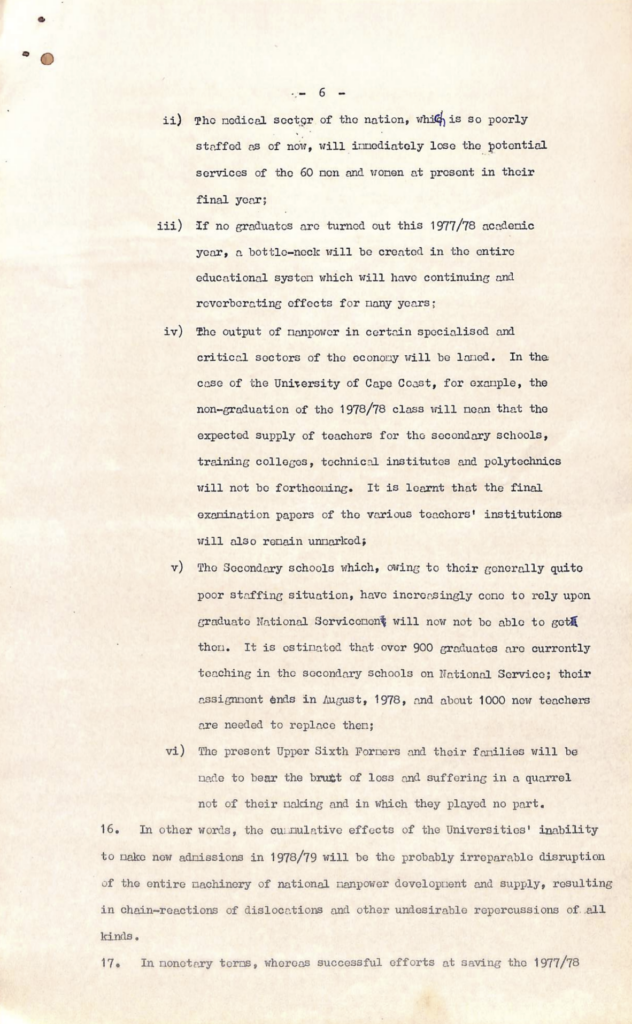
i) some 1600 students, of whom some 87 are non-Ghanaian are expected to pass out this academic year. If the academic year is lost, all these students, as well as those in the lower years in all three Universities, will have to repeat;
ii) The medical sector of the nation, which is so poorly staffed as of now, will immediately lose the potential services of the 60 men and women at present in their final year;
iii) If no graduates are turned out this 1977/78 academic year, a bottle-neck will be created in the entire educational system which will have continuing and reverberating effects for many years;
iv) The output of manpower in certain specialised and critical sectors of the economy will be laned. In the case of the University of Cape Coast, for example, the non-graduation of the 1978/78 class will mean that the expected supply of teachers for the secondary schools, training colleges, technical institutes and polytechnics will not be forthcoming. It is learnt that the final examination papers of the various teachers’ institutions will also remain unmarked;
v) The Secondary schools which, owing to their generally quite poor staffing situation, have increasingly come to rely upon graduate National Servicemen will now not be able to get them. It is estimated that over 900 graduates are currently teaching in the secondary schools on National Service; their assignment ends in August, 1978, and about 1000 new teachers are needed to replace them;
vi) The present Upper Sixth Formers and their families will be made to bear the brunt of loss and suffering in a quarrel not of their making and in which they played no part.
- In other words, the cumulative effects of the Universities’ inability to make new admissions in 1978/79 will be the probably irreparable disruption of the entire machinery of national manpower development and supply, resulting in chain-reactions of dislocations and other undesirable repercussions of all kinds.
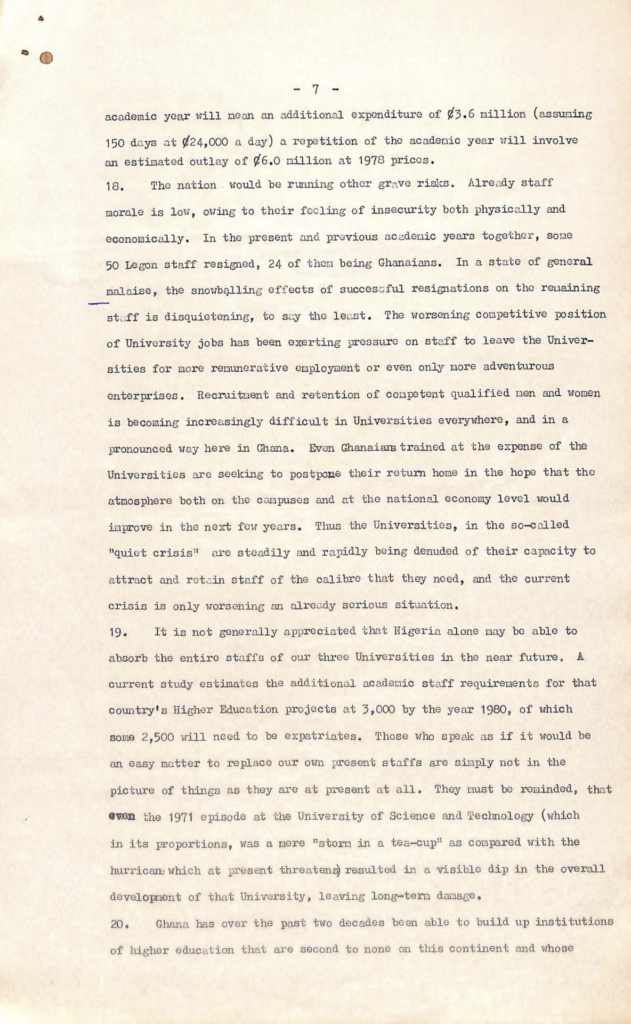
- In monetary terms, whereas successful efforts at saving the 1977/78 academic year will mean an additional expenditure of ₵3.6 million (assuming 150 days at ₵24,000 a day) a repetition of the academic year will involve an estimated outlay of ₵6.0 million at 1978 prices.
- The nation would be running other grave risks. Already staff morale is low, owing to their feeling of insecurity both physically and economically. In the present and previous academic years together, some 50 Legon staff resigned, 24 of them being Ghanaians. In a state of general malaise, the snowballing effects of successful resignations on the remaining staff is disquietening, to say the least. The worsening competitive position of University jobs has been exerting pressure on staff to leave the Universities for more remunerative employment or even only more adventurous enterprises. Recruitment and retention of competent qualified men and women is becoming increasingly difficult in Universities everywhere, and in a pronounced way here in Ghana. Even Ghanaians trained at the expense of the Universities are seeking to postpone their return home in the hope that the atmosphere both on the campuses and at the national economy level would improve in the next few years. Thus the Universities, in the so-called “quiet crisis” are steadily and rapidly being denuded of their capacity to attract and retain staff of the calibre that they need, and the current crisis is only worsening an already serious situation.
- It is not generally appreciated that Nigeria alone may be able to absorb the entire staff of our three Universities in the near future. A current study estimates the additional academic staff requirements for that country’s Higher Education projects at 3,000 by the year 1980, of which some 2,500 will need to be expatriates. Those who speak as if it would be an easy matter to replace our own present staff are simply not in the picture of things as they are at present at all. They must be reminded that even the 1971 episode at the University of Science and Technology (which in its proportions, was a mere “storm in a tea-cup” as compared with the hurricane which at present threatens) resulted in a visible dip in the overall development of that University, leaving long-term damage.
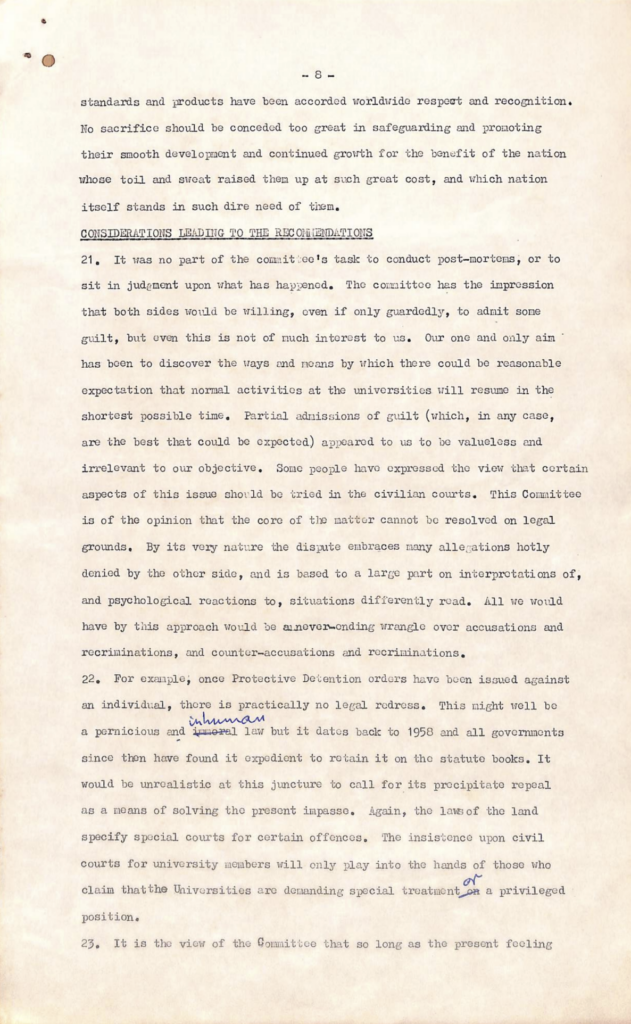
- 20.Ghana has over the past two decades been able to build up institutions of higher education that are second to none on this continent and whose standards and products have been accorded worldwide respect and recognition. No sacrifice should be conceded too great in safeguarding and promoting their smooth development and continued growth for the benefit of the nation whose toil and sweat raised them up at such great cost, and which nation itself stands in such dire need of them.
CONSIDERATIONS LEADING TO THE RECOMMENDATIONS
- It was no part of the committee’s task to conduct post-mortems, or to sit in judgment upon what has happened. The committee has the impression that both sides would be willing, even if only guardedly, to admit some guilt, but even this is not of much interest to us. Our one and only aim has been to discover the ways and means by which there could be reasonable expectation that normal activities at the universities will resume in the shortest possible time. Partial admissions of guilt (which, in any case, are the best that could be expected) appeared to us to be valueless and irrelevant to our objective. Some people have expressed the view that certain aspects of this issue should be tried in the civilian courts. This Committee is of the opinion that the core of the matter cannot be resolved on legal grounds. By its very nature the dispute embraces many allegations hotly denied by the other side, and is based to a large part on interpretations of, and psychological reactions to, situations differently read. All we would have by this approach would be a never-ending wrangle over accusations and recriminations, and counter-accusations and recriminations.
- For example, once Protective Detention orders have been issued against an individual, there is practically no legal redress. This might well be a pernicious and
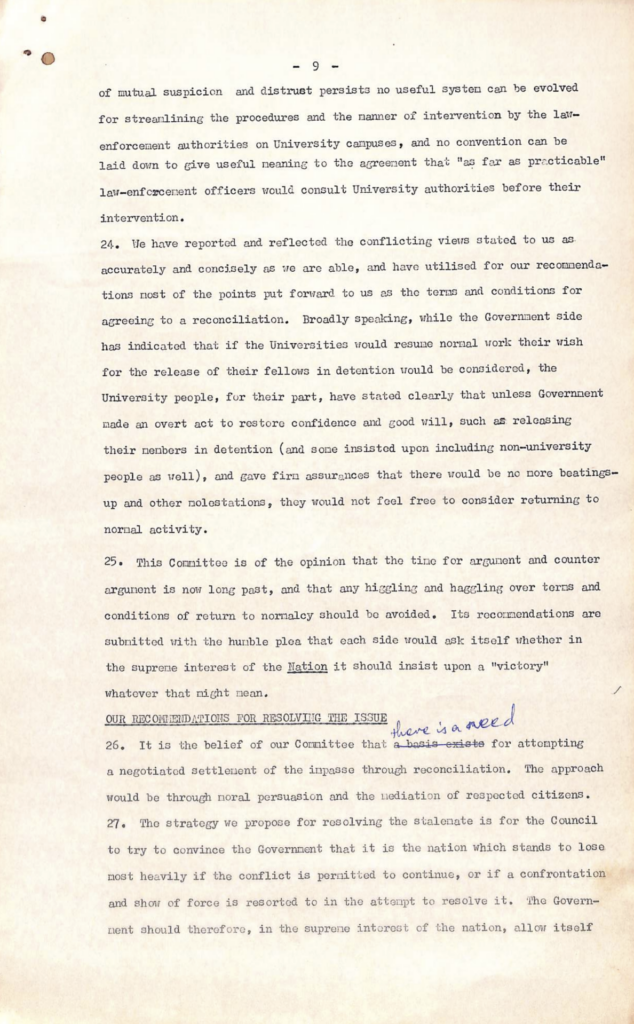
immoralinhumane law but it dates back to 1958 and all governments since then have found it expedient to retain it on the statute books. It would be unrealistic at this juncture to call for its precipitate repeal as a means of solving the present impasse. Again, the laws of the land specify special courts for certain offences. The insistence upon civil courts for university members will only play into the hands of those who claim that the Universities are demanding special treatment on a privileged position. - It is the view of the Committee that so long as the present feeling of mutual suspicion and distrust persists no useful system can be evolved for streamlining the procedures and the manner of intervention by the law- enforcement authorities on University campuses, and no convention can be laid down to give useful meaning to the agreement that “as far as practicable” law-enforcement officers would consult University authorities before their intervention.
- We have reported and reflected the conflicting views stated to us as accurately and concisely as we are able, and have utilised for our recommendations most of the points put forward to us as the terms and conditions for agreeing to a reconciliation. Broadly speaking, while the Government side has indicated that if the Universities would resume normal work their wish for the release of their fellows in detention would be considered, the University people, for their part, have stated clearly that unless Government made an overt act to restore confidence and good will, such as releasing their members in detention (and some insisted upon including non-university people as well), and gave firm assurances that there would be no more beatings-up and other molestations, they would not feel free to consider returning to normal activity.
- This Committee is of the opinion that the time for argument and counter argument is now long past, and that any higgling and haggling over terms and conditions of return to normalcy should be avoided. Its recommendations are submitted with the humble plea that each side would ask itself whether in the supreme interest of the Nation it should insist upon a “victory” whatever that might mean.
OUR RECOMMENDATIONS FOR RESOLVING THE ISSUE
- It is the belief of our Committee that
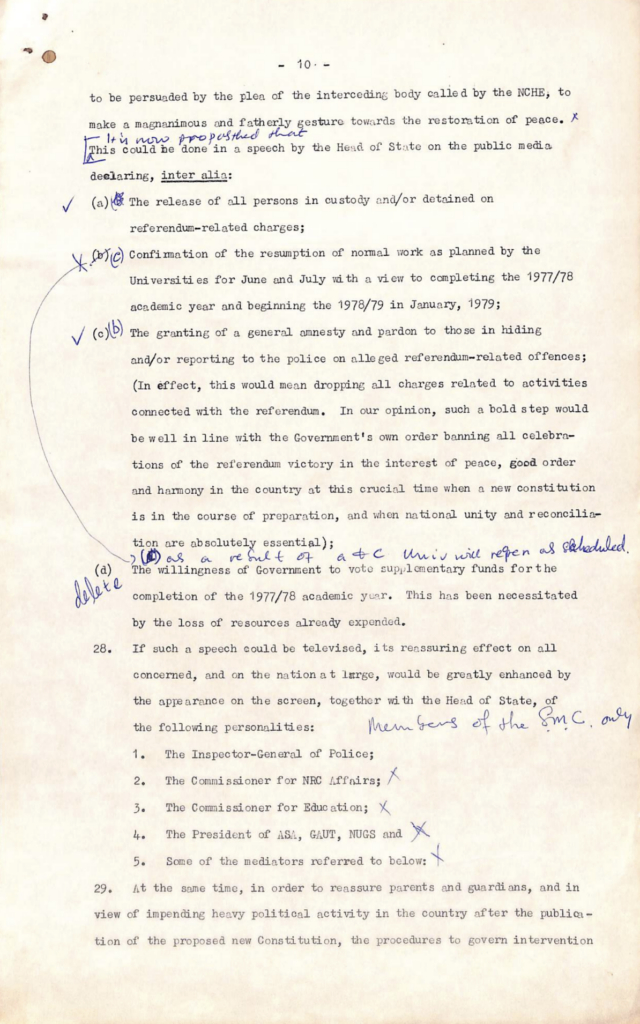
a basis exists - The strategy we propose for resolving the stalemate is for the Council to try to convince the Government that it is the nation which stands to lose most heavily if the conflict is permitted to continue, or if a confrontation and show of force is resorted to in the attempt to resolve it. The Government should therefore, in the supreme interest of the nation, allow itself to be persuaded by the plea of the interceding body called by the NCHE, to make a magnanimous gesture towards the restoration of peace. [It is now proposed that ]This could be done in a speech by the Head of State on the public media declaring, inter alia:
(a) The release of all persons in custody and/or detained on referendum-related charges;
(b) Confirmation of the resumption of normal work as planned by the Universities for June and July with a view to completing the 1977/78 academic year and beginning the 1978/79 in January, 1979;
(c) The granting of a general amnesty and pardon to those in hiding and/or reporting to the police on alleged referendum-related offences; (In effect, this would mean dropping all charges related to activities connected with the referendum. In our opinion, such a bold step would be well in line with the Government’s own order banning all celebrations of the referendum victory in the interest of peace, good order and harmony in the country at this crucial time when a new constitution is in the course of preparation, and when national unity and reconciliation are absolutely essential);
[As a result of a & c university will reopen as scheduled
(d) The willingness of Government to vote supplementary funds for the completion of the 1977/78 academic year. This has been necessitated by the loss of resources already expended. [delete]
- If such a speech could be televised, its reassuring effect on all concerned, and on the nation at large, would be greatly enhanced by the appearance on the screen, together with the Head of State, of the following personalities: [Members of the SMC only]
- The Inspector-General of Police;
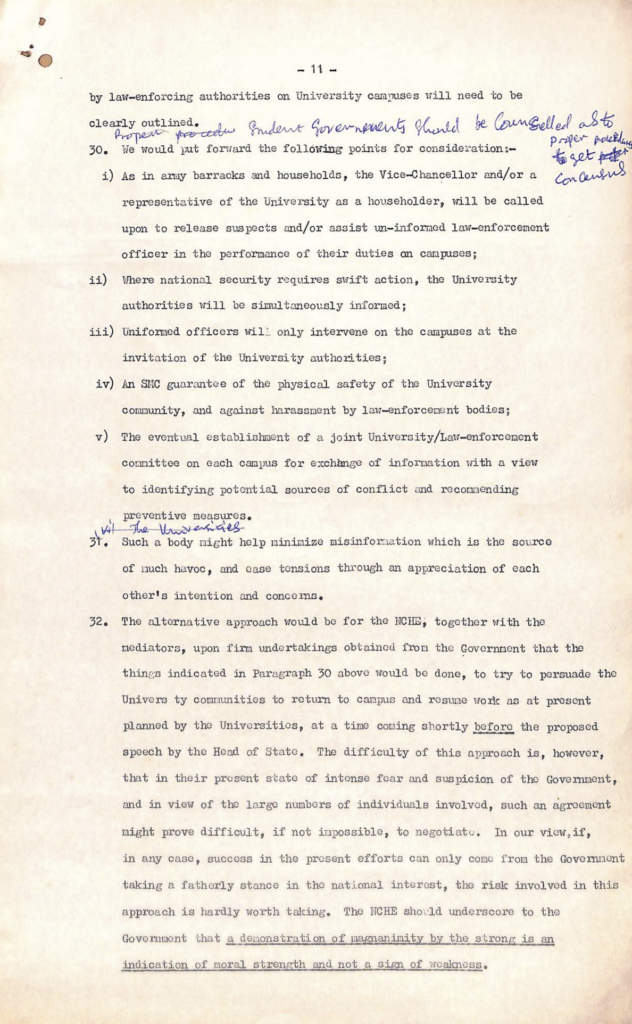
The Commissioner for NRC Affairs;The Commissioner for Education;The President of ASA, GAUT, NUGS andSome of the mediators referred to below:- At the same time, in order to reassure parents and guardians, and in view of impending heavy political activity in the country after the publication of the proposed new Constitution, the procedures to govern intervention by law-enforcing authorities on University campuses will need to be clearly outlined.
[Proper procedure: Student Government should be counseled as to proper process diary to set consensus]
- We would put forward the following points for consideration:-
- i) As in army barracks and households, the Vice-Chancellor and/or a representative of the University as a householder, will be called upon to release suspects and/or assist un-informed law-enforcement officer in the performance of their duties on campuses;
- ii) Where national security requires swift action, the University authorities will be simultaneously informed;
iii) Uniformed officers will only intervene on the campuses at the invitation of the University authorities;
- iv) An SMC guarantee of the physical safety of the University community, and against harassment by law-enforcement bodies;
- v) The eventual establishment of a joint University/Law-enforcement committee on each campus for exchange of information with a view to identifying potential sources of conflict and recommending preventive measures.
- Such a body might help minimize misinformation which is the source of much havoc, and ease tensions through an appreciation of each other’s intention and concerns.
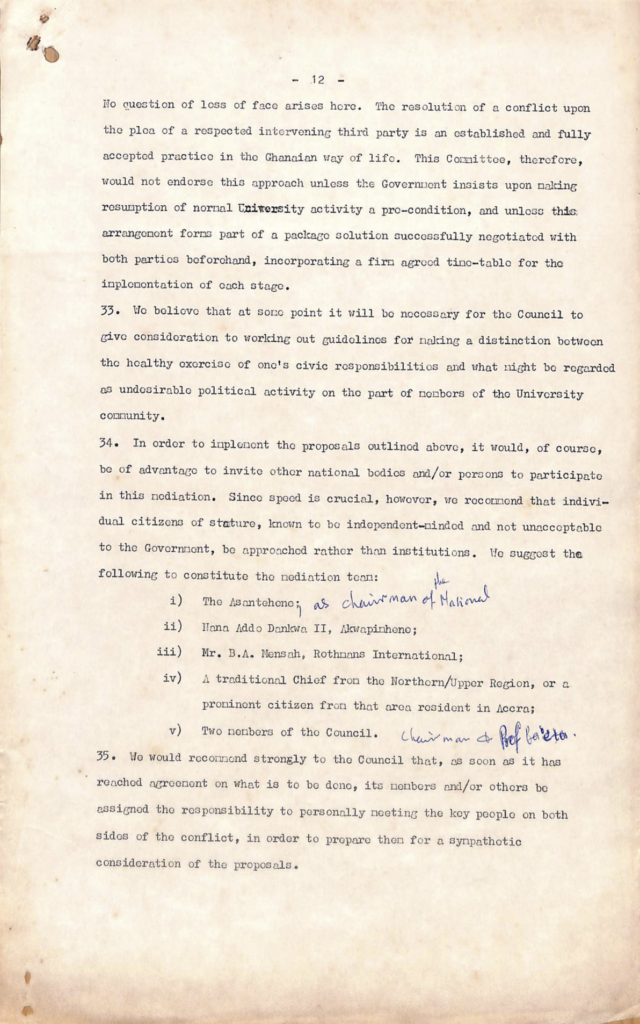
- The alternative approach would be for the NCHE, together with the mediators, upon firm undertakings obtained from the Government that the things indicated in Paragraph 30 above would be done, to try to persuade the Univers ty communities to return to campus and resume work as at present planned by the Universities, at a time coming shortly before the proposed speech by the Head of State. The difficulty of this approach is, however, that in their present state of intense fear and suspicion of the Government, and in view of the large numbers of individuals involved, such an agreement might prove difficult, if not impossible, to negotiate. In our view, if, in any case, success in the present efforts can only come from the Government taking a fatherly stance in the national interest, the risk involved in this approach is hardly worth taking. The NCHE should underscore to the Government that a demonstration of magnanimity by the strong is an indication of moral strength and not a sign of weakness. No question of loss of face arises here. The resolution of a conflict upon the plea of a respected intervening third party is an established and fully accepted practice in the Ghanaian way of life. This Committee, therefore, would not endorse this approach unless the Government insists upon making resumption of normal University activity a pro-condition, and unless this arrangement forms part of a package solution successfully negotiated with both parties beforehand, incorporating a firm agreed tinc-table for the implementation of each stage.
- We believe that at some point it will be necessary for the Council to give consideration to working out guidelines for making a distinction between the healthy exercise of one’s civic responsibilities and what might be regarded as undesirable political activity on the part of members of the University community.
- In order to implement the proposals outlined above, it would, of course, be of advantage to invite other national bodies and/or persons to participate in this mediation. Since speed is crucial, however, we recommend that indivi- dual citizens of stature, known to be independent-minded and not unacceptable to the Government, be approached rather than institutions. We suggest the following to constitute the mediation team: The Asantehene
- i) The Asantehene; [as chairman of the National]
- ii) Nana Addo Dankwa II, Akwapimhene;
iii) Mr. B.A. Mensah, Rothmans International;
iv) A traditional Chief from the Northern/Upper Region, or a prominent citizen from that area resident in Accra;
v) Two members of the Council.
35. We would recommend strongly to the Council that, as soon as it has reached agreement on what is to be done, its members and/or others be assigned the responsibility to personally meeting the key people on both sides of the conflict, in order to prepare them for a sympathetic consideration of the proposals.