Publication Of The Report Of The Commission Of Enquiry Into The Financial Administration Of The University
July 3, 2026


Transcript
National Council For Higher Education
April 8, 1971
The student leaders were informed that the University Council, at its meeting on 11th March, 1971, had decided to publish the report, and the Vice-Chancellor had in fact announced this in his Congregation address.
B. EXAMINATION FEES
As regards the allegation that charges raised by Legon were “too exorbitant”, the Chairman explained that as a matter of fact examination fees had remained unchanged since the University’s inception, as would be seen from the following figures:-
a) 1948 – 61
Part I – Science £8)
Part II – 11 £12
= £20
B.A. General £18
B.A. Honours £20
b) 1961-
F.U.E. Science N₵4.00
S.U.E. Science N18.00
Final Science N₵18.00
= N₵40.00
F.U.E. Arts N₵4.00
Final N₵36.00
=N₵40.00
Since 1961 the University had become autonomous, and had taken over responsibility for the conduct of examinations from London University. This responsibility had increased costs considerably. The devaluation had also affected expenditure. In spite of these developments, which would clearly justify increases in fees, the University continues to retain the same fees in 1970/71 as obtained in 1948-61.
C. BOOKSHOP PRICES
It had been alleged that prices in this University “are too dear, though the University makes enormous profits on book sales” and a demand for reduction in prices had been made.
This particular ‘grievance’ clearly stemmed from a publication in the student newspaper – “The Echo” – which had reported that a Law book selling at N45.00 in Kumasi costs N15.00 at Legon. No reference had been made to the edition of the books. It would appear, however, that the cost of the paper-back edition of the particular book Megarry and Wade’s ‘Manual of Real Property’ had been confused with that of the bound edition. Again it had been claimed that ball pens were being sold at 12Np at the University Bookshop but at only 10Np at the University Post Office. Investigations had revealed that the manufacturers of the ball pens had traced to Legon part of large quantities of their stolen stocks. Presumably the cheaper pons being sold at the Legon Post Office belonged to this stock. The Police were, in fact, investigating the matter. It was significant that the “Echo” had failed to publish the true facts when the Manager of the Bookshop wrote to correct the publication.
It might be pointed out here that it is the confirmed policy of the University not to mark-up prices of text books recommended for student use, which means that apart from the devaluation adjustment, students buy books at the published prices i.e. the price at which they are sold in the countries of origin. The 10 per cent surcharge now imposed on books, which is not being transferred to the student, means that the University is in fact heavily subsidising student text books.
D. CAMPUS SECURITY SYSTEM
The main grievance here related to the check system on taxis. It was explained to the student leaders that this system had been introduced to safeguard life and property on the campus. The crime wave on the campus was on the increase, and quite recently a Visiting Professor and his wife had been held up by unidentified persons in a taxi, slashed with a razor blade, deprived of their money and their car had been driven off. This had happened on the campus. Under the new system taxi drivers were required to deposit their licences at the check point before being permitted to enter. On their return they would be searched and given back their licences. Since the introduction of this system it has been noted that a great number of persons in control of taxis at night are not bona-fide drivers, and as a result cannot produce their licences. They had therefore had to deposit their passengers at the gate, While appreciating the inconvenience which the passengers were put to, and agreeing to consider ways and means of removing this difficulty, the Chairman had also expressed the hope that students would take the trouble to ensure that taxis they hired at night to the campus were controlled by bona-fide drivers.
Student proposals for linking the two main entrances with telephones, improving the calibre of the security guards at the gates, closure of certain unauthorised routes to the campus proposals already discussed at the Residence Board on 2nd March, 1971 were again raised. A new proposal submitted by the student leaders was that, in addition to the check on drivers licenses, students would also produce their identity cards. It was agreed that this would help considerably not only in facilitating the movement of taxis but also in effecting greater security control, since several people were posing as students.
E. TRANSPORT SYSTEM
The student request under this heading was that five buses be placed at their disposal. When the pressures on the University transport system had been explained to the leaders, they asked for a resumption of the former Saturday bus service into Accra, on the understanding that students would pay appropriate service was This was agreed to, on the condition that if the service was not patronised and the University was running at a loss, the University would be forced to discontinue it.
It was further agreed that the leaders should also examine possible ways of easing transportation difficulties between Legon and Accra and submit proposals to the Residence Board.
F. STUDENT REPRESENTATION ON UNIVERSITY BODIES
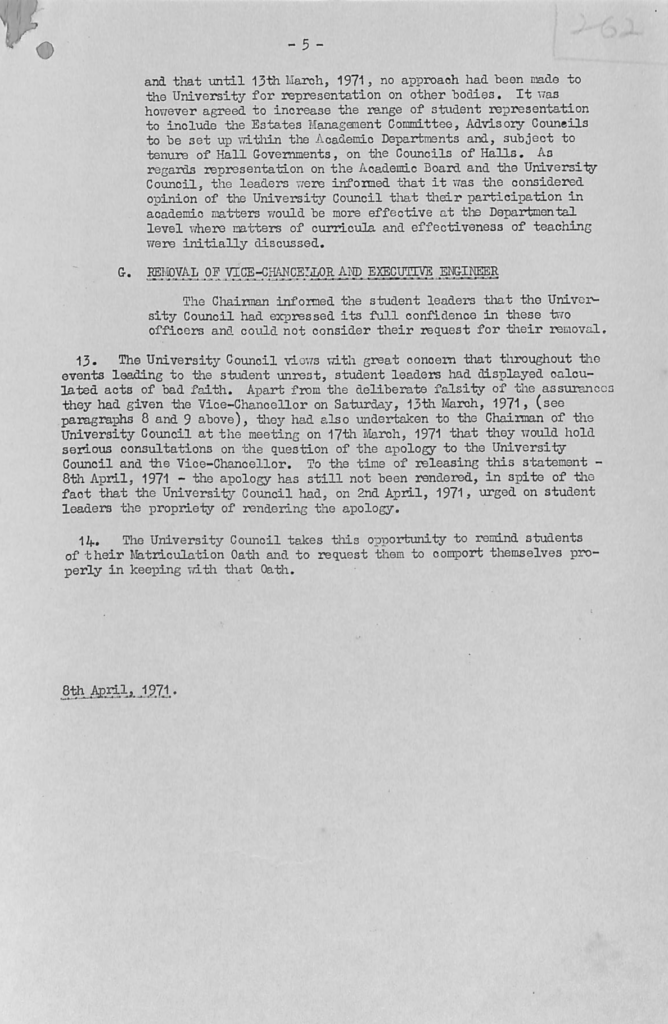
It was noted that students had representation on the Residence Board, the Bookshop Board, the Medical Services Board and the Management Committee of the Central Cafeteria, and that until 13th March, 1971, no approach had been made to the University for representation on other bodies. It was however agreed to increase the range of student representation to include the Estates Management Committee, Advisory Councils to be set up within the Academic Departments and, subject to tenure of Hall Governments, on the Councils of Halls. As regards representation on the Academic Board and the University Council, the leaders were informed that it was the considered opinion of the University Council that their participation in academic matters would be more effective at the Departmental level where matters of curricula and effectiveness of teaching were initially discussed.
E. REMOVAL OF VICE-CHANCELLOR AND EXECUTIVE ENGINEER
The Council Chairman informed student confidence leaders that The University Council had expressed its full confidence in these two officers and could not consider their request for their removal.
- The University Council views with great concern that throughout the events leading to the student unrest, student leaders had displayed calculated acts of bad faith. Apart from the deliberate falsity of the assurances they had given the Vice-Chancellor on Saturday, 13th March, 1971, (see paragraphs 8 and 9 above), they had also undertaken to the Chairman of the University Council at the meeting on 17th March, 1971 that they would hold serious consultations on the question of the apology to the University Council and the Vice-Chancellor. To the time of releasing this statement – 8th April, 1971 – the apology has still not been rendered, in spite of the fact that the University Council had, on 2nd April, 1971, urged on student leaders the propriety of rendering the apology.
- The Matriculation University Council takes this opportunity to remind students of their Matriculation Oath and to request them to comport themselves properly in keeping with that Oath.
8th April, 1971.