Press Release – Students Demonstrations
July 1, 2026



Transcript
National Council For Higher Education
October 25, 1968
In the evening of Sunday 20th October, 1968, at about 11 p.m., it got to the notice of certain officials of the University that there had been some disorder around Mensah Sarbah Hall. It was later learnt from certain students that they had decided on that evening to boycott formal dinner and that as they were going out of the Hall after the boycott they were confronted by police who ordered them to disperse and later attacked them. It is now understood that the police, having had information about preparations for disturbances in that Hall, had come to forestall any possible serious disorder. Throughout the night of Sunday to Monday, large groups of students paraded the University campus shouting, and retired to their Halls only in the early hours of Monday.
On Monday morning, large numbers of students were seen engaged in noisy and even violent demonstrations on the University campus, doing physical damage to persons and to University and private property. They erected road blocks, boycotted lectures and it is understood that certain students, particularly first-year students, who had turned up for lectures, were intimidated and thrown out of lecture rooms. Around mid-day, the Pro- Vice-Chancellor met a delegation of students purporting to be a properly constituted representative body of the student population who presented to him a petition in which grievances of the students had been outlined. This petition, in effect, demanded:
(i) the resignation of the Master of Mensah Sarbah Hall from that Office;
(ii) rescission “forthwith” of a disciplinary action taken by Mensah Sarbah Hall and approved by the Vice-Chancellor, through recalling the four students who had been sus- pended and
(iii) immediate release of the examination results of a fifth student, which had been withheld following the same disciplinary action.
In the course of the discussions between the Pro-Vice-Chancellor and the students’ representatives, when serious efforts were being made to resolve the issues, information reached the Pro-Vice-Chancellor that a group of students had attacked the residence of the Master of Mensah Sarbah Hall with stones, smashing glass panes, damaging other property and causing injuries to a member of the household. Furthermore, a report reached the Pro-Vice-Chancellor that a Senior Member of the University had been attacked and his car damaged. At this stage the Pro-Vice-Chancellor, who for fear of aggravating the situation, had requested the police not to come on the scene until he himself called them in, decided
to obtain police protection for the residence of the laster of Sarbah Hall. It should be noted that until that moment the Taster of Mensah Sarbah Hall, who had good cause to suspect such an invasion of his house by riotous students had been trying in vain, to get police protection and that the Master’s failure to obtain such protection was due wholly to the fact that the Pro-Vice-Chancellor had requested the police to keep away until he himself had called them in.
At 4.00 p.m. on the same day, an emergency meeting of the Executive Committee of the Academic Board summoned by the Pro-Vice- Chancellor, met to consider the petition which the students had presented to him earlier in the day.
The Executive Committee, having considered the petition of the students, made the following points:-
(i) that it deplored the violent and undisciplined behaviour of the students;
(ii) that it was not prepared, then or at any future time, to consider any student submissions under threats of any kind;
(iii) that any demand from the students for the resignation of a Senior Member of the University was grossly improper.
After taking the opportunity to express its full confidence in the Master of Mensah Sarbah Hall, the Executive Committee stressed that there were well established procedures in the University for dealing with student grievances and requests, and that the Committee expected these procedures to be observed by the students. The Executive Committee assured the students that the University was always prepared to consider any requests properly submitted by them. It required all students:-
(i) to resume attendance at lectures and classes as from 7.30 a.m. on the following day, Tuesday, 22nd October, 1968;
(ii)to comply with all University and Hall regulations;
(iii)to submit an apology to the University for the acts of
lawlessness committed by them;
(iv) to refrain from further acts of violence, including demonstrations, processions and obstruction to traffic, which had been a feature of the demonstrations.
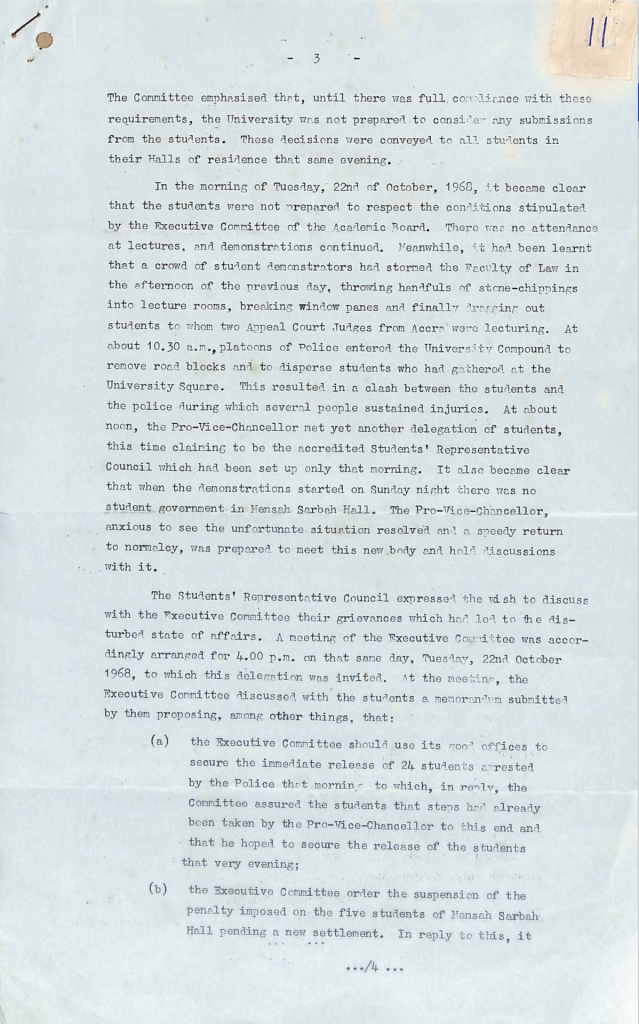
The Committee emphasised that, until there was full. compliance with these requirements, the University was not prepared to consider any submissions from the students. These decisions were conveyed to all students in their Halls of residence that same evening.
In the morning of Tuesday, 22nd of October, 1968, it became clear that the students were not prepared to respect the conditions stipulated by the Executive Committee of the Academic Board. There was no attendance at lectures, and demonstrations continued. Meanwhile, it had been learnt that a crowd of student demonstrators had stormed the Faculty of Law in the afternoon of the previous day, throwing handfuls of stone-chippings into lecture rooms, breaking window panes and finally dragging out students to whom two Appeal Court Judges from Accra were lecturing. At about 10.30 a.m., platoons of Police entered the University Compound to remove road blocks and to disperse students who had gathered at the University Square. This resulted in a clash between the students and the police during which several people sustained injuries. At about noon, the Pro-Vice-Chancellor met yet another delegation of students, this time claiming to be the accredited Students’ Representative Council which had been set up only that morning. It also became clear that when the demonstrations started on Sunday night there was no
student government in Mensah Sarbah Hall. The Pro-Vice-Chancellor, anxious to see the unfortunate situation resolved and a speedy return to normalcy, was prepared to meet this new body and hold discussions with it.
The Students’ Representative Council expressed the wish to discuss with the Executive Committee their grievances which had led to the disturbed state of affairs. A meeting of the Executive Committee was accordingly arranged for 4.00 p.m. on that same day, Tuesday, 22nd October 1968, to which this delegation was invited. At the meeting, the Executive Committee discussed with the students a memorandum submitted by them proposing, among other things, that:
(a)the Executive Committee should use its good offices to secure the immediate release of 24 students arrested by the Police that morning to which, in reply, the Committee assured the students that steps had already been taken by the Pro-Vice-Chancellor to this end and that he hoped to secure the release of the students that very evening;
(b) the Executive Committee order the suspension of the penalty imposed on the five students of Mensah Sarbah Hall pending a new settlement. In reply to this, it was explained at length to the students that in disciplinary matters any aggrieved student had a right of appeal first to the Vice-Chancellor and, if necessary, to the University Council. But it was stressed that only the aggrieved students themselves could appeal but not the whole student body on their behalf. It was therefore improper for the student body to take up the case of the students concerned, let alone the manner in which they were doing so.
It was agreed at this meeting between the Executive Committee and the Students’ Representative Council that:
(a) the University would set up immediately, an Appeal Committee to determine any appeals from the students under discipline:
(b) that should any of the appeals succeed, the period spent by the appellants outside the University as part of their punishment would not affect their residence requirements: the Appeal Committee would also be given power to decide whether the penalty imposed on each appellant should be suspended and the appellant permitted to come into residence pending the determination of the appeal;
(c) students would make nominations for service on the Appeal Committee. In the event of the membership being five, they would nominate two persons, and in the event of the membership being three, they would nominate one person. The Executive Committee also agreed to the requests by the students that:
(i) the Chairman of the Committee should be on eminent lawyer,
And
(ii) the setting up of the Committee should proceed with the greatest possible dispatch.
The Students’ Representative Council then undertook to discuss the above agreements with the student body and to report back to the Pro- Vice-Chancellor at 8 o’clock the following morning. Earlier in the afternoon, when it was raining, a group of students again attacked the house of the Master of Mensah Sarbah Hall with stones, cudgels and bottles, and in the process seriously injured two policemen who had been posted there on guard duties at the request of the University. This brought the number of attacks on the house of the Master of Mensah Sarbah Hall to three since Sunday evening.
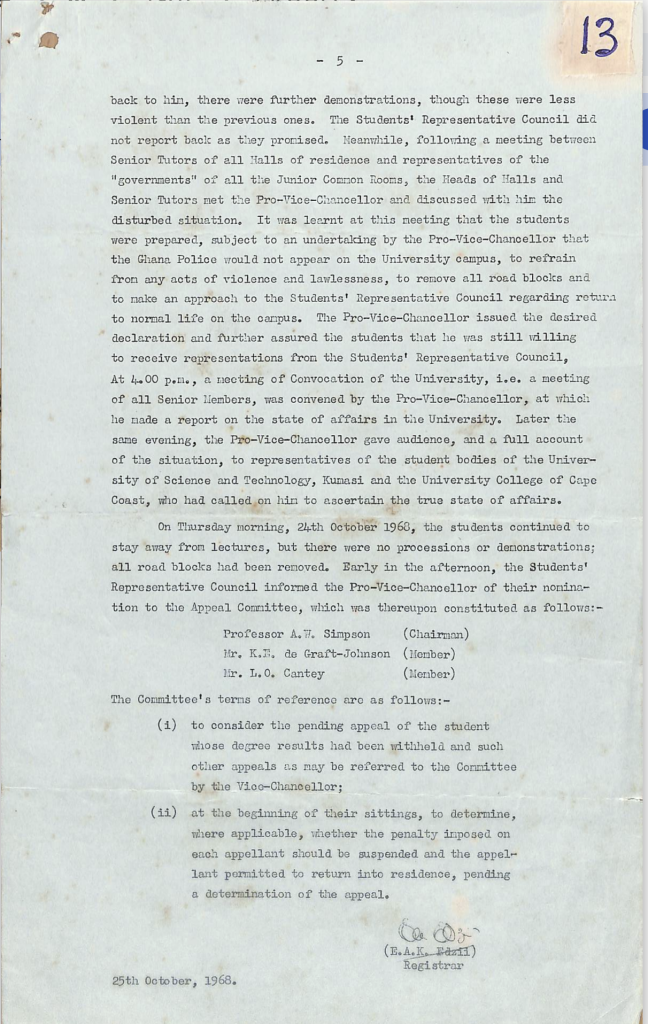
In the morning of Wednesday, 23rd October, while the Pro-Vice- Chancellor was waiting for the Students Representative Council to report back to him, there were further demonstrations, though these were less violent than the previous ones. The Students’ Representative Council dià not report back as they promised. Meanwhile, following a meeting between Senior Tutors of all Halls of residence and representatives of the “governments” of all the Junior Common Rooms, the Heads of Halls and Senior Tutors met the Pro-Vice-Chancellor and discussed with him the disturbed situation. It was learnt at this meeting that the students were prepared, subject to an undertaking by the Pro-Vice-Chancellor that the Ghana Police would not appear on the University campus, to refrain from any acts of violence and lawlessness, to remove all road blocks and to make an approach to the Students’ Representative Council regarding return to normal life on the campus. The Pro-Vice-Chancellor issued the desired declaration and further assured the students that he was still willing to receive representations from the Students’ Representative Council, At 4.00 p.m., a meeting of Convocation of the University, i.e. a meeting of all Senior Members, was convened by the Pro-Vice-Chancellor, at which he made a report on the state of affairs in the University. Later the same evening, the Pro-Vice-Chancellor gave audience, and a full account of the situation, to representatives of the student bodies of the University of Science and Technology, Kumasi and the University College of Cape Coast, who had called on him to ascertain the true state of affairs.
On Thursday morning, 24th October 1968, the students continued to stay away from lectures, but there were no processions or demonstrations; all road blocks had been removed. Early in the afternoon, the Students’ Representative Council informed the Pro-Vice-Chancellor of their nomination to the Appeal Committee, which was thereupon constituted as follows:-
Professor A. W. Simpson (Chairman)
Mr. K.. de Graft-Johnson (Member)
Mir. L. 0. Cantey (Member)
The Committee’s terms of reference are as follows:
(i) to consider the pending appeal of the student whose degree results had been withheld and such other appeals as may be referred to the Committee by the Vice-Chancellor;
(ii) at the beginning of their sittings, to determine, where applicable, whether the penalty imposed on each appellant should be suspended and the appellant permitted to return into residence, pending a determination of the appeal.
(E.A. K. Fazii)
Registrar
25th October, 1968.