National Council For Higher Education’s Discussion With Head Of State
August 2, 2026

Transcript
National Council For Higher Education
June 14, 1978
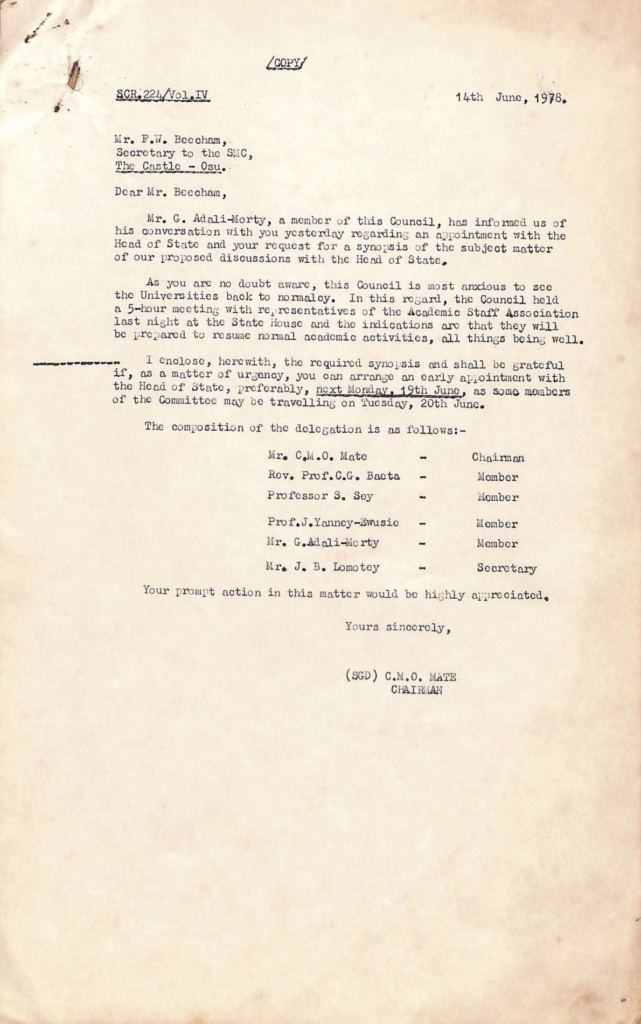
14th June, 1978.
Mr. F.W. Beecham,
Secretary to the SMC,
The Castle Osu.
Dear Mr. Beecham, Mr. G. Adali-Morty, a member of this Council, has informed us of his conversation with you yesterday regarding an appointment with the Head of State and your request for a synopsis of the subject matter of our proposed discussions with the Head of State.
As you are no doubt aware, this Council is most anxious to see the Universities back to normalcy. In this regard, the Council held a 5-hour meeting with representatives of the Academic Staff Association last night at the State House and the indications are that they will be prepared to resume normal academic activities, all things being well.
I enclose, herewith, the required synopsis and shall be grateful if, as a matter of urgency, you can arrange an early appointment with the Head of State, preferably, next Monday, 19th June, as some members of the Committee may be travelling on Tuesday, 20th June.
The composition of the delegation is as follows:
Mr. C.M.O. Mate Chairman
Rev. Prof.C.G. Bacta Momber
Professor S. Sey Momber
Prof.J.Yanney-Ewusie Member
Mr. G.Adali-Morty Member
Mr. J. B. Lomotey Secretary
Your prompt action in this matter would be highly appreciated.
Yours sincerely,
(SGD) C.M.O. MATE
CHAIRMAN
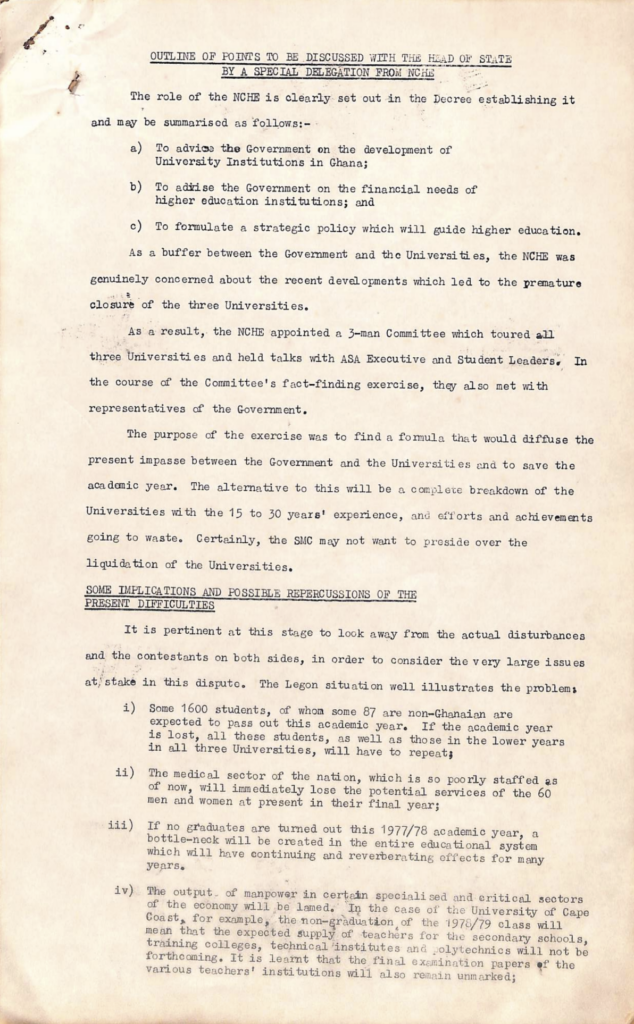
OUTLINE OF POINTS TO BE DISCUSSED WITH THE HEAD OF STATE BY A SPECIAL DELEGATION FROM NCHE
The role of the NCHE is clearly set out in the Decree establishing it and may be summarised as follows:-
a) To advice the Government on the development of University Institutions in Ghana;
b) To advise the Government on the financial needs of higher education institutions; and
c) To formulate a strategic policy which will guide higher education.
As a buffer between the Government and the Universities, the NCHE was genuinely concerned about the recent developments which led to the premature closure of the three Universities.
As a result, the NCHE appointed a 3-man Committee which toured all three Universities and held talks with ASA Executive and Student Leaders. In the course of the Committee’s fact-finding exercise, they also met with representatives of the Government.
The purpose of the exercise was to find a formula that would diffuse the present impasse between the Government and the Universities and to save the academic year. The alternative to this will be a complete breakdown of the Universities with the 15 to 30 years’ experience, and efforts and achievements going to waste. Certainly, the SMC may not want to preside over the liquidation of the Universities.
SOME IMPLICATIONS AND POSSIBLE REPERCUSSIONS OF THE PRESENT DIFFICULTIES
It is pertinent at this stage to look away from the actual disturbances and the contestants on both sides, in order to consider the very large issues at stake in this dispute. The Legon situation well illustrates the problem;
i) Some 1600 students, of whom some 87 are non-Ghanaian are expected to pass out this academic year. If the academic year is lost, all these students, as well as those in the lower years in all three Universities, will have to repeat;
ii) The medical sector of the nation, which is so poorly staffed as of now, will immediately lose the potential services of the 60 men and women at present in their final year;
iii) If no graduates are turned out this 1977/78 academic year, a bottle-neck will be created in the entire educational system which will have continuing and reverberating effects for many years.
iv) The output of manpower in certain specialised and critical sectors of the economy will be blamed. In the case of the University of Cape Coast, for example, the non-graduation of the 1978/79 class will mean that the expected supply of teachers for the secondary schools, training colleges, technical institutes and polytechnics will not be forthcoming. It is learnt that the final examination papers of the various teachers’ institutions will also remain unmarked;
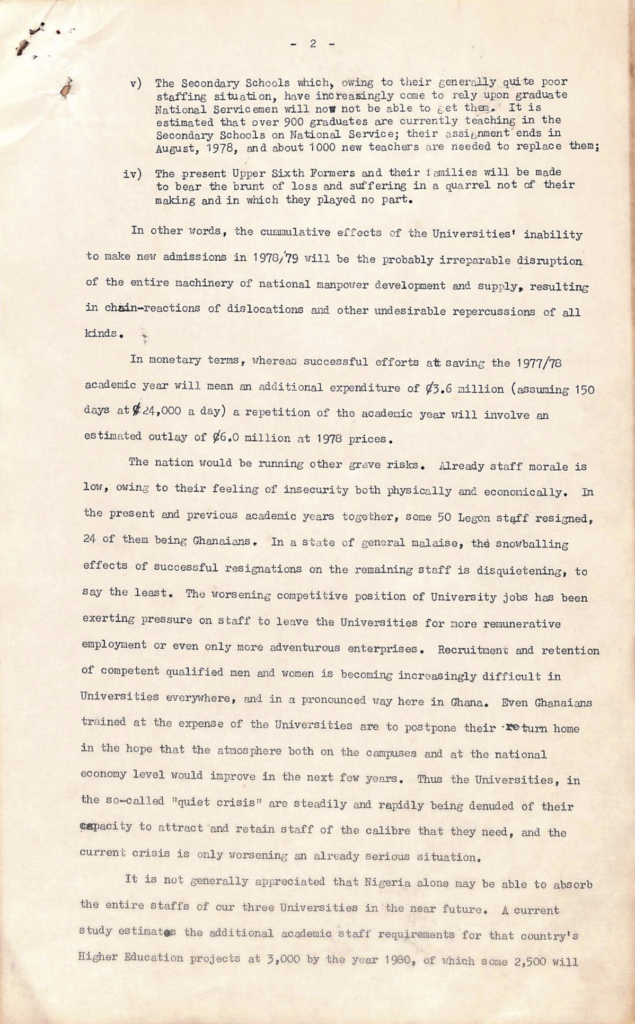
v) The Secondary Schools which, owing to their generally quite poor staffing situation, have increasingly come to rely upon graduate National Servicemen will now not be able to get them. It is estimated that over 900 graduates are currently teaching in the Secondary Schools on National Service; their assignment ends in August, 1978, and about 1000 new teachers are needed to replace them;
vi) The present Upper Sixth Formers and their families will be made to bear the brunt of loss and suffering in a quarrel not of their making and in which they played no part.
In other words, the cumulative effects of the Universities inability to make new admissions in 1978/79 will be the probably irreparable disruption of the entire machinery of national manpower development and supply, resulting in chain-reactions of dislocations and other undesirable repercussions of all kinds.
In monetary terms, whereas successful efforts at saving the 1977/78 academic year will mean an additional expenditure of ₵3.6 million (assuming 150 days at ₵24,000 a day) a repetition of the academic year will involve an estimated outlay of ₵6.0 million at 1978 prices.
The nation would be running other grave risks. Already staff morale is low, owing to their feeling of insecurity both physically and economically. In the present and previous academic years together, some 50 Legon staff resigned, 24 of them being Ghanaians. In a state of general malaise, the snowballing effects of successful resignations on the remaining staff is disquietening, to say the least. The worsening competitive position of University jobs has been exerting pressure on staff to leave the Universities for more remunerative employment or even only more adventurous enterprises. Recruitment and retention of competent qualified men and women is becoming increasingly difficult in Universities everywhere, and in a pronounced way here in Ghana. Even Ghanaians trained at the expense of the Universities are to postpone their return home in the hope that the atmosphere both on the campuses and at the national economy level would improve in the next few years. Thus the Universities, in the so-called “quiet crisis” are steadily and rapidly being denuded of their capacity to attract and retain staff of the calibre that they need, and the current crisis is only worsening an already serious situation.
It is not generally appreciated that Nigeria alone may be able to absorb the entire staffs of our three Universities in the near future. A current study estimates the additional academic staff requirements for that country’s Higher Education projects at 3,000 by the year 1980, of which some 2,500 will need to be expatriates. Those who speak as if it would be an easy matter to replace our own present staff are simply not in the picture of things as they are at present at all. They must be reminded that even the 1971 episode at the University of Science and Technology (which in its proportions, was a mere “storm in a tea-cup” as compared with the hurricane which at present threatens) resulted in a visible dip in the overall development of that University, leaving long-term damage.
The NCHE would like to appeal to the Government to exercise the greatest restraint and show magnanimity in this whole situation. A demonstra- tion of magnanimity by the strong we contend is an indication of moral strength and not a sign of weakness. No question of loss of face arises here. The resolution of a conflict upon the plea of a respected intervening third party is an established and fully accepted practice in the Ghanaian way of life.
14th June, 1978