Fourth Sitting Of The Committee Into Demonstrations By The University Of Ghana
July 14, 2026







Transcript
National Council For Higher Education
1974
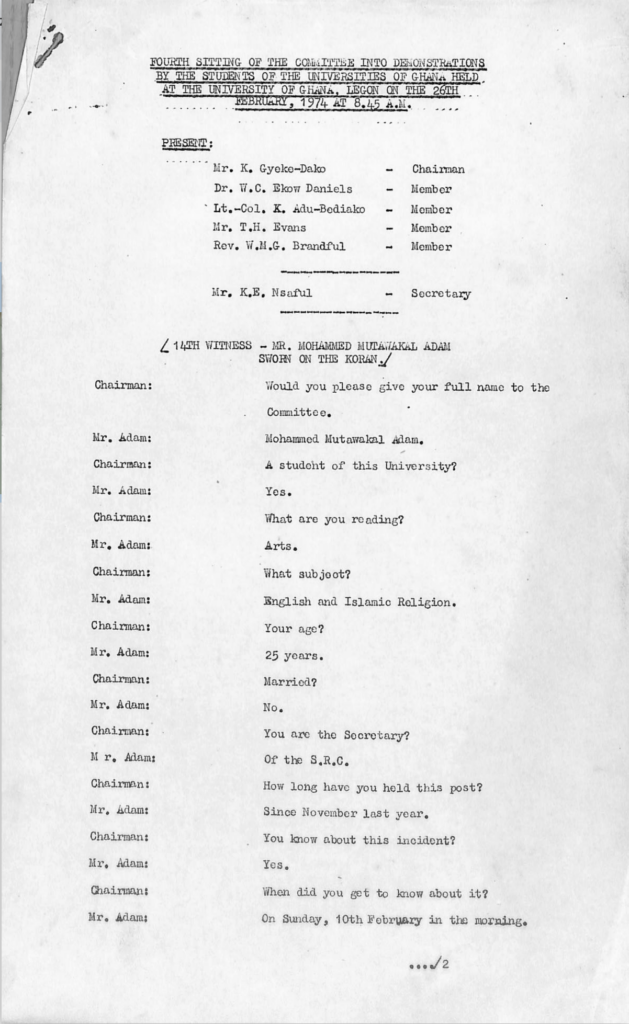
FOURTH SITTING OF THE COMMITTEE INTO DEMONSTRATIONS BY THE STUDENTS OF THE UNIVERSITIES OF GHANA HELD. AT THE UNIVERSITY OF GHANA, LEGON ON THE 26TH FEBRUARY, 1974 AT 8.45 A.M.
PRESENT:
Mr. K. Gyeke-Dako – Chairman
Dr. W.C. Ekow Daniels – Member
Lt.-Col. K. Adu-Bediako – Member
Mr. T.H. Evans – Member
Rev. W.M.G -. Brandful Member
Mr. K.E. Nsaful – Secretary
14TH WITNESS MR. MOHAMMED MUTAVAKAL ADAM SWORN ON THE KORAN
Chairman: Would you please give your full name to the Committee.
Mr. Adam: Mohammed Mutawakal Adam.
Chairman: A student of this University?
Mr. Adam: Yes.
Chairman: What are you reading?
Mr. Adam: Arts. Chairman: What subject?
Mr. Adam: English and Islamic Religion.
Chairman: Your age?
Mr. Adam: 25 years.
Chairman: Married?
Mr. Adam: No.
Chairman: You are the Secretary?
Mr. Adam: Of the S.R.C.
Chairman: How long have you held this post?
Mr. Adam: Since November last year.
Chairman: You know about this incident?
Mr. Adam: Yes.
Chairman: When did you get to know about it?
Mr. Adam: On Sunday, 10th February in the morning.
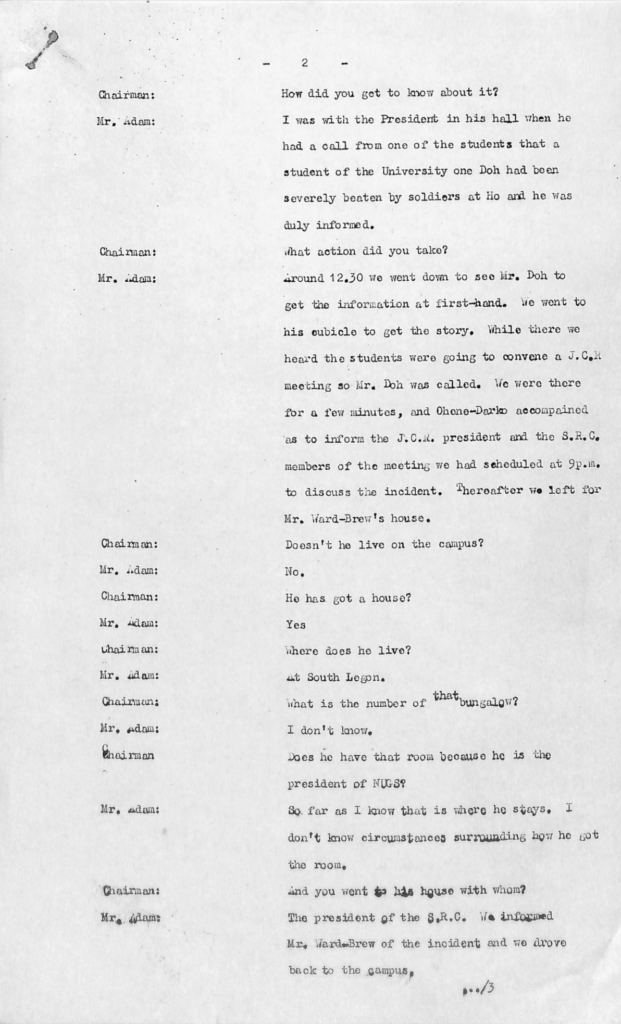
Chairman: How did you get to know about it?
Mr. Adam: I was with the President in his hall when he had a call from one of the students that a student of the University one Doh had been severely beaten by soldiers at Ho and he was duly informed.
Chairman: What action did you take?
Mr. Adam: Around 12.30 we went down to see Mr. Doh to get the information at first-hand. We went to his cubicle to get the story. While there we heard the students were going to convene a J. C. meeting so Mr. Doh was called. We were there for a few minutes, and Ohone-Darko accompanied as to inform the J.C.R. president and the S.R.C. members of the meeting we had scheduled at 9p.m. to discuss the incident. Thereafter we left for Mr. Ward-Brew’s house.
Chairman: Doesn’t he live on the campus?
Mr. Adam: No.
Chairman: He has got a house?
Mr. Adam: Yes
Chairman: Where does he live?
Mr. Adam: At South Legon.
Chairman: what is the number of that bungalow?
Mr. Adam: I don’t know.
Chairman: Does he have that room because he is the president of NUGS?
Mr. Adam: So far as I know that is where he stays. I don’t know circumstances surrounding how he got the room.
Chairman: And you went his house with whom?
Mr. Adam: The president of the S.R.C. We informed Mr. Ward Brew of the incident and we drove
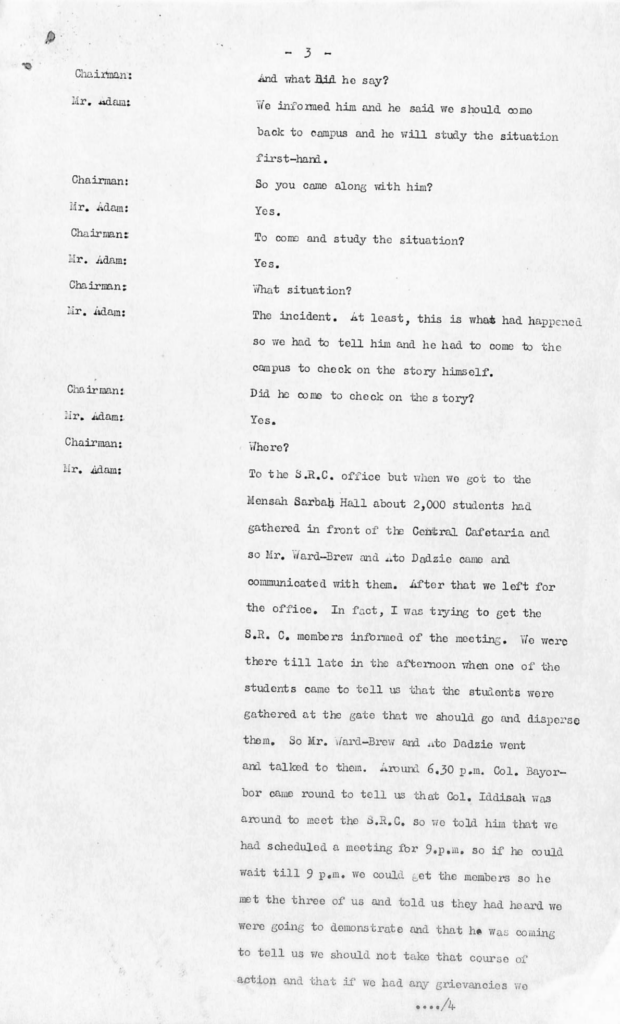
Chairman: And what did he say?
Mr. Adam: We informed him and he said we should come back to campus and he will study the situation first-hand.
Chairman: So you came along with him?
Mr. Adam: Yes.
Chairman: To come and study the situation?
Mr. Adam: Yes.
Chairman: What situation?
Mr. Adam: The incident. At least, this is what had happened so we had to tell him and he had to come to the campus to check on the story himself.
Chairman: Did he come to check on the story?
Adam: Yes.
Chairman: Where?
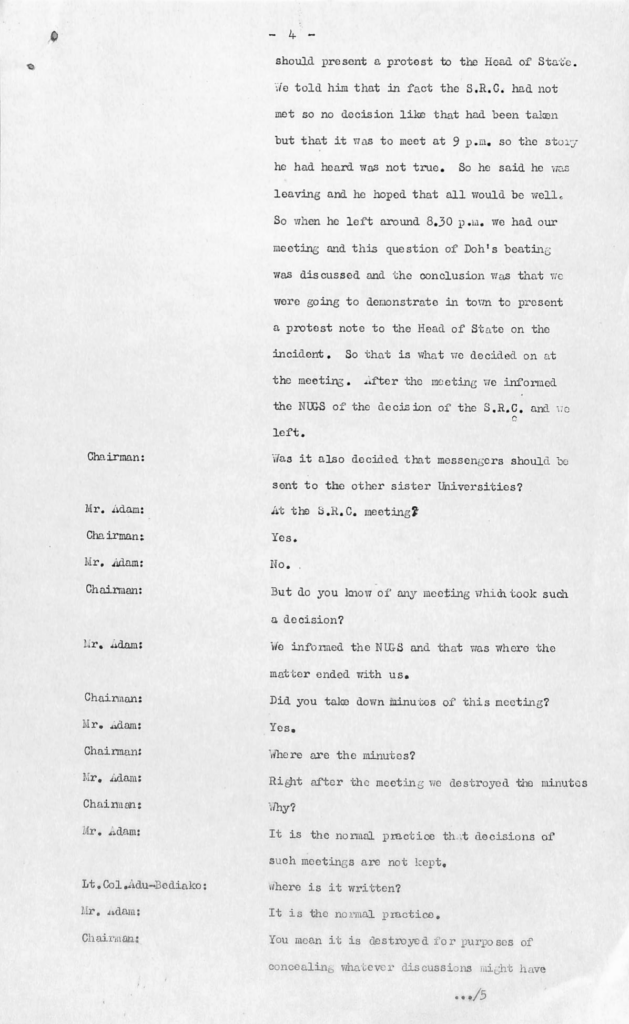
Mr. Adam: To the S.R.C. office but when we got to the Mensah Sarbah Hall about 2,000 students had gathered in front of the Central Cafetaria and so Mr. Ward-Brew and to Dadzie came and communicated with them. After that we left for the office. In fact, I was trying to get the S.R. C. members informed of the meeting. We were there till late in the afternoon when one of the students came to tell us that the students were gathered at the gate and that we should go and disperse them. So Mr. Ward-Brew and Dadzie went and talked to them. Around 6.30 p.m. Col. Bayor- bor came round to tell us that Col. Iddisah was around to meet the S.R.C. So we told him that we had scheduled a meeting for 9 p.m. so if he could wait till 9 p.m. we could get the members so he met the three of us and told us they had heard we were going to demonstrate and that he was coming to tell us we should not take that course of action and that if we had any grievances we should present a protest to the Head of State. We told him that in fact the S.R.C. had not met so no decision like that had been taken but that it was to meet at 9 p.m. so the story he had heard was not true. So he said he was leaving and he hoped that all would be well. So when he left around 8.30 p.m. we had our meeting and this question of Doh’s beating was discussed and the conclusion was that we were going to demonstrate in town to present a protest note to the Head of State on the incident. So that is what we decided on at the meeting. After the meeting we informed the NUGS of the decision of the S.R.C. and we left.
Chairman: Was it also decided that messengers should be sent to the other sister Universities?
Mr. Adam: At the S.R.C. meeting?
Chairman: Yes.
Mr. Adam: No.
Chairman: But do you know of any meeting which took such a decision?
Mr. Adam: We informed the NUGS and that was where the matter ended with us.
Chairman: Did you take down minutes of this meeting?
Mr. Adam: Yes.
Chairman: Where are the minutes?
Mr. Adam: Right after the meeting we destroyed the minutes
Chairman: Why?
Mr. Adam: It is the normal practice that decisions of such meetings are not kept.
Lt. Col.Adu-Bediako: Where is it written?
Mr. Adam: It is the normal practice.
Chairman: You mean it is destroyed for purposes of concealing whatever discussions might have taken place there?
Mr. Adam: We discussed this thing and after that –
Chairman: What I am saying is that normally when you attend this S.R.C. meeting you as Secretary will have to take down minutes. In fact if you are asked to produce minutes of a meeting other than those of the meeting that decided on the demonstration you will be able to do so?
Mr. Adam: Yes.
Chairman: These minutes were obviously destroyed in order not to provide evidence.
Adam: We didn’t need them.
Chairman: Don’t try to pretend to be cleverer than anybody here and also don’t try to pull wool over the eyes of the Committee. If you have told this committee that minutes relating to a decision to demonstrate are destroyed immediately after the meeting then would you not agree with me that the purpose of the destruction is not to pro- vide information as to whatever took place at that meeting?
Mr. Adam: No, that is not the reason.
Chairman: If you say that you didn’t actually need the minutes, what is the point in taking down the minutes only to destroy them?
Mr. Adam: In fact, there is a meeting so we will have to take down minutes to know what we should do after the decision had been taken then we do not need the minutes to refer to anything.
Chairman: I think you owe a duty to the students who elected you and I think you also do not have to underrate the intelligence and the mentality of the students who elected you. We all know that minutes of the previous meeting may not necessarily have any bearing on the agenda for the next meeting but still minutes are taken as reflecting the true situation of what took place there and which must be signed by either the Chairman or the president and the secretary who recorded them. Let me tell you that by saying that the minutes were destroyed you are only exposing your ignorance and incompetence. You don’t impress anyone here. We are not impressed because if this is the trend of your thought and the explanations you are trying to give for destroying the minutes then I would seriously say that you are not even competent to hold the office of a secretary to the S.R.C. Would you please come out and tell us why you destroyed these minutes?
Mr. Adam: I think I have told you that this is the normal thing we do. It is not that I destroyed-
Chairman: Were you in the S.R.C. before you were elected secretary?
Mr. Adam: No.
Chairman: Who told you that that was the convention?
Mr. Adam: Nobody told me.
Chairman: So you have not been told that the convention is that minutes relating to a demonstration should be destroyed after they have been taken down. Shall we take it that it was done on your own initiative?
Mr. Adam: No, it was not.
Chairman: Who told you to destroy the minutes?
Mr. Adam: After the meeting what was necessary had been done.
Lt.Col. Adu-Bediako: Why are you wasting our time?
Mr. Adams: There is no other motive behind this.
Chairman: I think you are displaying your modus operandi in this whole drama to us?
Mr. Adam: I don’t know how you take it – the effect.
Chairman: You have never been a secretary to the S.R.C.- you only assumed office in November.
Dr. Ekow Daniels: Did you come across any minutes at all when you became secretary?
Mr. Adam: I did not see any minutes at all.
Chairman: There were no minutes?
Mr. Adam: I have not seen any minutes.
Chairman: Do you mean to tell us that the S.R.C. had not previous minutes of any meeting?
Mr. Adam: We have but I have not come across any.
Chairman: Was there any handing over?
Mr. Adam: There was.
Chairman: And you were not giving any minutes book?
Mr. Adam: We have files but I did not come across any minutes book.
Chairman: You did not see minutes of the previous meetings?
Mr. Adam: No.
Chairman: Did you ask for them?
Mr. Adam: No I didn’t.
Chairman: Do you seriously want us to believe that the S.R.C. had never taken any previous decisions?
Mr. Adam: They had taken decisions.
Chairman: How did you know?
Mr. Adam: I am a student and I know that last year the S.R.C. were doing certain things.
Chairman: And it never occured to you when you took office to ask your predecessor to produce the minutes of those meetings?
Mr. Adam: He gave me the files and all the papers they have were in the file.
Chairman: There were no minutes?
Mr. Adam: No.
Dr. Ekow Daniels: In your communication to the Government authorities did you send copies of the resolutions to them?
Mr. Adam: Yes, if it is an issue we write to the body concerned and we keep a copy on the file.
Chairman: Would you be able to produce minutes of any meetings held by the S.R.C. other than this particular meeting?
Mr. Adam: Yes.
Chairman: But you admitted before us that you took minutes relating to this particular incident?
Mr. Adam: Yes.
Chairman: And you also admit that after you have taken the minutes you destroyed them?
Mr. Adam: Yes, Then we told the NUGS and we left. Then the next morning we gathered at the University square and we started marching.
Lt.-Col. Adu Bediako: You were at the meeting which was attended by your president and you don’t remember anybody making a recommendation that the sister Universities should be involved?
Mr. Adam: No. I don’t.
Lt.-Col. Adu Bediako: Did you decide on placards?
Mr. Adam: No. In fact there was no time so if you get some paper somewhere we just scribbled something.
Dr. Ekow Daniels: But you are not responsible for the contents?
Mr. Adam: No.
Lt. Col. Adu Bediako: Did you decide on the use of placards?
Mr. Adam: Yes.
Chairman: You wrote whatever you liked?
Mr. Adam: No, we know that we were going to demonstrate against Military brutality so there was no time for anybody to sit down.
Lt. Col. Adu Bediako: Do you think it was an organised demonstration?
Mr. Adam: It was a spontaneous demonstration so we decided we should write placards on the separate matter – Military brutality.
Dr. Ekow Daniels: You intended it to be a peaceful demonstration?
Mr. Adam: Yes.
Lt.-Col. Adu Bodiako: Did it go according to plan?
Mr. Adam: We were stopped at the barrier.
Lt. Col. Adu Bediako: Even up to the barrier was the demonstration according to plan?
Mr. Adam: Yes, we were with the students and the President talked to them that this was a peaceful demonstration and that everybody should comport himself.
Lt. Col. Adu-Bedialoo: Which they did?
Mr. Adam: Yes.
Chairman: By Sunday 9 p.m. was there any event which indicated that the element of peacefulness the contemplated demonstration had become suspect?
Mr. Adam: On Sunday we had not decided on a demonstration at all.
Chairman: You had. You held a meeting on Sunday and I am asking you that before 9 p.m. that you held the meeting were you aware that the element of peace- fulness in the contemplated demonstration had become suspect? Mr. Adam: Before 9 p.m. we had not decided on the demons- tration.
Dr. Ekow Daniels: Would you denounce the practice of the breaking of the glasses?
Mr. Adam: In fact we did not know and we did send a note to the State Transport Corporation to own up for the breaking of the glasses and we settled it.
Chairman: All we want to know is that the membership of the S.R.C. we understand is 30. Do you think that 30 members could conveniently and effectively control 2,000 students?
Mr. Adam: Yes, we could go on a peaceful demonstration.
Chairman: Did you personally think that this was the only way you could bring the Government’s attention to what you term military-cum-police brutality?
Mr. Adam: There could be other methods.
Chairman: Other methods which may be better than this?
Mr. Adam: No.
Chairman: Have you ever presented a petition on this very subject to the Government or to anybody?
Mr. Adam: No
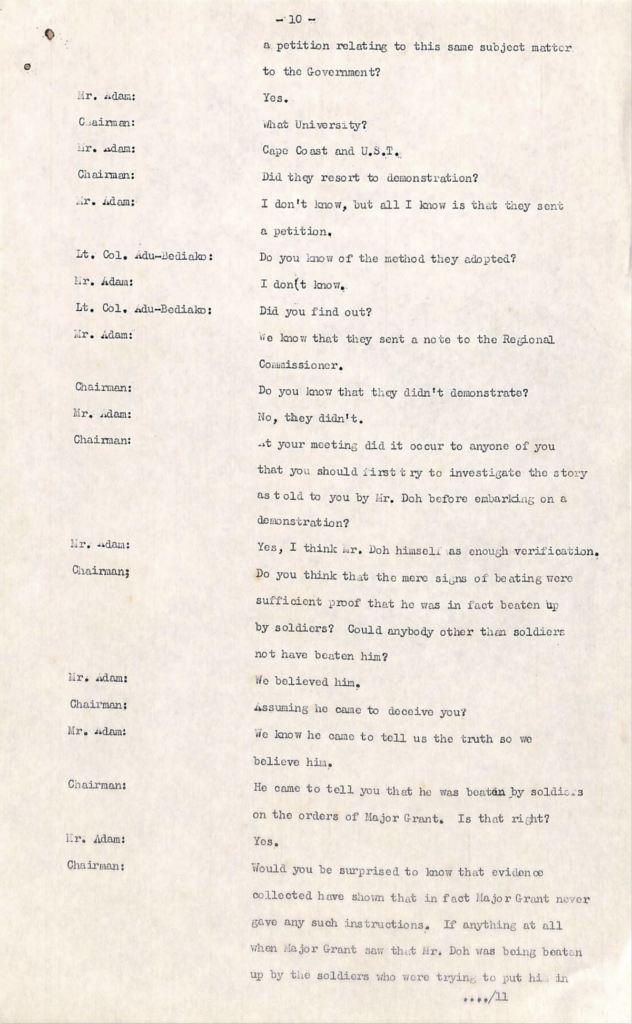
Chairman: Do you know of any sister University having sent a petition relating to this same subject matter to the Government?
Mr. Adam: Yes.
Chairman: What University?
Mr. Adam: Cape Coast and U.S.T.
Chairman: Did they resort to demonstration?
Mr. Adam: I don’t know, but all I know is that they sent a petition.
Lt. Col. Adu-Bediako: Do you know of the method they adopted?
Mr. Adam: I don’t know.
Lt. Col. Adu-Bediako: Did you find out?
Mr. Adam: We know that they sent a note to the Regional Commissioner.
Chairman: Do you know that they didn’t demonstrate?
Mr. Adam: No, they didn’t.
Chairman: at your meeting did it occur to anyone of you that you should first try to investigate the story as told to you by Mr. Doh before embarking on a demonstration?
Mr. Adam: Yes, I think Mr. Doh himself as enough verification.
Chairman: Do you think that the mere signs of beating were sufficient proof that he was in fact beaten up by soldiers? Could anybody other than soldiers not have beaten him?
Mr. Adam: We believed him.
Chairman: Assuming he came to deceive you?
Mr. Adam: We low he came to tell us the truth so we believe him.
Chairman: He came to tell you that he was beaten by soldiers on the orders of Major Grant. Is that right?
Mr. Adam: Yes.
Chairman: Would you be surprised to know that evidence collected has shown that in fact Major Grant never gave any such instructions. If anything at all when Major Grant saw that Mr. Doh was being beaten up by the soldiers who were trying to put him in the truck, he gave orders that nobody should touch Mr. Doh?
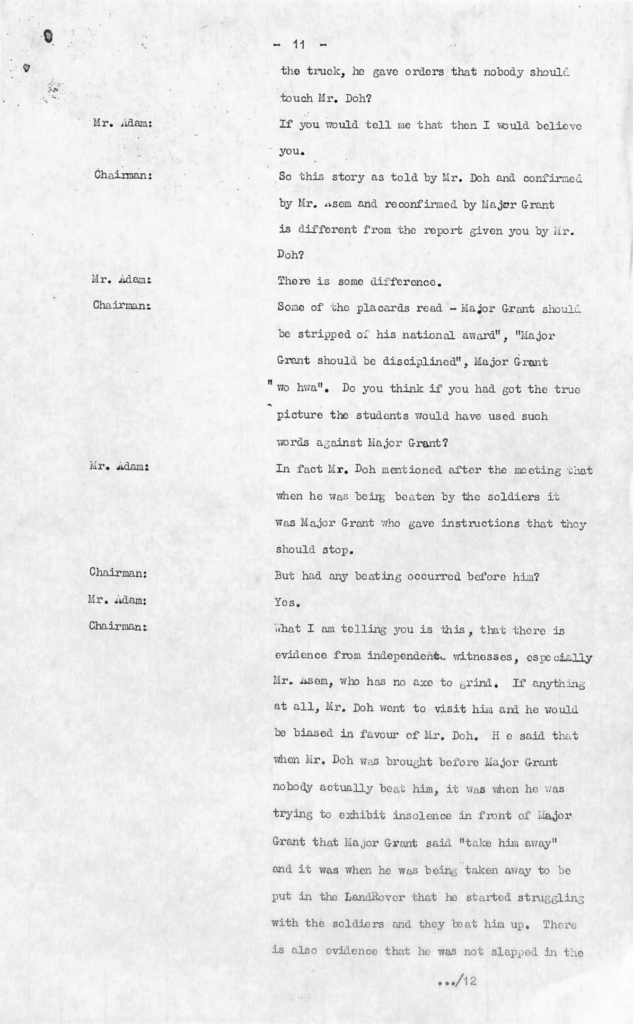
Mr. Adam: If you would tell me that then I would believe you.
Chairman: So this story as told by Mr. Doh and confirmed by Mr. Asem and reconfirmed by Major Grant is different from the report given you by Mr. Doh?
Mr. Adam: There is some difference.
Chairman: Some of the placards read “Major Grant should be stripped of his national award”, “Major Grant should be disciplined”, Major Grant “wo hwa”. Do you think if you had got the true picture the students would have used such words against Major Grant?
Mr. Adam: In fact Mr. Doh mentioned after the meeting that when he was being beaten by the soldiers it was Major Grant who gave instructions that they should stop.
Chairman: But had any beating occurred before him?
Mr. Adam: Yes.
Chairman: What I am telling you is this, that there is evidence from independent witnesses, especially Mr. Asem, who has no axe to grind. If anything at all, Mr. Doh went to visit him and he would be biased in favour of Mr. Doh. He said that when lir. Doh was brought before Major Grant nobody actually beat him, it was when he was trying to exhibit insolence in front of Major Grant that Major Grant said “take him away” and it was when he was being taken away to be put in the LandRover that he started struggling with the soldiers and they beat him up. There is also evidence that he was not slapped in the presence of Major Grant. That is why I have been trying to find out whether it didn’t occur to you that before deciding on a course of action to take, it would have been better for you to observe the principles of natural justice:
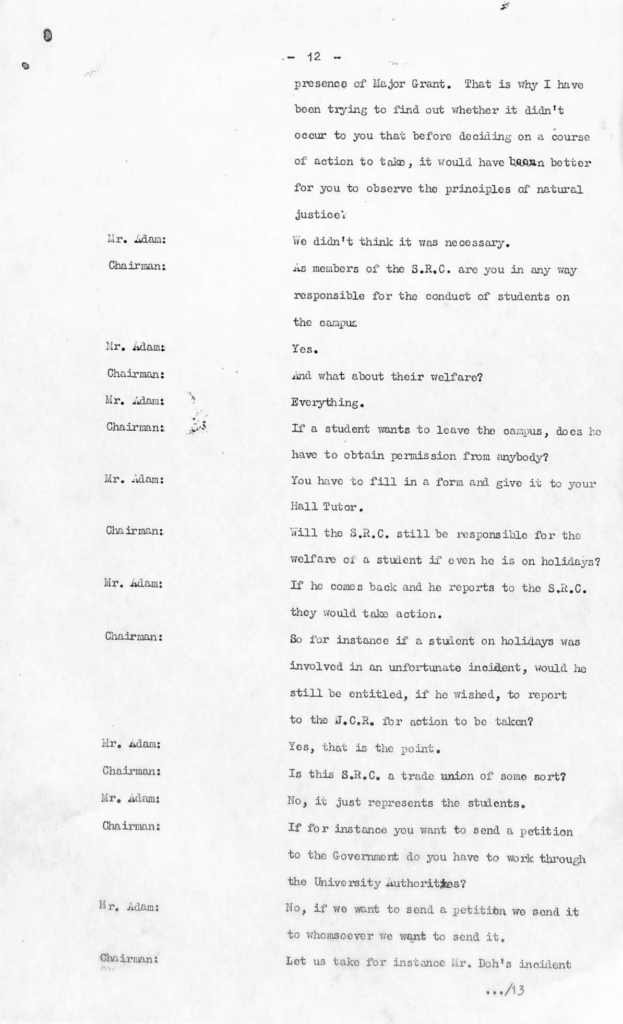
Mr. Adam: We didn’t think it was necessary.
Chairman: As members of the S.R.C. are you in any way responsible for the conduct of students on the campus?
Mr. Adam: Yes.
Chairman: And what about their welfare?
Mr. Adam: Everything.
Chairman: If a student wants to leave the campus, does he have to obtain permission from anybody?
Mr. Adam: You have to fill in a form and give it to your Hall Tutor.
Chairman: Will the S.R.C. still be responsible for the welfare of a student if even he is on holidays?
Mr. Adam: If he comes back and he reports to the S.R.C. they would take action.
Chairman: So for instance if a student on holidays was involved in an unfortunate incident, would he still be entitled, if he wished, to report to the J.C.R. for action to be taken?
Mr. Adam: Yes, that is the point.
Chairman: Is this S.R.C. a trade union of some sort?
Mr. Adam: No, it just represents the students.
Chairman: If for instance you want to send a petition to the Government do you have to work through the University Authorities?
Mr. Adam: No, if we want to send a petition we send it to whomsoever we went to send it to.
Chairman: Let us take for instance Mr. Doh’s incident; did you have to send your petition through the University Authorities?
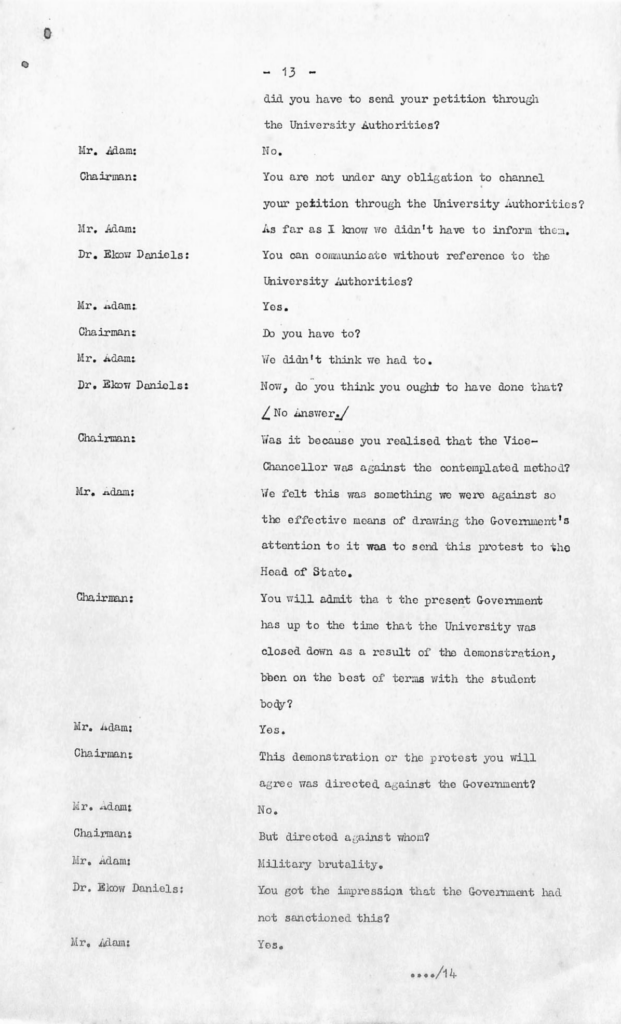
Mr. Adam: No.
Chairman: You are not under any obligation to channel your petition through the University Authorities?
Mr. Adam: As far as I know we didn’t have to inform them.
Dr. Ekow Daniels: You can communicate without reference to the University Authorities?
Mr. Adam: Yes.
Chairman: Do you have to?
Mr. Adam: We didn’t think we had to.
Dr. Ekow Daniels: Now, do you think you ought to have done that?
[No answer]
Chairman: Was it because you realised that the Vice-Chancellor was against the contemplated method?
Mr. Adam: We felt this was something we were against so the effective means of drawing the Government’s attention to it was to send this protest to the Head of State.
Chairman: You will admit that the present Government has up to the time that the University was closed down as a result of the demonstration, been on the best of terms with the student body?
Mr. Adam: Yes.
Chairman: This demonstration or the protest you will agree was directed against the Government?
Mr. Adam: No.
Chairman: But directed against whom?
Mr. Adam: Military brutality.
Dr. Ekow Daniels: You got the impression that the Government had not sanctioned this?
Mr. Adam: Yes.
Dr. Ekow Daniels: So you were drawing the Government’s attention to this?
Mr. Adam: Yes.
Chairman: Let us be realistic. Do you remember telling us this morning that Cape Coast and Kumasi Universities had protested to the Government about this Military brutality?
Mr. Adam: Yes.
Chairman: And you decided on this demonstration because the Government had not done anything about it?
Mr. Adam: Yes.
Chairman: Then what was the protest against?
Mr. Adam: Those brutalities.
Chairman: Was it then against the brutalities but not against the fact that the Government had not been doing anything about it?
Mr. Adam: That was not the reason for the demonstration.
Chairman: Were you in the procession to the Chemical Laboratory?
Mr. Adam: Yes.
Chairman: Did you hear people chanting, “N.R.C. Sakabo”?
Mr. Adams No.
Dr. Ekow Daniels: If you heard would you approve a slogan like that?
Mr. Adam: Yes. Chairman: It would have been out of the terms of your decision?
Mr. Adam: Yes, because there were not meant for the N.R.C.
Chairman: But you were protesting to the N.R.C.?
Mr. Adam: Yes.
Chairman: Do you know very much about this University?
Mr. Adam: I have been here for only 2 years.
Chairman: Do you pay anything towards your education here?
Mr. Adam: I don’t pay anything.
Chairman: Are you given any allowance?
Mr. Adam: 100 for books.
Chairman: Since the University was closed down to you know that some of you had been to the Scholarship Secretariat, are you one of those people who went there?
Mr. Adam: I have not been there. Chairman: Having reflected on the whole incident do you. think you have achieved your objective?
Mr. Adam: Yes.
Chairman: What is that objective you achieved?
Mr. Adam: At least, to draw the public’s attention to these acts of brutalities.
Chairman: So in fact it was a means of drawing the public,, but not the Government’s attention?
Mr. Adam: It was to present a petition to the Government but in the process to draw the public’s attention.
Chairman: So at least you have drawn the public’s attention to those acts?
Mr. Adam: Yes.
Chairman: Through demonstration?
Mr. Adam: Yes.
Chairman: Having reflected on your action do you still think that the method adopted is still the best way of protesting to the Government?
Mr. Adam: Yes, the best under the circumstances.
Dr. Ekow Daniels: Did you contemplate that as a result of the method used there might be a counter reaction from the Government?
Mr. Adam: No, we do not think.
Dr. Ekow Daniels: Now that the University has been closed down for this length of time what is your own assessment of the situation?
Mr. Adam: Personally, I think the Government decision has been too severe. These things have been going on and it is possible the Government is not aware so we felt we had a duty to let the Government know that this is how we feel about it.
Dr. Ekow Daniels: And could/not have sent an application for instance to see the Government?
Mr. Adam: Yes we could have done it but considering past experiences our sister universities had done it and NUGS had an occasion to come out about this and these things still persist.
Dr. Ekow Daniels: Did it not occur to you that, in fact, by such action you will embarrass the Government especially when even a member of the Council came on his own to see you?
Mr. Adam: In fact, when he came we had not decided on anything. He told us that he had heard that we were going to demonstrate and wa told him we had not met.
Chairman: Thank you.
[Witness leaves box]
15TH WITNESS – THOMAS NUAKO WARD-BREW S.O.B. IN ENGLISH
Mr. Ward-Brew: May I ask for a clarification, can I be represented by counsel?
Chairman: If your counsel is here let him come over.
Mr. Ward Brow: I have no counsel.
Chairman: So you want us to understand that in fact you have not got anybody to represent you?
Mr. Ward-Brow: Yes.
Chairman: You just asked this question because of the Press report. Is it your intention to have somebody represent you?
Mr. Ward-Brew: Not necessarily but I thought that it was a point worth clarifying
Chairman: Give your full name to this committee.
Mr. Ward-Brew: Thomas Nuako Ward-Brew.
Chairman: You are a student?
Mr. Ward-Brew: Yes.
Chairman: And what subjects are you reading?
Mr. Ward-Brew: I am reading law.
Chairman: What year?
Mr. Ward-Brew: First year law diploma.
Chairman: How old are you?
Mr. Ward-Brew: I am 32 years.
Chairman: Are you married?
Mr. Ward-Brew: Yes.
Chairman: Children?
Mr. Ward-Brew: No children.
Chairman: You are the president of N.U.G.S.?
Mr. Ward-Brew: Yes.
Chairman: Who are the members of this Union?
Mr. Ward-Brew: They comprise the students of the three Universities, all Secondary schools and forms four to six and all training colleges.
Chairman: What about technical schools?
Mr. Ward-Brew: They also belong to it.
Chairman: And private institutions?
Mr. Ward-Brew: Yes they also belong to it.
Chairman: What are the objects of this union?
Mr. Ward-Brew: To cater for the interest of the student body in the country.
Chairman: Both public and private interest?
Mr. Ward-Brew: Yes.
Chairman: Have you got a constitution?
Mr. Ward-Brew: Yes we have.
Chairman: Where do you live?
Mr. Ward-Brew: In Accra.
Chairman: We have been told that you live at South Legon?
Mr. Ward-Brew: Yes.
Chairman: Is it a house allocated to you by the University?
Mr. Ward-Brew: It is rented.
Chairman: By the University?
Mr. Ward-Brew: Yes.
Chairman: Is it a bungalow?
Mr. Ward-Brew: It is a chalet.
Chairman: Can you bring your mind to bear on Mr. Doh’s incident of 10th February, 1974 which led to the demonstrations by the students of our Universities. Can you tell us what you know about this?
Mr. Ward-Brew: On the 10th of February I was at home about to have my lunch when I saw the S.R.C. President and the Secretary dashing down to my house and they seemed a little bit agitated. I was sitting at a table when they came to tell me that there was a big trouble on the campus. I asked them to wait to let me have my lunch first. After I had had my lunch they told me about a big gathering on the extension of the campus and that a student of Legon by name George Doh had been brutally assaulted by soldiers at Ho and the whole campus has gathered. In fact, I received this with a big uneasiness and I was troubled because as a student leader I knew that ultimately any response that resulted from this was going to be my responsibility which I could not shirk. So after I had finished eating I said we should go. When we went there was a large gathering behind the cafeteria and some students were holding branches and leaves. So the moment I arrived they hoisted me aloft so that I could address them. In fact I was touched because there were shouting “Demonstration” Demonstration” so I asked them whether they were really prepared for a demonstration and the conse- quences of it. and they shouted “Yes”. So I told them that this issue of Military brutality is a delicate matter which involved a principle and therefore it would need thorough reflection on their part and they started to ask me “What are we to do? And I said for the meantime we should go and think of what to do. Again they were asking me “What about tomorrow”? And I said there is no good general who easily makes known his plans to the general followers and still they were shouting “No Class, No Class”. So after that Mr. Ato Dadzie made a speech and together we went to the S.R.C. Office where we discussed this issue. Whilst we were there someone rang frantically and said “Ward-Brew”, the students have gone out of the main gate so if you don’t go the consequences would be very bad”. I was on my way out of the S.R.C. Office when I saw my Secretary who had traveled at the week-end and he asked me the story and I told him that he should go in and he would be told. I asked them to come in but when I came I saw immediately that the re Was government transport bus and I was told that the back glasses had been broken because they said there was a soldier in the bus and in an attempt to get him out the glass was broken. So this is what I heard from the students so I went to the Police Station and asked the Policeman what had happened but they said they did not know. I could see they were being very cautious so they asked me who I was and what my name was but I didn’t tell them. Later on I told him that I had heard the students version of the incident and I want to find out their story but they were insisting of my name so I told them that it was not necessary but since the man was insisting one of the students said I should tell them because ultimately they will find out that I am Ward-Brew, the President. Then he took back to the campus and this excitement was growing up. Then we heard that Col. Iddisah wanted to see the S.R.C. members but in fact he would not see me so he had to leave.
Chairman: So you didn’t meet him?
Mr. Ward-Brew: No, because he was not asking for ward-Brow, he was asking for Mr. Ato Dadzie, and I thought that because of the general command since he said he wanted to meet the S.R.C. President. I did not mind him.
Chairman: What were the students doing?
Mr. Ward-Brew: They were shouting.
Chairman: Shouting what?
Mr. Ward-Brew: N.R.C. Sakabo.
Lt. Col. Adu Bediako: I am more interested in your chain of command. Can you described the chain to us?
Mr. Ward-Brew: The President then the first and second vice-présidents, the first and second secretaries, and the first and second treasurer.
Lt. Col. Adu Bediako: And from you what does it go?
Mr. Ward-Brew: We have the organs of NUGS. Then we have the National Secretariat, the National Executive then the Congress which is the supreme body of the NUGS.
Lt. Col. du-Bediako: Who makes up the Congress?
Ward-Brew: The component institutions.
Chairman: Continue your story, please. Mr. Ward-Brew: So later on all I could see was that Col. Iddisah came to pass and the students were still shouting. Then around 9 p.m. the S.R.C. met. I didn’t go into the room I was standing outside because ultimately I had to find out what came out and the decisions which they later, conveyed to me was that we should go on a peaceful demonstration.
Chairman: Did you believe that the demonstration would be peaceful?
Mr. Ward-Brew: Yes I did. Chairman: Irrespective of the fact that you had seen signs of violence?
Mr. Ward-Brew: That was an exception which would not be said to be the general rule.
Chairman: You had actually seen signs of violence, the windscreen of a State Transport Busi. had been broken by the students and even you went to the extent of asking how it happened. Did you believe that the demonstration could be peaceful?
Mr. Ward-Brew: Yes.
Chairman: So in fact you will agree with me that something can be incidental to a purpose?
Mr. Ward-Brew: What was incidental to the purpose was not necessarily the purpose. Chairman: But it could mar the objective?
Mr. Ward-Brew: That is where the leadership comes in.
Chairman: Did you consider that it could get out of hand?
Mr. Ward-Brew: Yes.
Chairman: Did you make provision for it?
Mr. Ward–Brew: Yes. After the resolution I outlined all the possible consequences that would arise.
Chairman: Like what?
Mr. Ward-Brow: The closure of the University and I also said that it was also possible that there would be road blocks. These are some of the things I told them but their main concern was a peace- ful demonstration. This was the basic objective which I expected.
Chairman: You have told us that Ato Dadzie and the Secretary came to your place and reported to you as to how Doh had been beaten up by the army. You have also told us that they communicated the decision of demonstration to you as president of NUGS. Did it occur to you that in fact further investigation could have been made into the allegations made by Doh before embarking on any demonstration?
Mr. Ward-Brow: After those resolutions had been passed we sat down and had a short meeting. Then we also realised that if we wanted to fight on a national level than it would have to be on the basis of a principle and the principle in this case was fighting against the military- cum-police brutality.
Chairman: I think my question has not been answered. What I am asking you is whether you didn’t think it necessary as president of NUGS and as a person upon whose shoulders the ultimate responsibility would rest to act solely, on a report made to you by Ato Dadzie without satisfying yourself?
Mr. Ward-Brew: Initially Ato Radzie told me all this and later on when I came to the campus he showed me the back of Doh and he narrated the inci- dont to me. Doh is a person I had known for about six weeks and the first time I saw him at Dawhenya. I saw flashes of responsibilities in him and because of that we made him the field commandant among the various students.
Chairman: He may be a person for a difference at Dawhenya but he may not be the same person at Bukom Square.
Mr. Ward-Brew: Yes I mean that when one is leading a group of people we should be able to size people up in a flash. So in the particular situation I found that within the period he was in the command.
Dr. Ekow Daniels: You had no reason to doubt his credibility?
Mr. Ward-Brew: At all.
Chairman: Were you told by Dadzie that Doh had told him that he was put before Major Grant as ordered but before he could open his mouth to answer the question he was given two blinding slaps and Major Grant also gave order for him to be beaten up?
Mr. Ward-Brew: Yes.
Chairman: Would you be surprised to know that from Doh’s own evidence at Ho before this Committee he said that Major Grant never gave instructions that he should be beaten up by the soldiers? Would you also be surprised to know that from the evidence of independent witnesses Doh received no two blinding slaps when he was before Major Grant? Would you also be surprised to know that according to evidence when Major Grant said that he should be taken away the soldiers struggled with him to get him into the Land Rover it was Major Grant who gave an order that nobody should touch Doh?
Mr. Ward-Brew: I cannot see any major difference
Chairman: Is there any difference between these two versions?
Mr. Ward-Brew: I did not say any major difference. The reason is that there is a possible misrepresentation as a result of when the order was given by Major Grant. I went to Ho to check on these things and according to lir. sem after Doh had been beaten he intervened that this boy might collapse or he might die. Then Major Grant gave the order that he should be stopped. According to both Asem and Doh he says that Hajor Grant seemed to have a way of giving certain orders which have a certain type of meaning so that when he gives an order that he should be stopped it went by implication that “give him more slops”. [Laughter]
Chairman: What I am trying to find out from you is whether you didn’t think it necessary since you were going to take such a major decision to check upon the story of Doh because you have told us that you went to Ho?
Mr. Ward-Brew: As I said the background of Doh influences me considerably. I say this because he had shown in him such type of spirit in showing interest in people who have been aggrieved. So when he told me in a moving way I could actually believe what he was telling me.
Chairman: And you didn’t think that it was necessary for you to make any further investigations?
Mr. Ward-Brew: Yes. I say this because so many times men have taken decisions on the fact of faith.
Chairman: What I want to assure you is that this is a fact- finding committee, nobody has made up his mind one way or the other. We are only after the facts and to report the facts as we see them.
Mr. Ward-Brew: But sometimes in a cross-examination there is tendency that people who are not used to receiving questions directly can be prevented from telling what actually they saw because the question and answer system is a new thing to them.
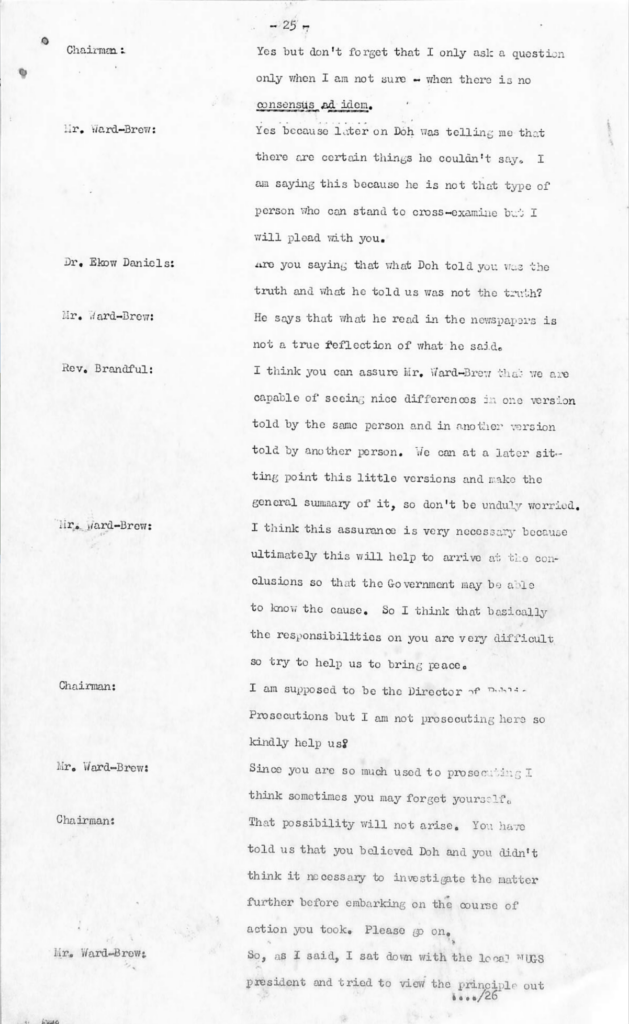
Chairman: Yes but don’t forget that I only ask a question only when I am not sure – when there is no consensus ad idem.
Mr. Ward-Brew: Yes because later on Doh was telling me that there are certain things he couldn’t say. I am saying this because he is not that type of person who can stand to cross-examine but I will plead with you.
Dr. Ekow Daniels: Are you saying that what Doh told you was the truth and what he told us was not the truth?
Mr. Ward-Brew: He says that what he read in the newspapers is not a true reflection of what he said.
Rev. Brandful: I think you can assure Mr. Ward-Brew that we are capable of seeing nice differences in one version told by the same person and in another version told by another person. We can at a later sitting point this little versions and make the general summary of it, so don’t be unduly worried.
Mr. Ward-Brow: I think this assurance is very necessary because ultimately this will help to arrive at the conclusions so that the Government may be able to know the cause. So I think that basically the responsibilities on you are very difficult so try to help us to bring peace.
Chairman: I am supposed to be the Director 14 Prosecutions but I am not prosecuting here so kindly help us!
Mr. Ward-Brew: Since you are so much used to prosecuting I think sometimes you may forget yourself.
Chairman: That possibility will not arise. You have told us that you believed Doh and you didn’t think it necessary to investigate the matter further before embarking on the course of action you took. Please go on.
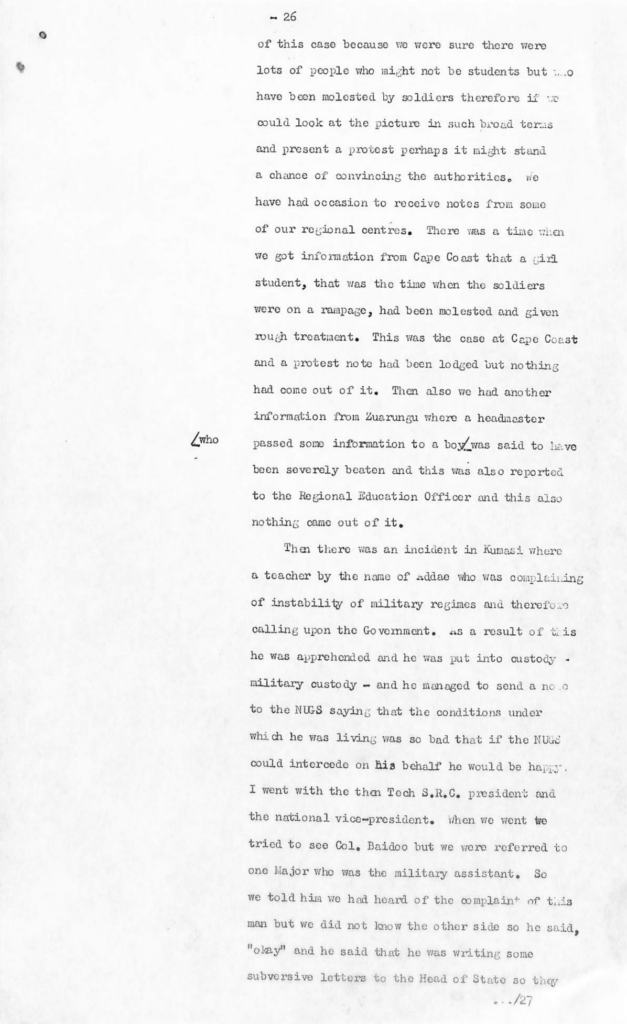
Mr. Ward-Brew: So, as I said, I sat down with the local UGS president and tried to view the principle out se we were sure there were lots of people who might not be students but…o have been molested by soldiers therefore if te could look at the picture in such broad terms and present a protest perhaps it might stand a chance of convincing the authorities. we have had occasion to receive notes from some of our regional centres. There was a time when we got information from Cape Coast that a girl student, that was the time when the soldiers were on a rampage, had been molested and given rough treatment. This was the case at Cape Coast and a protest no te had been lodged but nothing had come out of it. Then also we had another information from Zuarungu where a headmaster Lo passed some information to a boy was said to have been severely beaten and this was also reported to the Regional Education Officer and this also nothing came out of it.
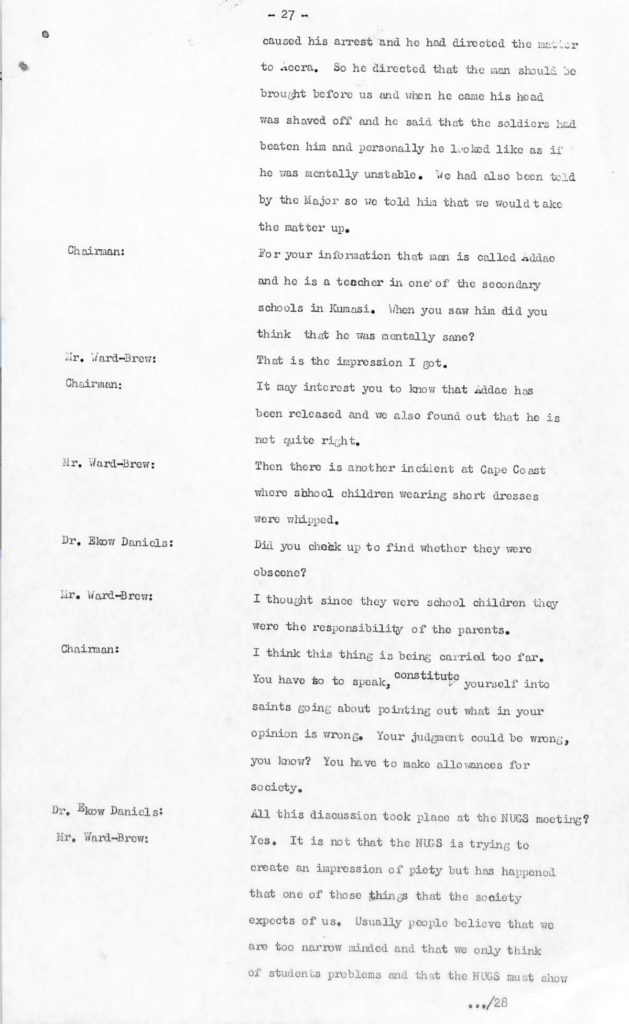
Then there was an incident in Kumasi where a teacher by the name of addae who was complaining of instability of military regimes and therefore calling upon the Government. as a result of this he was apprehended and he was put into custody. military custody – and he managed to send a note to the NUGS saying that the conditions under which he was living was so bad that if the NUGS could intercede on his behalf he would be happy”. I went with the then Tech S.R.C. president and the national vice-president. When we went tre tried to see Col. Baidoo but we were referred to one Major who was the military assistant. So we told him we had heard of the complaint of this man but we did not know the other side so he said, “okay” and he said that he was writing some subversive letters to the Head of State so they caused his arrest and he had directed the matter to Accra. So he directed that the man should be brought before us and when he came his head was shaved off and he said that the soldiers had beaten him and personally he looked as if he was mentally unstable. We had also been told by the Major so we told him that we would take the matter up.
Chairman: For your information that man is called Addae and he is a teacher in one of the secondary schools in Kumasi. When you saw him did you think that he was mentally sane?
Mr. Ward-Brew: That is the impression I got.
Chairman: It may interest you to know that Addae has been released and we also found out that he is not quite right.
Mr. Ward-Brew: Then there is another incident at Cape Coast where school children wearing short dresses were whipped.
Dr. Ekow Daniels: Did you check up to find whether they were obscene?
Mr. Ward-Brew: I thought since they were school children they were the responsibility of the parents.
Chairman: I think this thing is being carried too far. You have so to speak, constitute yourself into saints going about pointing out what in your opinion is wrong. Your judgment could be wrong, you know? You have to make allowances for society.
Dr. Ekow Daniels: All this discussion took place at the NUGS meeting?
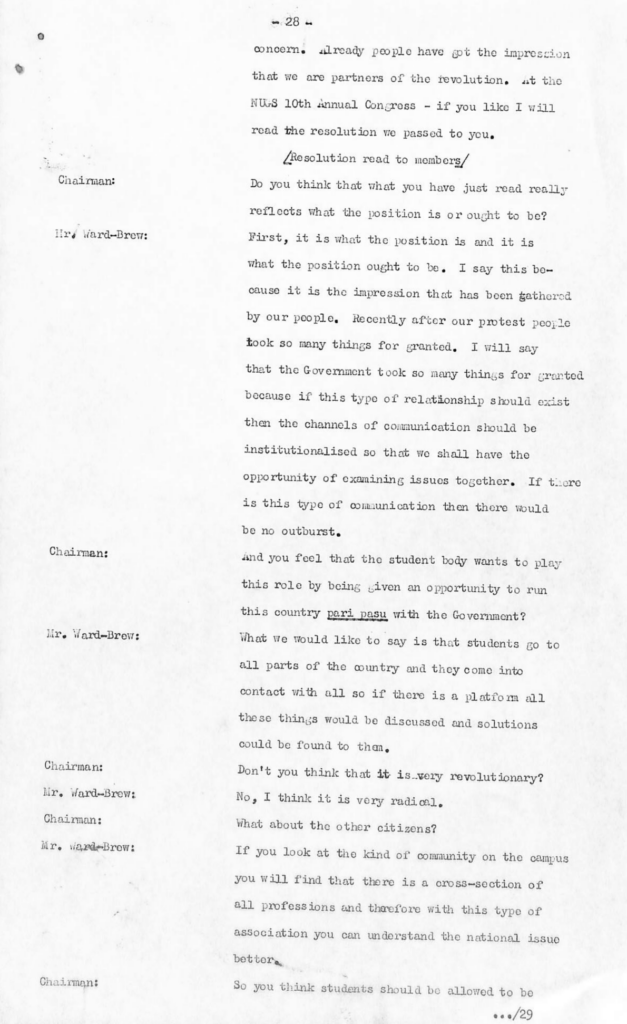
Mr. Ward-Brew: Yes. It is not that the NUGS is trying to create an impression of piety but has happened that one of those things that the society expects of us. Usually people believe that wo are too narrow minded and that we only think of students problems and that the NUGS must show concern. already people have got the impression that we are partners of the revolution. at the NUS 10th Annual Congress if you like I will read the resolution we passed to you.
[Resolution read to members]
Chairman: Do you think that what you have just read really reflects what the position is or ought to be?
Mr Ward-Brew: First, it is what the position is and it is what the position ought to be. I say this be- cause it is the impression that has been gathered by our people. Recently after our protest people took so many things for granted. I will say that the Government took so many things for granted because if this type of relationship should exist then the channels of communication should be institutionalised so that we shall have the opportunity of examining issues together. If there is this type of communication then there would be no outburst.
Chairman: And you feel that the student body wants to play this role by being given an opportunity to run this country pari pasu with the Government?
Mr. Ward-Brew: What we would like to say is that students go to all parts of the country and they come into contact with all so if there is a platform all these things would be discussed and solutions could be found to them.
Chairman: Don’t you think that it is..very revolutionary?
Mr. Ward-Brew: No, I think it is very radical.
Chairman: What about the other citizens?
Mr. Ward Brew: If you look at the kind of community on the campus you will find that there is a cross-section of all professions and therefore with this type of association you can understand the national issue better.
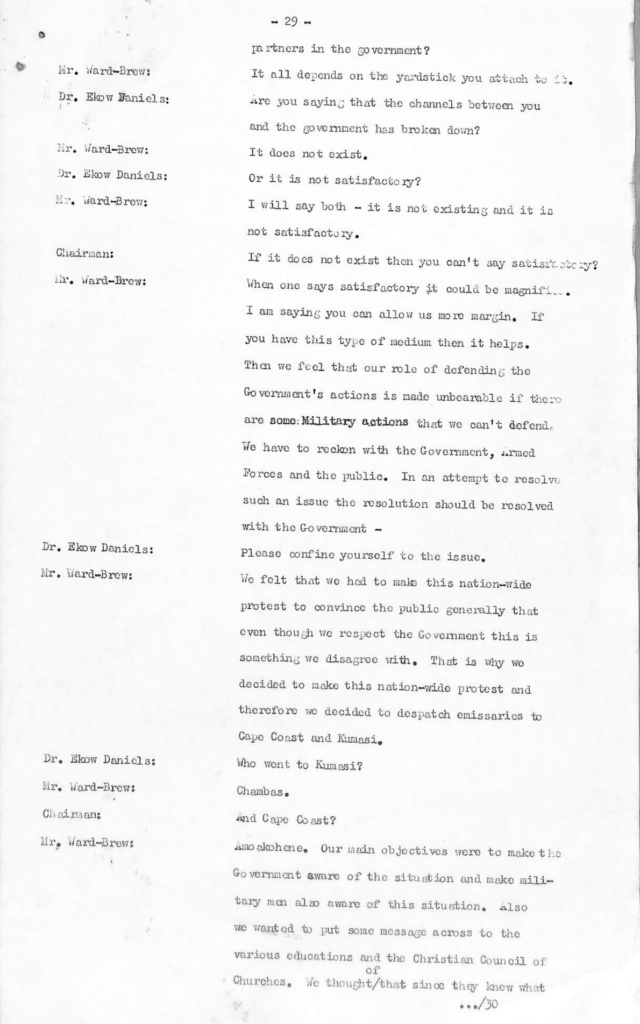
Chairman: So you think students should be allowed to be partners in the government?
Mr. Ward-Brew: It all depends on the yardstick you attach to it.
Dr. Ekow Baniels: Are you saying that the channels between you and the government has broken down?
Mr. Ward-Brew: It does not exist.
Dr. Ekow Daniels: Or it is not satisfactory?
Mr. Ward-Brew: I will say both it is not existing and it is not satisfactory.
Chairman: If it does not exist then you can’t say satisfactory?
Ward-Brew: When one says satisfactory it could be magnified. I am saying you can allow us more margin. If you have this type of medium then it helps. Then we feel that our role of defending the Government’s actions is made unbearable if there are some: Military actions that we can’t defend. We have to reckon with the Government, Armed Forces and the public. In an attempt to resolve such an issue the resolution should be resolved with the Government –
Dr. Ekow Danicls: Please confine yourself to the issue.
Mr. Ward-Brew: We felt that we had to make this nation-wide protest to convince the public generally that even though we respect the Government this is something we disagree with. That is why wo decided to make this nation-wide protest and therefore we decided to despatch emissaries to Cape Coast and Kumasi.
Dr. Ekow Daniels: Who went to Kumasi?
Mr. Ward-Brew: Chambas.
Chairman: And Cape Coast?
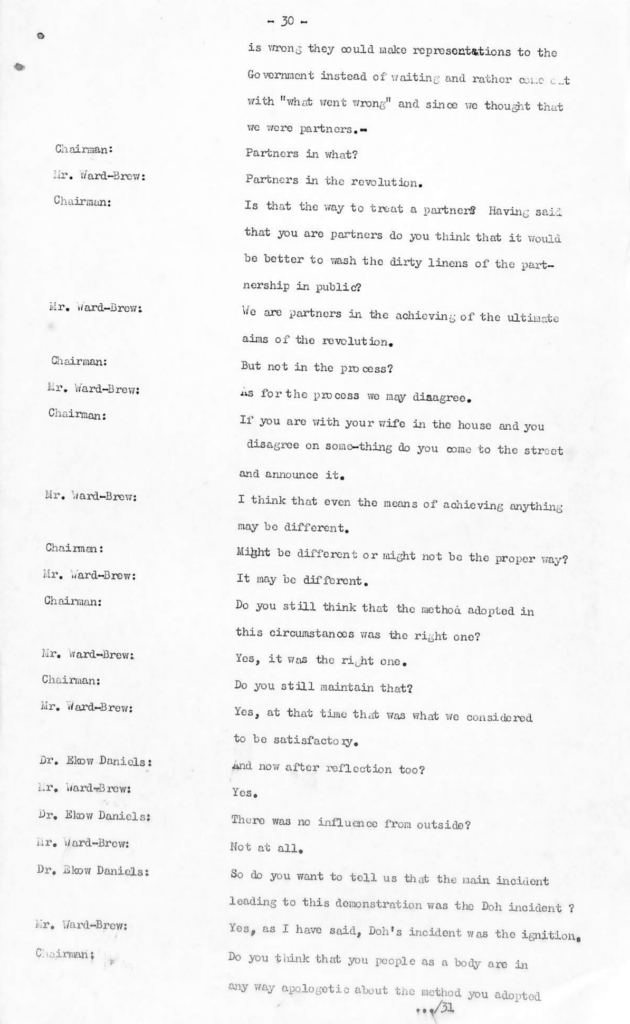
Mr. Ward-Brew: Amoakohene. Our main objectives were to make the Government aware of the situation and make mili- tary men also aware of this situation. Also we wanted to put some message across to the various educations and the Christian Council of of Churches. We thought/that since they knew what is wrong they could make representations to the Government instead of waiting and rather come c..t with “what went wrong” and since we thought that we were partners-
Chairman: Partners in what?
Mr. Ward-Brow: Partners in the revolution.
Chairman: Is that the way to treat a partner? Having said that you are partners do you think that it would be better to wash the dirty linens of the part- nership in public?
Mr. Ward-Brew: We are partners in the achieving of the ultimate aims of the revolution.
Chairman: But not in the process?
Mr. Ward-Brew: As for the process we may disagree.
Chairman: If you are with your wife in the house and you disagree on some-thing do you come to the street and announce it.
Mr. Ward-Brew: I think that even the means of achieving anything may be different.
Chairman: Might be different or might not be the proper way?
Mr. Ward-Brow: It may be different.
Chairman: Do you still think that the methoȧ adopted in this circumstances was the right one?
Mr. Ward-Brew: Yes, it was the right one.
Chairman: Do you still maintain that?
Mr. Ward-Brew: Yes, at that time that was what we considered to be satisfactory.
Dr. Ekow Daniels: And now after reflection too?
Mr. Ward-Brew: Yes.
Dr. Ekow Daniels: There was no influence from outside?
Mr. Ward-Brew: Not at all.
Dr. Ekow Daniels: So do you want to tell us that the main incident leading to this demonstration was the Doh incident?
Mr. Ward-Brew: Yes, as I have said, Doh’s incident was the ignition.
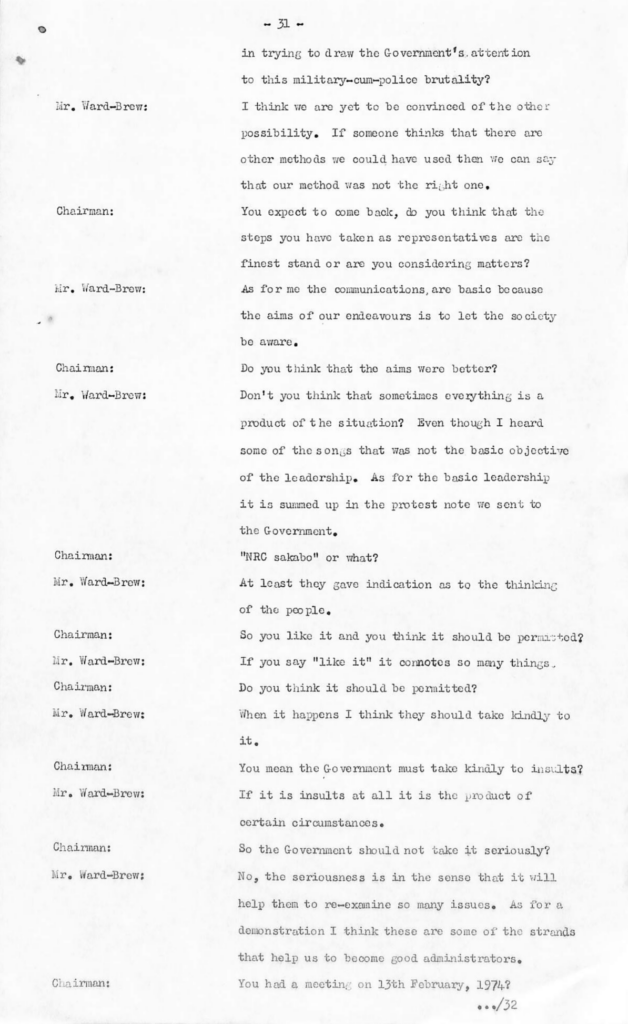
Chairman; Do you think that you people as a body are in any way apologetic about the method you adopted in trying to draw the Government’s attention to this military-cum-police brutality?
Mr. Ward-Brew: I think we are yet to be convinced of the other possibility. If someone thinks that there are other methods we could have used then we can say that our method was not the right one.
Chairman: You expect to come back, do you think that the steps you have taken as representatives are the finest stand or are you considering matters?
Mr. Ward-Brew: As for me the communications are basic because the aims of our endeavours is to let the society be aware.
Chairman: Do you think that the aims were better?
Mr. Ward-Brew: Don’t you think that sometimes everything is a product of the situation? Even though I heard some of the songs that was not the basic objective of the leadership. As for the basic leadership it is summed up in the protest note we sent to the Government.
Chairman: “NRC sakabo” or what?
Mr. Ward-Brew: At least they gave indication as to the thinking of the people.
Chairman: So you like it and you think it should be permitted?
Mr. Ward-Brew: If you say “like it” it connotes so many things.
Chairman: Do you think it should be permitted?
Mr. Ward-Brew: When it happens I think they should take kindly to it.
Chairman: You mean the Government must take kindly to insults?
Mr. Ward-Brew: If it is insults at all it is the product of certain circumstances.
Chairman: So the Government should not take it seriously?
Mr. Ward-Brew: No, the seriousness is in the sense that it will help them to re-examine so many issues. As for a demonstration I think these are some of the strands that help us to become good administrators.
Chairman: You had a meeting on 13th February, 1974?
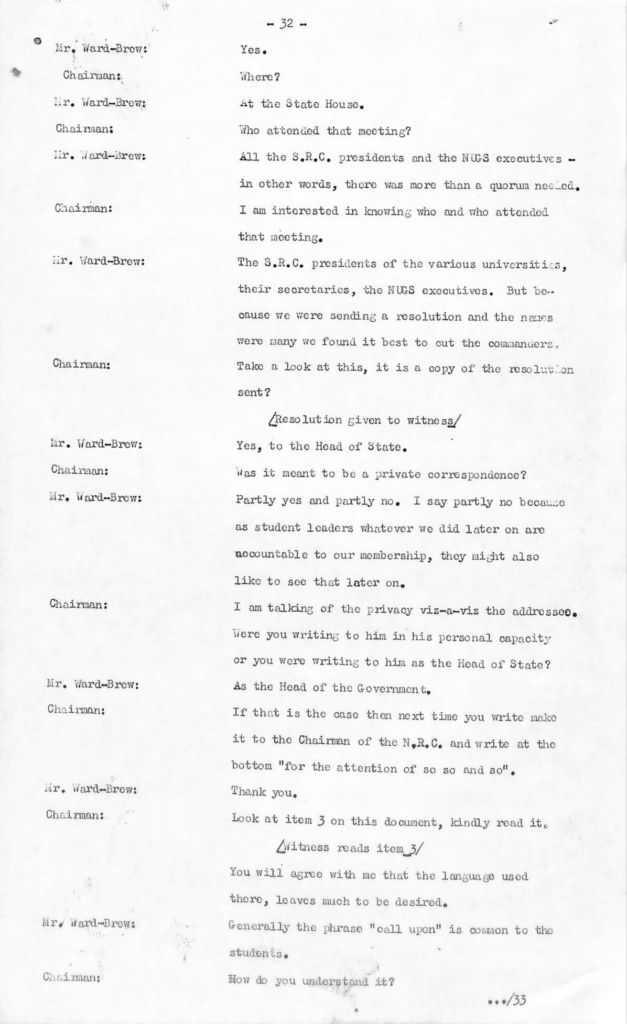
Mr. Ward-Brow: Yes.
Chairman: Where?
Mr. Ward-Brew: At the State House.
Chairman: Who attended that meeting?
Mr. Ward-Brew: All the S.R.C. presidents and the NUGS executives – in other words, there was more than a quorum nected.
Chairman: I am interested in knowing who and who attended that meeting.
Mr. Ward-Brew: The S.R.C. presidents of the various universitics, their secretaries, the NUGS executives. But be cause we were sending a resolution and the names. were many we found it best to cut the commanders.
Chairman: Take a look at this, it is a copy of the resolution sent?
[Resolution given to witness]
Mr. Ward-Brew: Yes, to the Head of State.
Chairman: Was it meant to be a private correspondence?
Mr. Ward-Brew: Partly yes and partly no. I say partly no because as student leaders whatever we did later on are accountable to our membership, they might also like to see that later on.
Chairman: I am talking of the privacy vis-a-viz the addressee. Were you writing to him in his personal capacity or you were writing to him as the Head of State?
Mr. Ward-Brow: As the Head of the Government.
Chairman: If that is the case then next time you write make it to the Chairman of the N.R.C. and write at the bottom “for the attention of so so and so”.
Mr. Ward-Brew: Thank you.
Chairman: Look at item 3 on this document, kindly read it.
[Witness reads item]
You will agree with me that the language used there, leaves much to be desired.
Mr. Ward-Brew: Generally the phrase “call upon” is common to the students.
Chairman: How do you understand it?
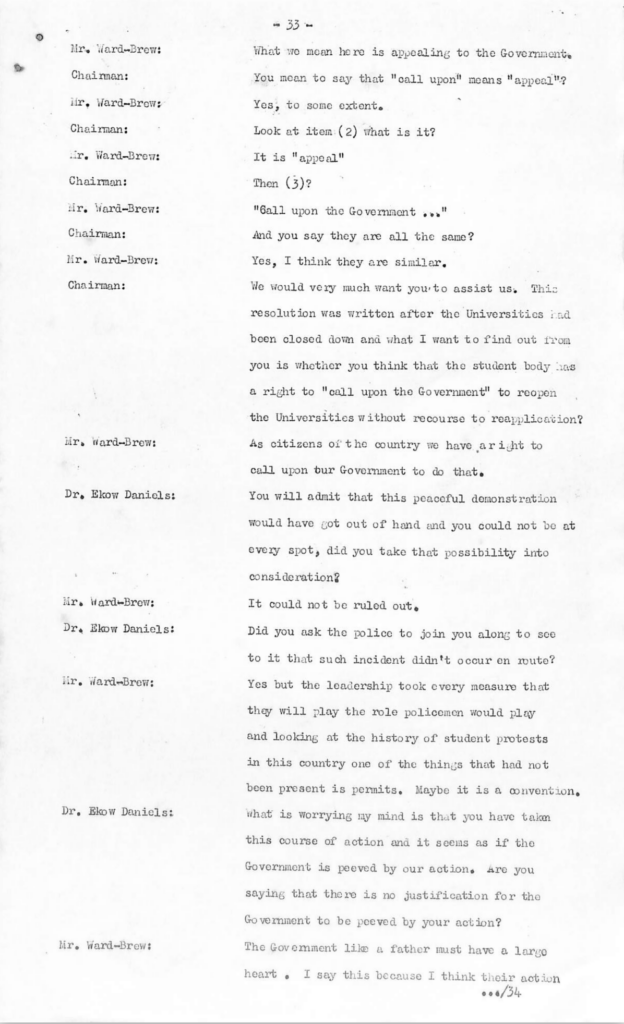
Mr. Ward-Brew: What we mean here is appealing to the Government.
Chairman: You mean to say that “call upon” means “appeal”?
Mr. Ward-Brow: Yes, to some extent.
Chairman: Look at item (2) what is it?
Mr. Ward-Brew: It is “appeal”
Chairman: Then (3)?
Mr. Ward-Brew: “Call upon the Government…
Chairman: And you say they are all the same?
Mr. Ward-Brew: Yes, I think they are similar.
Chairman: We would very much want you to assist us. This resolution was written after the Universities had been closed down and what I want to find out from you is whether you think that the student body has a right to “call upon the Government” to reopen the Universities without recourse to reapplication?
Mr. Ward-Brew: As citizens of the country we have a right to call upon the Government to do that.
Dr. Ekow Daniels: You will admit that this peaceful demonstration would have got out of hand and you could not be at every spot, did you take that possibility into consideration?
Mr. Ward-Brew: It could not be ruled out.
Dr. Ekow Daniels: Did you ask the police to join you along to see to it that such incident didn’t occur en route?
Mr. Ward-Brew: Yes but the leadership took every measure that they will play the role policemen would play and looking at the history of student protests in this country one of the things that had not been present is permits. Maybe it is a convention.
Dr. Ekow Daniels: what is worrying my mind is that you have taken this course of action and it seems as if the Government is peeved by our action. Are you saying that there is no justification for the Government to be peeved by your action?
Mr. Ward-Brew: The Govemment like a father must have a largo heart. I say this because I think their action is a reflection on us and to do this the Govern- ment must show it.
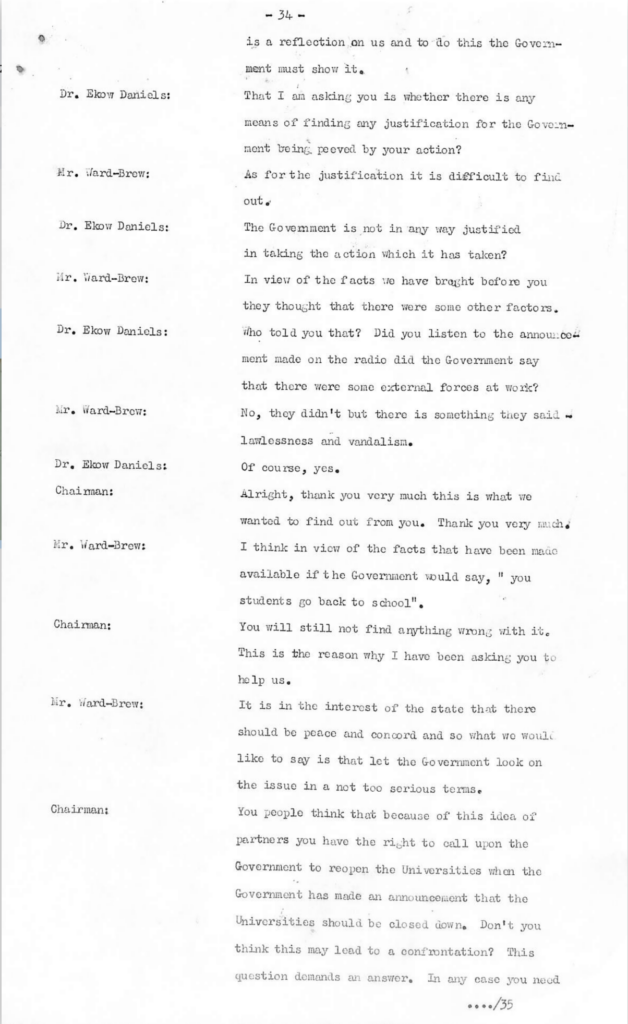
Dr. Ekow Daniels: That I am asking you is whether there is any means of finding any justification for the Government being peeved by your action?
Mr. Ward-Brew: As for the justification it is difficult to find out.
Dr. Ekow Daniels: The Government is not in any way justified in taking the action which it has taken?
Mr. Ward-Brew: In view of the facts we have brought before you they thought that there were some other factors.
Dr. Ekow Daniels: Who told you that? Did you listen to the annou.co ment made on the radio did the Government say that there were some external forces at work?
Mr. Ward-Brow: No, they didn’t but there is something they said lawlessness and vandalism.
Dr. Ekow Daniels: Of course, yes.
Chairman: Alright, thank you very much this is what we wanted to find out from you. Thank you very much.
Mr. Ward-Brew: I think in view of the facts that have been maão available if the Government would say, “you students go back to school”.
Chairman: You will still not find anything wrong with it. This is the reason why I have been asking you to help us.
Mr. Ward-Brew: It is in the interest of the state that there should be peace and concord and so what we would like to say is that let the Government look on the issue in a not too serious terms.
Chairman: You people think that because of this idea of partners you have the right to call upon the Government to reopen the Universities when the Government has made an announcement that the Universities should be closed down. Don’t you think this may lead to a confrontation? This question demands an answer. In any case you need not answer it if you don’t want to. Thank you very much.
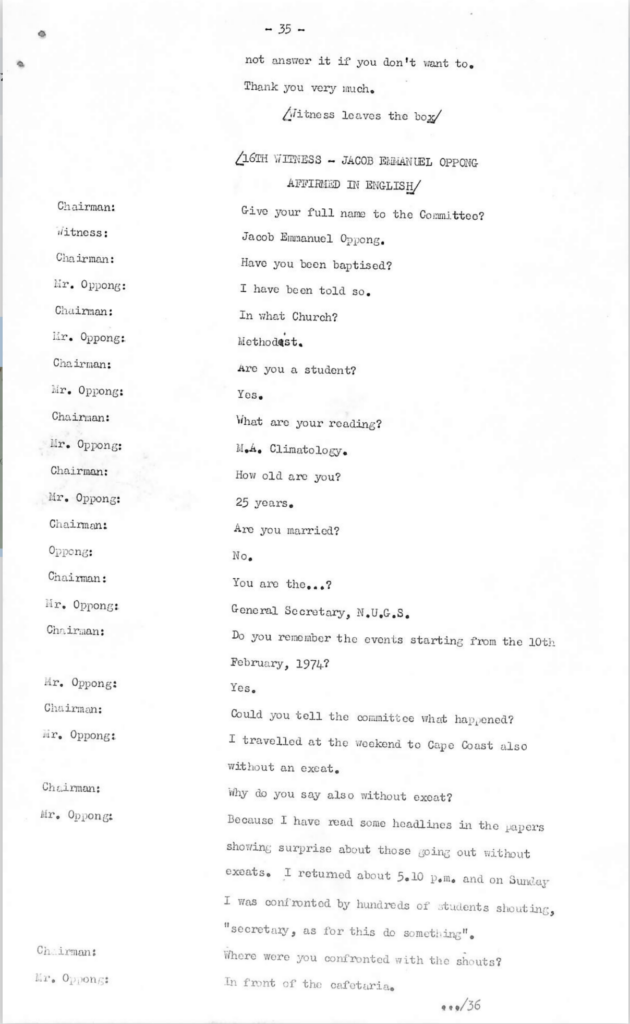
[Witness leaves the box]
16TH WITNESS JACOB EMANUEL OPPONG
AFFIRMED IN ENGLISH
Chairman: Give your full name to the Committee?
Witness: Jacob Emmanuel Oppong.
Chairman: Have you been baptised?
Mr. Oppong: I have been told so. Chairman: In what Church?
Mr. Oppong: Methodest.
Chairman: Are you a student?
Mr. Oppong: Yes.
Chairman: What are you reading?
Mr. Oppong: M.A. Climatology.
Chairman: How old are you?
Mr. Oppong: 25 years.
Chairman: Are you married?
Mr. Oppong: No.
Chairman: You are the…?
Mr. Oppong: General Secretary, N.U.G.S.
Chairman: Do you remember the events starting from the 10th February, 1974?
Mr. Oppong: Yes.
Chairman: Could you tell the committee what happened?
Mr. Oppong: I travelled at the weekend to Cape Coast also without an exeat.
Chairman: Why do you say also without excat?
Mr. Oppong: Because I have read some headlines in the papers showing surprise about those going out without exeats. I retumed about 5.10 p.m. and on Sunday I was confronted by hundreds of students shouting, “secretary, as for this do something”.
Chairman: Where were you confronted with the shouts? Mr. Oppong: In front of the cafetaria.
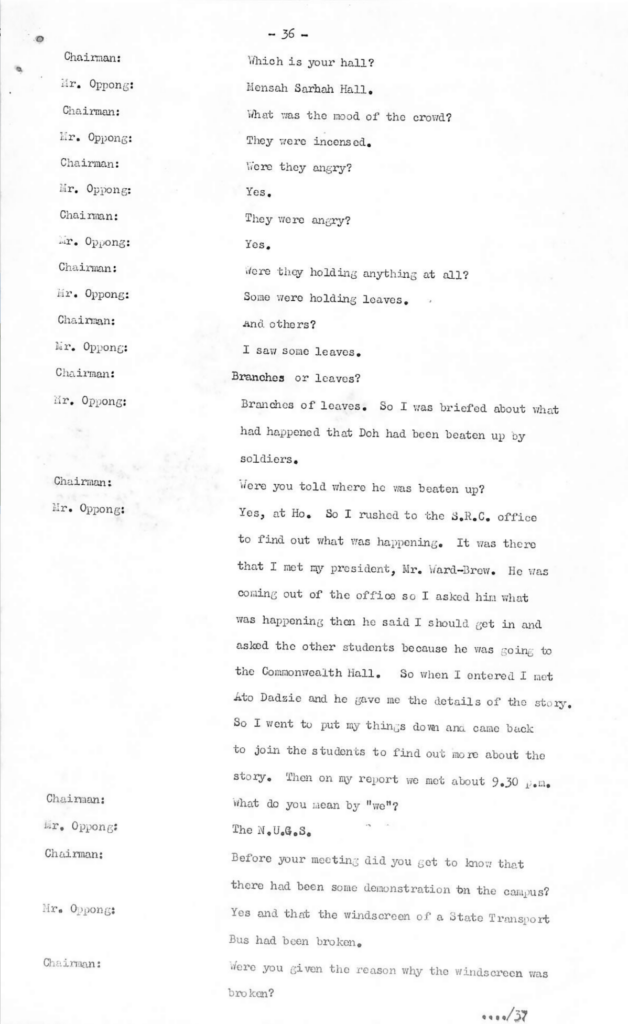
Chairman: Which is your hall?
Mr. Oppong: Mensah Sarhah Hall.
Chairman: What was the mood of the crowd?
Mr. Oppong: They were incensed.
Chairman: Were they angry?
Mr. Oppong: Yes.
Chairman: They were angry?
Mr. Oppong: Yes.
Chairman: Were they holding anything at all?
Mr. Oppong: Some were holding leaves.
Chairman: And others?
Mr. Oppong: I saw some leaves.
Chairman: Branches or leaves?
Mr. Oppong: Branches of leaves. So I was briefed about what had happened that Doh had been beaten up by soldiers.
Chairman: Were you told where he was beaten up?
Mr. Oppong: Yes, at Ho. So I rushed to the S.R.C. office to find out what was happening. It was there that I met my president, Mr. Ward-Brow. He was coming out of the office so I asked him what was happening then he said I should get in and asked the other students because he was going to the Commonwealth Hall. So when I entered I met Ato Dadzie and he gave me the details of the story. So I went to put my things down and came back to join the students to find out more about the story. Then on my report we met about 9.30 p.m.
Chairman: What do you mean by “we”?
Mr. Oppong: The N.U.G.S.
Chairman: Before your meeting did you get to know that there had been some demonstration on the campus?
Mr. Oppong: Yes and that the windscreen of a State Transport Bus had been broken.
Chairman: Were you given the reason why the windscreen was broken?
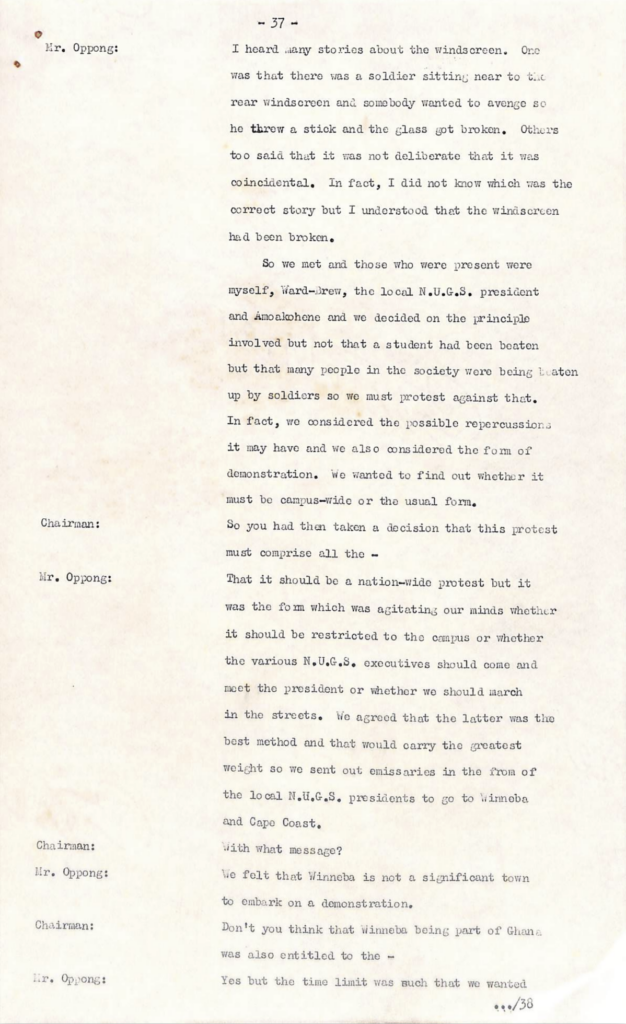
Mr. Oppong: I heard any stories about the windscreen. One was that there was a soldier sitting near to the rear windscreen and some body wanted to avenge so he throw a stick and the glass got broken. Others too said that it was not deliberate that it was coincidental. In fact, I did not know which was the correct story but I understood that the windscreen had been broken.
So we met and those who were present were myself, Ward-Brew, the local N.U.G.S. president and Amoakohene and we decided on the principle involved but not that a student had been beaten but that many people in the society were being beaten up by soldiers so we must protest against that. In fact, we considered the possible repercussions it may have and we also considered the form of demonstration. We wanted to find out whether it must be campus-wide or the usual form.
Chairman: So you had then taken a decision that this protest must comprise all the –
Mr. Oppong: That it should be a nation-wide protest but it was the form which was agitating our minds whether it should be restricted to the campus or whether the various N.U.G.S. executives should come and meet the president or whether we should march in the streets. We agreed that the latter was the best method and that would carry the greatest weight so we sent out emissaries in the form of the local N.U.G.S. presidents to go to Wirmoba and Cape Coast.
Chairman: With what message?
Mr. Oppong: We felt that Winneba is not a significant town to embark on a demonstration.
Chairman: Don’t you think that Winneba being part of Ghana was also entitled to the –
Mr. Oppong: Yes but the time limit was such that we wanted the greatest way where the level of significance was great.
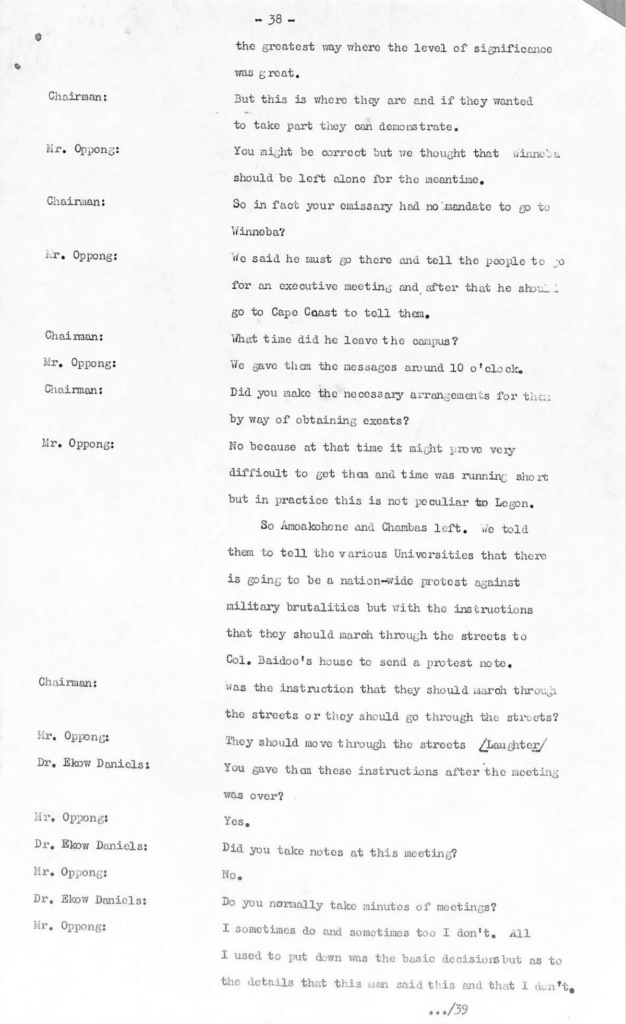
Chairman: But this is where they are and if they wanted to take part they can demonstrate.
Mr. Oppong: You might be correct but we thought that winneba should be left alone for the meantime.
Chairman: So in fact your omissary had no mandate to go to Winneba?
Mr. Oppong: We said he must go there and tell the people to go for an executive meeting and, after that he should go to Cape Coast to tell them.
Chairman: What time did he leave the campus?
Mr. Oppong: We gave them the messages around 10 o’clock. Chairman: Did you make the necessary arrangements for the by way of obtaining exeats?
Mr. Oppong: No because at that time it might prove very difficult to get then and time was running short but in practice this is not peculiar to Legon. So Amoakohene and Chambas left. We told them to tell the various Universities that there is going to be a nation-wide protest against military brutalities but with the instructions that they should march through the streets to Col. Baidoo’s house to send a protest note.
Chairman: was the instruction that they should march through the streets or they should go through the streets?
Mr. Oppong: They should move through the streets [Laughter]
Dr. Ekow Daniels: You gave them these instructions after the meeting was over?
Mr. Oppong: Yes.
Dr. Ekow Daniels: Did you take notes at this meeting?
Mr. Oppong: No.
Dr. Ekow Daniels: Do you normally take minutes of meetings?
Mr. Oppong: I sometimes do and sometimes too I don’t. All I used to put down was the basic decisions but as to the details that this man said this and that I don’t.
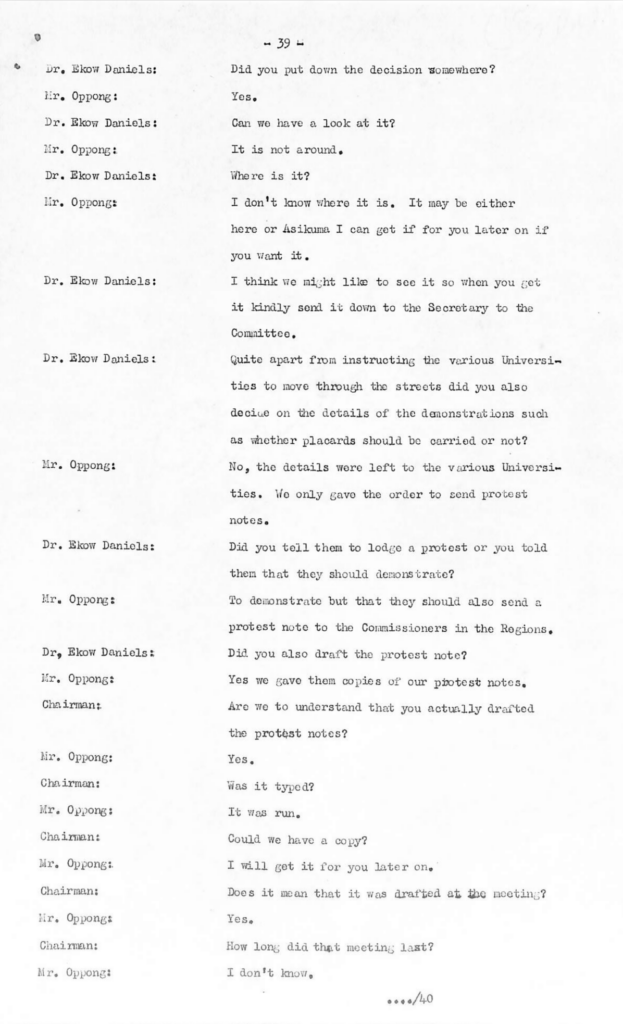
Dr. Ekow Daniels: Did you put down the decision somewhere?
Mr. Oppong: Yes.
Dr. Ekow Daniels: Can we have a look at it?
Mr. Oppong: It is not around.
Dr. Ekow Daniels: Where is it?
Mr. Oppong: I don’t know where it is. It may be either here or Asikuma I can get if for you later on if you want it.
Dr. Ekow Daniels: I think we might like to see it so when you get it kindly send it down to the Secretary to the Committee.
Dr. Ekow Daniels: Quite apart from instructing the various Universities to move through the streets did you also decide on the details of the demonstrations such as whether placards should be carried or not?
Mr. Oppong: No, the details were left to the various Universi- ties. We only gave the order to send protest notes.
Dr. Ekow Daniels: Did you tell them to lodge a protest or you told them that they should demonstrate?
Mr. Oppong: To demonstrate but that they should also send a protest note to the Commissioners in the Regions.
Dr. Ekow Daniels: Did you also draft the protest note?
Mr. Oppong: Yes we gave them copies of our protest notes.
Chairman: Are we to understand that you actually drafted the protest notes?
Mr. Oppong: Yes.
Chairman: Was it typed?
Mr. Oppong: It was run.
Chairman: Could we have a copy?
Mr. Oppong: I will get it for you later on.
Chairman: Does it mean that it was drafted at the meeting?
Mr. Oppong: Yes.
Chairman: How long did that meeting last?
Mr. Oppong: I don’t know.
Chairman: Did you appreciate you were taking a major decision?
Mr. Oppong: Yes.
Chairman: Who run the protest?
Mr. Oppong: I don’t know but I can check up.
Chairman: You want us to understand that people other than the Executive of N.U.G.S. attended that meeting?
Mr. Oppong: There were many observers also at that time we could not strictly say you are not a member so go out.
Chairman: Were you in any way pressurised into taking the decision?
Mr. Oppong: I don’t think we were in any way pressurised because we believed in the principle that being a soldier should not entitle anybody to beat anybody. So on Monday I followed the crowd and, in fact, I was slightly late so when I rushed to the barrier I saw the soldiers at the other end and the students heading towards the Legon section.
Chairman: About how many students were gathered there?
Mr. Oppong I think everybody was present over 3,000.
Chairman: Could you tell us some of the slogans?
Mr. Oppong: “You are neither beast nor machines nor robots but human beings”, “End Military brutalities now”. I think these are the two which come to me readily.
Chairman: Did you see any to this effect “Strip Major Grant of his national award”?
Mr. Oppong: No, please.
Chairman: Were the students singing?
Mr. Oppong Yes.
Chairman: What song?
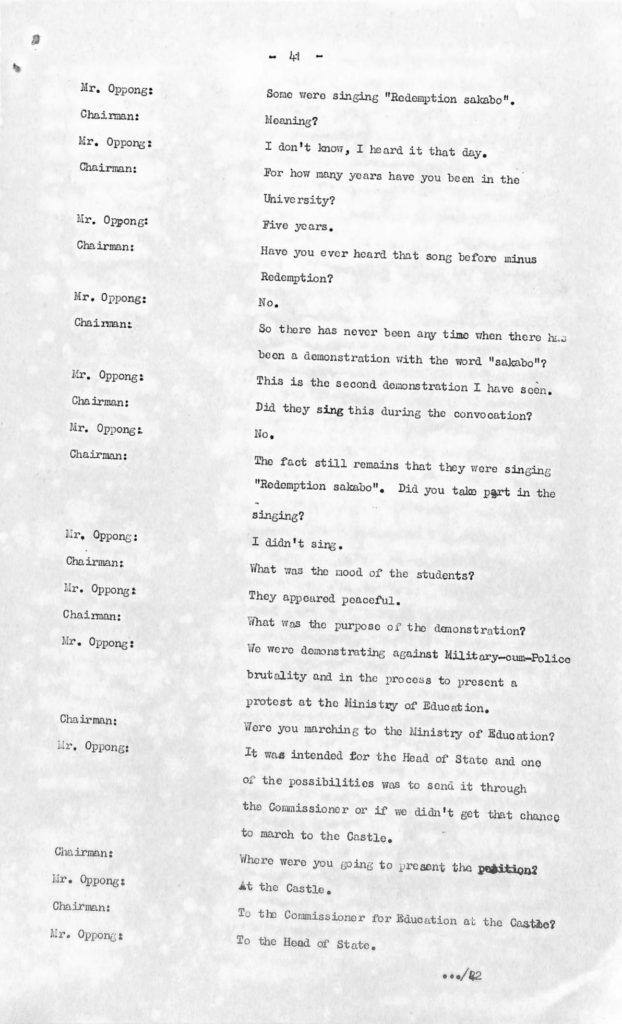
Mr. Oppong: Some were singing “Redemption sakabo”.
Chairman: Meaning?
Mr. Oppong: I don’t know, I heard it that day.
Chairman: For how many years have you been in the University?
Mr. Oppong: Five years.
Chairman: Have you ever heard that song before minus Redemption?
Mr. Oppong: No.
Chairman: So there has never been any time when there has been a demonstration with the word “sakabo”?
Mr. Oppong: This is the second demonstration I have seen.
Chairman: Did they sing this during the convocation?
Mr. Oppong: No.
Chairman: The fact still remains that they were singing “Redemption sakabo”. Did you take part in the singing?
Mr. Oppong: I didn’t sing.
Chairman: What was the mood of the students?
Mr. Oppong: They appeared peaceful.
Chairman: What was the purpose of the demonstration?
Mr. Oppong: We were demonstrating against Military-cum-Police brutality and in the process to present a protest at the Ministry of Education.
Chairman: Were you marching to the Ministry of Education?
Mr. Oppong: It was intended for the Head of State and one of the possibilities was to send it through the Commissioner or if we didn’t get that chance to march to the Castle.
Chairman: Where were you going to present the position?
Mr. Oppong: At the Castle.
Chairman: To the Commissioner for Education at the Castle?
Mr. Oppong: To the Head of State.
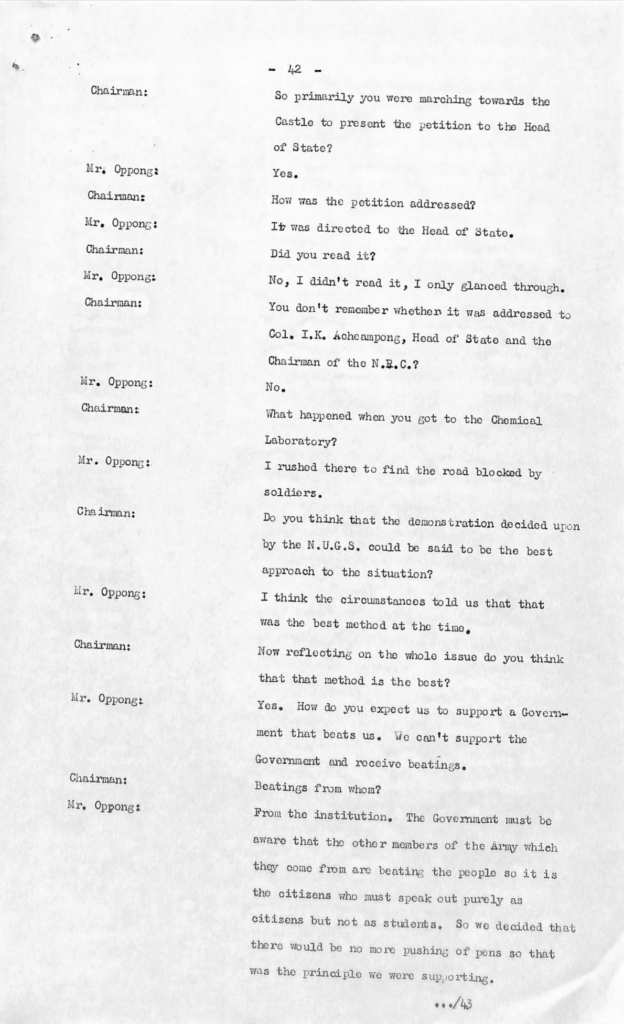
Chairman: So primarily you were marching towards the Castle to present the petition to the Head of State?
Mr. Oppong: Yes.
Chairman: How was the petition addressed?
Mr. Oppong: It was directed to the Head of State.
Chairman: Did you read it?
Mr. Oppong: No, I didn’t read it, I only glanced through.
Chairman: You don’t remember whether it was addressed to Col. I.K. Acheampong, Head of State and the Chairman of the N.B.C.?
Mr. Oppong: No.
Chairman: What happened when you got to the Chemical Laboratory?
Mr. Oppong: I rushed there to find the road blocked by soldiers.
Chairman: Do you think that the demonstration decided upon by the N.U.G.S. could be said to be the best approach to the situation?
Mr. Oppong: I think the circumstances told us that that was the best method at the time.
Chairman: Now reflecting on the whole issue, do you think that that method is the best?
Mr. Oppong: Yes. How do you expect us to support a Government that beats us. We can’t support the Government and receive beatings.
Chairman: Beatings from whom?
Mr. Oppong: From the institution. The Government must be aware that the other members of the Army which they come from are beating the people so it is the citizens who must speak out purely as citizens but not as students. So we decided that there would be no more pushing of pens so that was the principle we were supporting.
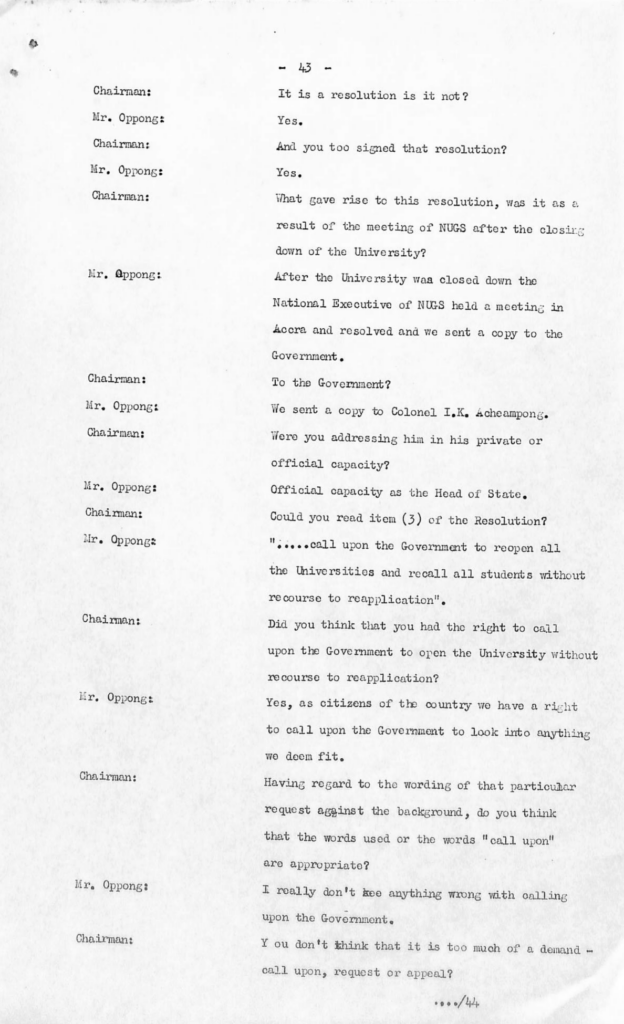
Chairman: It is a resolution is it not?
Mr. Oppong: Yes.
Chairman: And you too signed that resolution?
Mr. Oppong: Yes.
Chairman: What gave rise to this resolution, was it as a result of the meeting of NUGS after the closing down of the University?
Mr. Oppong: After the University was closed down the National Executive of NUGS held a meeting in Accra and resolved and we sent a copy to the Government.
Chairman: To the Government?
Mr. Oppong: We sent a copy to Colonel I.K. Acheampong.
Chairman: Were you addressing him in his private or official capacity?
Mr. Oppong: Official capacity as the Head of State.
Chairman: Could you read item (3) of the Resolution?
Mr. Oppong “…..call upon the Government to reopen all the Universities and recall all students without re course to reapplication”.
Chairman: Did you think that you had the right to call upon the Government to open the University without recourse to reapplication?
Mr. Oppong: Yes, as citizens of the country we have a right to call upon the Government to look into anything we deem fit.
Chairman: Having regard to the wording of that particular request against the background, do you think that the words used or the words “call upon” are appropriate?
Mr. Oppong: I really don’t see anything wrong with calling upon the Government.
Chairman: You don’t think that it is too much of a demand – call upon, request or appeal?
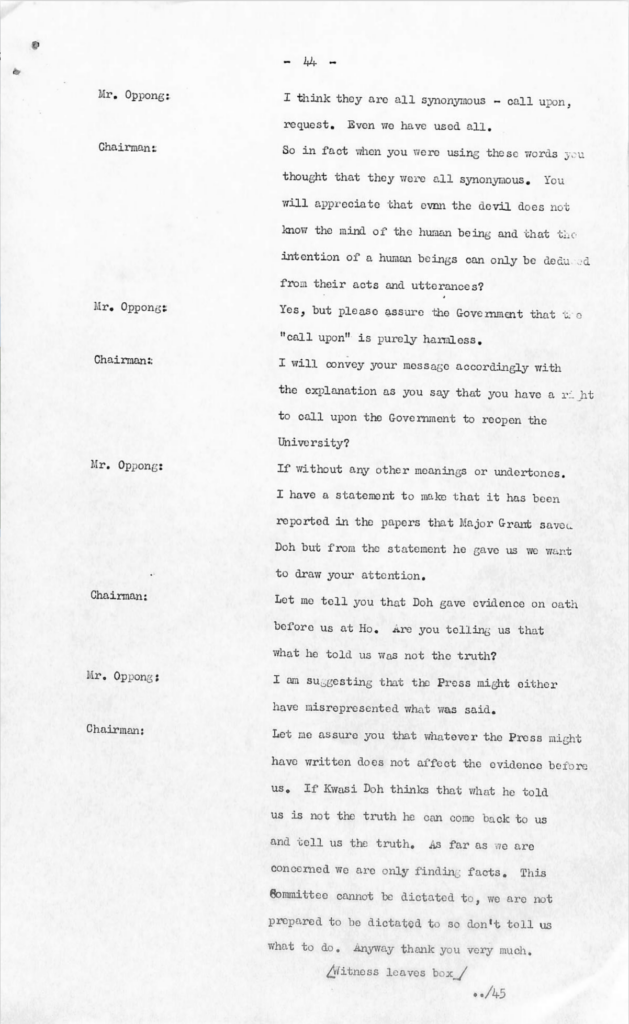
Mr. Oppong: I think they are all synonymous call upon, request. Even we have used all.
Chairman: So in fact when you were using these words you thought that they were all synonymous. You will appreciate that even the devil does not know the mind of the human being and that the intention of a human beings can only be deduced from their acts and utterances?
Mr. Oppong: Yes, but please assure the Government that the “call upon” is purely harmless.
Chairman: I will convey your message accordingly with the explanation as you say that you have a right to call upon the Government to reopen the University?
Mr. Oppong: If without any other meanings or undertones. I have a statement to make that it has been reported in the papers that Major Grant savo Doh but from the statement he gave us we want to draw your attention.
Chairman: Let me tell you that Doh gave evidence on oath before us at Ho. Are you telling us that what he told us was not the truth?
Mr. Oppong: I am suggesting that the Press might either have misrepresented what was said.
Chairman: Let me assure you that whatever the Press might have written does not affect the evidence before us. If Kwasi Doh thinks that what he told us is not the truth he can come back to us and tell us the truth. As far as we are concerned we are only finding facts. This Committee cannot be dictated to, we are not prepared to be dictated to so don’t toll us what to do. Anyway, thank you very much.
[Witness leaves box]
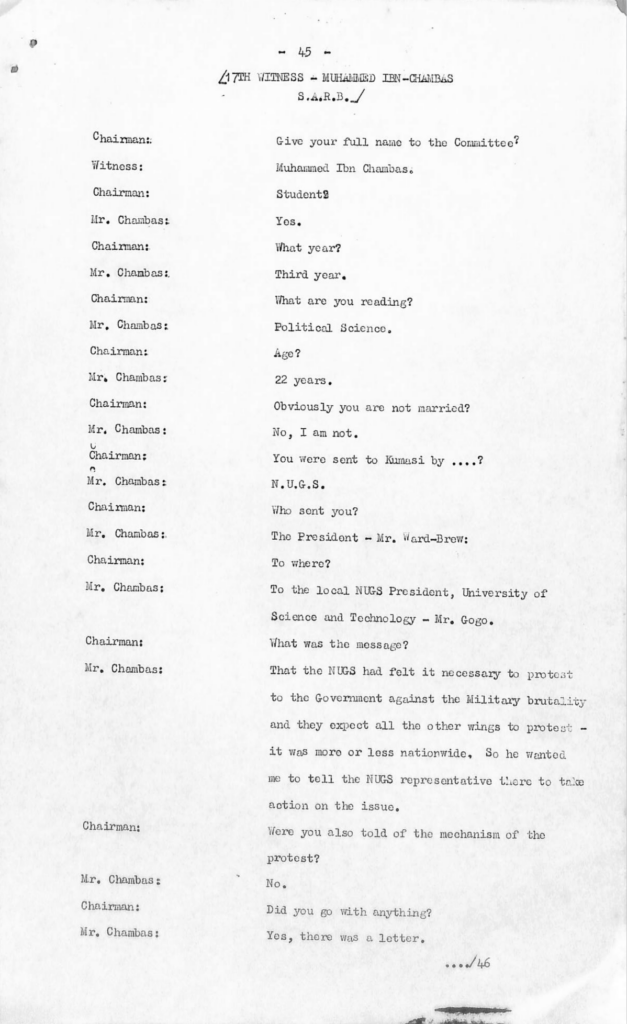
[17TH WITNESS – MUHAMMED IBN-CHAMBAS S.A.R.B. ]
Chairman: Give your full name to the Committee?
Witness: Muhammed Ibn Chambas.
Chairman: Student?
Mr. Chambas: Yes.
Chairman: What year?
Mr. Chanbas: Third year.
Chairman: What are you reading?
Mr. Chambas: Political Science.
Chairman: Age?
Mr. Chambas: 22 years.
Chairman: Obviously you are not married?
Mr. Chambas: No, I am not.
Chairman: You were sent to Kumasi by….?
Mr. Chambas: N.U.G.S.
Chairman: Who sent you?
Mr. Chambas: The President – Mr. Ward-Brew:
Chairman: To where?
Mr. Chambas: To the local NUGS President, University of Science and Technology Mr. Gogo.
Chairman: What was the message?
Mr. Chambas: That the NUGS had felt it necessary to protest to the Government against the Military brutality and they expect all the other wings to protest it more or less nationwide. So he wanted me to tell the NUGS representative there to take action on the issue.
Chairman: Were you also told of the mechanism of the protest?
Mr. Chambas: No.
Chairman: Did you go with anything?
Mr. Chambas: Yes, there was a letter.
Chairman: How did you go?
Mr. Chambas: I went by bus to Nkawkaw and from Nkawkaw I went with the Daily Graphic truck.
Chairman: At what time did you get there?
Mr. Chambas Between 4.15 and 4.30 a.m.
Chairman: What time did you come back?
Mr. Chambas: The following day at 5.30 p.m.
Chairman: And you heard?
Mr. Chambas: I heard that the Universities had been closed down.
Dr. Ekow Daniels: Were you surprised?
Mr. Chambas: I was.
Chairman: When you went there did you join the students to see that in fact they carry out the instructions?
Mr. Chambas: To a point, yes. I went with them to town. The message was also that besides the demonstration there was going to be a NUGS Executive meeting but the members there thought they could not make it so I should come back to tell them that they couldn’t make it.
Chairman: Did you go with them to the Residency?
Mr. Chambas: No, I didn’t go there.
Chairman: Thank you very much.
[Witness leaves box]
In the opinion of the Committee I think this is all the evidence we need here. We shall be moving to Kumasi. On behalf of the Committee we thank all of you for taking interest in our work and especially those people who gave evidence before us for their frankness and, of course, the door is still open for Kwasi Doh if he wants to come. If anybody feels that he has got something to say which might help the Committee the person should write to the Secretary. On behalf of the Committee, we thank all of you.
[Sitting adjourned at 1.30 till February 27, 1974 at 8.30 a.m.]