Correspondence Between Peter Sarpong, Chairman of Council, U.S.T. And E. Evans-Anfom, Vice-Chancellor, U.S.T.. 2
July 2, 2026

Transcript
May 8, 1973
8th May, 1973
BK:93/73/4
Vice-Chancellor,
Dr. E.Evans-Anfom,
University of Science & Technology,
KUMASI
Dear Vice-Chancellor,
Before leaving for Accra en route for U.S.A., I am writing in haste to acknowledge your letter, VC/UC/1(a) of 6th May, 1973.
I thought that during our discussion on my BK:93/73/3 of 2nd May, 1973, I had explained my point so clearly that, even though you did not conceal your disagreement with my decision not to have the Johnson Committee Report released, you had understood my position. It therefore comes as a surprise to me that you should bring up again some of these points in your letter.
I am pleased to read that the President of the S.R.C. has in a discussion with you confirmed that I did not give the students any promise or assurance that the S.R.C. would be given a copy of the Report of the Committee.
You now wish me to note that the decision to give a copy of the Report to the students was taken, not on the basis of any promise made by me (as I was alleged to have made) “but solely on the desirability of doing so.” I regret I cannot accept this. The question of desirability to release the Report to the students was canvassed by you when you came to see me on 5th May, 1973, to discuss with me the views I had communicated to you in my letter of 2nd May, 1973, that the Report of the Committee should not be published without the appendices, and without an accompanying ‘White Paper embodying the comments etc. of Council.
With regard to this question of desirability, you yourself had advised that the appendices should not be released. This to me meant that you thought it undesirable to publicize the appendices. During our discussion, however, you agreed that the Report could not be released without the appendices. Did this not imply that the whole Report could not be released?
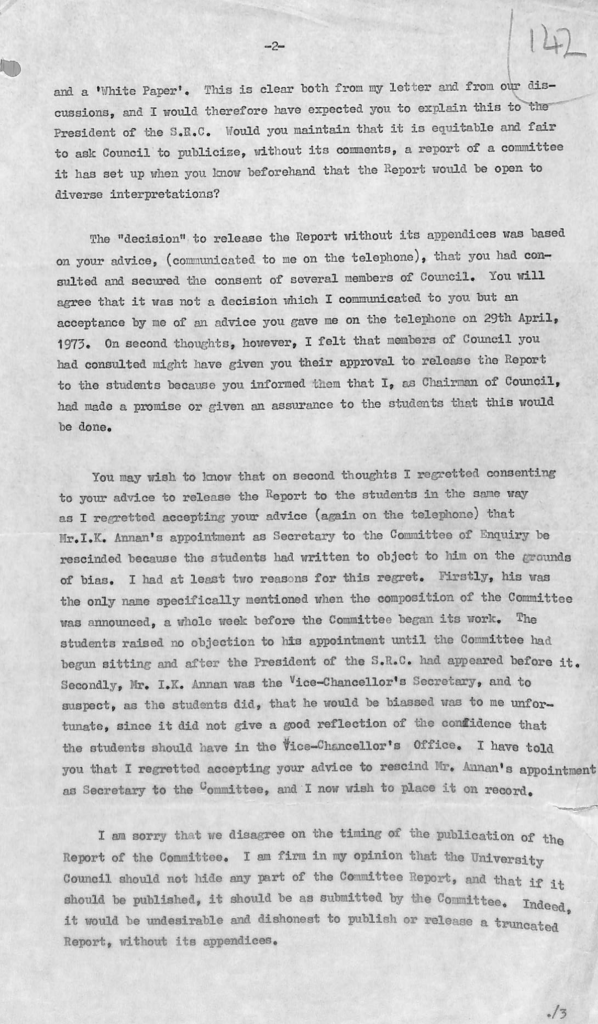
My decision was not that the Report should not be made available to the students, but that it could not be publicized without the appendices and a ‘White Paper’. This is clear both from my letter and from our discussions, and I would therefore have expected you to explain this to the President of the S.R.C. Would you maintain that it is equitable and fair to ask Council to publicize, without its comments, a report of a committee it has set up when you know beforehand that the Report would be open to diverse interpretations?
The “decision” to release the Report without its appendices was based on your advice, (communicated to me on the telephone), that you had consulted and secured the consent of several members of Council. You will agree that it was not a decision which I communicated to you but an acceptance by me of an advice you gave me on the telephone on 29th April, 1973. On second thoughts, however, I felt that members of Council you had consulted might have given you their approval to release the Report to the students because you informed them that I, as Chairman of Council, had made a promise or given an assurance to the students that this would be done.
You may wish to know that on second thoughts I regretted consenting to your advice to release the Report to the students in the same way as I regretted accepting your advice (again on the telephone) that Mr.I.K. Annan’s appointment as Secretary to the Committee of Enquiry be rescinded because the students had written to object to him on the grounds of bias. I had at least two reasons for this regret. Firstly, his was the only name specifically mentioned when the composition of the Committee was announced, a whole week before the Committee began its work. The students raised no objection to his appointment until the Committee had begun sitting and after the President of the S.R.C. had appeared before it. Secondly, Mr. I.K. Annan was the Vice-Chancellor’s Secretary, and to suspect, as the students did, that he would be biased was to me unfortunate, since it did not give a good reflection of the confidence that the students should have in the Vice-Chancellor’s office. I have told you that I regretted accepting your advice to rescind Mr. Annan’s appointment as Secretary to the Committee, and I now wish to place it on record.
I am sorry that we disagree on the timing of the publication of the Report of the Committee. I am firm in my opinion that the University Council should not hide any part of the Committee Report, and that if it should be published, it should be as submitted by the Committee. Indeed, it would be undesirable and dishonest to publish or release a truncated Report, without its appendices.
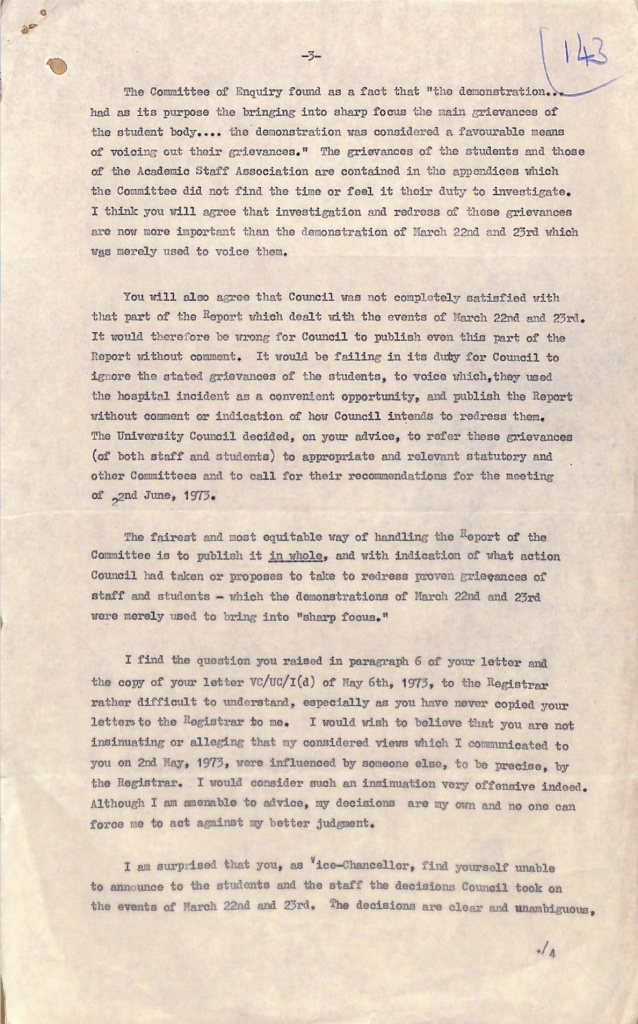
The Committee of Enquiry found as a fact that “the demonstration…. had as its purpose the bringing into sharp focus the main grievances of the student body…. the demonstration was considered a favourable means of voicing out their grievances.” The grievances of the students and those of the Academic Staff Association are contained in the appendices which the Committee did not find the time or feel it their duty to investigate. I think you will agree that investigation and redress of these grievances are now more important than the demonstration of March 22nd and 23rd which was merely used to voice them.
You will also agree that Council was not completely satisfied with that part of the Report which dealt with the events of March 22nd and 23rd. It would therefore be wrong for Council to publish even this part of the Report without comment. It would be failing in its duty for Council to ignore the stated grievances of the students, to voice which, they used the hospital incident as a convenient opportunity, and publish the Report without comment or indication of how Council intends to redress them. The University Council decided, on your advice, to refer these grievances (of both staff and students) to appropriate and relevant statutory and other Committees and to call for their recommendations for the meeting of 22nd June, 1973.
The fairest and most equitable way of handling the Report of the Committee is to publish it in whole, and with indication of what action Council had taken or proposes to take to redress proven grievances of staff and students R which the demonstrations of March 22nd and 23rd were merely used to bring into “sharp focus.”
I find the question you raised in paragraph 6 of your letter and the copy of your letter VC/UC/1(a) of May 6th, 1973, to the Registrar rather difficult to understand, especially as you have never copied your letters to the Registrar to me. I would wish to believe that you are not insinuating or alleging that my considered views which I communicated to you on 2nd May, 1973, wore influenced by someone else, to be precise, by the Registrar. I would consider such an insinuation very offensive indeed. Although I am amenable to advice, my decisions are my own and no one can force me to act against my better judgment.
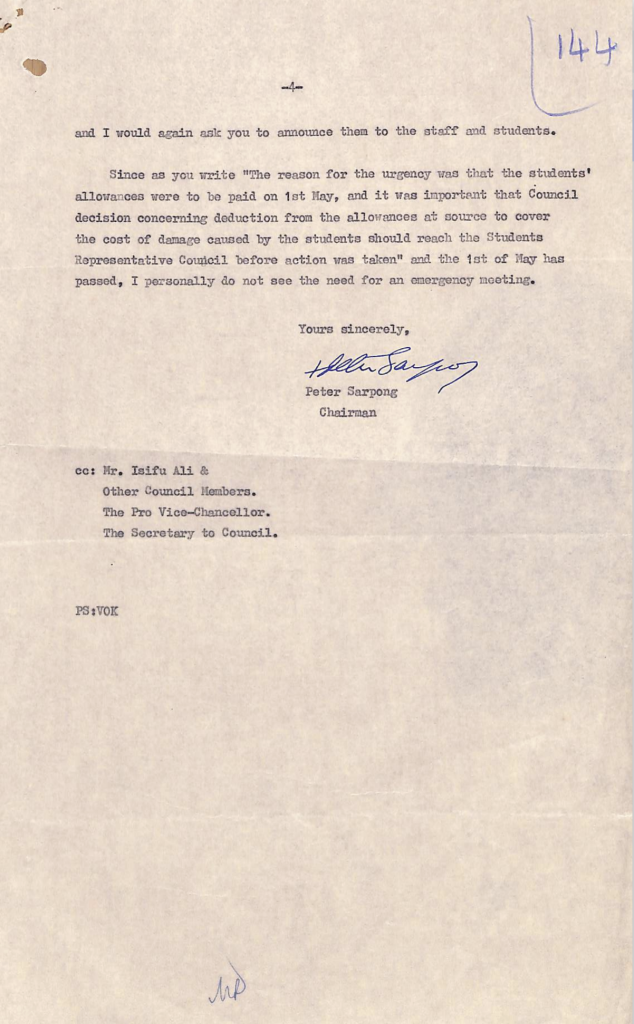
I am surprised that you, as Vice-Chancellor, find yourself unable to announce to the students and the staff the decisions Council took on the events of March 22nd and 23rd. The decisions are clear and unambiguous, and I would again ask you to announce them to the staff and students.
Since as you write “The reason for the urgency was that the students’ allowances were to be paid on 1st May, and it was important that Council decision concerning deduction from the allowances at source to cover the cost of damage caused by the students should reach the Students Representative Council before action was taken” and the 1st of May has passed, I personally do not see the need for an emergency meeting.
Yours sincerely,
Peter Sarpong
Chairman
cc: Mr. Isifu Ali & Other Council Members.
The Pro Vice-Chancellor.
The Secretary to Council.
PS: VOK