Excerpt: Human Rights In Ghana
August 11, 2026

Transcript
International Commission of Jurists (ICJ)
1984
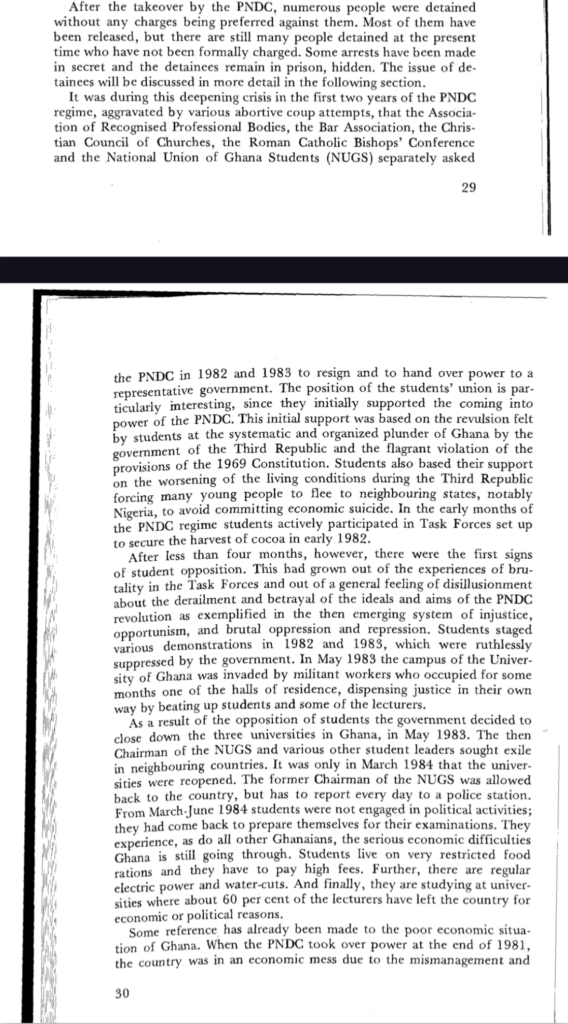
…After the takeover by the PNDC, numerous people were detained without any charges being preferred against them. Most of them have been released, but there are still many people detained at the present time who have not been formally charged. Some arrests have been made
in secret and the detainees remain in prison, hidden. The issue of detainees will be discussed in more detail in the following section.
It was during this deepening crisis in the first two years of the PNDC regime, aggravated by various abortive coup attempts, that the Association of Recognised Professional Bodies, the Bar Association, the Christian Council of Churches, the Roman Catholic Bishops’ Conference and the National Union of Ghana Students (NUGS) separately asked the PNDC in 1982 and 1983 to resign and to hand over power to a representative government. The position of the students’ union is particularly interesting, since they initially supported the coming into power of the PNDC. This initial support was based on the revulsion felt by students at the systematic and organized plunder of Ghana by the government of the Third Republic and the flagrant violation of the provisions of the 1969 Constitution. Students also based their support on the worsening of the living conditions during the Third Republic forcing many young people to flee to neighbouring states, notably Nigeria, to avoid committing economic suicide. In the early months of the PNDC regime students actively participated in Task Forces set up to secure the harvest of cocoa in early 1982.
After less than four months, however, there were the first signs of student opposition. This had grown out of the experiences of brutality in the Task Forces and out of a general feeling of disillusionment about the derailment and betrayal of the ideals and aims of the PNDC revolution as exemplified in the then emerging system of injustice, opportunism, and brutal oppression and repression. Students staged various demonstrations in 1982 and 1983, which were ruthlessly suppressed by the government. In May 1983 the campus of the University of Ghana was invaded by militant workers who occupied for some months one of the halls of residence, dispensing justice in their own way by beating up students and some of the lecturers.
As a result of the opposition of students the government decided to close down the three universities in Ghana, in May 1983. The then Chairman of the NUGS and various other student leaders sought exile in neighbouring countries. It was only in March 1984 that the universities were reopened. The former Chairman of the NUGS was allowed back to the country, but has to report every day to a police station. From March-June 1984 students were not engaged in political activities; they had come back to prepare themselves for their examinations. They experience, as do all other Ghanaians, the serious economic difficulties Ghana is still going through. Students live on very restricted food rations and they have to pay high fees. Further, there are regular electric power and water-cuts. And finally, they are studying at universities where about 60 per cent of the lecturers have left the country for economic or political reasons.
Some reference has already been made to the poor economic situation of Ghana…