Student Agitations In The Schools
August 5, 2026
Transcript
1982
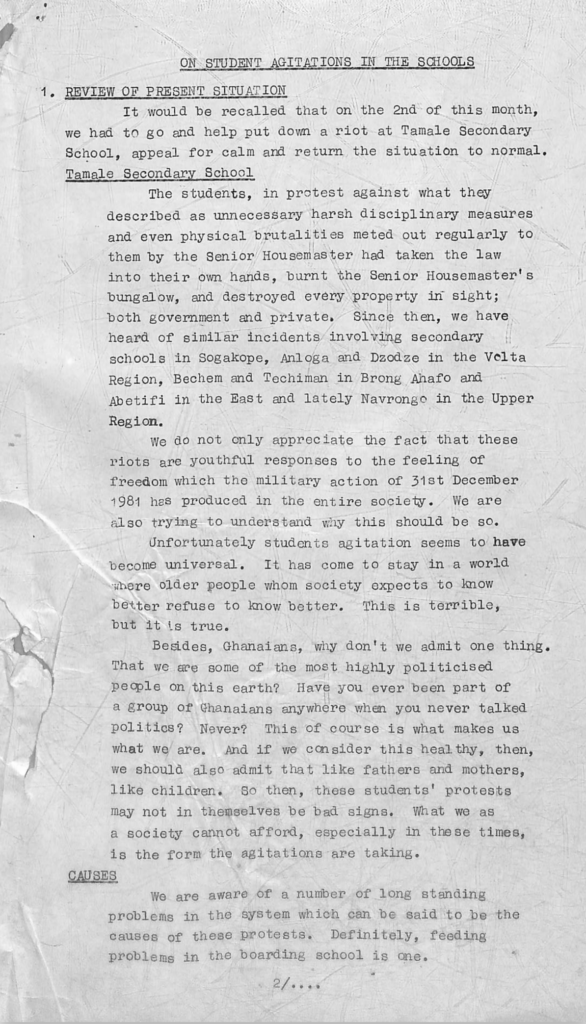
ON STUDENT AGITATIONS IN THE SCHOOLS
1. REVIEW OF PRESENT SITUATION
It would be recalled that on the 2nd of this month, we had to go and help put down a riot at Tamale Secondary School, appeal for calm and return the situation to normal. Tamale Secondary School
The students, in protest against what they described as unnecessary harsh disciplinary measures and even physical brutalities meted out regularly to them by the Senior Housemaster had taken the law into their own hands, burnt the Senior Housemaster’s bungalow, and destroyed every property in sight; both government and private. Since then, we have heard of similar incidents involving secondary schools in Sogakope, Anloga and Dzodze in the Volta Region, Bechem and Techiman in Brong Ahafo and Abetifi in the East and lately Navrongo in the Upper Region.
We do not only appreciate the fact that these riots are youthful responses to the feeling of freedom which the military action of 31st December 1981 has produced in the entire society. We are also trying to understand why this should be so.
Unfortunately students agitation seems to have become universal. It has come to stay in a world where older people whom society expects to know better refuse to know better. This is terrible, but it is true.
CAUSES
Besides, Ghanaians, why don’t we admit one thing. That we are some of the most highly politicised people on this earth? Have you ever been part of a group of Ghanaians anywhere when you never talked politics? Never? This of course is what makes us what we are. And if we consider this healthy, then, we should also admit that like fathers and mothers,
like children. So then, these students’ protests may not in themselves be bad signs. What we as a society cannot afford, especially in these times, is the form the agitations are taking.
We are aware of a number of long standing problems in the system which can be said to be the causes of these protests. Definitely, feeding problems in the boarding school is one
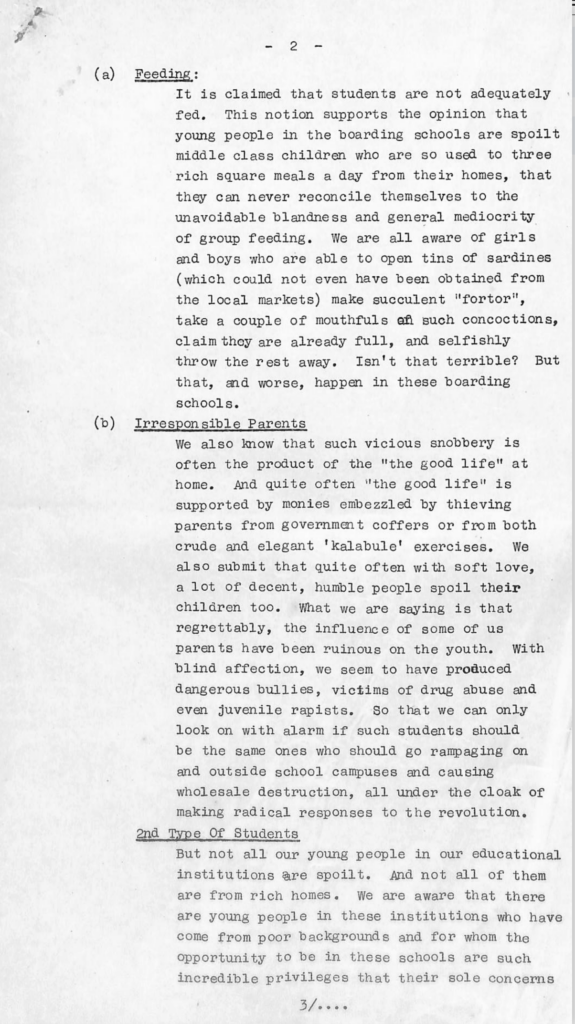
(a) Feeding:
It is claimed that students are not adequately fed. This notion supports the opinion that young people in the boarding schools are spoilt middle class children who are so used to three rich square meals a day from their homes, that they can never reconcile themselves to the unavoidable blandness and general mediocrity of group feeding. We are all aware of girls and boys who are able to open tins of sardines (which could not even have been obtained from the local markets) make succulent “fortor”, take a couple of mouthfuls of such concoctions, claim they are already full, and selfishly throw the rest away. Isn’t that terrible? But that, and worse, happen in these boarding schools.
(b) Irresponsible Parents
We also know that such vicious snobbery is often the product of the “the good life” at home. And quite often “the good life” is supported by monies embezzled by thieving parents from government coffers or from both crude and elegant ‘kalabule’ exercises. We also submit that quite often with soft love, a lot of decent, humble people spoil their children too. What we are saying is that regrettably, the influence of some of us parents have been ruinous on the youth. With blind affection, we seem to have produced dangerous bullies, victims of drug abuse and even juvenile rapists. So that we can only look on with alarm if such students should be the same ones who should go rampaging on and outside school campuses and causing wholesale destruction, all under the cloak of making radical responses to the revolution.
2nd Type Of Students
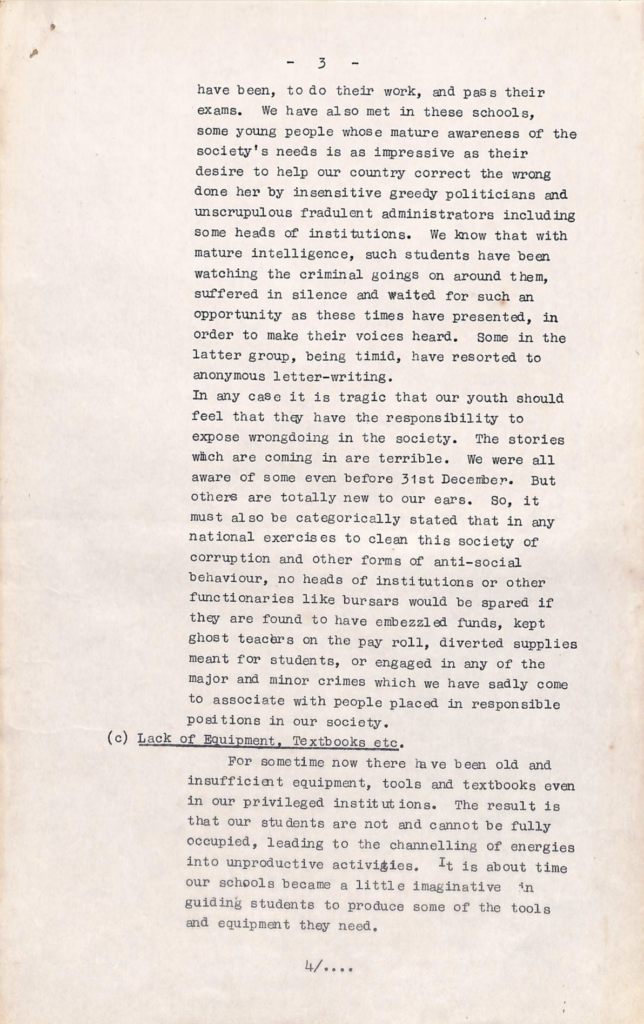
But not all our young people in our educational institutions are spoilt. And not all of them are from rich homes. We are aware that there are young people in these institutions who have come from poor backgrounds and for whom the opportunity to be in these schools are such incredible privileges that their sole concerns have been, to do their work, and pass their exams. We have also met in these schools, some young people whose mature awareness of the society’s needs is as impressive as their desire to help our country correct the wrong done her by insensitive greedy politicians and unscrupulous fraudulent administrators including some heads of institutions. We know that with mature intelligence, such students have been watching the criminal goings on around them, suffered in silence and waited for such an
opportunity as these times have presented, in order to make their voices heard. Some in the latter group, being timid, have resorted to anonymous letter-writing.
In any case it is tragic that our youth should feel that they have the responsibility to expose wrongdoing in the society. The stories which are coming in are terrible. We were all aware of some even before 31st December. But others are totally new to our ears. So, it must also be categorically stated that in any national exercises to clean this society of corruption and other forms of anti-social behaviour, no heads of institutions or other functionaries like bursars would be spared if they are found to have embezzled funds, kept ghost teachers on the pay roll, diverted supplies meant for students, or engaged in any of the major and minor crimes which we have sadly come to associate with people placed in responsible positions in our society.
(c) Lack of Equipment, Textbooks etc.
For some time now there have been old and insufficient equipment, tools and textbooks even in our privileged institutions. The result is that our students are not and cannot be fully occupied, leading to the channelling of energies
into unproductive activities. It is about time our schools became a little imaginative in guiding students to produce some of the tools and equipment they need.
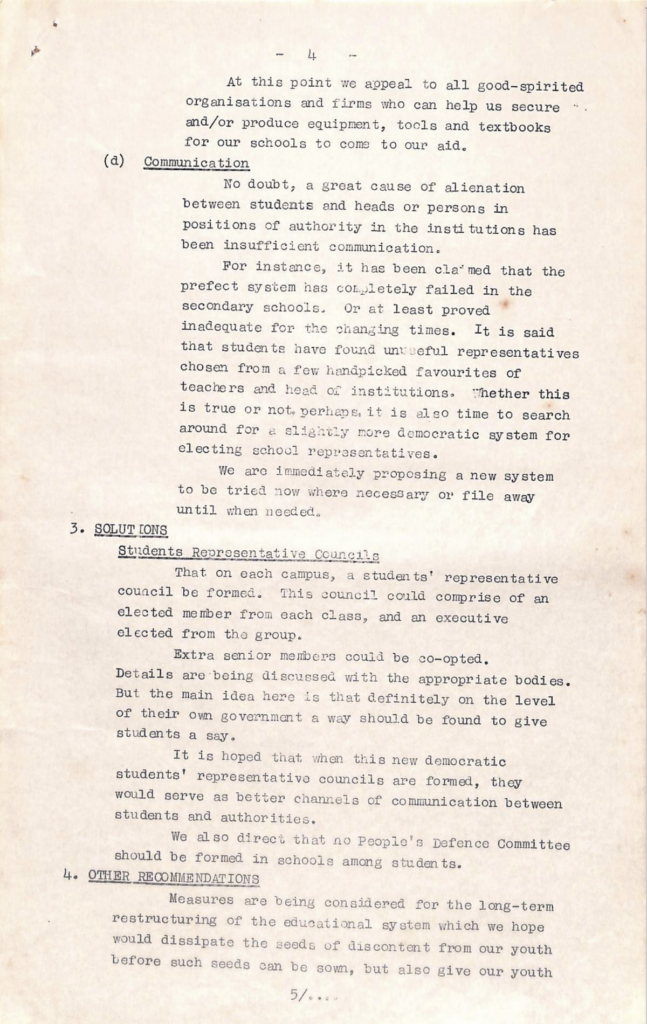
At this point we appeal to all good-spirited organisations and firms who can help us secure and/or produce equipment, tools and textbooks for our schools to come to our aid.
(d) Communication
No doubt, a great cause of alienation between students and heads or persons in positions of authority in the institutions has been insufficient communication.
For instance, it has been claimed that the prefect system has completely failed in the secondary schools. Or at least proved inadequate for the changing times. It is said that students have found unuseful representatives chosen from a few handpicked favourites of teachers and head of institutions. Whether this is true or not. perhaps, it is also time to search
around for a slightly more democratic system for electing school representatives.
We are immediately proposing a new system to be tried now where necessary or file away until when needed.
3. SOLUTIONS
Students Representative Councils
That on each campus, a students’ representative council be formed. This council could comprise of an elected member from each class, and an executive elected from the group.
Extra senior members could be co-opted. Details are being discussed with the appropriate bodies. But the main idea here is that definitely on the level of their own government a way should be found to give students a say.
It is hoped that when this new democratic students’ representative councils are formed, they would serve as better channels of communication between students and authorities.
We also direct that no People’s Defence Committee should be formed in schools among students.
4. OTHER RECOMMENDATIONS
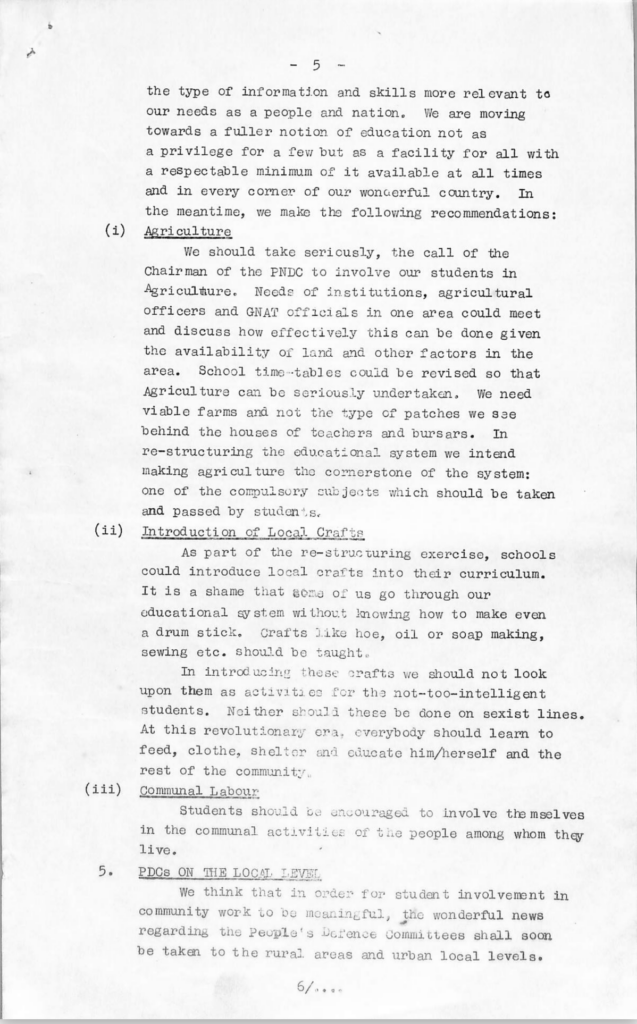
Measures are being considered for the long-term restructuring of the educational sy stem which we hope would dissipate the seeds of discontent from our youth before such seeds can be sown, but also give our youth the type of information and skills more relevant to our needs as a people and nation. We are moving towards a fuller notion of education not as a privilege for a few but as a facility for all with a respectable minimum of it available at all times and in every corner of our wonderful country. In the meantime, we make the following recommendations:
(i) Agriculture
We should take seriously, the call of the Chairman of the PNDC to involve our students in Agriculture. Needs of institutions, agricultural officers and GNAT officials in one area could meet and discuss how effectively this can be done given the availability of land and other factors in the area. School time tables could be revised so that Agriculture can be seriously undertaken. We need viable farms and not the type of patches we see behind the houses of teachers and bursars. In re-structuring the educational system we intend making agriculture the cornerstone of the system: one of the compulsory subjects which should be taken and passed by students.
(ii) Introduction of Local Crafts
As part of the re-structuring exercise, schools could introduce local crafts into their curriculum. It is a shame that some of us go through our educational system without knowing how to make even a drum stick. Crafts like hoe, oil or soap making, sewing etc. should be taught.
In introducing these crafts we should not look upon them as activities for the not-too-intelligent students. Neither should these be done on sexist lines. At this revolutionary era, everybody should learn to feed, clothe, shelter and educate him/herself and the rest of the community.
(iii) Communal Labour
Students should be encouraged to involve themselves in the communal activities of the people among whom they live.
5. PDCS ON THE LOCAL LEVEL
We think that in order for student involvement in community work to be meaningful, the wonderful news regarding the People’s Defence Committees shall soon be taken to the rural areas and urban local levels.
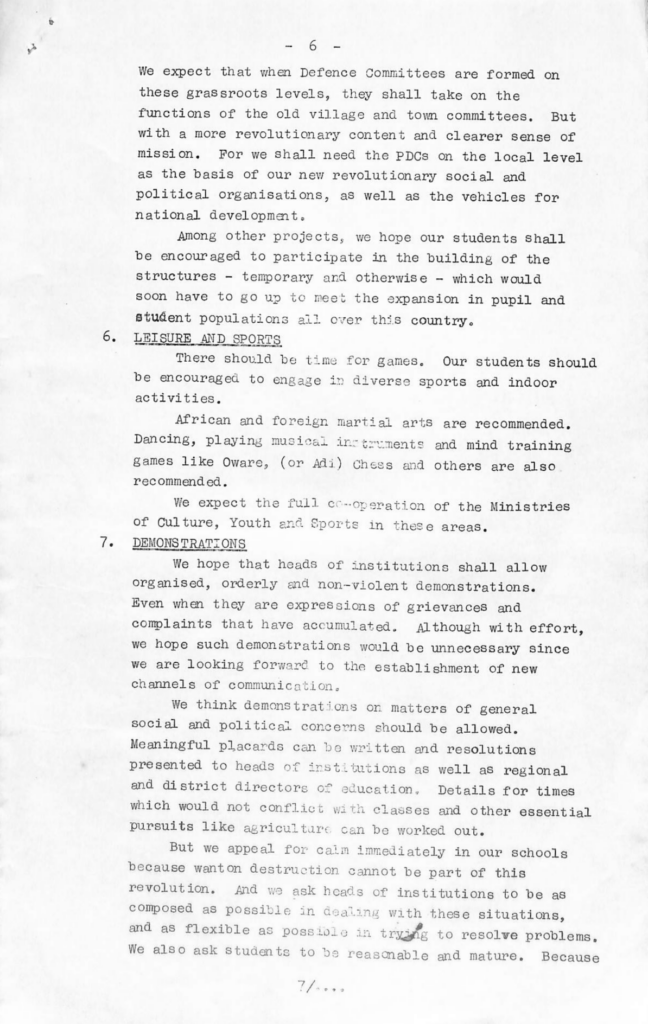
We expect that when Defence Committees are formed on these grassroots levels, they shall take on the functions of the old village and town committees. with a more revolutionary content and clearer sense of mission. For we shall need the PDCS on the local level as the basis of our new revolutionary social and political organisations, as well as the vehicles for
national development.
Among other projects, we hope our students shall be encouraged to participate in the building of the structures –temporary and otherwise– which would soon have to go up to meet the expansion in pupil and student populations all over this country.
6. LEISURE AND SPORTS
There should be time for games. Our students should be encouraged to engage in diverse sports and indoor activities.
African and foreign martial arts are recommended. Dancing, playing musical instruments and mind training games like Oware, (or Adi) Chess and others are also recommended.
We expect the full co-operation of the Ministries of Culture, Youth and Sports in these areas.
7. DEMONSTRATIONS
We hope that heads of institutions shall allow organised, orderly and non-violent demonstrations. Even when they are expressions of grievances and complaints that have accumulated. Although with effort, we hope such demonstrations would be unnecessary since we are looking forward to the establishment of new channels of communication.
We think demonstrations on matters of general social and political concerns should be allowed. Meaningful placards can be written and resolutions presented to heads of institutions as well as region al and district directors of education. Details for times which would not conflict with classes and other essential pursuits like agriculture can be worked out.
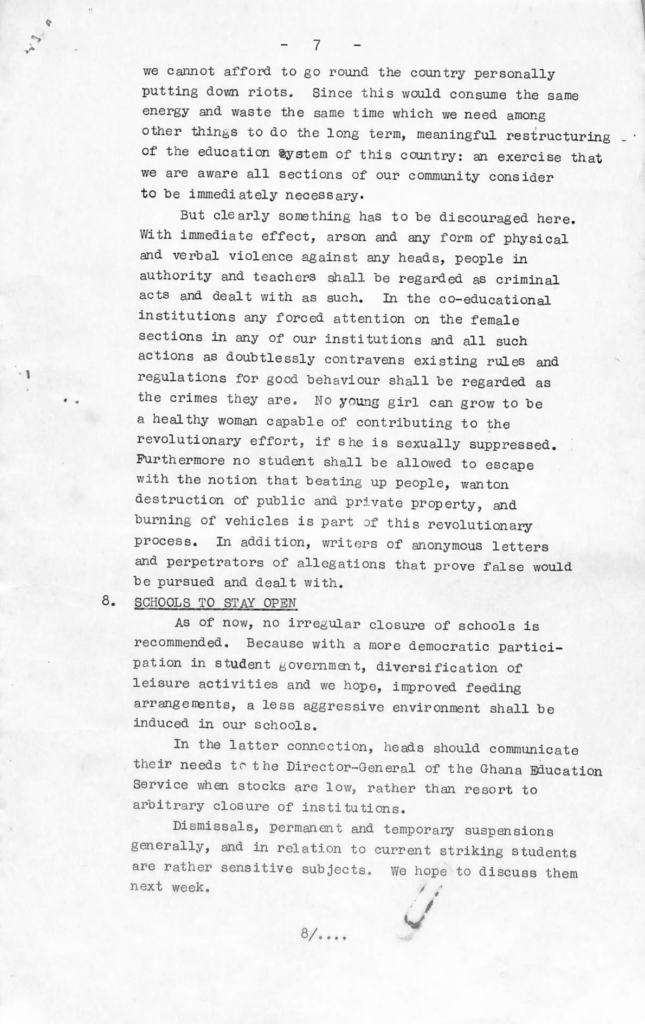
But we appeal for calm immediately in our schools because want on destruction cannot be part of this revolution. And we ask heads of institutions to be as composed as possible in dealing with these situations, and as flexible as possible in trying to resolve problems. We also ask students to be reasonable and mature. Because we cannot afford to go round the country personally putting down riots. Since this would consume the same energy and waste the same time which we need among other things to do the long term, meaningful restructuring of the education system of this country: an exercise that we are aware all sections of our community consider to be immediately necessary.
But clearly something has to be discouraged here. With immediate effect, arson and any form of physical and verbal violence against any heads, people in authority and teachers shall be regarded as criminal acts and dealt with as such.
such. In the co-educational institutions any forced attention on the female sections in any of our institutions and all such
actions as doubtlessly contravenes existing rules and regulations for good behaviour shall be regarded as the crimes they are. No young girl can grow to be a healthy woman capable of contributing to the revolutionary effort, if she is sexually suppressed.
Furthermore no student shall be allowed to escape with the notion that beating up people, wanton destruction of public and private property, and burning of vehicles is part of this revolutionary process. In addition, writers of anonymous letters and perpetrators of allegations that prove false would be pursued and dealt with.
8. SCHOOLS TO STAY OPEN
As of now, no irregular closure of schools is recommended. Because with a more democratic participation in student government, diversification of leisure activities and we hope, improved feeding arrangements, a less aggressive environment shall be induced in our schools.
In the latter connection, heads should communicate their needs to the Director-General of the Ghana Education Service when stocks are low, rather than resort to arbitrary closure of institutions. Dismissals, permanent and temporary suspensions generally, and in relation to current striking students are rather sensitive subjects.
We hope to discuss them next week.
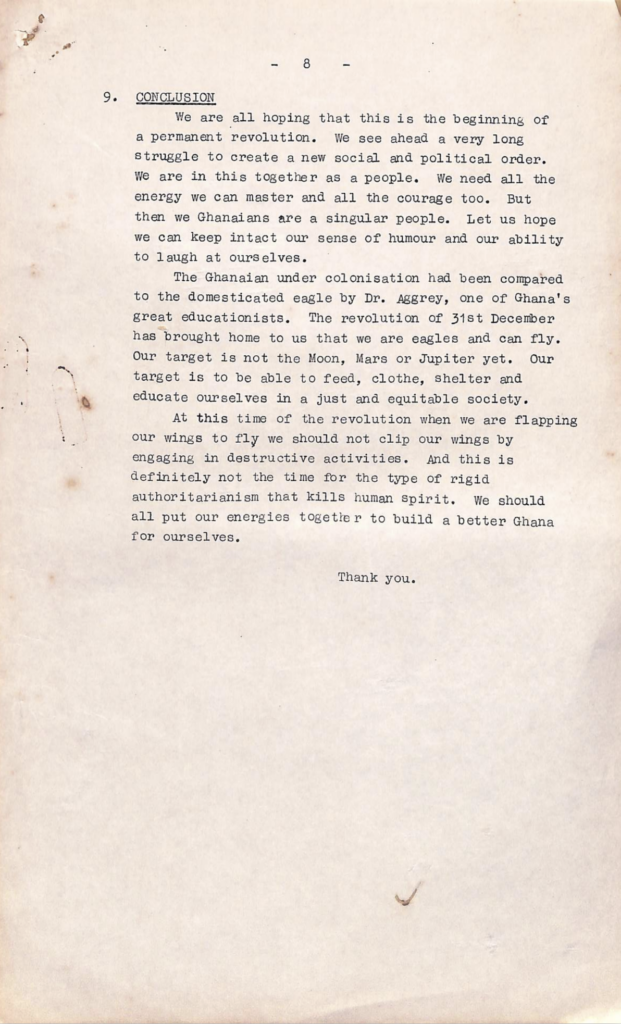
9. CONCLUSION
We are all hoping that this is the beginning of a permanent revolution. We see ahead a very long struggle to create a new social and political order. We are in this together as a people. We need all the energy we can master and all the courage too. But then we Ghanaians are a singular people. Let us hope we can keep intact our sense of humour and our ability
to laugh at ourselves.
The Ghanaian under colonisation had been compared to the domesticated eagle by Dr. Aggrey, one of Ghana’s great educationists. The revolution of 31st December has brought home to us that we are eagles and can fly. Our target is not the Moon, Mars or Jupiter yet. Our target is to be able to feed, clothe, shelter and educate ourselves in a just and equitable society.
At this time of the revolution when we are flapping our wings to fly we should not clip our wings by engaging in destructive activities. And this is definitely not the time for the type of rigid authoritarianism that kills human spirit. We should all put our energies together to build a better Ghana for ourselves.
Thank you.
Other articles featuring senior high school students