Signs Of The Times
August 4, 2026
Transcript
The Standard
June 22, 1980
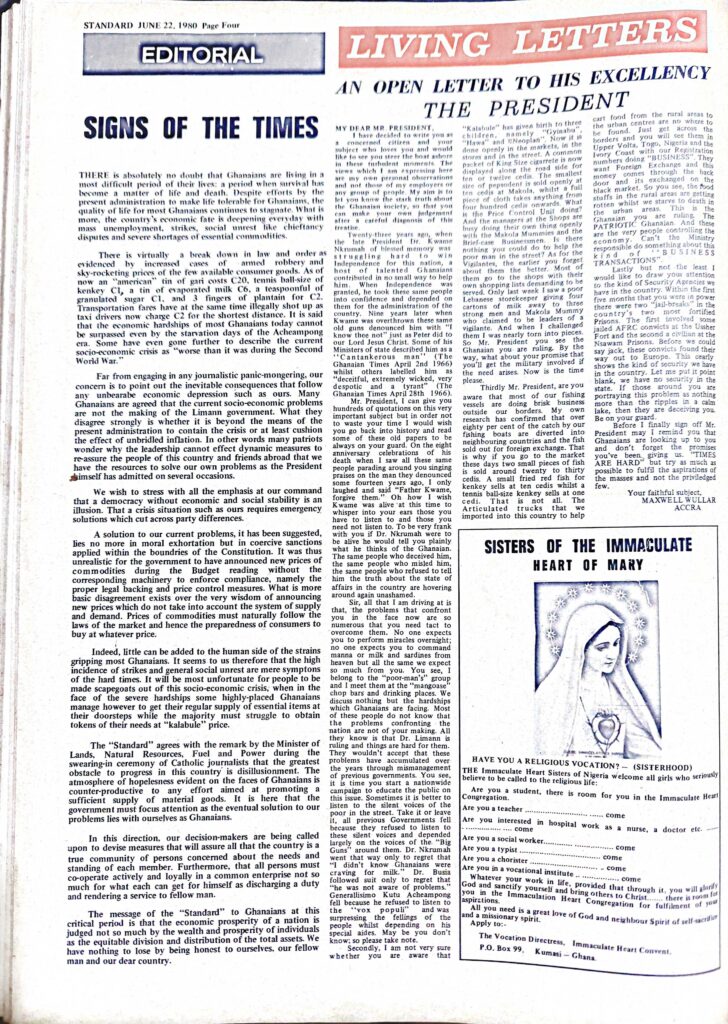
There is absolutely no doubt that Ghanaians are living in a most difficult period of their lives: a period when survival has become a matter of life and death. Despite efforts by the present administration to make life tolerable for Ghanaians, the quality of life for most Ghanaians continues to stagnate. What is more, the country’s economic fate is deepening everyday with mass unemployment, strikes, social unrest like chieftaincy disputes and severe shortages of essential commodities.
There is virtually a breakdown in law and order as evidenced by increased cases of armed robbery and sky-rocketing prices of the few available consumer goods. As of now an “american” tin of gari costs C20, tennis ball-size of kenkey Cl, a tin of evaporated milk C6, a teaspoonful of granulated sugar C1, and 3 fingers of plantain for C2. Transportation fares have at the same time illegally shot up as taxi drivers now charge C2 for the shortest distance. It is said that the economic hardships of most Ghanaians today cannot be surpassed even by the starvation days of the Acheampong era. Some have even gone further to describe the current socio-economic crisis as “worse than it was during the Second World War.”
Far from engaging in any journalistic panic-mongering, our concern is to point out the inevitable consequences that follow any unbearable economic depression such as ours. Many Ghanaians agree that the current socio-economic problems are not the making of the Limann government. What they disagree strongly is whether it is beyond the means of the present administration to contain the crisis or at least cushion the effect of unbridled inflation. In other words, many patriots wonder why the leadership cannot effect dynamic measures to re-assure the people of this country and friends abroad that we have the resources to solve our own problems as the President himself has admitted on several occasions.
We wish to stress with all the emphasis at our command that a democracy without economic and social stability is an illusion. That a crisis situation such as ours requires emergency solutions which cut across party differences.
A solution to our current problems, it has been suggested, lies no more in moral exhortation but in coercive sanctions applied within the boundaries of the Constitution. It was thus unrealistic for the government to have announced new prices of commodities during the Budget reading without the corresponding machinery to enforce compliance, namely the proper basic disagreement legal backing exists and price control measures. What is more, basic disagreements existover the very wisdom of announcing new prices which do not take into account the system of supply and demand. Prices of commodities must naturally follow the laws of the market and hence the preparedness of consumers to buy at whatever price.
Indeed, little can be added to the human side of the strains gripping most Ghanaians. It seems to us therefore that the high incidence of strikes and general social unrest are mere symptoms of the hard times. It will be most unfortunate for people to be face made of scapegoats the severe out hardships of this socio-economic some highly-placed crisis, when Ghanaians in the manage however to get their regular supply of essential items at their doorsteps while the majority must struggle to obtain tokens of their needs at “kalabule” price.
The “Standard” agrees with the remark by the Minister of Lands, Natural Resources, Fuel and Power during the swearing-in ceremony of Catholic journalists that the greatest obstacle to progress in this country is disillusionment. The atmosphere of hopelessness evident on the faces of Ghanaians is counter-productive to any effort aimed at promoting a sufficient supply of material goods. It is here that the government must focus attention as the eventual solution to our problems lies with ourselves as Ghanaians.
In this direction, our decision-makers are being called upon to devise measures that will assure all that the country is a true community of persons concerned about the needs and standing of each member. Furthermore, that all persons must co-operate actively and loyally in a common enterprise not so much for what each for himself discharging duty can get as a and rendering a service to fellow man.
The message of the “Standard” to Ghanaians at this critical period is that the economic prosperity of a nation is judged not so much by the wealth and prosperity of individuals as the equitable division and distribution of the total assets. We have nothing to lose by being honest to ourselves, our fellow man and our dear country.
Read other editorials below:
- Student Power of Sorts
- Two More Cars Burnt: Who Burnt Them
- University Students Discuss Future
- The Economics Of University Education
- Towards A More Meaningful Referendum
- The Catholic Church, The Standard, And National Issues
- Churches, Students Must Show The Way
- Save The Universities
- Students Power
- NUGS In Political Set-Up-A Rejoiner
- An Open Letter To The President