AFRC – June 4- September 24, 1979
August 3, 2026
Transcript
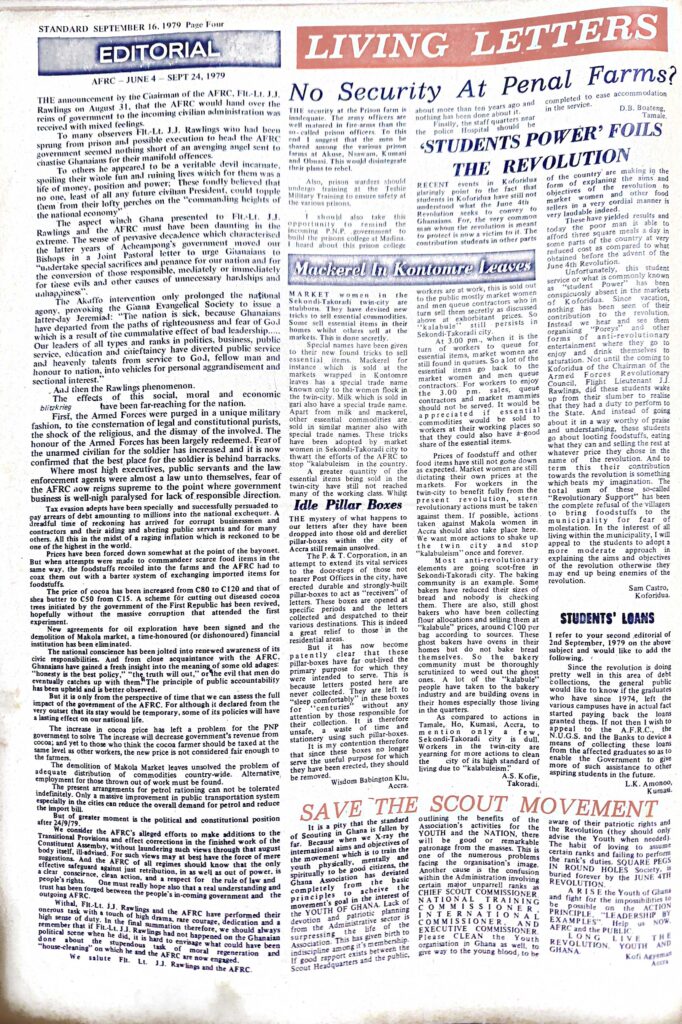
The Standard
September 16,1979
The announcement by the Chairman of the AFRC, FIt. Lt. J.J. Rawlings on August 31, that the AFRC would hand over the reins of government to the incoming civilian administration was received with mixed feelings.
To many observers FIt. Lt. J.J. Rawlings who had been sprung from prison and possible execution to head the AFRC government seemed nothing short of an avenging angel sent to chastise Ghanaians for their manifold offences.
To others he appeared to be a veritable devil incarnate, spoiling their whole fun and ruining lives which for them was a life of money, position and power. These fondly believed that no one, least of all any future civilian President, could topple them from their lofty perches on the “commanding heights of the national economy.”
The aspect which Ghana presented to FIt. Lt. J.J. Rawlings and the AFRC must have been daunting in the extreme.The sense of pervasive decadence which characterised Acheampong’s government moved our Bishops in a Joint Pastoral Letter to urge Ghanaians to “undertake special sacrifices and penance for our nation and for the conversion of those responsible, mediately or immediately for these evils and other causes of unnecessary hardships and unhappiness.”
The Akaffo intervention only prolonged the agony, provoking the Ghana Evangelical Society to issue a latter-day Jeremiad: “The nation is sick, because Ghanaians have departed from the paths of righteousness and fear of God which is a result of the cumulative effect of bad leadership. Our leaders of all types and ranks in politics, business, public service service, education and chieftaincy have diverted public service and heavenly talents from service to God, fellow man and honour to nation, into vehicles for personal aggrandisement and sectional interest.”
And then the Rawlings phenomenon.
The effects of this social, moral and economic blitzkrieg have been far-reaching for the nation.
First, the Armed Forces were purged in a unique military fashion, to the consternation of legal and constitutional purists. the shock of the religious, and the dismay of the involved. The honour of the Armed Forces has been largely redeemed. Fear of the unarmed civilian for the soldier has increased and it is now confirmed that the best place for the soldier is behind barracks.
Where most high executives, public servants and the law enforcement agents were almost a law unto themselves, fear of the AFRC now reigns supreme to the point where government business is well-nigh paralysed for lack of responsible direction.
Tax evasion adepts have been specially and successfully persuaded to pay arrears of debt amounting to millions into the national exchequer. A dreadful time of reckoning has arrived for corrupt businessmen and contractors and their aiding and abetting public servants and for many others. All this in the midst of a raging inflation which is reckoned to be one of the highest in the world.
Prices have been forced down somewhat at the point of the bayonet. But when attempts were made to commandeer scarce food items in the same way, the foodstuffs recoiled into the farms and the AFRC had to coax them out with a barter system of exchanging imported items for foodstuffs.
The price of cocoa has been increased from C80 to C120 and that of shea butter to C50 from C15. A scheme for cutting out diseased cocoa trees initiated by the government of the First Republic has been revived, hopefully without the massive corruption that attended the first experiment.
New agreements for oil exploration have been signed and the demolition of Makola market, a time-honoured (or dishonoured) financial institution has been eliminated.
The national conscience has been jolted into renewed awareness of its civic responsibilities. And from close acquaintance with the AFRC. Ghanaians have gained a fresh insight into the meaning of some old adages: “honesty is the best policy,” “the truth will out,” or the evil that men do eventually catches up with them. The principle of public accountability has been upheld and is better observed.
But it is only from the perspective of time that we can assess the full impact of the government of the AFRC. For although it declared from the very outset that its stay would be temporary, some of its policies will have a lasting effect on our national life.
The increase in cocoa price has left a problem for the PNB government to solve. The increase will decrease government’s revenue from cocoa; and yet to those who think the cocoa farmer should be taxed at the same level as other workers, the new price is not considered fair enough to the farmers.
The demolition of Makola Market leaves unsolved the problem of adequate distribution of commodities country-wide. Alternative employment for those thrown out of work must be found.
The present arrangements for petrol rationing can not be tolerated indefinitely. Only a massive improvement in public transportation system especially in the cities can reduce the overall demand for petrol and reduce the import bill.
But of greater moment is the political and constitutional position after 24/9/79.
We consider the AFRC’s alleged efforts to make additions to the Transitional Provisions and effect corrections in the finished work of the constituent assembly, without laundering such views through that august body itself, ill advised. For such views may at best have the force of mere suggestions. And the AFRC of all regimes should know that the only safeguard against just retribution, in as well as out of power, is a clear conscience, clean action, and a respect for the rule of law and people’s rights. One must really hope also that a real understanding and trust has been forged between the people’s in-coming government and people’s outgoing AFRC,
We consider the AFRC’s alleged efforts to make additions to the Transitional Provisions and effect corrections in the finished work of the Constituent Assembly, without laundering such views through that august body itself, ill-advised. For such views may at best have the force of mere suggestions. And the AFRC of all regimes should know that the only effective safeguard against just retribution, in as well as out of power, is a clear conscience, clean action, and a respect for the rule of law and people’s rights. One must really hope also that a real understanding and trust has been forged between the people’s in-coming government and the outgoing AFRC.
Withal, FIt. Lt. J.J. Rawlings and the AFRC have performed their onerous task with a touch of high drama, rare courage, dedication and a high sense of duty. In the final summation therefore, we should always remember that if FIt. Lt. J.J. Rawlings had not happened on the Ghanaian political scene when he did, it is hard to envisage what could have been done about the stupendous task of moral regeneration and “house-cleaning” on which he and the AFRC are now engaged.
We salute FIt. Lt. J.J. Rawlings and the AFRC.
Read other editorials below: