University Of Ghana Report On The Committee Of Enquiry Into The Disturbances Of 13th January, 1978: Review Of The University’s programme Of Work
August 3, 2026

Transcript
University of Ghana
March 23, 1978
CHAPTER FOUR
REVIEW OF THE UNIVERSITY’S PROGRAMME OF WORK
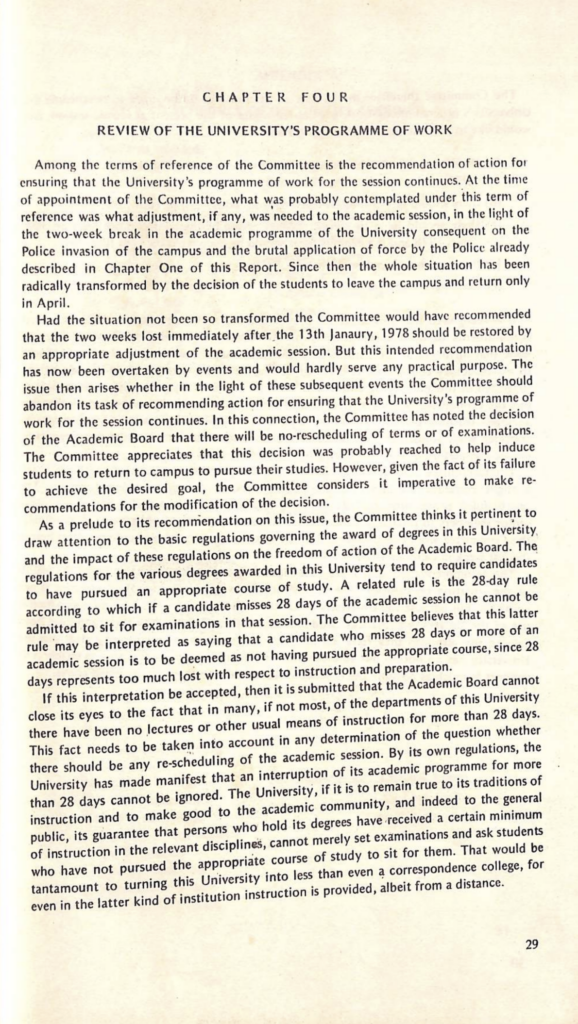
Among the terms of reference of the Committee is the recommendation of action ensuring that the University’s programme of work for the session continues. At the time of appointment of the Committee, what was probably contemplated under this term of reference was what adjustment, if any, was needed the two-week to the academic session, in the light of break in the academic programme of the University consequent on the Police invasion of the campus and the brutal application of force by the Police already described in Chapter One of this Report. Since then the whole situation has been radically transformed by the decision of the students to leave the campus in April.
Had the situation not been so transformed the Committee would have recommended that the two weeks lost immediately after the 13th January, 1978 should be restored by an appropriate adjustment of the academic session. But this intended recommendation has now been overtaken by events and would hardly serve any practical purpose. The issue then arises whether in the light of these subsequent events the Committee should abandon its task of recommending action for ensuring that the University’s programme of work for the session continues. In this connection, the Committee has noted the decision of the Academic Board that there will be no-rescheduling of terms or of examinations. The Committee appreciates that this decision was probably reached to help induce students to return to campus to pursue their studies. However, given the fact of its failure to achieve the desired goal, the Committee considers it imperative to make re- commendations for the modification of the decision.
As a prelude to its recommendation on this issue, the Committee thinks it pertinent to draw attention to the basic regulations governing the award of degrees in this University and the impact of these regulations on the freedom of action of the Academic Board. The regulations for the various degrees awarded in this University tend to require candidates to have pursued an appropriate course of study. A related rule is the 28-day rule according to which if a candidate misses 28 days of the academic session he cannot be admitted to sit for examinations in that session. The Committee believes that this latter rule may be interpreted as saying that a candidate who misses 28 days or more of an academic session is to be deemed as not having pursued the appropriate course, since 28 days represents too much lost with respect to instruction and preparation.
If this interpretation be accepted, then it is submitted that the Academic Board cannot close its eyes to the fact that in many, if not most, of the departments of this University there have been no lectures or other usual means of instruction for more than 28 days. This fact needs to be taken into account in any determination of the question whether there should be any re-scheduling of the academic session. By its own regulations, the University has made manifest that an interruption of its academic programme for more than 28 days cannot be ignored. The University, if it is to remain true to its traditions of instruction and to make good to the academic community, and indeed to the general public, its guarantee that persons who hold its degrees have received a certain minimum of instruction in the relevant disciplines, cannot merely set examinations and ask students who have not pursued the appropriate course of study to sit for them. That would be tantamount to turning this University into less than even a correspondence college, for even in the latter kind of institution instruction is provided, albeit from a distance.
The Committee therefore thinks that an attempt should be made to re-schedule the University’s programme of work for the remainder of the present academic session, and would like to propose the following programme:-
(a) the University should be formally closed down now and re-open on 7th April, 1978;
(b) there should be continuous teaching from 10th April to 16th June, 1978;
(c) there should be a two-week revision period before examinations start on 30th June, 1978 and the examinations’ should be completed by 17th July, 1978;
(d) the term should end on 18th July, 1978;
(e) examiners’ meetings should be between 1-10 August, 1978. It is recognised that this suggested programme might disrupt the planned activities and commitments of the various members of the University community, but we sincerely hope that members of the University would like to see the academic programme brought to a satisfactory conclusion.
It is recognised further that the ten-week period of teaching suggested in the above programme falls short of the usual length of the teaching period but the Committee considers that most of the essential teaching can be done during this abridged teaching period. It may be necessary, however, for Heads of Departments to consider what adjustments to make in the teaching programmes of the departments to ensure completion of teaching during the abridged period.
The Committee considers that the re-scheduled programme presented above will entail a slight consequential re-scheduling of the work of the next academic session. The re-scheduled programme curtails the long vacation which is a useful period for many senior members to discharge various research and international obligations. Accordingly the Committee would recommend that the next academic session should not start before the last week in October 1978.
The recommendation that there be an immediate closure is forced on us by the reality of the situation on campus. The normal academic programme of the University is not going on, but because the University is still formally open there has been an unproductive use of the University’s finances. Students have collected their allowances and have been catered for, although they have not attended classes. It seems increasingly clear that the University has no option but to close down now to conserve its finances to enable it to support as much as possible the re-scheduled academic programme suggested above.