Closing Down The Universities
July 16, 2026
Transcript
The Legon Observer
February 22, 1974
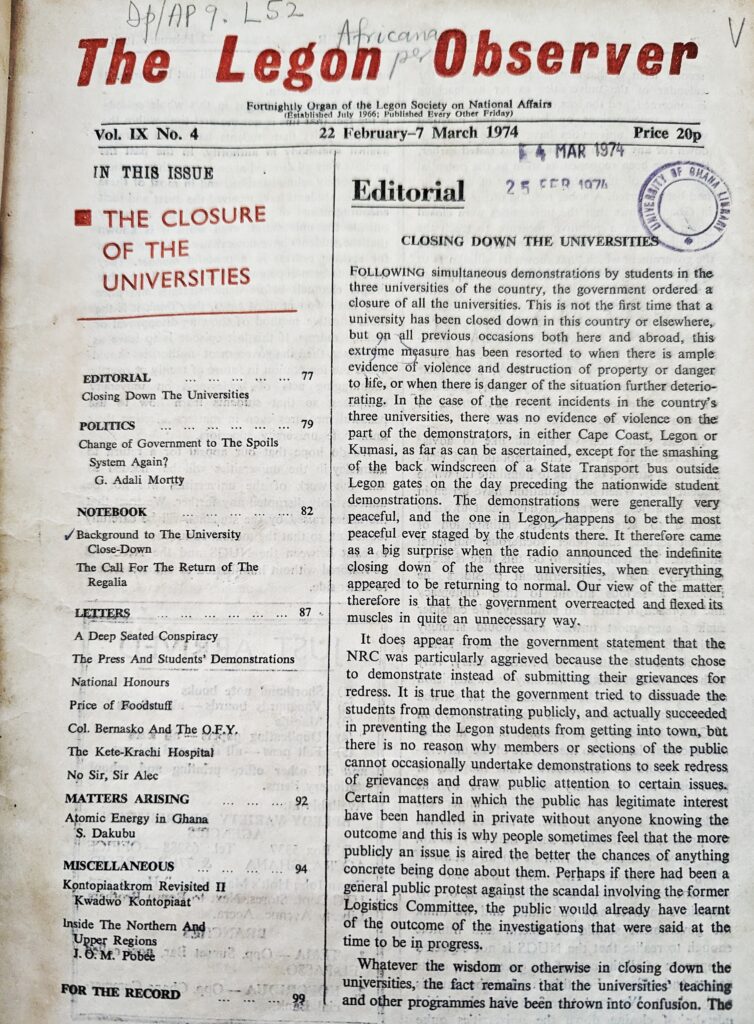
Following simultaneous demonstrations by students in the three universities of the country, the government ordered a closure of all the universities. This is not the first time that a university has been closed down in this country or elsewhere, but on all previous occasions both here and abroad, this extreme measure has been resorted to when there is ample evidence of violence and destruction of property or danger to life, or when there is danger of the situation further deterio- rating. In the case of the recent incidents in the country’s three universities, there was no evidence of violence on the part of the demonstrators, in either Cape Coast, Legon or Kumasi, as far as can be ascertained, except for the smashing of the back windscreen of a State Transport bus outside Legon gates on the day preceding the nationwide student demonstrations. The demonstrations were generally very peaceful, and the one in Legon happens to be the most peaceful ever staged by the students there. It therefore came as a big surprise when the radio announced the indefinite closing down of the three universities, when everything appeared to be returning to normal. Our view of the matter therefore is that the government overreacted and flexed its muscles in quite an unnecessary way.
It does appear from the government statement that the NRC was particularly aggrieved because the students chose to demonstrate instead of submitting their grievances for redress. It is true that the government tried to dissuade the students from demonstrating publicly, and actually succeeded in preventing the Legon students from getting into town, but there is no reason why members or sections of the public cannot occasionally undertake demonstrations to seek redress of grievances and draw public attention to certain issues. Certain matters in which the public has legitimate interest have been handled in private without anyone knowing the outcome and this is why people sometimes feel that the more publicly an issue is aired the better the chances of anything concrete being done about them. Perhaps if there had been a general public protest against the scandal involving the former Logistics Committee, the public would already have learnt of the outcome of the investigations that were said at the time to be in progress.
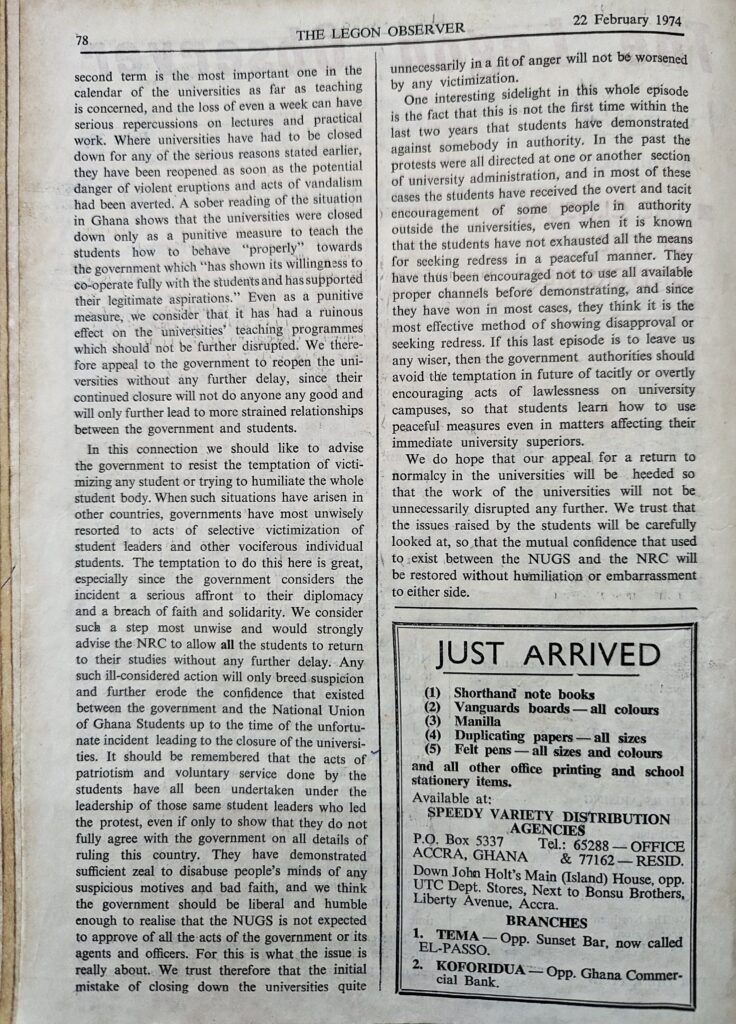
Whatever the wisdom or otherwise in closing down the universities, the fact remains that the universities’ teaching and other programmes have been thrown into confusion. The second term is the most important one in the calendar of the universities as far as teaching is concerned, and the loss of even a week can have serious repercussions on lectures and practical work. Where universities have had to be closed down for any of the serious reasons stated earlier, they have been reopened as soon as the potential danger of violent eruptions and acts of vandalism had been averted. A sober reading of the situation in Ghana shows that the universities were closed down only as a punitive measure to teach the students how to behave “properly” towards the government which “has shown its willingness to co-operate fully with the students and has supported their legitimate aspirations.” Even as a punitive measure, we consider that it has had a ruinous effect on the universities’ teaching programmes which should not be further disrupted. We there- fore appeal to the government to reopen the universities without any further delay, since their continued closure will not do anyone any good and will only further lead to more strained relationships between the government and students.
In this connection we should like to advise the government to resist the temptation of victimizing any student or trying to humiliate the whole student body. When such situations have arisen in other countries, governments have most unwisely resorted to acts of selective victimization of student leaders and other vociferous individual students. The temptation to do this here is great, especially since the government considers the incident a serious affront to their diplomacy and a breach of faith and solidarity. We consider such a step most unwise and would strongly advise the NRC to allow all the students to return to their studies without any further delay. Any such ill-considered action will only breed suspicion and further erode the confidence that existed between the government and the National Union of Ghana Students up to the time of the unfortunate incident leading to the closure of the universities. It should be remembered that the acts of patriotism and voluntary service done by the students have all been undertaken under the leadership of those same student leaders who led the protest, even if only to show that they do not fully agree with the government on all details of ruling this country. They have demonstrated sufficient zeal to disabuse people’s minds of any suspicious motives and bad faith, and we think the government should be liberal and humble enough to realise that the NUGS is not expected to approve of all the acts of the government or its agents and officers. For this is what the issue is really about. We trust therefore that the initial mistake of closing down the universities quite unnecessarily in a fit of anger will not be worsened by any victimization. One interesting sidelight in this whole episode is the fact that this is not the first time within the last two years that students have demonstrated against somebody in authority. In the past the protests were all directed at one or another section of university administration, and in most of these cases the students have received the overt and tacit encouragement of some people in authority outside the universities, even when it is known that the students have not exhausted all the means for seeking redress in a peaceful manner. They have thus been encouraged not to use all available proper channels before demonstrating, and since they have won in most cases, they think it is the most effective method of showing disapproval or seeking redress. If this last episode is to leave us any wiser, then the government authorities should avoid the temptation in future of tacitly or overtly encouraging acts of lawlessness on university campuses, so that students learn how to use peaceful measures even in matters affecting their immediate university superiors.
We do hope that our appeal for a return to normalcy in the universities will be heeded so that the work of the universities will not be unnecessarily disrupted any further. We trust that the issues raised by the students will be carefully looked at, so that the mutual confidence that used to exist between the NUGS and the NRC will be restored without humiliation or embarrassment to either side.