Closing Down Of University Following Disturbances Resulting From Student Demonstrations
July 14, 2026
Transcript
National Council For Higher Education
Feb 12, 1974
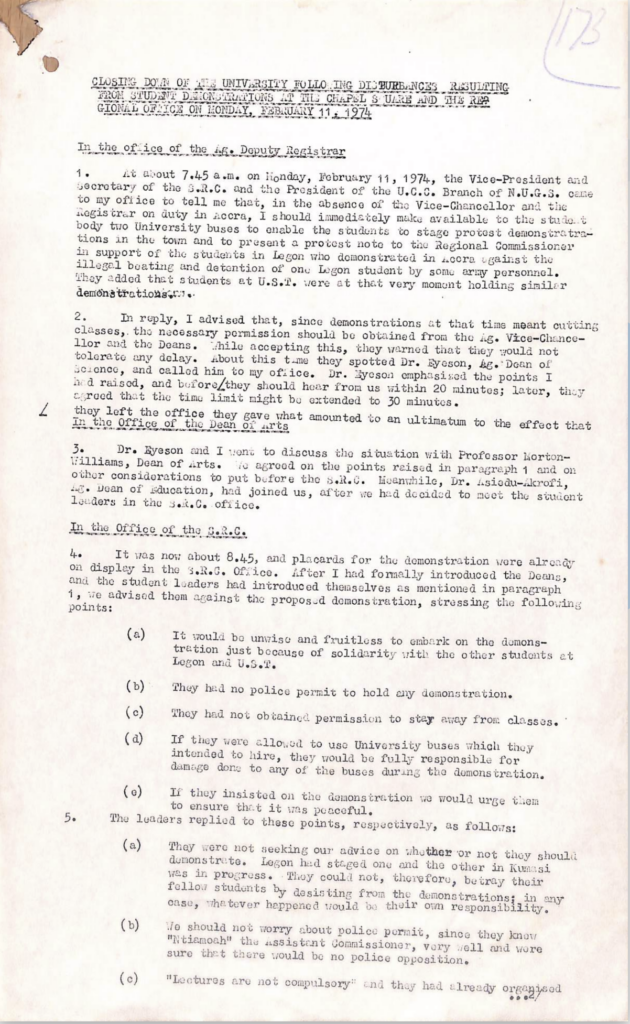
CLOSING DOWN OF UNIVERSITY FOLLOWING DISTURBANCES RESULTING FROM STUDENT DEMONSTRATIONS AT THE CHAPEL S URE AND THE REA GIONAL OFFICE ON MONDAY, FEBRUARY 11, 1974
In the office of the Deputy Registrar
- At about 7.45 a.m. on Monday, February 11, 1974, the Vice-President and Secretary of the S.R.C. and the President of the U.C.C. Branch of N.U.G.S. cane to my office to tell me that, in the absence of the Vice-Chancellor and the Registrar on duty in Accra, I should immediately make available to the student body two University buses to enable the students to stage protest demonstrations in the town and to present a protest note to the Regional Commissioner in support of the students in Legon who demonstrated in Accra against the illegal boating and detention of one Legon student by some army personnel. They added that students at U.S.T. were at that very moment holding similar demonstrations
- In reply, I advised that, since demonstrations at that time meant cutting classes, the necessary permission should be obtained from the Ag. Vice-Chancellor and the Deans. While accepting this, they warned that they would not tolerate any delay. About this time they spotted Dr. Eyeson, g. Dean of Science, and called him to my office. Dr. Syeson emphasised the points I hed raised, and before they should hear from us within 20 minutes; later, they agreed that the time limit might be extended to 30 minutes. They left the office they gave what amounted to an ultimatum to the effect that
In the Office of the Dean of Arts
- Dr. Eyeson and I went to discuss the situation with Professor korton- Williams, Dean of Arts. o agreed on the points raised in paragraph 1 and on other considerations to put before the S.R.C. Meanwhile, Dr. Asiedu-Akrofi, Ag. Dean of Education, had joined us, after we had decided to meet the student leaders in the S.R.C. office.
In the Office of the S.R.C.
- It was now about 8.45, and placards for the demonstration were already on display in the s.R.G. Office. After I had formally introduced the Deans, and the student leaders had introduced themselves as mentioned in paragraph 1, we advised them against the proposed demonstration, stressing the following points:
(a) It would be unwise and fruitless to embark on the demonstration just because of solidarity with the other students at Legon and U.S.T.
(b) They had no police permit to hold any demonstration.
(c) They had not obtained permission to stay away from classes.
d) If they were allowed to use University buses which they intended to hire, they would be fully responsible for damage done to any of the buses during the demonstration.
(e) If they insisted on the demonstration we would urge them to ensure that it was peaceful.
- The leaders replied to these points, respectively, as follows:
(a) They were not seeking our advice on whether or not they should demonstrate. Legon had staged one and the other in Kumasi was in progress. They could not, therefore, betray their fellow students by desisting from the demonstrations; in any case, whatever happened would be their own responsibility.
(b) We should not worry about police permit, since they know “Ntiamoah” the Assistant Commissioner, very well and were sure that there would be no police opposition.
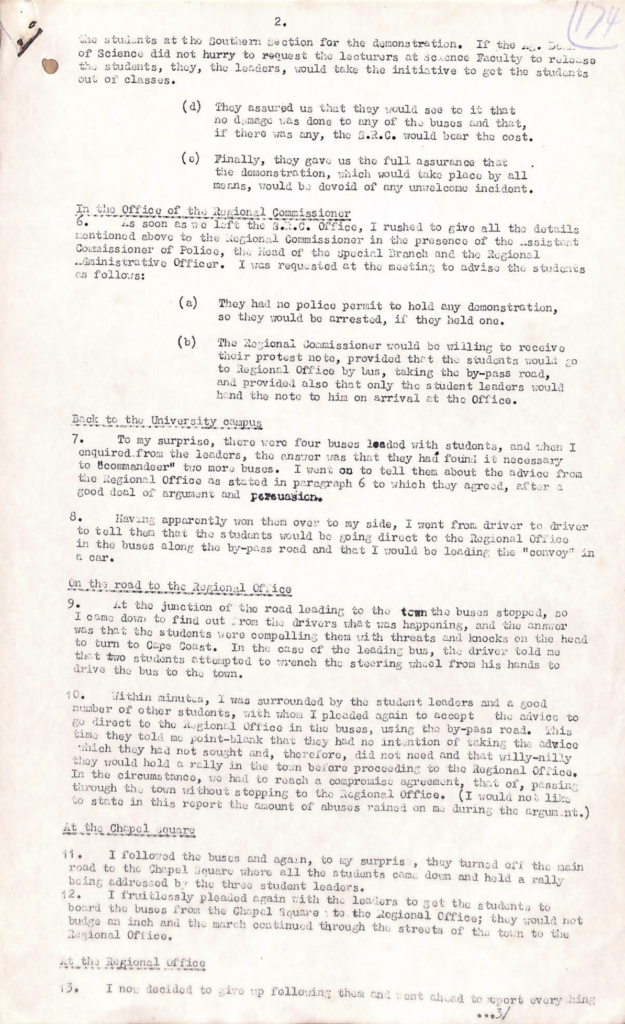
(c) “Lectures are not compulsory” and they had already organised the students at the Southern section for the demonstration. If the Ag. Dean of Science did not hurry to request the lecturers at Science Faculty to release the students, they, the leaders, would take the initiative to get the students out of classes.
(d) They assured us that they would see to it that no damage was done to any of the buses and that, if there was any, the S.R.C. would bear the cost.
(e) Finally, they gave us the full assurance that the demonstration, which would take place by all means, would be devoid of any unwelcome incident.
In the Office of the Regional Commissioner
- As soon as we left the S.R.C. Office, I rushed to give all the details mentioned above to the Regional Commissioner in the presence of the ..ssistant Commissioner of Police, the Head of the special Branch and the Regional Administrative Officer. I was requested at the meeting to advise the students es follows:
(a) They had no police permit to hold any demonstration, so they would be arrested, if they held one.
(b) The Regional Commissioner would be willing to receive their protest note, provided that the students would go to Regional Office by bus, taking the by-pass road, and provided also that only the student leaders would hand the note to him on arrival at the Office.
Back to the University campus
- To my surprise, there were four buses loaded with students, and when I enquired from the leaders, the answer was that they had found it necessary to commandeer” two more buses. I went on to tell them about the advice from the Regional Office as stated in paragraph 6 to which they agreed, after a good deal of argument and persuasion.
- Having apparently won them over to my side, I went from driver to driver to tell them that the students would be going direct to the Regional Office in the buses along the by-pass road and that I would be leading the “convoy in a car.
On the road to the Regional Office
- At the junction of the road leading to the town the buses stopped, so I came down to find out from the drivers that was happening, and the answer was that the students were compelling them with threats and knocks on the head to turn to Cape Coast. In the case of the leading bus, the driver told me that two students attempted to wrench the steering wheel from his hands to drive the bus to the town.
- Within minutes, I was surrounded by the student leaders and a good number of other students, with whom I pleaded again to accept the advice to go direct to the Regional Office in the buses, using the by-pass road. This time they told me point-blank that they had no intention of taking the advice which they had not sought and, therefore, did not need and that willy-nilly they would hold a rally in the town before proceeding to the Regional Office. In the circumstance, we had to reach a compromise agreement, that of, passing through the town without stopping to the Regional office. (I would not like to state in this report the amount of abuses rained on me during the argument.)
At the Chapel Square
- I followed the buses and again, to my surprise, they turned off the main road to the Chapel Square where all the students came down and held a rally being addressed by the three student leaders.
- I fruitlessly pleaded again with the leaders to get the students to board the buses from the Chapel Square: to the Regional Office; they would not budge an inch and the march continued through the streets of the town to the Regional Office.
At the Regional office
- I now decided to give up following them and went ahead to report everything to the Regional Administrative Officer, who told me that their Intelligence Service had informed the Regional Commissioner about the defiance of the sub as regards his advice that they should go to the office in buses.
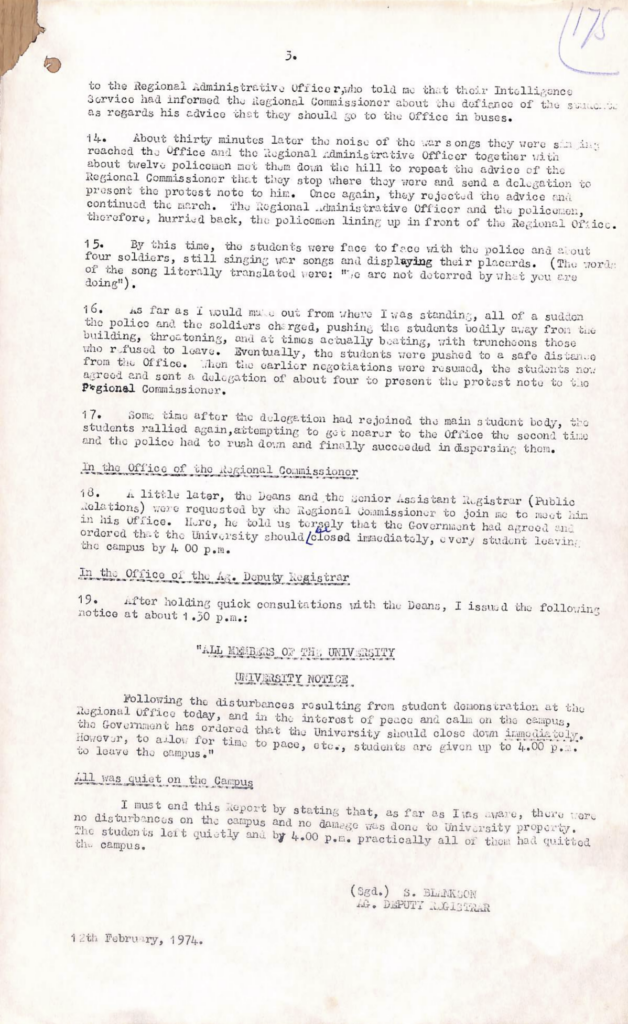
- About thirty minutes later the noise of the war songs they wore sin g reached the Office and the Regional administrative Officer together with about twelve policemen not them down the hill to repeat the advice of the Regional Commissioner that they stop where they were and send a delegation to present the protest note to him. Once again, they rejected the advice and continued the march. The Regional Administrative Officer and the policemen, therefore, hurried back, the policemen lining up in front of the Regional Office.
- By this time, the students were face to face with the police and about four soldiers, still singing war songs and displaying their placards. (The words of the song literally translated vere: “we are not deterred by what you are doing”).
- As far as I would me out from where I was standing, all of a sudden the police and the soldiers charged, pushing the students bodily away from the building, threatening, and at times actually boating, with truncheons those who refused to leave. Eventually, the students were pushed to a safe distance from the Office. Then the earlier negotiations were resumed, the students now agreed and sent a delegation of about four to present the protest note to the Regional Commissioner.
- Some time after the delegation had rejoined the main student body, the students rallied again, attempting to get nearer to the office the second time and the police had to rush down and finally succeeded in dispersing them.
In the Office of the Regional Commissioner
- A little later, the Deans and the senior Assistant Registrar (Public Relations) were requested by the Regional Commissioner to join me to meet him in his office. Here, he told us tersely that the Government had agreed and ordered that the University should be closed immediately, every student leaving the campus by 4: 00 p.m.
In the Office of the Ag. Deputy Registrar
- After holding quick consultations with the Deans, I issued the following notice at about 1.30 p.m.:
“ALL MEMBERS OF THE UNIVERSITY”
UNIVERSITY NOTICE
Following the disturbances resulting from student demonstration at the Regional office today, and in the interest of peace and calm on the campus, the Government has ordered that the University should close down immediately. However, to allow for time to pace, etc., students are given up to 4.00 p.m. to leave the campus.”
All was quiet on the Campus
I must end this Report by stating that, as far as I was aware, there were no disturbances on the campus and no damage was done to University property. The students left quietly and by 4.00 p.m. practically all of them had quitted the campus.
(Sgd.) S. BLANKSON
DEPUTY REGISTRAR
12th February, 1974.
Read part 1 here
Read part 2 here
Read George Doh's personal account