Vice-Chancellor’s Address To Students Of The University Of Ghana On 23rd March, 1974
July 14, 2026



Transcript
March 23, 1974
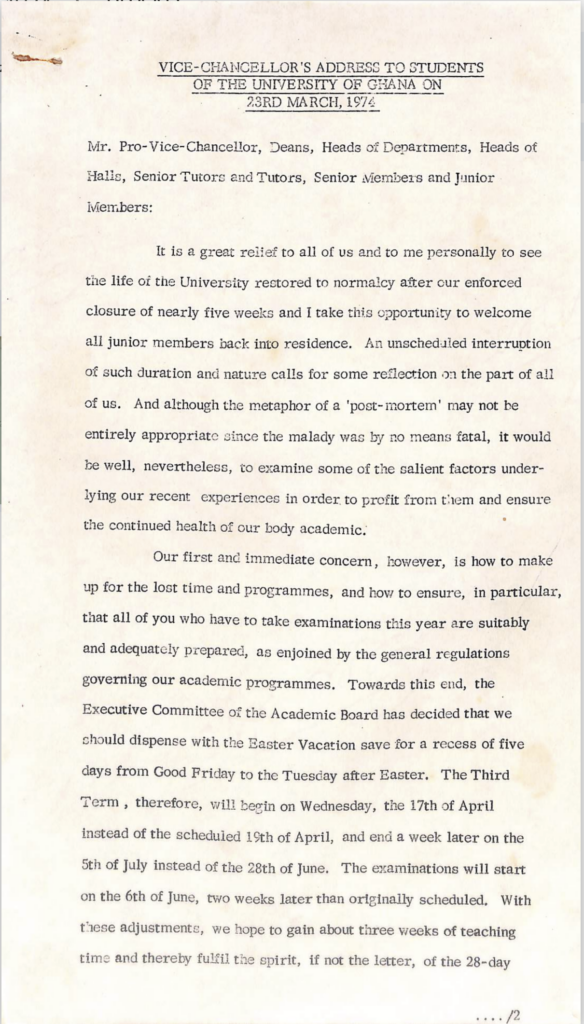
Mr. Pro-Vice-Chancellor, Deans, Heads of Departments, Heads of Halls, Senior Tutors and Tutors, Senior Members and Junior Members:
It is a great relief to all of us and to me personally to see the life of the University restored to normalcy after our enforced closure of nearly five weeks and I take this opportunity to welcome all junior members back into residence. An unscheduled interruption of such duration and nature calls for some reflection on the part of all of us. And although the metaphor of a ‘post-mortem’ may not be entirely appropriate since the malady was by no means fatal, it would be well, nevertheless, to examine some of the salient factors under- lying our recent experiences in order to profit from them and ensure the continued health of our body academic.
Our first and immediate concern, however, is how to make up for the lost time and programmes, and how to ensure, in particular, that all of you who have to take examinations this year are suitably and adequately prepared, as enjoined by the general regulations governing our academic programmes. Towards this end, the Executive Committee of the Academic Board has decided that we should dispense with the Easter Vacation save for a recess of five days from Good Friday to the Tuesday after Easter. The Third Term, therefore, will begin on Wednesday, the 17th of April instead of the scheduled 19th of April, and end a week later on the 5th of July Instead of the 28th of June. The examinations will start on the 6th of June, two weeks later than originally scheduled. With these adjustments, we hope to gain about three weeks of teaching time and thereby fulfil the spirit, if not the letter, of the 28-day clause which has suddenly become the centre of discussion both within and outside the University. But there is no doubt that we cannot completely recover all the ground that has been lost, but every effort will be made to minimise the inconvenience and difficulties, and I hope you will all co-operate.
We now need to take ourselves back to the events leading to the closure of the University. We need to do this because I believe not all of us are aware of what actually happened. I know, for instance, that some students were in hospital at the time; others were away on field-trips related to their studies; others were busy with their studies. But even for those of us who were on the campus and actively participated in the events of the 11th of February and those of the day before, we need to go over the ground to see what useful lessons may be drawn from such facts as we have; for it is an ‘ill wind that blows no one any good,’ and only a fool refuses to learn from adversity.
Briefly, if we may recapitulate the facts, they are that while on a visit to the Volta Region, a student from Legon Hall chanced upon some alleged suspects undergoing some “drilling”. He protested to the military and was not only beaten up but also confined to a cell and eventually arraigned before a Magistrate on charges of obstructing public officers in the performance of their duties and of peddling Indian hemp. When he eventually returned to the campus, the members of his Hall and other colleagues were aroused by the story of his experiences and the sight of his injuries and the leader- ship of the S. R. C. decided that a protest should be lodged with the National Redemption Council against the maltreatment of civilians by the military. On the 11th of February, therefore, a column of demonstrating students bearing placards left the campus on its way to town to present a petition to Government. The march did not, however, go beyond South Legon where they were stopped by a barricade erected by the military. But opportunity was given for the leaders to proceed by car to Burma Camp to present the petition to the Acting Chief of Defence Staff and the Commissioner for Education. I accompanied them. Later in the morning, I had the opportunity of meeting the Chairman of the National Redemption Council to discuss the day’s events. It was then I was told that simultaneous demonstrations were occurring at the two other campuses in Kumasi and Cape Coast and for that reason the Government had decided to close down all three Universities in the country. A Committee of Enquiry was subsequently appointed to examine the circumstances leading to the disturbances. The findings of the Committee have yet to be published, but the state- ment issued by Government on the report of the Committee is well known to all of you: among other things, it announced that the Universities should be re-opened last Saturday and all students who gave an undertaking to be of good behaviour be re-admitted. You have all signed this undertaking and I am pleased to see you here this morning. I hope you will fulfil the terms of this undertaking and settle down to your life here.
The important point which emerges from this bald resume of the events leading to the closure is clearly this: however good one’s cause may be, it is always necessary to observe approved procedures and to seek to right wrongs by rightful means. What happened on the 11th of February was the pursuit of an evidently good cause by wrongful methods. He who seeks equity, as the saying goes, must himself do equity.
I believe that we were all quite well aware of the right procedure. When I heard on Sunday evening, the 10th of February, that a demonstration was to be launched the next day to lodge a protest with Government, I warned the S. R. C. Executive of the dangers of attempting anything illegal, however, just the objectives. I drew attention to the need for obtaining a police permit if they intended to march into town. I also pointed out the possibility that their intention might be misinterpreted. As against all that, I offered myself to transmit a petition to Government with my full support if they were willing to submit it to me together with the appropriate documentation. I was assured that my advice would be given due weight in the final decision. But, in the event, the decision that was taken was the exact reverse of what I had advised: to stage not only a demonstration here but to escalate the protest to the other two Universities as well. The consequences that flowed from the rejection of my advice and the decision to embark upon what was, in effect, a confrontation with the national authorities, were, unfortunately, as predictable as I had foretold: a trial of strength with the Government which sent troops to occupy the campus and ordered a closure of the University for an indefinite period.
An important consideration emerges from all this: the need to distinguish between the rights and responsibilities of students as students on their campus on the one hand and, on the other, their rights and responsibilities as citizens of the country. Their former rights are based upon the basic integrity and freedom of the University, i. e. academic freedom. The latter form part of the larger national rights and responsibilities. Although academic freedom has its own essence and integrity, it is by no means separate from or in conflict with the larger freedom of the state; and the two are always delicately balanced one with the other. We know that there can be no effective academic freedom without the larger national freedom.
It has unfortunately become the case that some students have tended to disregard these basic distinctions and accordingly ignore procedures laid down within the Universities for the proper functioning of our community. They ignore the regulations and procedures enacted for the good governance and wellbeing of our institutions and they wish to have things all their own way regardless of procedures. Some resort to shouting and chanting of obscenities at the least provocation and do not hesitate to do violence to persons and property in the University. As the President of the Legon Hall J. C. R. sadly admitted before the Gyeke-Darko Committee’s sitting in this very Hail, in fact, ponding is a very unpleasant experience!”. Reason which should inform all our proceedings has, alas, recently often been abandoned by one party or the other in favour of brute force and intimidation. ‘Charging’ at meals and the destruction of public property are not unknown occurrences. Yet, the very health and existence of our University is dependent upon the arbitrament of reason, on rational discourse and orderly behaviour. The opposite of reasoned behaviour, riotousness and rowdyism, is surely a recipe for disaster both in the short and long term; and clearly ‘student power’ ought to have nothing to do with these untoward manifestations. If we seek academic freedom and autonomy, and I believe we do, then surely our lives here must be governed by the due processes of our established procedures and laid down rules of good and civilized behaviour.
In his role as a member of the University community, a student’s primary responsibility is to study, to cultivate his mind, to acquire the requisite knowledge and skill and to develop his personality for a life of responsible citizenship as an adult in later life. A residential University such as ours aims at ensuring that students not only receive this training of the mind but also a training in how to live together in a community as tolerant, rational adult human beings. It is to this end that the various organs and facilities here have been established on the campus: the Halls of Residence, the J. C. Rs., the S. R. C., the Residence Board, the various societies and committees in which student self-government is actively encouraged. And as you are aware, we have been reviewing our disciplinary code and procedures with a view to making them more reasonable and effective, and student participation is being actively fostered in the various academic and departmental bodies. I have always encouraged students to take a keen interest in all these extra-curricular activities but this must be done in due measure to ensure that you strike the appropriate balance between your academic studies and your social and cultural pursuits. The Hall system is thus an important and indeed essential part of your education here in the University, and I urge you to make the most of it. This system is also valuable in enabling you to meet senior members outside the lecture rooms and laboratories, and to learn from scholars who are slightly older and have more academic experience than yourselves but, in other respects, share the same pre-occupations and are no different from you.
There is, however, some confusion both in the minds of students themselves and the general public when one comes to the role of students as citizens and as members of the community. The University is not a Secondary School, and all evidence to the contrary, the Vice-Chancellor is not a Headmaster. You are therefore free, within the normal regulations, to exercise your judgment and to live your lives as free adults. Students as citizens have every right to be concerned with national issues and any matters of public interest, like other citizens. Indeed, as members of the population who are receiving the highest education, they are expected to take a lively interest in national affairs and to make appropriate contributions to national life. But they cannot claim nor should they be accorded any privileges and rights over and above those accorded to the rest of the community; and they are subject, therefore, to the laws of the land. They are entitled to exercise their political and social conscience in accordance with the laws of the land and they cannot therefore claim exemption from these laws when they venture from their campuses to participate in public life. Indeed, they will find that they will best serve their own cause, as well as that of the nation as a whole, if they use the appropriate channels of communication between themselves as students and the Government. It is particularly important for any student leader who has ambitions that transcend the normal boundaries of his campus to bear this distinction clearly in mind, and it is to the advantage of all concerned if Government, for its part, also bears this distinction in mind, and while rightly seeking to mobilise students for national service and reconstruction avoid the temptation of placing student leaders on a pedestal and of bypassing the normal channels of communication through the appropriate authorities. And here, I am happy to note the assurances given us by Government in its statement that these channels will be respected. And I quote:
“The Government is aware that the Universities have laid down channels of communication. In this regard, the Government directs that henceforth the channels of communication between Government and students’ organisations should be through the properly constituted authorities.. ….. The Government further directs “that the main channel of communication between the University authorities and the Government shall be the National Council for Higher Education. The Government, however, assures the authorities of the Universities that they have the support of the Government in the execution of their legitimate duties. Government accordingly directs that they exercise full control over their students by enforcing such rules and regulations as are necessary towards smooth administration in the Universities”.
It must, therefore, be understood that any student who wishes to participate in national politics or to cut a figure on the national scene does so solely in his capacity as a citizen and not as a student.
The role of students as future leaders is often emphasised: I would rather emphasise their role as future servants or ministers of the community by virtue of the specialised training and skill they derive from their higher education. It is through such service based on their privileged education that they earn the right to lead.
One other lesson which emerges from the closure is its total and indiscriminate application, both to those who participated and those who did not in the demonstrations. This emphasises that such important decisions, whether or not to embark upon a public manifestation, should be taken by all concerned and that those who disagree should be able and, indeed, feel it their duty to express their dissent by word and by deed, or, as the saying goes, stand up and be counted. The University of Ghana Act enjoins upon us as one of our prime duties the inculcation of critical and independent thinking, and clearly the right of dissent is an essential ingredient of critical and independent thinking.
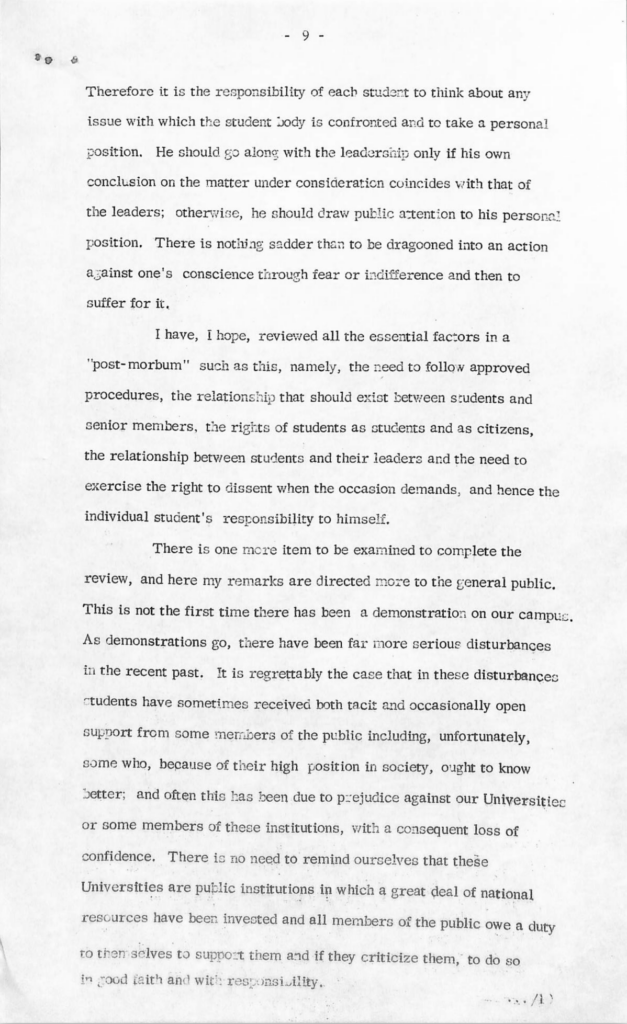
Therefore it is the responsibility of each student to think about any issue with which the student body is confronted and to take a personal position. He should go along with the leadership only if his own conclusion on the matter under consideration coincides with that of the leaders; otherwise, he should draw public attention to his persona! position. There is nothing sadder than to be dragooned into an action against one’s conscience through fear or indifference and then to suffer for it.
I have, I hope, reviewed all the essential factors in a “post-mortem” such as this, namely, the need to follow approved procedures, the relationship that should exist between students and senior members, the rights of students as students and as citizens, the relationship between students and their leaders and the need to exercise the right to dissent when the occasion demands, and hence the individual student’s responsibility to himself.
There is one more item to be examined to complete the review, and here my remarks are directed more to the general public. This is not the first time there has been a demonstration on our campus. As demonstrations go, there have been far more serious disturbances in the recent past. It is regrettably the case that in these disturbances students have sometimes received both tacit and occasionally open support from some members of the public including, unfortunately, some who, because of their high position in society, ought to know better; and often this has been due to prejudice against our Universities or some members of these institutions, with a consequent loss of confidence. There is no need to remind ourselves that these Universities are public institutions in which a great deal of national resources have been invested and all members of the public owe a duty to themselves to support them and if they criticize them, to do so In good faith and with responsibility.
The closure of the University for five weeks is as unfortunate as the events which led to it. Our teaching programmes have been disrupted; the nation’s time and money invested in us have been wasted; and so has the time of all of us here. It has been a most expensive experience. Yet viewed in another light, the inconvenience we have suffered was not without some benefit. I hope it has helped to clear the air; and that, as a result of this experience all have come to know the confines, for good or ill, of ‘student power’. I hope we will take to heart these experiences and that there will now be peace on our campus to carry on our legitimate concerns.
But we ought also to take full advantage of this period of lull to set our house in order and to ensure that our peace of mind is not again threatened in the future. The Tutorial System has been subjected to a series of reviews in the recent past. The consensus among both senior and junior members from my reading of the records is that it is both viable and desirable. Nevertheless, it was also clear from the evidence given in this Hall to the Committee that all is not well with the system and that all involved in it must strive harder to make it work better. I am requesting Heads of Halls and Senior Tutors to give their Hall regulations wide publicity within the Halls and to ensure that Tutors give the students in their charge close attention. We should all endeavour to do our duty as expected of us and may God help us.
Thank you.
(A. A. Kwapong)
Vice-Chancellor
23rd March, 1974.