University Students Discuss Future
July 3, 2026
Transcript
The Standard
March 27, 1966
INTRODUCTION
WHEN soon after the coup of the 24th of February the National Liberation Council announced it was going to appoint a Constitutional Committee, which would be charged with the drafting of a new Constitution, it appealed to all sections of the population to submit memoranda or suggestions to the Committee in writing, to which members of the appointed commission would give their unbiased and undivided attention. However, before being able to submit such documents a discussion has to be started by the Press in Ghana amongst all the layers of the population to find the mind of the various sections so that by comparative study one may more easily come to a well-defined insight of how to best formulate the “great expectations” of Ghanaians concerning the new democratic state they all want to bring about. With the granting of basic rights of freedom for the Press, which we want to exercise responsibly and constructively, we are confident that a fruitful discussion can be started. We hope that all our readers will participate in the series of articles which we intend to publish on the subject. We expect letters and opinions regarding this all-important event in the nation’s history and we promise to publish all of them in due course.
Ghana has been agog with all shades of political opinion since the dawn of Independence, after its realization and more so in recent years when the liberties and the rights of the citizens were trampled upon by, to speak euphemistically, inconsiderate politicians. Though people had to discuss these things under their breath, the desire for a return to human rights and political freedom became more intense the more politicians clamped down on dissidents. When the stop blew off the national pot, spilling the froth, a remarkable and noble peace settled all at once, because people in Ghana had already long come to the decision that “never again will our liberties be abused by a single man or a single group, whatever the cost.” You may question our selection of University students to start the ball rolling. In our opinion however, it is exactly the university students who by their formation and passionate desire for a “fair deal” (evident from several actions undertaken by the former regime to discourage their political interests) who will be eminently suited to put the points of discussion into relief. We asked a selected group of students from several departments in Legon University, representing Law, Political Science, African History, Statistics, Economics and Philosophy to sit in on an interview regarding the political future of their country. Their answers you will find in the article and we have kept as closely as possible to their personal opinions, quoting them at various instances and try-ing to summarise their conclusions; in so doing we hope to activate an engaging discussion, drawing into it as many Ghanaians as possible. —EDITOR
Frank Opinion:
Legon
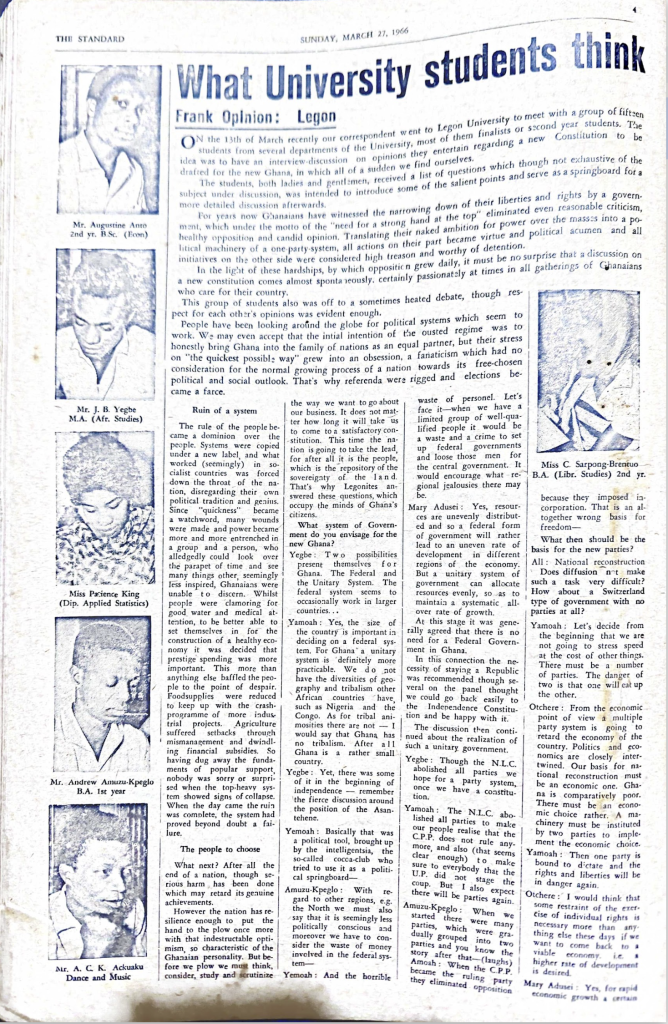
ON the 13th of March recently our correspondent went to Legon University to meet with a group of fifteen students. The idea was to have an interview-discussion on opinions they entertain regarding a new Constitution to be students from several departments of the University, most of them finalists or second year students. The drafted for the new Ghana, in which all of a sudden we find ourselves.
The students, both ladies and gentlemen, all received a list of questions which though not exhaustive of the subject under discussion, was and some of the salient points and serve as a springboard for a more detailed discussion afterwards.
For years now Ghanaians have witnessed the narrowing down of their liberties and rights by a government, which under the motto of the “need for a strong hand at the top” eliminated even reasonable criticism, healthy opposition and candid opinion. Translating their naked ambition for power over the masses into a political machinery of a one-party-system, all actions on their part became virtue and political acumen and all initiatives on the other side were considered high treason and worthy of detention. In the light of these hardships, by which opposition grew daily, it must be no surprise that a discussion on a new constitution comes almost spontaneously, certainly passionately at times in all gatherings of Ghanaians who care for their country.
This group of students also was off to a sometimes heated debate, though respect for each other’s opinions was evident enough.
People have been looking around the globe for political systems which seem to work. We may even accept that the initial intention of the ousted regime was to honestly bring Ghana into the family of nations as an equal partner, but their stress on “the quickest possible way” grew into an obsession, a fanaticism which had no consideration for the normal growing process of a nation towards its free-chosen political and social outlook. That’s why referenda were rigged and elections became a farce.
Ruin of a system.
The rule of the people became a dominion over the people. Systems were copied under a new label, and what worked (seemingly) in socialist countries was forced down the throat of the nation, disregarding their own political tradition and genius. Since “quickness” became over a watchword, many wounds were made and power became more and more entrenched in a group and a person, who allegedly could look the parapet of time and see many things other, seemingly less inspired, Ghanaians were unable to discern. Whilst people were clamoring for good water and medical attention, to be better able to set themselves in for the construction of a healthy economy it was decided that prestige spending was more important. This more than anything else baffled the peo-ple to the point of despair. Foodsupplies to keep up with the crash-programme of more indus trial projects. Agriculture suffered setbacks through mismanagement and dwindl-ing financial subsidies. So having dug away the funda-ments of popular support, nobody was sorry or surpri-sed when the top-heavy sys-tem showed signs of collapse. When the day came the ruin was complete, the system had proved beyond doubt a fai-lure. were reduced
The people to choose
What next? After all the end of a nation, though serious harm has been done which may retard its genuine achievements.
However the nation has resilience enough to put the hand to the plow once more with that indestructible optimism, so characteristic of the Ghanaian personality. But before we plow we must think, consider, study and scrutinize the way we want to go about our business. It does not matter how long it will take us to come to a satisfactory constitution. This time the nation is going to take the lead, for after all it is the people, which is the repository of the sovereignty of the land. That’s why Legonites answered these questions, which occupy the minds of Ghana’s citizens.
What system of Govern-ment do you envisage for the new Ghana?
Yegbe: Two possibilities present themselves for Ghana. The Federal and the Unitary System. The federal system seems to occasionally work in larger countries…
Yamoah: Yes, the size of the country is important in deciding on a federal system. For Ghana a unitary system is definitely more practicable. We do not have the diversities of geography and tribalism other African countries have such as Nigeria and the Congo. As for tribal animosities there are not. I would say that Ghana has no tribalism. After all Ghana is a rather small country.
Yegbe: Yet, there was some of it in the beginning of independence. Remember the fierce discussion around the position of the Asantehene.
Yemoah: Basically that was a political tool, brought up by the intelligentsia, the so-called cocoa-club who tried to use it as a political springboard.
Amuzu-Kpeglo: With regard to other regions, e.g. the North we must also say that it is seemingly less politically conscious and moreover we have to con-sider the waste of money involved in the federal system.
Yemoah: And the horrible waste of personnel. Let’s face it, when we have a limited group of well-qualified people it would be a waste and a crime to set up federal governments and lose those men for the central government. It would encourage what regional jealousies there may be.
Mary Adusei: Yes, resources are unevenly distributed and so a federal form of government will rather lead to an uneven rate of development in different regions of the economy. But a unitary system of government can allocate resources evenly, so as to maintain a systematic all-over rate of growth.
At this stage it was gene-rally agreed that there is no need for a Federal Govern-ment in Ghana.
In this connection the necessity of staying a Republic was recommended though several on the panel thought we could go back easily to the Independence Constitution and be happy with it.
The discussion then continued about the realization of such a unitary government.
Yegbe: Though the N.L.C. abolished all parties. We hope for a party system, once we have a constitution.
Yamoah: The N.I..C. abolished all parties to make our people realise that the C.P.P. does not rule any-more, and also (that seems clear enough) to make sure to everybody that the U.P. did not stage the coup. But I also expect C there will be parties again.
Amuzu-Kpeglo: When we started there were many parties, which dually grouped into two parties and you know the story after that (laughs)Amoah: When the C.P.P. became the ruling party they eliminated opposition because they imposed in-corporation. That is an al-together wrong basis for freedom-
What then should be the basis for the new parties?
All: National reconstruction Does diffusion not make such a task very difficult? How about a Switzerland type of government with no parties at all?
Yamoah: Let’s decide from the beginning that we are not going to stress speed at the cost of other things. There must be a number of parties. The danger of two is that one will eat up the other.
Otchere: From the economic point of view a multiple party system is going to retard the economy of the country. Politics and economics are closely inter-twined. Our basis for national reconstruction must be an economic one. Gha-na is comparatively poor. There must be an economic choice rather. A machinery must be instituted by two parties to implement the economic choice.
Yamoah: Then one party is bound to dictate and the rights and liberties will be in danger again.
Otchere: I would think that some restraint of the exercise of individual rights is necessary more than anything else these days if we want to come back to a viable economy. ie. higher rate of development is desired.
Mary Adusei: Yes, for rapid economic growth a certain restraint of the exercise of individual tights is indispensable.
Yamoah: Ruling Party is alright, but also an opposition of two parties to guarantee the rights of the people.
Would this suggest the need for regional parties then?
Amuzu-Kpeglo: No regional parties, so as to discourage regional animosities. And certainly a limited number of parties.
Mary Adusei: Since a certain proportion of our people are illiterates and politically not educated they are more directly concerned with their basic needs. (food and shelter).
Grant: Maybe independent candidates should represent some constituencies to keep a balance of power.
Mr. C. Anto: Then the fat chances of corruption and bribery would even become better than they have been. No. Those votes could be bought by the parties.
Grant: Not when they are independent.
What would be the task of the President in the new system?
Odjidja: The President would have to be independent. His powers would be arbitrary, only something like a referee.
Sey: He could be head of government or head of state or both, we must make distinctions.
Odjidja and Yamoah: Never Head of government. Not again.
All panelists agreed that the President should never again have more than nominal powers. His task would have to be to act on the ad-vice of Parliament as a whole or on the advice of the ruling party and be the guar-dian of the Constitution. He should be elected by the people after the general elections. and hold office for five years. At election time (general elections) the President should be working with the civil service, who would have to be the returning officers at the elections. In case General and Presidential elections would occur in the same year, Parliament should be elected first and then the President. Parliamentary elections were favoured to occur so that every three years, constituencies could easily keep control of their representatives, reappoint them or relieve them of their seat.
Otchere: If the president has no political representation what should be his position?
Yamoah: He will be just like the speaker of the House of Commons in Great Britain. He is not to influence the decisions of Parliament.
Miss Anto: I agree, he should have no political affiliation, though one can suppose that the parties will come with a candidate, come election time.
Sey: After the elections even when the Presidential Candidate has been proposed by a party, he instantly drops from the party and will only work within the limits of the new constitu Lion. His vocation is to be objective and judge accord-ing to the rules of the Constitution, nothing more, nothing less.
What would be the task of the Prime Minister? What is the task of Parliament?
After some discussion it was soon agreed amongst the members of the panel that Parliament should be the supreme Legislative body, because they are under a man-dat of the electorate. The Prime Minister and the Cabinet would have the supreme executive power, though most insisted as well that the relationship between Prime Minister and Cabinet should be sharply defined.
Traditional Rulers
Then the position of the traditional Rulers was discussed. One panel member formulated it the following way.
THERE ARE TOO MANY HOUSES OF CHIEFS. MUST WE NOT THINK OF A BETTER PLACE FOR THEM? HOW ABOUT SETTING UP A SENATE, COMPOSED OF TRADITIONAL RULERS, RETIRED POLITICIANS AND INTELLECTUALS?
The general opinion amongst panel members was that there would be no resources for that and that their task of defending the customary laws could be continued in the structure of “Houses of Chiefs.’
It was mentioned that their contact with the rural population might be a reason for the intellectuals amongst the chiefs to stand for Parliament. The danger of increased tribal ani-mosity was seen in the appoint-ment of tribal chiefs to a Sena-te. It was also the opinion of the majority of the panel members that the chiefs would not automatically be placed on the legislative body of the country. Their essential task of form-ing the traditional councils should be continued though their political capacities should not barr them from running for Parliament in a general election. As one panelmember put it. If they are good enough the electorate will vote for them, but we must not put the clock back by thinking that we have to put them in Parliament simply because they are traditional rulers. A modern state must draw the best possible candidates from all sections of the population, be they traditional rulers, lawyers or businessmen.”
Members of Parliament
ON WHICH BASIS THEN WOULD YOU ELECT MEMBERS OF PARLIAMENT?
1) REPRESENTING RE GIONS (OR CONSTITUENCIES)
2) REPRESENTING PROFESSIONS OR SECTORS OF NATIONAL LIFE.
3) OR REPRESENTING NATIONAL PARTIES WITHIN THE CONSTITUENCIES?
Some panel members thought that initially, in order to stress the economic choice of the country and avoid too many political squabbles it might be advisable to put up candidates for constituencies from the sectors (or professions) in the National Life. They would have to be independent candidates who would campaign simply on their own merits. But many others thought that this would certainly lead to a confused line of policy. As expressed before, most panel members fin-ally agreed that the basis, providing for a national spirit through its national involve-ment, would be to present the electorate with candidates from national parties in each consti-tuency. They also hoped that the constituencies would be created on a basis of proportional representation of the population.
SHOULD IT BE DECREED CONSTITUTIONALLY THAT M.P.’S ARE RESPON-SIBLE TO THE ELECTORATE RATHER THAN TO THE TOP-BRASS OF THE NATIONAL PARTIES?
Yamoah: They are going to be the representatives of the constituencies and definitely not delegates of a party, to which they may belong.
Odjidja: The people have electoral powers. Maybe there should also be referenda-powers for them so that we make sure that the entrench-ed clauses in the Constitution can only be amended by a referendum to the country. They should certainly not just be amended by Parliamentarians, whenever they seem fit.
Yegbe: Looking round I think we can safely say that all panel members agree to the principle that Parliamentarians will have to be responsible to the electorate.
IN THIS CONNECTION ALSO THE QUESTION ARISES: HOW TO GUAR-ANTEE THAT HENCEFORTH ELECTIONS AND REFERENDA WILL HONEST-LY REFLECT THE TRUE OPINION OF THE ELECTO-RATE?
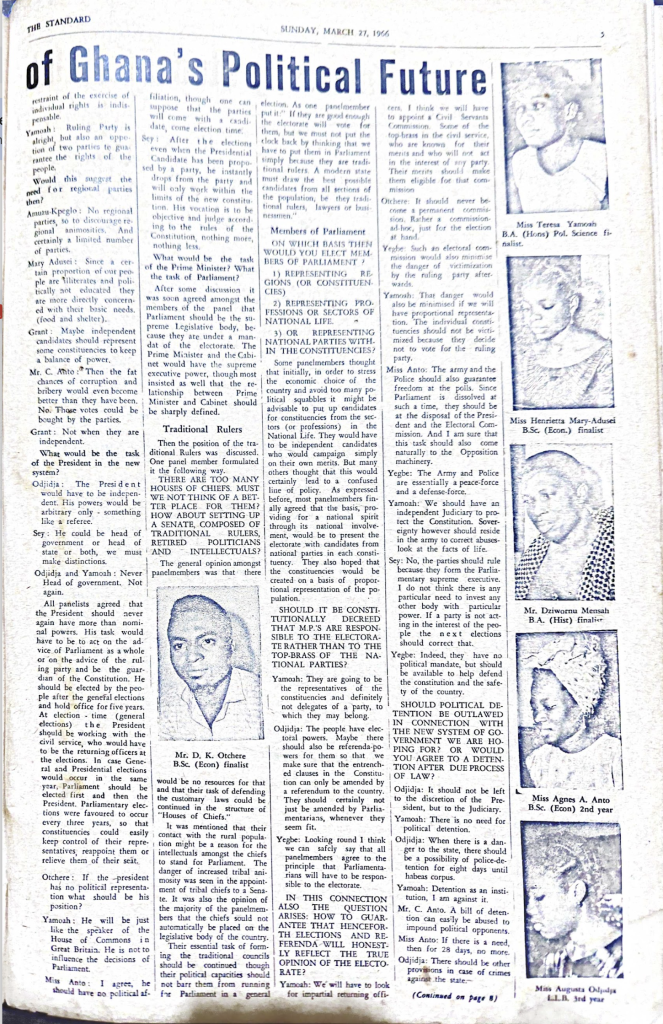
Yamoah: We will have to look for impartial returning officers, I think we will have to appoint a Civil Servants Commission. Some of the top-brass in the civil service, who are known for their merits and who will not act in the interest of any party. Their merits should make them eligible for that com mission
Otchere: It should never become a permanent commission, rather a commission-ad hoe, just for the election at hand.
Yegbe: Such an electoral commission would also minimise the danger of victimization by the ruling party afterwards.
Yamoah: That danger would also be minimised if we will have proportional representation. The individual constituencies should not be victimized because they decide not to vote for the ruling party.
Miss Anto: The army and the Police should also guarantee freedom at the polls. Since Parliament is dissolved at such a time, they should be at the disposal of the Presi-dent and the Electoral Com-mission. And I am sure that this task should also come naturally to the Opposition machinery.
Yegbe: The Army and Police are essentially a peace-force and a defense force.
Yamoah: We should have an independent Judiciary to protect the Constitution. Sovereignty however should reside in the army to correct abuses-look at the facts of life.
Sey: No, the parties should rule because they form the Parliamentary supreme executive. I do not think there is any particular need to invest in any other body with particular power. If a party is not act-ing in the interest of the peple the next elections should correct that.
Yegbe: Indeed, they have no political mandate, but should be available to help defend the constitution and the safety of the country.
SHOULD POLITICAL DETENTION BE OUTLAWED IN CONNECTION WITH THE NEW SYSTEM OF GOVERNMENT WE ARE HOPING FOR? OR WOULD YOU AGREE TO A DETEN-TION AFTER DUE PROCESS OF LAW?
Odjidja: It should not be left to the discretion of the President, but to the Judiciary.
Yamoah: There is no need for political detention.
Odjidja: When there is a danger to the state, there should be a possibility of police-detention for eight days until habeas corpus.
Yamoah: Detention as an institution, I am against it.
Mr. C. Anto. A bill of detention can easily be abused to impound political opponents. Miss Anto: If there is a need, then for 28 days, no more.
Odjidja: There should be other provisions in case of crimes against the state.